Author: admin

  • POEMS: Portugal having a word in semiconductor innovation

    POEMS: Portugal having a word in semiconductor innovation

    INESC-ID is one of the 16 members of POEMS – the Portuguese Competence Centre in Semiconductors, a national initiative set to position Portugal in the field of microelectronics and semiconductor innovation.

    Launched under the Chips for Europe Initiative and co-funded by Fundação para a Ciência e a Tecnologia (FCT) and the Chips Joint Undertaking – European Union, POEMS directly responds to the priorities of Axis 1 of the National Semiconductor Strategy. The project targets two main fronts: capacity building through advanced training (Work Package 3) and technological advancement in semiconductor solutions (Work Package 4), aligning with Europe’s ambition for a more resilient and competitive tech industry.

    The POEMS consortium brings together leading institutions across academia, research, and industry with expertise in chip design, advanced packaging, and emerging semiconductor technologies. Through collaborative work packages, POEMS will strengthen national infrastructure, allow access to innovation networks such as the European Network of Chips Competence Centres (ENCCC), and support the transition from R&D to market through business support and funding mechanisms. It also includes the development of a dedicated digital collaboration platform, which will house the Portuguese Semiconductor Observatory, training portals, and innovation support services.

    With its unique characteristics and wide-reaching scope — from promoting STEM careers among youth to providing critical tools for companies and researchers — POEMS is more than a technological project; it’s a strategic engine for national growth in a critical and essential area.

    From a total budget of nearly four million euros, INESC-ID will manage approximately 121,000 euros, under the coordination of researcher Jorge Fernandes, the institute’s Principal Investigator for POEMS.


  • Call for Expressions of Interest: MSCA Postdoctoral Fellowships 2025 at INESC-ID

    Call for Expressions of Interest: MSCA Postdoctoral Fellowships 2025 at INESC-ID

    INESC ID is currently inviting Expressions of Interest from researchers interested in applying for the Marie Skłodowska-Curie Actions Postdoctoral Fellowships (MSCA PF 2025), with INESC-ID as their host institution.

    We welcome highly motivated postdoctoral candidates of any nationality interested in developing cutting-edge research in one of our scientific areas.

    The MSCA PF program offers competitive funding for 12–24 months, salary, mobility, and family allowances. Fellows will benefit from INESC-ID’s dynamic research environment, experienced supervision, and a strong international collaboration network.

    Candidates must meet the following eligibility criteria of the call, including:

    • hold a PhD degree on the closing date for applications. Applicants who have successfully defended their doctoral thesis but who have not yet formally been awarded the doctoral degree are also eligible to apply
    • have a maximum of eight years of experience in research from the date of the award of the PhD degree
    • comply with mobility rules: they must not have resided or carried out their main activity (work, studies, etc.) in the country of the beneficiary (in this case, Portugal) for more than 12 months in the 36 months immediately before the call deadline

    Full conditions are published at the announcement of the MSCA PF 2025 Call.

    To express your interest, please send the following documents by June 30th to this e-mail (silvia.castro@inesc-id.pt):

    • A short CV (max 2 pages)
    • A brief outline of your research proposal (max 1 page)
    • Preferred Thematic Line/Scientific area or potential supervisor at INESC-ID

    We encourage prospective candidates to get in touch as early as possible to ensure adequate time for proposal development and support. For any questions, please contact us at silvia.castro@inesc-id.pt

  • Getting ready for the quantum era. INESC-ID joins European effort to strengthen cybersecurity and quantum resilience

    Getting ready for the quantum era. INESC-ID joins European effort to strengthen cybersecurity and quantum resilience

    Quantum computing is a serious threat to today’s cryptographic systems. A strong reason for the European Defence Fund (EDF) to invest in the development of quantum-resistant solutions for the defense sector. One of these initiatives is project SEQURED: Strengthening Defense Networks for the Quantum Era, launched May, 1st.

    With a duration of 36 months and a budget of nearly four million euros, SEQURED brings together nine partners across Europe, including INESC-ID, to develop next-generation encryption tools, digital signatures, and secure data-sharing mechanisms.

    As quantum technologies evolve, so do the risks posed to current cryptographic systems and so SEQURED aims to develop innovative solutions to ensure that both private and public sector organisations can protect their data against the emerging threat of quantum-enabled cyberattacks.

    This international consortium of academic and industry partners is funded by Horizon Europe programme and is under the European Commission’s broader strategy for digital sovereignty and security. The project focuses on real-world applications of post-quantum cryptography (PQC), ensuring that today’s encrypted communications remain secure tomorrow, even in a post-quantum world. It also integrates cutting-edge cybersecurity practices with privacy-by-design principles and compliance with evolving EU regulations.

    At INESC-ID, funded with €359k, researchers contribute their expertise in cryptographic algorithms, architectures, and secure system design, leading the project’s work package in these areas.  Leonel Sousa, the projects’ PI, is taking part at the kick off meeting, happening May 19 and 20, in Greece.

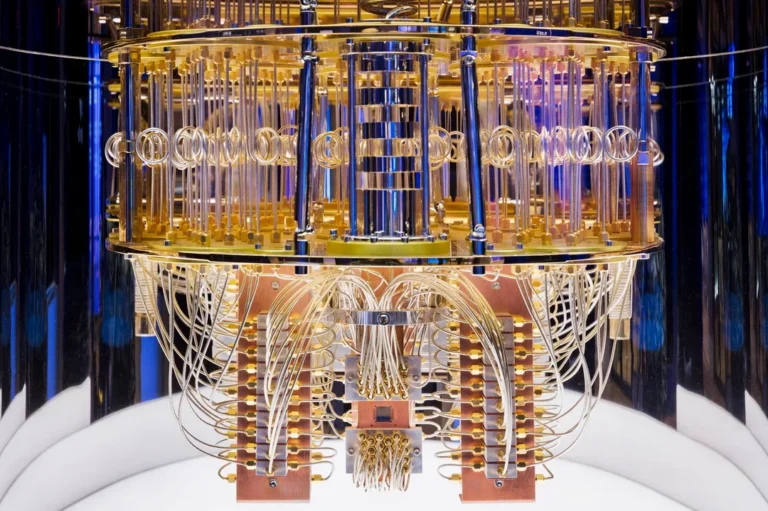
    Images | © 2025 IBM

  • American media mogul uses copyright violations detector developed at INESC-ID

    American media mogul uses copyright violations detector developed at INESC-ID

    A novel method developed by INESC-ID researchers is at the heart of a headline-making investigation into AI training practices. The technique — DE-COP: Detecting Copyrighted Content in Language Models Training Data— has been used in a recent study by the AI Disclosures Project, co-founded by media figure Tim O’Reilly and economist Ilan Strauss, to examine whether OpenAI’s GPT-4o model was trained on copyrighted, paywalled content without permission.

    At the core of the controversy is the possibility that OpenAI, a leading player in generative AI, used proprietary books from O’Reilly Media in the training of its most advanced model to date, GPT-4o. The AI Disclosures Project’s paper points to DE-COP as a critical tool in establishing this likelihood.

    Developed in 2024 by INESC-ID researchers André Duarte and Arlindo Oliveira, together with colleagues from University of California and Carnegie Mellon University, DE-COP tackles one of the most relevant and difficult questions in the field of AI ethics and transparency: How can we detect if copyrighted content was used in a model’s training data, when that data is not publicly disclosed?

    DE-COP works by probing large language models (LLMs) with multiple-choice questions, where the correct answer is embedded within both exact quotes and paraphrased versions of suspected training content. If a model consistently selects verbatim excerpts over paraphrased ones, it suggests prior exposure — a hallmark of what is known in the field as a “membership inference attack.”

    To validate the approach, the researchers behind DE-COP constructed BookTection, a benchmark dataset featuring excerpts and paraphrases from 165 books, both pre- and post-dating the training cutoffs of popular LLMs. The method outperformed previous techniques by a significant margin — a 9.6% improvement in detection performance on models with available logits, and 72% accuracy on fully black-box models, where prior methods hovered around four percent.

    The AI Disclosures Project applied DE-COP to a set of 34 books from O’Reilly Media, analysing nearly 14,000 paragraph excerpts. The study found that GPT-4o showed a much higher “recognition” of paywalled content from O’Reilly books compared to OpenAI’s previous model, GPT-3.5 Turbo. As noted in the article published at TechCrunch.

    “GPT-4o [likely] recognizes, and so has prior knowledge of, many non-public O’Reilly books published prior to its training cutoff date,” the authors noted. They also found that GPT-3.5 Turbo, in contrast, demonstrated greater recognition of publicly available O’Reilly materials — suggesting a significant shift in training data sources between model generations.

  • Harnessing the power of microbial diversity: MALDIBANK kicks off in Braga

    Harnessing the power of microbial diversity: MALDIBANK kicks off in Braga

    Microbes are essential to life and have an impact on everything, from ecosystem dynamics to human health and industries like agriculture and food safety. Their diversity, however, remains largely underestimated. Considering their implications in sectors like food safety and climate change, it is crucial to accurately identify microorganisms and harness their potential.

    Here is where MALDIBANK (Multi-domain Open MALDI Spectra Archive for Identification of Microorganisms) comes in. The new project, funded by the Horizon Europe programme, will gather 24 partners, including INESC-ID, tomorrow, May 13, in Braga for their kick-off meeting. This meeting, hosted by Universidade do Minho, will serve as a starting point to better define the action plan for the duration of MALDIBANK. At INESC-ID the project will be managed by Information and Decision Support Systems researcher and Life and Health Technology coordinator, Ana Teresa Freitas, with a funding of around €500K euros. The group will also count with Arlindo Oliveira, Emanuel Gonçalves as task leader, Daniel Faria as workpackage leader, Pedro Monteiro, Ruxandra Barbulescu and Sílvia Castro, both in impact.

    For 4 years, the project will advance a database designed to expand the application of MALDI-TOF technology. This groundbreaking initiative will combine a vast spectrum database with advanced algorithmic tools, enabling innovative solutions for the identification and understanding of microorganisms. In the end, MALDIBANK will empower scientists to tackle antimicrobial resistance, environmental monitoring, among others, contributing to global problem-solving.

    More info on the project here.

    Image: MALDIBANK consortium and areas.

  • AMALIA, giving voice to Portuguese identity through Artificial Intelligence

    AMALIA, giving voice to Portuguese identity through Artificial Intelligence

    Few expressed pain and longing with the intensity of Amália Rodrigues, the iconic fado singer who became a symbol of Portuguese cultural identity. Her voice, her language, and her emotion are all part of a legacy that continues to shape Portugal’s artistic and emotional landscape. Drawing inspiration from that deep cultural well, AMALIA (Automatic Multimodal Language Assistant with Artificial Intelligence) is the name chosen for the first Portuguese Large Language Model (LLM) designed from scratch to reflect and preserve the richness of the Portuguese language and identity – with INESC-ID playing a crucial role, particularly in the area of speech processing.

    Derived from the Latin word for “fate,” fado conveys a broad spectrum of emotions, from heartbreak and nostalgia to joy and resilience. Similarly, AMALIA is being designed to understand, process, and generate content in European Portuguese, capturing nuances in both language and culture. “This tool will serve a wide range of applications across essential sectors such as education, media, science, cultural heritage, and public administration”, anticipates INESC-ID researcher and Professor at Técnico, Alberto Abad, from Human Language Technologies.

    A strategic national investment

    Supported under Portugal’s Recovery and Resilience Plan (PRR) and coordinated by the Foundation for Science and Technology (FCT), AMALIA is being developed by a national consortium of top academic and research institutions. This includes Universidade de Lisboa, via Instituto Superior Técnico, Universidade NOVA, the Universidade do Porto, Universidade de Coimbra, Universidade do Minho, and the national laboratories NOVA LINCS, IT, INESC TEC, CISUC/LASI, and ALGORITMI/LASI. Experts from the University of Beira Interior and the University of Évora are also contributing.

    Under the coordination of Alberto Abad, INESC-ID’s contribution focuses on multimodal language processing, particularly the integration of spoken language. This means AMALIA will not only be able to interpret text but also receive and process speech and images – giving it “ears” and “eyes,” with the “brain” generating accurate and contextually aware text responses.

    Unlike commercial AI models primarily optimized for global markets, AMALIA is trained from the scratch using resources such as Arquivo.pt and is specifically tailored for European Portuguese. It will be open source and designed to operate in closed and secure environments, ensuring data protection and reinforcing national technological sovereignty.

    AMALIA will serve as a strategic asset for Portugal – not just as a language model, but as a digital guardian of linguistic and cultural heritage. In an age when companies tend to prioritize broader language variants like Brazilian Portuguese, AMALIA’s focus on the European variant is both a cultural imperative and a technical challenge.

    Filling a niche

    By September 2025, the consortium aims to release a public version of the model. A first internal version was successfully launched on March 31, 2025, already capable of engaging in contextual conversations and demonstrating knowledge of Portuguese culture and language.

    “AMALIA will not replace general-purpose models like ChatGPT”, Alberto Abad underlines. “Instead, it fills a vital niche: delivering specialized, context-sensitive responses in domains where language, culture, and data privacy matter.” Its potential spans education, public service, cultural preservation, and more.

    As Fernando Pessoa once said, “My homeland is the Portuguese language (A minha pátria é a língua portuguesa).” With AMALIA, that homeland now has a voice in the digital future. One that speaks, understands, and respects its unique identity.


  • INESC-ID secures 14 new FCT-Funded Projects to Drive AI, Data Science, and Cybersecurity in Public Administration

    INESC-ID secures 14 new FCT-Funded Projects to Drive AI, Data Science, and Cybersecurity in Public Administration

    After having two exploratory research projects (ERPs) approved in the Call for Exploratory Projects in All Scientific Domains 2023, INESC-ID recently had eight more projects approved by FCT, in the Call for the 2024 program in “Artificial Intelligence, Data Science and Cybersecurity of relevance in Public Administration”. 

    This call will be fully funded by the Recovery and Resilience Plan (PRR) and aims to support the launch of a programme of R&D projects aimed at the development and implementation of advanced Cybersecurity systems, Artificial Intelligence, and Data Science in Public Administration. 

    The projects will be focused on optimising resources and combating fraud and error, leading to continuous improvements in public services and mutual knowledge exchange between Public Administration and the National Science and Technology System (SNCT). This initiative is expected to accelerate the digital transformation of science and support services within the SNCT, while contributing to the increase of both national and international competitiveness of science and technology.

    INESC-ID had the following projects approved in three different thematic areas:

    Artificial Intelligence and Data Science

    • “OptiGov: Leveraging AI for Process Efficiency in Public Administration” 

    PI: Alessandro Gianola

    Public Administration processes usually face challenges in compliance, particularly in aligning contractual specification documents with legal guidelines. To optimise and manage this complexity, the OptiGov project will harness the power of Data Science and Artificial Intelligence (AI), to introduce a method, enhanced with Large Language Model techniques, that will align specification documents and the meta-level guidelines dictating how the processes should be.

    • “Sarcoma Clinical Data Integration with AI-Driven Automation for the National Oncology Registry”

    PI: Emanuel Gonçalves

    The SARC-RON-AI project aims to develop an LLM-based (Large Language Model) system to efficiently process EHRs (Electronic Health Records), automating data submission for the southern regional oncology registry, Registo Oncológico Regional Sul (ROR-Sul). A prototype will be delivered, designed to operate within the real-world clinical context, thus improving Public Administration institutions.

    • “EquiVet.AI: An AI Assistant for Veterinarians in Equine Practice”

    PI: Luísa Coheur 

    EquiVet.AI proposes user-friendly non-invasive tools for the diagnosis of allergic diseases in horses, improving veterinary care and leveraging LLMs to generate reports from medical notes. The development of these tools will consider feedback from veterinarians, ensuring that the AI models are well-aligned with their needs, with the goal of facilitating their integration into daily workflows and promoting AI literacy within the community.

    • Artificial Intelligence in Tribunal” 

    PI: Ricardo Ribeiro

    This project aims to enhance some of the capabilities of the IRIS initiative, a previous collaboration between INESC-ID and the Supreme Court of Justice (STJ), and to improve two of the three resulting apps, currently used by STJ. It will address challenges such as entity extraction, structure identification, summarisation, classification, and case analysis support. The ultimate goal is to increase efficiency, effectiveness and consider a broader context for the use of these application, including other national courts, the High Council of the Judiciary (CSM), and courts of Portuguese-speaking African countries (PALOP).

    • “WebCAP: Web Data Collection via Automated Program Synthesis” 

    PI: José Santos

    Web scrapers are programs used for the challenging process of parsing and retrieving information scattered across web pages, and although useful, their development and deployment are complex, error-prone and time-consuming. WebCAP will address this challenge by leveraging recent advancements in programming language and machine learning, to introduce a novel framework capable of automating the creation of web scrapers. It will be particularly focused on scrapers tailored to collect data relevant to the Portuguese public administration, improving the formulation of public policies across various sectors.


    Cybersecurity

    • “WELL – Wallet for ELectronic heaLth records” 

    PI: David R. Matos

    The main output of the project will be combining cloud storage and a blockchain to create the WELL platform, composed of a repository to store EHRs (Electronic Health Records), and a wallet, to manage the EHRs of the patients. While the application will be designed for patients, medical professionals, insurance companies, and researchers, EHRs can only be shared with the consent of the patient, empowering the users with immediate access to and control over their health data.

    • “InfraGov: A Public Framework for Reliable and Secure IT Infrastructure” 

    PI: João Ferreira 

    InfraGov aims to develop an innovative solution for automated error and vulnerability detection and repair in software configuration and infrastructure code. The project involves collaboration with INESC-TEC, Agência para a Modernização Administrativa (AMA), Instituto de Gestão Financeira e Equipamentos da Justiça (IGFEJ), and Entidade de Serviços Partilhados da Administração Pública (ESPAP). As public administrative services transition to digital platforms, this outcome will significantly reduce the incidence of system failures and security breaches, improving the reliability and security of IT infrastructures.

    Interaction design and design of digital and physical systems

    • “Pediatric Palliative Care Support System”

    PI: Helena Galhardas

    The expected result of PiCaSSO is an integrated digital platform for the registration, characterisation, and monitoring of children and young people with Complex Chronic Diseases (CCDs) and palliative care needs in Portugal. This characterisation and monitoring will be essential to effectively stratify and organise the delivery of palliative care for these children and establish a care network supported with well-specified data.

    Besides these, INESC-ID is also a collaborator in six other projects, all in the thematic area of Artificial Intelligence and Data Science.

    More information about the Call (in Portuguese) here.

  • INESC-ID Stands out in ACM CHI Conference

    INESC-ID Stands out in ACM CHI Conference

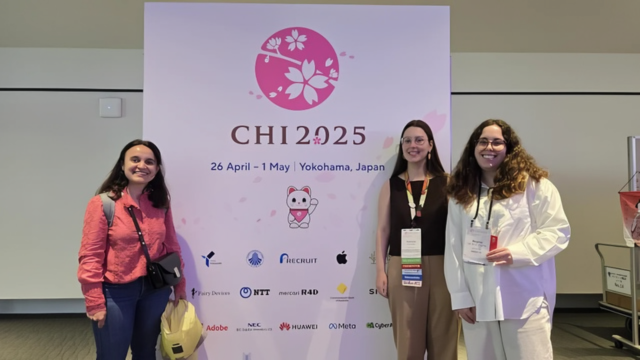
    Our institute made waves last week during the ACM (Association of Computing Machinery) CHI 2025 conference on Human Factors in Computing Systems, with several contributions presented.

    Patrícia Piedade, Artificial Intelligence for People and Society (AIPS) PhD student and Rui Prada, AIPS  researcher, co-authored a paper that received an honorable mention, placing it in the top 5% of submissions. In addition, three other papers, co-written by INESC-ID researchers, were presented at the conference. It is worth noting that one of these articles was solely authored by women, including AIPS PhD student, Regina Duarte and AIPS researchers Ana Paiva and Joana Campos; an inspiring example of the growing presence of women in computer science. Isabel Neto, former INESC-ID researcher authored two of the papers mentioned.

    ACM CHI is the world’s most important conference on human-computer interaction, where researchers and practitioners present cutting-edge work on how people interact with digital technologies. It is held annually and in 2025 it took place from 26 April to 1 May in Yokohama, Japan.

  • INESC-ID researchers receive ACM SIGSOFT Distinguished Paper Award at ICSE 2025

    INESC-ID researchers receive ACM SIGSOFT Distinguished Paper Award at ICSE 2025

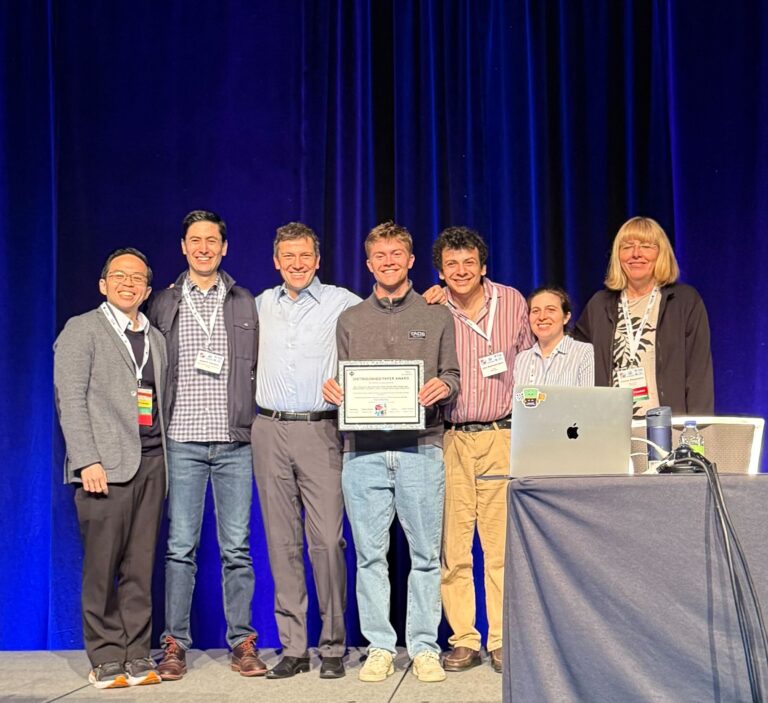
    João F. Ferreira, INESC-ID researcher and professor at the Department of Computer Science and Engineering (DEI) at Instituto Superior Técnico, and Nuno Saavedra, PhD student and INESC-ID researcher, have received the prestigious ACM SIGSOFT Distinguished Paper Award at the International Conference on Software Engineering (ICSE) 2025—the premier global event in software engineering.

    The award-winning paper, titled Rango: Adaptive Retrieval-Augmented Proving for Automated Software Verification,” presents a novel approach to proof synthesis using machine learning and large language models (LLMs), enhanced by retrieval augmentation techniques. Rango introduces a dynamic, adaptive system that identifies and integrates relevant proofs and premises at each stage of the software verification process. This allows the tool to tailor its reasoning to both the specific project and the evolving state of the proof itself.

    The effectiveness of Rango was demonstrated using a newly curated dataset, CoqStoq, which contains more than 2,200 open-source Coq projects. The tool successfully synthesized proofs for 32% of theorems, marking a 29% improvement over previous state-of-the-art systems—an impressive leap forward that could help make formal software verification more accessible and practical for developers.

    This significant achievement is the result of a strong international collaboration with the research including researchers from the University of California San Diego, the University of Massachusetts and Pedro Carrott, a former MSc student at Técnico, supervised by João F. Ferreira and presently at Imperial College London.

    The ACM SIGSOFT Distinguished Paper Award is reserved for papers of exceptional quality presented at ICSE, and this recognition reflects both the scientific impact and collaborative excellence behind the work.

  • In the Media: Women in Science and Engineering. Inês Lynce participates in article for Diferencial

    In the Media: Women in Science and Engineering. Inês Lynce participates in article for Diferencial

    “If you asked me who I admire: I admire my women colleagues.” – these were the words of INESC-ID’s President of the Board and researcher, Inês Lynce in a recent article published on Diferencial, the newspaper by Instituto Superior Técnico students, where the challenges and lessons of being a woman in science and engineering were discussed. 

    To highlight the increasing presence of women in these fields, Diferencial brought together three women of reference, DEI and INESC-ID’s Inês Lynce, DEEC’s Helena Ramos and COSTAR’s Rita Santos, to share their perspectives on what it means to be a woman in computer science, electrical engineering and physics, respectively. Throughout the discussion, they acknowledged that men and women often have different approaches in professional settings. Women may often face a sense of natural insecurity and are more aware of their limitations, which can lead to more cautious and reserved behaviours. Furthermore, to make their voices heard, women often need to be more assertive and “louder” than their male colleagues in order to effectively communicate their ideas.

    Inês Lynce, who studied at Instituto Superior Técnico (IST) and is now a full professor, noted that the percentage of women starting their studies in computer science has barely risen, which she describes as a “frightening” scenario. Greater diversity in science is essential because it enriches the field by incorporating a variety of perspectives, regardless of gender, a notion that all participants agreed on. As our researcher stated, “If all computer science is made by men, we’re in trouble, right? Games will remain masculine, as will apps”. On a positive note, there is now increased recognition and awareness of the issue, and efforts are already underway to ensure equal opportunities for everyone, an important step towards greater inclusion.

    Besides the challenges acknowledged, the three researchers expressed a strong sense of professional fulfilment, emphasising their excitement to learn more in their respective fields each day. Inês Lynce concludes that when choosing an academic and professional path, the most important factor is, “regardless of whether you are a boy or a girl, is that you make an informed decision and that you like it”. For women, she highlights the importance of “being proud of being a woman”.

    Read the full article, in Portuguese, here.