Category: Conferences

  • The BIG ERA Chair Closing Ceremony
    The BIG ERA Chair Closing Ceremony

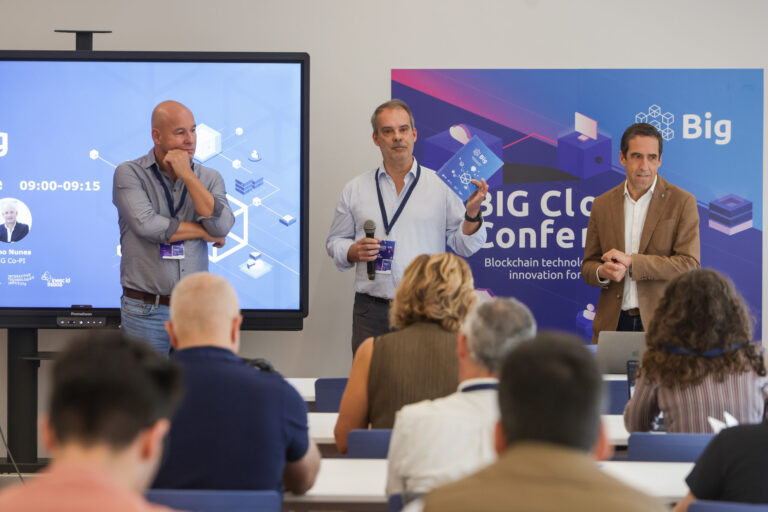
    The BIG ERA Chair came to a successful finale, with its Closing Ceremony taking place last week, on October 27. In the IA room of Instituto Superior Técnico, more than 50 participants, from students to industry leaders, gathered to watch the project’s main achievements over the years and reflected how digital ledger technology can drive trust, transparency and social good

    The conference featured keynote speakers, Diogo Mónica and Manuel Costa, who went over Tokenization and Confidential Computing respectively. In addition to the keynotes, there was a presentation of the BIG Lab’s research highlights, an Industry and Society Panel and several interventions by INESC-ID researchers, including Luís Caires, Miguel Pupo Correia, Rodrigo Rodrigues, Paolo Romano, Miguel Matos, Miguel Pardal, David R. Matos, Nuno Lopes and Christof Torres. Overall, the ceremony served as a platform for all stakeholders in Blockchain and related areas to present and discuss studies and challenges.

    The BIG Closing Conference really was a unique moment to witness the impact of BIG as an extremely successful multi-institutional and interdisciplinary initiative, leveraging the quite unique characteristics of the ERA program.” – Stated Luís Caires, Chair Holder for the BIG ERA Chair and researcher of the INESC-ID Information and Decision Support Systems Scientific Area. “And this is just the start of a new phase of the BIG Lab community, looking forward to the future challenges of decentralized, participatory, and trustworthy computing for all.

    The BIG ERA Chair Closing Conference was organised in the scope of the BIG ERA Chair Project (GA 952226), a project funded by the European Commission involving INESC-ID, IST and ITI-LARSyS.

    Know more on the BIG ERA Chair website

    Images | © 2025 BIG ERA Chair Project

  • In the Media: Inês Lynce’s role at record-breaking ECAI 2025 featured in Il Mattino

    In the Media: Inês Lynce’s role at record-breaking ECAI 2025 featured in Il Mattino

    According to Il Mattino, one of the main Italian newspapers, this year’s European Conference on Artificial Intelligence (ECAI 2025),  one of the most prestigious international AI conferences, being held in Bologna from October 25 to 30, has set attendance and submission records. 

    The article highlights the scientific leadership of Aniello Murano, Professor of Computer Science at the University of Naples, and Inês Lynce, INESC-ID researcher, President of the Board of Directors, and Professor at Instituto Superior Técnico, who together are co-chairing the conference’s Program Committee. Selected through a rigorous international process, their leadership is credited with making this 28th edition the largest in ECAI’s history. 

    According to the piece, ECAI 2025 has seen a 20% increase in paper submissions (now double the number from 2023), 2500 participants, and over 2500 expert reviewers, nominated under Lynce and Murano’s coordination. 

    The program is described as a “map of the future of Artificial Intelligence,” featuring over 700 papers, 60 workshops, and 20 tutorials on topics ranging from machine learning and robotics to natural language processing and multi-agent systems. 

    Read more in Il Mattino’s full article on ECAI 2025 here. 

  • INESC-ID at the INESC Brussels Hub Summer Meeting 2025

    INESC-ID at the INESC Brussels Hub Summer Meeting 2025

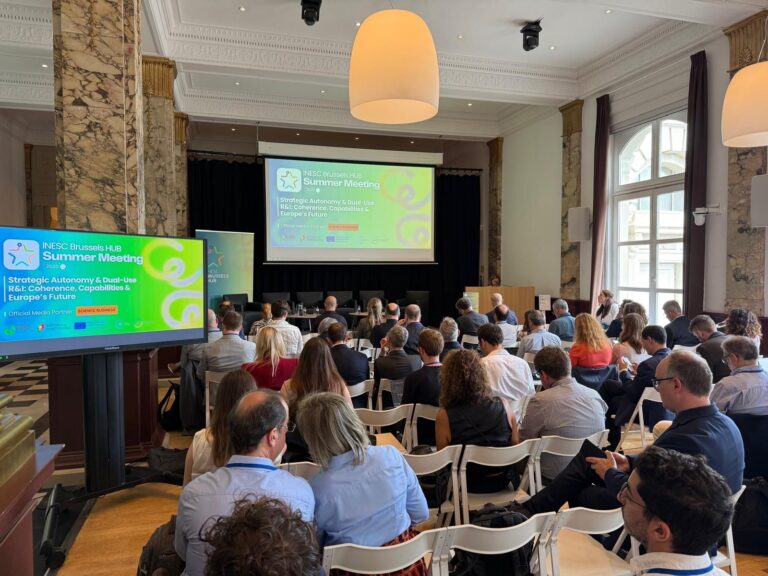
    Last month, the BIP Meeting Centre, in Brussels, hosted the 2025 INESC Brussels Hub Summer Meeting, which brought together over 200 participants, including researchers, EU policymakers, and industry leaders. From June 25 to 26, the high-level policy and strategy forum, organised by INESC Brussels Hub, addressed Europe’s most pressing research and innovation policy changes, from strategic autonomy to the role of dual-use research in Europe’s future. 

    The two-day event featured plenary and breakout sessions and foresight dialogue, promoting critical reflections and discussions focused on a singular policy challenge: “How can Europe design research and innovation strategies that are resilient, integrated, and capable of securing both prosperity and security in an era of uncertainty?” 

    “This meeting offers INESC-ID a unique opportunity to strengthen its international reputation, align its research with European policies, and enhance its relevance and visibility within the INESC community and beyond,” remarks our President of the Board Inês Lynce, who represented INESC-ID at the event, alongside Ana Teresa Freitas, Arlindo Oliveira and João Paulo Carvalho.   

    Ana Teresa Freitas moderated Breakout B1: Health, Cyber and Sensors for Societal Resilience, which explored possible contributions to societal resilience, particularly in potential civil protection and defence contexts, through advanced sensing, AI and simulation tools. 

    Learn more here

    Image | © 2025 INESC Brussels Hub

  • The Chicken-and-Egg Dilemma of Electric Mobility: Reflections from the EV4EU Conference

    The Chicken-and-Egg Dilemma of Electric Mobility: Reflections from the EV4EU Conference

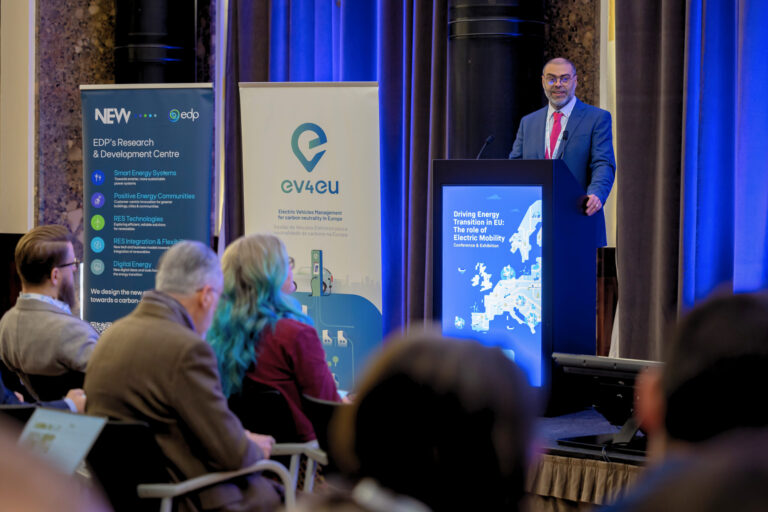
    It was a cold winter morning, blessed with sunshine that lured people to the main entrance of Instituto Superior Técnico, in Lisbon, enjoying the warm rays while chatting about … energy. Their badges revealed a shared purpose, the conference Driving Energy Transition in EU: The Role of Electric Mobility, promoted by the INESC-ID project EV4EU.

    The event gathered on January 15 specialists from around the world, coming both from research institutes and companies, to discuss electric mobility and the energy transition in Europe. An issue that INESC-ID project coordinator and Conference Chair, Hugo Morais, described as the “chicken-and-egg” dilemma of EV adoption: “no cars without infrastructure, and no infrastructure without cars.”

    Some of the projects in focus are intended to solve the riddle, such as the Scale Project – a user-centric approach, involving seven countries, to address the complexities of scaling EV infrastructure; DRIVE2X, with demos in Maia, Portugal, and Amsterdam, the Netherlands, highlighting real-world applications of EV technology, the project aims to accelerate the uptake of vehicle electrification through new bi-directional smart charging technologies; FLOW Project, that tackles the increase in energy efficiency through energy exchange with buildings, vehicles and the grid and XL-Connect, in which the main goal is to optimize the entire charging process, from the energy generation until the end user, by developing a digital twin of the entire system and developing optimal smart charging technologies.

    At the opening session, Inês Lynce, President of the Board of Directors, aptly remarked that we are living in the best time in history to discuss such a relevant topic. “We are in the right place, at the right time,” she said, emphasizing the importance of attracting young people to contribute to this transformative journey. Rogério Colaço, President of Instituto Superior Técnico, added that the shift to electric vehicles (EVs) represents “one of the greatest challenges of our time”, but one that is critical. He noted that EVs are inherently “more efficient than internal combustion engine vehicles”, a fact that underpins their central role in the energy transition.

    Voices from Portugal and Beyond

    Admitting the problem is more than ten years old, Jorge Martins from REN, presented the new Fast charging using transmission network Speed-E, with the belief that “this time, the market will take off”. “Electric trucks, though fewer in number, hold immense relevance due to the extensive kilometres they cover.

    “The issue is not energy availability but power capacity, especially during peak demand”, stressed Hugo Morais, while Rui Gonçalves, from E-Redes, emphasized the need for significant grid upgrades, with planned investments increasing by 50% between 2026 and 2030. “Flexibility”, he argued, is key to address the challenges of energy transition for grids.

    Portugal was celebrated as a case study in electric mobility. Débora Melo Fernandes, lawyer and Partner at Pérez-Llorca, specialized in energy, highlighted the country’s pioneering 2010 regulatory framework, which fostered a user-centric and competitive ecosystem. Débora outlined challenges such as fragmented regulations and lengthy permitting processes but emphasized the opportunities offered by aggregators and mechanisms like E-credits mandated by the latest Renewable Energy Directive, RED III, set for implementation by 2025.

    Bruno Vieira, from EDA, brought the unique challenges of the Azores into focus. With nine islands and no capacity to export energy, the region faces distinct hurdles in adopting EVs and enhancing infrastructure. Meanwhile, Luís Prazeres, from Brisa, underscored the importance of education and training to boost performance and efficiency in the mobility sector.

    Key Takeaways

    With a large experience in the energy sector, the independent consultant António Vidigal sustained that electric vehicles have a significant role to play in the electrical systems of the future. And regulation can help. “Portugal is already recognized as a leading example in the adoption of renewable energy. It should also be a model for regulation that supports the energy transition”, he defended. The concept of “vehicles as batteries on wheels” offers immense potential for grid support, but current legislation limits V2G (vehicle-to-grid) applications, the specialist noted.

    As Gonçalo Castelo Branco, from EDP Comercial, aptly put it, “whatever there is to come, we are still at the very beginning of what is going to be.” And as highlighted by INESC-ID’s President, Miguel Pupo Correia, the institute’s thematic lines and scientific areas underscore the societal importance of these efforts. Miguel noted that on a context of war, like the war in Ukraine, the energy systems are a target, including for cyberattacks.

    And for great endeavours, collaboration is always the key, underlined Hugo Morais. “The future of electric mobility depends on interdisciplinary collaboration—regulators, consumers, and developers working hand in hand.”

    Text by Sara Sá, Science Writer | Communications and Outreach Office, INESC-ID / © 2025 INESC-ID

    Images | © EV4EU

  • Navigating the Grey Areas: AI and Uncertainty at IPMU 2024

    Navigating the Grey Areas: AI and Uncertainty at IPMU 2024

    Almost nothing in life is black or white, rather a diversity of shades of grey. This is to say that uncertainty is everywhere, including in computational problems. But most of the time, engineers ignore this component of uncertainty, transforming it into zero/one solutions. “And then mistakes happen,” notes João Paulo Carvalho, from the Human Language Technologies research area, a board member of INESC-ID and a professor at Técnico. “When we move to real life, uncertainty takes on a different significance.”

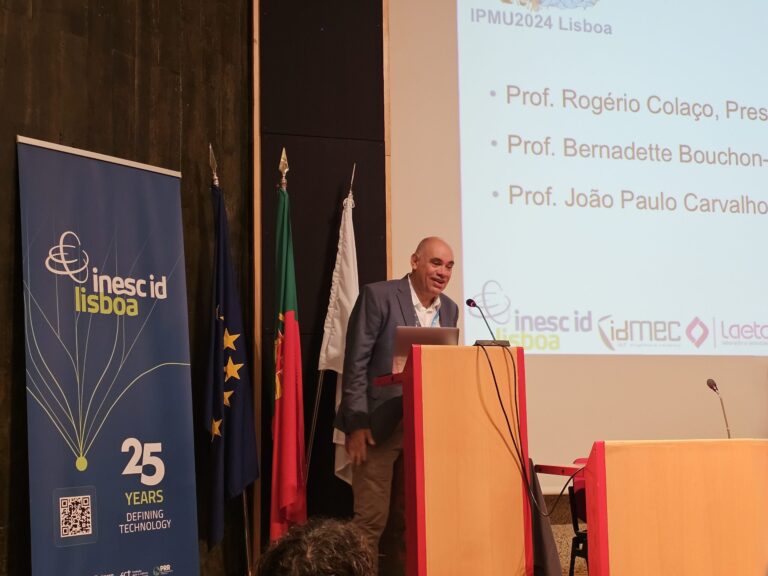
    Since 1986, computational scientists, mathematicians, and engineers gather every two years to discuss this topic at the International Conference on Information Processing and Management of Uncertainty in Knowledge-Based Systems (IPMU). It brings together everyone interested in developing methods for the management of uncertainty and aggregation, which allows for the management of data from multiple models and origins. IPMU2024, the 20th edition, happened from July 22 to 26 at Técnico, Lisbon, under the supervision of João Paulo Carvalho, the General Chair of the event.

    Many things in the area have changed since João Paulo first attended an IPMU. “In 2008, hardly anyone in this area focused on Neural Networks (NN) or Artificial Intelligence (AI). Many thought they were dying,” João Paulo recalls. Now, with the rise and dominance of Large Language Models (LLM) it is what we all know. Both expressions have reached the mainstream, and every year and a half there is a jump in the area that turns previous knowledge outdated. Hence, uncertainty in AI has become one of the main topics in IPMU.

    IPMU represents a privileged forum for the exchange of ideas between theoreticians and practitioners in these and related areas. Around 200 people, from 31 nationalities, attended the conference, with “very positive feedback,” João Paulo mentions. The event was also an opportunity to present some out-of-the-box topics, like the one introduced to a curious audience just on the first morning, by the keynote speaker Keeley Crockett, from Manchester Metropolitan University, UK, who gave a talk under the topic “People Powered AI – Challenges and opportunities in responsible and trustworthy AI development”.

    Apart from a career in computational science, Keeley is very interested in bringing topics such as AI to the public. “I am a people person,” she confesses during a conversation after the talk. “I want to empower people to have a voice,” Keeley adds, referring to the roadshows she used to do, speaking to senior communities. “The challenge is making sure things are done ethically. It is a different level to talk companies into doing it properly. It takes time, and resources.” Money that SMEs may not have to invest in this, she notes. “It is a triangle and the key is legislation.” Recognizing there are lots of people working in the field of ethics in AI – “that has grown in the last three to four years” – there is still a gap to fill, and “it is the people.”

    Text by Sara Sá, Science Writer | Communications and Outreach Office, INESC-ID / © 2024 INESC-ID

    Images | © 2024 INESC-ID

  • INESC-ID brings Smart Care, International Collaborations, and Scientific Excellence to “Ciência 2024”

    INESC-ID brings Smart Care, International Collaborations, and Scientific Excellence to “Ciência 2024”

    From July 3 to 5, the city of Porto became the center of science and innovation during the Science Meeting “Ciência 2024”, Portugal’s premier Science and Innovation event. Organized by Fundação para a Ciência e a Tecnologia (FCT), Universidade do Porto, and Ciência Viva, the event brought together a vibrant community of national and international researchers to exchange cutting-edge results, knowledge, and experiences under this year’s inspiring motto: “+Science for One Health and Global Wellbeing”.

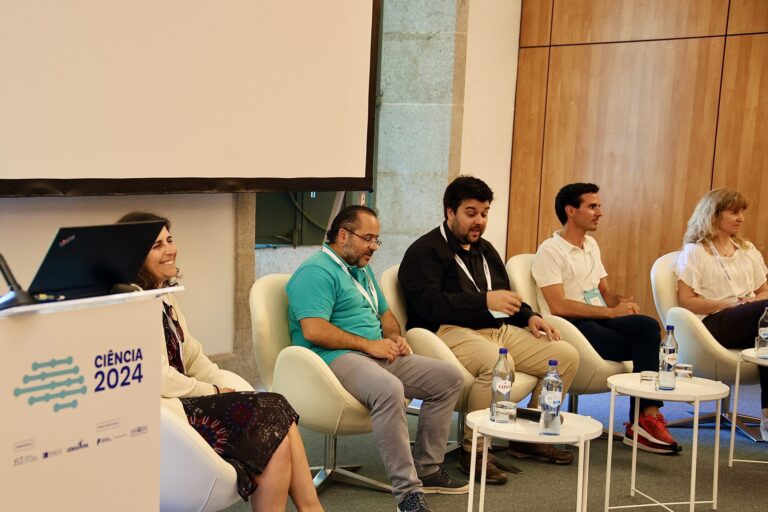
    INESC-ID once again showed a strong presence this year, co-organizing and participating in two impactful sessions. The first session, “Smart Care: The Bridge Between AI and Healthcare Systems According to Advances Made at INESCs”, brought together INESC-ID with partner institutes INESC TEC, INOV, and INESC-MN, along with key players from the healthcare sector.

    Aligned with our institute’s R&D Thematic Line – Life and Health Technology and mission to address pressing societal challenges, the discussion focused on key advances in Smart Care, through the emerging contributions of the INESCs institutes at the intersection of Artificial Intelligence and Health Systems. Rui Henriques, a researcher at INESC-ID, presented “Human Health Technologies: Ongoing Advances at INESC-ID,” highlighting the institute’s innovative R&D+i initiatives. His presentation covered a range of cutting-edge topics, including smart monitoring for intelligent care, precision decision-making for diagnosis and treatment, and advanced robotics for critical and social care, optimization, and molecular therapies.

    The second session, titled “Collaborative Projects within Portugal’s Partnerships with Carnegie Mellon Portugal Program, MIT Portugal Program, and UT Austin Portugal Program”, was hosted by the three programmes. The CMU Portugal session was moderated by INESC-ID President and co-director of CMU Portugal, Inês Lynce, and highlighted innovative initiatives, partnerships, and contributions to talent and academic development, industrial innovation and entrepreneurship.

    In the third session “ERC in Portugal: Sinergies and Good Examples”, a panel of researchers consisting of European Research Council (ERC) Grantees, former ERC Panel members, and ERC-Portugal participants, including INESC-ID researcher Nuno Santos, shared their valuable experiences and debated future opportunities.

    A highlight of the event was when José Tribolet, Founder of INESC and Professor Emeritus at Instituto Superior Técnico, was honoured with the prestigious Scientific Merit Medal by the Ministry of Science, Technology, and Higher Education. This award celebrates individuals whose exceptional contributions have significantly advanced science and scientific culture in Portugal.