Category: In-Depth

  • PRR Projects:                                                        How can I help you, como posso ajudar, koma podi ajudá?
    PRR Projects: How can I help you, como posso ajudar, koma podi ajudá?

    Who hasn’t had a frustrating experience with a chatbot? If you haven’t, either you’ve never used one, or you’ve interacted in American English or any other of the preferred languages of the big tech companies.

    It may not be obvious, but developing a conversational agent could be a powerful way to promote inclusion. This is precisely one of the goals of the consortium Accelerat.ai, created to advance the digital transformation of the public and private sectors in Portugal, with active participation from INESC-ID. “We intend to develop technology in Portugal to support sectors that are particularly important, such as a conversational system for SNS24 (Portuguese National Health Service’s helpline) and customer support solutions for businesses”, describes Alberto Abad from Scientific Area Human Language Technologies and the leader of INESC-ID’s participation in the consortium, which is supported under the Recovery and Resilience Plan (RRP).

    As seen in other areas of technology, the need to improve the quality and reliability of conversational agents was stressed during the Covid-19 pandemic, due to the transformation of services that previously provided in-person assistance and had to close. Consequently, there was a shortage of personnel to handle requests coming through contact centres, which were often not designed for that purpose. “Such circumstances created a need for, whenever possible, automated assistance,” notes Abad, a professor at Técnico, which is also a member of the consortium.

    In this world of ours, there are about 7 000 spoken languages. According to Defined.ai, an AI marketplace for tools, data and models, and the leader of Accelerat.ai consortium, “29% of business has lost clients due to a lack of multilingual support and 70% of end-users express greater loyalty to companies offering support in their native language.” And so, the mission of this ambitious project, with a budget of 35 million euros, 2.18 million of which is allocated to INESC-ID, is to develop a conversational assistant for languages outside the top 15 language roadmaps of the big 5 tech companies, starting with European Portuguese.

    The solutions in development are based on Conversational Artificial Intelligence Agents and CCaaS (Contact Centre as a Service). At INESC-ID, we will investigate and explore the capacity to mutually convert from speech to text and text to speech – an area known as Automatic Speech Recognition and Speech Synthesis. “It is a technology that has existed for many years, with several components – speech-to-text, and the reverse, text-to-speech”, Abad notes. “Additionally, there is the ‘brain’ of the system, which involves dialogue management and task handling, and this has evolved significantly in recent times with the advent of large language models (LLMs) that have transformed the landscape.” 

    To public and private organizations

    Some of this technology is already on the market, typically dominated by major tech companies such as Microsoft, Google, and Apple. These corporations have a business vision and often overlook niche languages, such as European Portuguese, spoken by ten million people. Consequently, the level of maturity and the amount of data available to develop these systems for minority languages is lower. “Therefore, the goal of the project is to provide Portuguese companies with technology specifically tailored to the Portuguese context, including its variants”, like dialects or regional forms of the language.

    Together on this mission, Defined.ai states that the project represents a strategic effort to cater the needs of the public and private sectors in Portugal and related markets, enhancing communication and accessibility in digital platforms. “If a developer intends to use voice systems in the Portuguese market, they must rely on generic models with a considerable margin of error, or in English and Brazilian Portuguese, languages that are not the preferred options for Portuguese speakers”, defended Daniela Braga, from Defined.ai, in a press release.

    Over the past ten years, errors on this kind of systems have been drastically reduced. “The systems are improving so much that we may be approaching a situation where, in certain tasks, it will be difficult to distinguish a human from a machine. The components are the same, but they work much better”, explains Alberto Abad. And so synthetic speech may end up being indistinguishable from recordings in terms of naturalness and fluidity. “Today, it is possible to have dialogue systems that solve many problems”, he adds. But still there is margin for improvement, by pushing the boundaries of the state of the art.

    Picking up on emotional cues

    One of the research goals is to extract emotional cues from speech to create more empathetic, human-like responses, moving further away from a robotic response. Another purpose is to improve speech recognition in non-ideal conditions, such as low-resource languages (with relatively less data available for training), or atypical speech. “Systems are tested for normative speech – such as children, where the lexicon is different, pitch is different and there are more fluctuations”, says the researcher. Elderly and people with any type of disability that affects speech are also in the scope of Accelerat.ai. The system may be trained to speak slower when interacting with elderly, use youthful speech with youngsters or adapting the accent, to create more closeness to the user.

    “Speech can be considered private information. If used maliciously, it is easy to create synthesis systems with our voice”, he alerts. “There can be a set of automatically extracted information that we might want to protect” – Alberto Abad.

    It is becoming increasingly evident that voice data can contain valuable information that may be used to detect health conditions, such as Parkinson’s disease. “Depending on the type of client and the circumstances, this information can be useful for characterizing the patient, as in a hospital setting”, exemplifies Abad.

    However, the more valuable the data, the greater the concern about privacy. “Speech can be considered private information. If used maliciously, it is easy to create synthesis systems with our voice”, he alerts. “There can be a set of automatically extracted information that we might want to protect.” To guarantee this, INESC-ID’s team is also working in ways to extract information while ensuring user privacy. And for this there are several approaches. “One idea is to use encryption. Another is to allow users to control which information they want to be leaked—such as being okay with their gender being known but not wanting anything else to be disclosed, or only allowing their speech to be used to understand what they are saying.”

    Presence at Interspeech

    Privacy is also a significant part of the project, with PhD students working in this area. “Currently, when we use such a system, the speech is stored, and we don’t know what might be done with it. We are working on improving speech recognition, on extracting features and health biomarkers, and in the future, on making interactions more private, addressing security and ethical concerns.”

    Six senior researchers, five post-doc, three PhD students, a master student are part of the project, a team that had a notable presence in the last Interspeech conference (the largest one on speech and language technologies in the world), with the participation of several members, the presentation of three scientific works related to the improvement of automatic speech recognition in low-resource settings and the use of LLMs as speech annotators to characterize speakers, the participation of a junior PhD as an expert pannellist in the special session “Connecting Speech-science and Speech-technology for Children’s Speech”. and above all, with the recognition of Professor Isabel Trancoso who received the ISCA Medal for Scientific Achievement, an annual distinction that honors each year an individual who has made extraordinary contributions to the field of speech communication science and technology.

    Projects like Accelerat.ai bring progress to conversational AI, prioritizing inclusiveness and accessibility. With applications ranging from healthcare to customer support, innovations in speech recognition and synthesis will increasingly become part of our everyday lives, bringing human-centered solutions at the base of AI development in Portugal and beyond.


    Text by Sara Sá, Science Writer | Communications and Outreach Office, INESC-ID
    © 2025 INESC-ID. Credit INESC-ID and the author, and link to the original source when sharing or adapting this article.

    Images | © 2024 INESC-ID, Accelerat.ai

  • José Tribolet, a visionary shaping INESC’s legacy

    José Tribolet, a visionary shaping INESC’s legacy

    José Tribolet’s life is intertwined with the history of INESC. This dedication to science and technology was recognized by Fundação para a Ciência e Tecnologia during Encontro Ciência 2024 with a Scientific Merit Medal.

    The idea to create a research institute focused on technology came to him in his twenties, after studying and working at prestigious institutions in the United States: MIT, where he completed a PhD in Electrical Engineering and Computer Science, and Bell Laboratories, where Tribolet worked as a researcher in the acoustics department. “They were engines of technology production, and I grasped what a fully technological university entails,” he recalls.

    Upon returning to Portugal, and inspired by the April Revolution four years earlier, Tribolet, along with colleagues João Lourenço Fernandes and José Fonseca de Moura, began conceptualizing a research institution dedicated to R&D in collaboration with Instituto Superior Técnico. In early 1979, the team began seeking funding for projects in electronics, digital systems, and digital signal processing. “I felt obligated to give back to the country what I had learned in the USA, especially at the university. Without investment in research, we cannot develop competent human resources or ensure quality education.” Having come from Bell Labs, the importance of digital transformation became evident.

    A year and a half after the inception of the research institution, the association was formally established. It was August 1980, with founding partners IST and UTL from the academic side, and CTT and TLP from the business sector – following a fifty-fifty partnership logic.

    Arlindo Oliveira, President of INESC since 2020, succeeding José Tribolet, underscores that “the Medal of Scientific Merit awarded to Prof. José Tribolet not only recognizes his individual contributions as a scientist and researcher, but also his vision and ability to cultivate an ecosystem for scientific research and technological development that has evolved into today’s INESC system.” A vision, he stresses, that has decisively influenced today’s national scientific system, “comprising a network of autonomous and independent institutions with their own strategies and dynamics, which underpin major scientific advances in Portugal.”

    In parallel with founding and leading INESC, Tribolet established both the bachelor’s degree in Computer Science and Engineering at IST, in 1989, and the Department of Computer Science and Engineering in 1998, together with colleagues João Pavão Martins and José Alves Marques. As a scientist at INESC-ID, in research area Information and Decision Support Systems, he focused on applying digital signal processing to various fields, including seismic studies, speech coding, and recognition. Later, Tribolet developed an interest in Enterprise Engineering. “The primary concern in any company or organization is purpose. We must ask ourselves, ‘what is our purpose?’”

    In 1999, INESC underwent restructuring to establish more focused institutions with distinct and complementary objectives. INESC-ID emerged from this process. “INESC-ID represents a fundamental capacity in research and human capital development in computer science and electrical engineering, contributing directly to applied research, technological development, and services”, Tribolet mentions.

    For Inês Lynce, President of INESC-ID, José Tribolet is a “man ahead of his time” who “shaped a generation.” With an unceasingly curious mind, José Tribolet emphasizes that for the future, we must manage virtual spaces alongside legal frameworks to safeguard our reality. Only then can we fully leverage the potential of technologies like AI. “Data is not information, and all data contain errors,” he observes. “Today, we do not fully harness the potential of people within organizations; we often treat them like robots.”


    Text by Sara Sá, Science Writer | Communications and Outreach Office, INESC-ID
    © 2025 INESC-ID. Credit INESC-ID and the author, and link to the original source when sharing or adapting this article.

    Images | © 2024 INESC-ID, Book 1980 – 2015 (35 Years of INESC), Encontro Ciência

  • PRR Projects:                                                    Mirror, mirror on the wall, am I real or am I fake?

    PRR Projects: Mirror, mirror on the wall, am I real or am I fake?

    Working in agriculture is exhausting, unpredictable, and sometimes not financially rewarding. Miguel Batista is a son, grandson and a great-grandson of cherry producers and he surely knows what he is talking about when mentioning the hardships, and also the joy, of living off farming. “I am afraid my son will not be a cherry producer”, he admits while talking at a debate taking place at Festa da Cereja, in Alcongosta, Fundão. Under the name “Cherry 4.0 – on the road to modernization”, organized by the Ciência Viva Agency and the Fundão Municipality, the gathering joined cherry producers, scientists and technology people. Batista, from the company Sota e Lino, provided the motto for the discussion. “When I started 30 years ago, no one checked the labels. Nowadays, everybody does.”

    And there is a lot of information that can be added to a label, like the origin, carbon footprint, fertilizers used during cultivation, all of this weighs increasingly more when the consumer decides. The Agenda “Decentralize Portugal with Blockchain”, funded under the PRR (Programa de Recuperação e Resiliência), in which INESC-ID is one of the promoters, aims to create a national blockchain network, preparing the country to be a world leader in the technology. It was also showcased during the debate.

    Coordinated by VOID Software and comprising 56 entities, including companies, research institutions, associations, and public bodies, “Decentralize Portugal with Blockchain” is organized into ten work packages addressing sectors like agriculture, digital asset management, and interoperability. With an investment exceeding 72 million euros, the agenda aims to launch 26 scalable products with significant export potential. Key focuses include “farm-to-fork” traceability integrating IoT with blockchains, managing digital assets in real estate and beyond, and interoperability solutions for data exchange between diverse blockchain systems and technologies across sectors. The end goal, as described on the project’s website, is “to propel Portugal to the forefront of blockchain technology in Europe and advance the country’s digital transformation.”

    Tracing the origins of Cereja do Fundão

    One of the proposed applications – Work Package 1 – is concerning the traceability of Cereja do Fundão. Fundão Cherries, cultivated in the Cova da Beira region of Portugal, stand out for their superior quality and unique characteristics that make them valuable in the market. However, it is important that they are authentic and monitored from origin to consumer. So, the goal of this demonstrator is to develop a first version of an innovative information system to ensure the traceability of Fundão cherries from harvest to consumer, with the vision of the “importance of technology as a driver of innovation and taking advantage of global business opportunities made possible by this technology”, notes the coordinator of the project, Miguel Pardal, an INESC-ID researcher, from Distributed Parallel and Secure Systems, and a professor at Técnico. “The use of Blockchain aims to ensure the integrity of the collected data, providing a reliable source of information about the origin and quality of cherries”, Pardal explains. “Unlike traditional databases, it is not under the control of a single entity but rather involves a network of partners, including producers, distributors, retailers, and technology providers.”

    Festa da Cereja, in Alcongosta, was the perfect opportunity to demonstrate it to the population and test its impact. The demonstrator, developed in collaboration with the organization of cherry producers Cerfundão, the retailer Sonae MC and the technology company Sensefinity, included an app through which consumers can have access to the information.

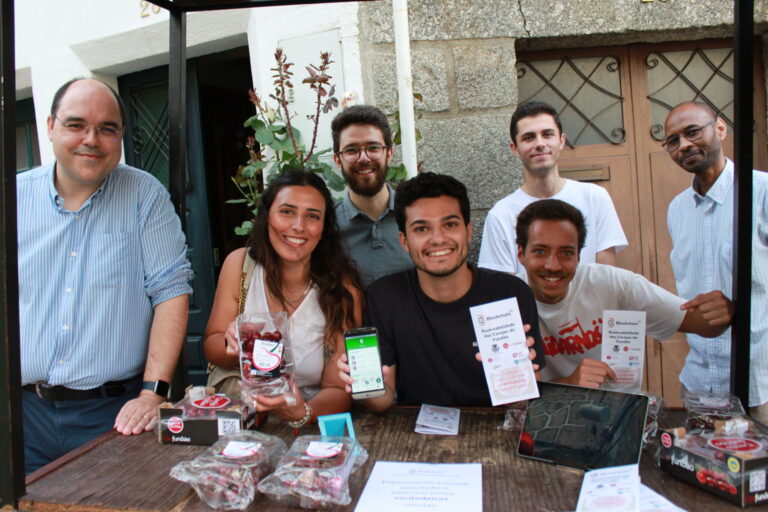
    Visitors passing through the main street of the mountain village during Festa da Cereja were looking for the traditional cherry products, like pies and liquors. But they also found technology. For two days, on the stand of Blockchain.pt people could test the system and become familiar with the main aspects of the project. By reading the QR code on the box, the app would show the community area (freguesia) in which it was produced and all the steps the fruits have gone through to reach the customer. “The focus of this initial demonstrator is the assurance of origin and, therefore, the locations involved in the supply chain. In the future, the system will include integrated sensors for temperature, humidity, light, and vibration, for example, in field boxes and packaging labels, to enable better monitoring of transportation and storage conditions”, Miguel Pardal explains.

    Where technology meets tradition

    The project involves a group of master students, working on the app in order for it to be appealing to end users, with a gamification component. All the server programming is also with INESC-ID. The smart label is being developed by Sensefinity with the data sent through LoRa net. The position, detected by GPS, is communicated every five minutes, from the fields to Cerfundão, and then on every thirty minutes. The labels are attached to the boxes and pallets and the sensor also registers temperatures and humidity. “These data can be relevant in case there is some sort of sanitary problem”, underlines the CEO of Sensefinity, Orlando Remédios.

    The system will be integrated with the enterprise information systems of the partners involved in the supply chain. The use of Blockchain aims to ensure the integrity of the collected data, providing a reliable source of information about the origin and quality of the cherries. “Unlike traditional databases, this information is not controlled by a single entity, but by the group of partners involved in the system, including producers, distributors, and retailers, as well as the technology providers involved”, Miguel Pardal explains.

    “This approach enables the construction of shared systems even in environments where there is only partial trust between partners, which often hindered the adoption of new technologies. By using blockchain, we can ensure that data and code are managed securely and transparently, eliminating single points of failure and preventing fraud. This model can be applied to various sectors and help boost the economy.” Miguel Pardal

    Cherries were only a start. Other food products might follow, like almonds and meat. “This project is building a food traceability system that provides guarantees about the origin of products”, Miguel Pardal summarizes. “It can also monitor their storage and transport conditions to protect quality and freshness.”

    According to Miguel Pardal, this project can have a significant impact on the agriculture sector, protecting and adding value to Portuguese products. “From a research perspective, it allows for experimenting with new business integration architectures by implementing a logically centralized system—simpler, with which all participants communicate and with common data schemes—but with technological guarantees that data storage and code execution are performed in a decentralized and consensual manner among all business partners. This approach enables the construction of shared systems even in environments where there is only partial trust between partners, which often hindered the adoption of new technologies. By using blockchain, we can ensure that data and code are managed securely and transparently, eliminating single points of failure and preventing fraud. This model can be applied to various sectors and help boost the economy.” A new dawn is rising.

    Text by Sara Sá, Science Writer | Communications and Outreach Office, INESC-ID / © 2024 INESC-ID

    Images | © 2024 INESC-ID

    A team of INESC-ID was at Festa da Cereja, Alcongosta, with a demo of the Blockchain.Pt project