Category: INESC-ID

  • Artificial Intelligence for COVID-19 chest X-ray diagnosis

    Artificial Intelligence for COVID-19 chest X-ray diagnosis

    The DeepPathCOVIDx project will allow to develop of a solution that will assist healthcare professionals in the analysis of chest X-ray images.

    A team of researchers from Técnico and INESC-ID, in collaboration with Hospital da Luz Learning Health, is developing a solution consisting of AI models for the analysis of chest radiography of patients suspected of having COVID-19, in an emergency context.

    Besides causing cough, fever and fatigue, the SARS-CoV-2 virus can cause acute upper tract infection. Identifying these clinical cases and prevent worsening clinical conditions is crucial to reduce pandemic deaths. Conventional chest radiography allows the assessment of infection and, consequently, the strategy of monitoring and treating the patient. Chest X-rays can also be used as a complementary diagnostic method, although they are not part of the official protocol.

    Thus, the creation of AI models to identify radiological characteristics of COVID-19 in chest X-ray images allows, together with other clinical information, to help in the decision-making for suspected cases of COVID-19, being an important and useful tool to support the work of healthcare professionals. “The main purpose of this tool is to be able to detect, autonomously, and with a high degree of certainty, COVID-19 on chest X-rays and how severe the disease is”, explains Arlindo Oliveira, Técnico professor and Principal Investigator of the project.

    This tool aims to optimize the work of radiologists, identifying and prioritizing the x-rays of suspected COVID-19 patients in the work list, to assist doctors in an emergency context when radiologists are not available, with a tool for analyzing radiographs, and to increase efficiency in an emergency context, facilitating professionals’ decision making.

    The system is currently being tested “with data from Hospital da Luz and Hospital Beatriz Ângelo”, shares by professor Arlindo Oliveira. “The data provided by our partners will allow us to test the accuracy of the model. If we succeed, it will be included in hospital admissions”, explains professor Arlindo Oliveira.

    The project’s feasibility study should be completed in a few months. The next phase will go through the implementation of the tool in a hospital. Although this phase no longer relies on the research team, professor Arlindo Oliveira believes that “it may be operational a few months after the demonstration is finished”.

    The multidisciplinary team consists of Técnico/INESC-ID researchers in the fields of machine learning and artificial intelligence, radiologists, ER doctors at Hospital da Luz Lisboa and Hospital Beatriz Ângelo, human factors and ergonomics experts, information systems experts and managers. DeepPathCOVIDx was one of the projects funded bythe Portugal 2020 programme. The results will be announced in the first half of this year.

    According to professor Arlindo Oliveira “the collaboration between engineering and medicine is always very fruitful and will play an essential role in medical advances”.


    Source: Técnico

  • COVID-19 detection from coughs and speech

    COVID-19 detection from coughs and speech

    A team of researchers from IST (Instituto Superior Técnico – Universidade de Lisboa) and INESC-ID (Instituto de Engenharia de Sistemas e Computadores – Investigação e Desenvolvimento), coordinated by Isabel Trancoso, is developing a new project to explore the possibility of automatically detecting COVID-19 from its effects on cough and speech.

    This project would allow developing a cheap, fast and easy to use artificial intelligence-based tool (deployed as a web platform and/or a mobile application) that could provide a preliminary assessment of potential infection by COVID-19. Although not a clinical diagnosis, this is valuable information that would help individuals to adopt preventive measures, and public and private healthcare operators, institutions, companies, etc. to optimize their screening campaigns by allowing them to focus their attention on suspected infected individuals.

    For this goal, it is fundamental to collect an extensive dataset with representative examples of speech and simulated coughs and snores from both COVID-19 positive (symptomatic and asymptomatic) and negative individuals (ideally including also participants with respiratory conditions other than COVID-19, such as flu, cold, asthma, etc.). Then, signal processing and machine learning techniques will be used to assess the presence of biomarkers indicative of COVID-19 in coughs and speech, and to develop robust systems for the detection of COVID-19.

    “We hope that this work will not end with the current pandemic and will allow us to continue studying clues of diseases that affect the respiratory system through acoustic signals that can be collected in a non-intrusive way”, said Isabel Trancoso, The Project Coordinator.

    Your participation in this study is essential and warmly appreciated. To participate, just follow this link (where you can find the informed consent form), or use the following QR code.

    More info: https://www.hlt.inesc-id.pt/w/COVID19

  • João Madeiras Pereira is a new senior member of ACM

    João Madeiras Pereira is a new senior member of ACM

    João Madeiras Pereira was nominated Senior Member of the ACM – Association for Computing Machinery.

    As mentioned by the Senior Member Committee “we are delighted that you will be among the inductees honored with this designation and wish to congratulate you on this well-deserved recognition”.

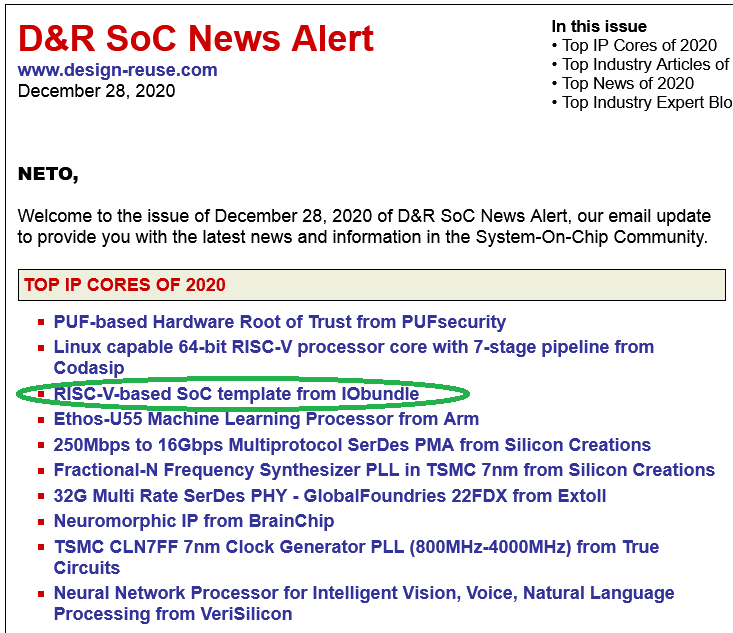
  • IObundle IP at 2020 Design&Reuse top10

    IObundle IP at 2020 Design&Reuse top10

    IOb-SoC is a System-on-Chip template equipped with a CPU, a memory system and a serial communications module. By democratising the use of CPUs in electronic design, IOb-SoC is at the forefront of enabling powerful AI and machine learning algorithms in all sorts of electronic equipments, especially ultra low-poer ones. Users can easily customise IOb-SoC to implement more complex and specific SoCs. It uses RISC-V processors at its core, dispensing with cumbersome and expensive solutions such as ARM processors. By democratising the use of CPUs in electronic design, IOb-SoC is at the forefront of enabling powerful AI and machine learning algorithms in all sorts of electronic equipment, especially ultra-low-power ones. It is released in the public domain under the MIT permissive license and distributed using the Github platform. By providing the code publicly, and at no charge, stakeholders can easily use IOb-SoC for teaching, research, and industrial innovation.

    The motivation for IOb-SoC is that of a speedy and straightforward setup, quickly grasped by students, instructors, researchers and innovators. The IOb-SoC hardware uses the System Verilog language, and its software uses the C/C++ languages.

    The design is straightforward: the processor reads instructions and accesses data from the memory system and peripherals, and executes the program. The system has been used in several master’s dissertations and is being used in one PhD work, supervised by our researcher José Teixeira de Sousa.

    IOb-SoC has also been used as a research tool and industrial applications.

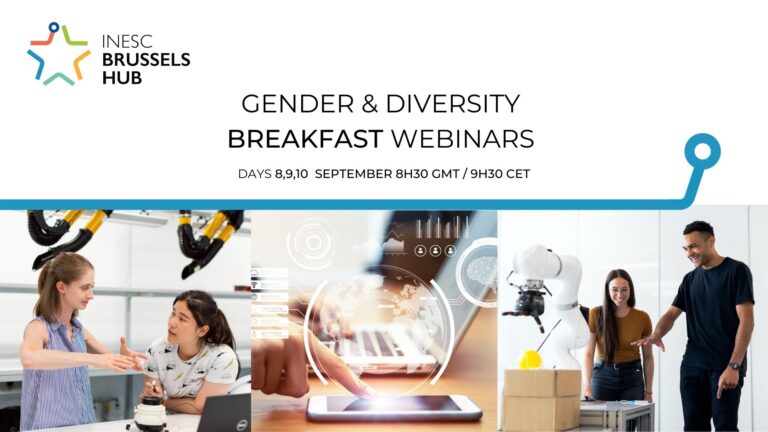
  • Gender&Diversity Breakfast Webinars – INESC Brussels HUB

    Gender&Diversity Breakfast Webinars – INESC Brussels HUB

    Organized by INESC Brussels Hub, ‘Gender&Diversity Breakfast Webinars’ took on September 8, 9 and 11.

    Listen to the first episode here.

    Download the speakers’ presentations here: Gender and Diversity in research and technology organisations in Europe | Gender equality in R&I EC – Mina Stareva | Tomas Brage – Lund University

  • Talks on Model Driven Engineering & Artificial Intelligence Approaches

    António Menezes Leitão
    João Penha-Lopes
    ,

    Abstract:

    3rd Talk/2020: IST, 24/January/2020, with Prof. António Menezes Leitão (IST) and Dr. João Penha-Lopes (Quidgest)

    The department of Computer Science and Engineering from Instituto Superior Técnico and Quidgest associates to promote a series of meetings with guest speakers at lunch time. APDSI, COTEC, CS03 from IPQ and Link to Leaders also support the initiative.

    Light lunch offered to participants!
    Registration is free and required, limited to the seats of the auditorium.

    More info here.

    Title: The Algorithmization of Architecture

    Since many other areas, architecture is going through a deep but irreversible change: the new generation of practitioners starts to adopt algorithmic approaches in their project processes, which allows conceiving ways that were almost unthinkable before.
    Besides that, using algorithms, project and analysis processes are automated and also can optimize projects.

    In this presentation we will discuss the algorithmization of architecture and also present some recent developments in this area.

    Guest Speaker: António Menezes Leitão*.

    At this session will also be presented the article “Model Driven Automatic Code Generation: An Evolutionary Approach to Disruptive Innovation Benefits”, written by João Penha-Lopes, Manuel Au-Yong-Oliveira e Ramiro Gonçalves.

    Guest Speaker: João Penha-Lopes**.

    Bio


    (*) António Menezes Leitão is graduated in Mechanical Engineering, has a MSc degree in Electrical Engineering and a PhD degree in Computer Engineering from Instituto Superior Técnico (IST). Is currently an Assistant professor from IST and Senior Researcher at INESC-ID, at the Software Engineering group, teaching and researching in Architecture and Computation.

    (**) João Penha-Lopes é Master of Science – MS Field Of Study Telecommunications Engineering from Instituto Superior Técnico and PhD Field Of Study Information Management from Universidad de Alcalá. Presently is a VP Global Growth at Quidgest.


    Date: 2020-Jan-24     Time: 13:00:00     Room: Room 0.17 Pavilhão de Informática II, IST


    For more information:

  • Scaling Distributed Machine Learning with In-Network Aggregation

    Marco Canini,

    KAUST: King Abdullah University of Science and Technology

    Abstract:

    Training complex machine learning models in parallel is an increasingly important workload. We accelerate distributed parallel training by designing a communication primitive that uses a programmable switch dataplane to execute a key step of the training process. Our approach reduces the volume of exchanged data by aggregating the model updates from multiple workers in the network. We co-design the switch processing with the end-host protocols and ML frameworks to provide a robust, efficient solution that speeds up training by up to 310%, and at least by 20% in most cases for a number of real-world benchmark models.

    Bio

    Marco does not know what the next big thing will be. But he’s sure that our next-gen computing and networking infrastructure must be a viable platform for it and avoid stifling innovation. Marco’s research area is cloud computing, distributed systems and networking. His current interest is in designing better systems support for AI/ML and provide practical implementations deployable in the real-world.
    Marco is an associate professor in Computer Science at KAUST. Marco obtained his Ph.D. in computer science and engineering from the University of Genoa in 2009 after spending the last year as a visiting student at the University of Cambridge, Computer Laboratory. He was a postdoctoral researcher at EPFL from 2009 to 2012 and after that a senior research scientist for one year at Deutsche Telekom Innovation Labs & TU Berlin. Before joining KAUST, he was an assistant professor at the UCLouvain. He also held positions at Intel, Microsoft and Google.

    For more information:

  • Talks and Lectures:  Artificial Intelligence Applications, Implications and Speculations

    Talks and Lectures: Artificial Intelligence Applications, Implications and Speculations


    Artificial intelligence is increasingly imposing itself on the reality of contemporary societies, although new technological developments come into being every day, this phenomenon is not correspondingly reflected in the public sphere. Considering that it is important to know and discuss this reality, this cycle of debates takes a look at the current applications of artificial intelligence reflecting upon its social implications in a whole range of different areas (ranging from health to privacy, employability and other areas) and the way in which the future can be imagined within this new paradigm.

    Between April and June, the cycle is divided into three separate moments, each of them a double programme: a debate with several speakers from the academic and business worlds and a conference.

    17 APRIL

    16:00 Applications with Luísa Coheur, Pedro Bizarro, Milind Tambe
    18:30 Applications (The Good and the Bad) with Mário Figueiredo

    15 MAY

    16:00 Implications with Luís Moniz Pereira, Manuel Dias, Virginia Dignum
    18:30 Robot ascension with Martin Ford

    05 JUNE

    16:00 Speculations with Ana Paiva, André Martins, Arlindo Oliveira
    18:30 Artificial intelligence Compatible Human with Stuart Russell

    Free entry (subject to availability), tickets available on the day from 15:00 at the ticket-office.

    In portuguese and english with simultaneous translation

    Live streaming here

    More information about the event here

  • Candidatura a projetos de IA para a modernização da administração pública

    Candidatura a projetos de IA para a modernização da administração pública

    Candidaturas abertas no âmbito do Sistema de Apoio à Transformação Digital da Administração Pública

    “INTELIGÊNCIA ARTIFICIAL E CIÊNCIA DOS DADOS”

    São elegíveis acções de promoção e divulgação de iniciativas com vista à disseminação de melhores práticas e partilha de conhecimento de novas formas de organização interna e de prestação de serviços públicos aos cidadãos e às empresas, bem como o desenvolvimento de novos modelos de inovação e de experimentação na Administração Pública, como sejam laboratórios de inovação, plataformas de incubação e aceleradores, projetos colaborativos de cocriação de soluções inovadoras, projetos de governação integrada, em particular os que visam a cooperação internacional e respostas a desafios societais.

    Entidades beneficiárias:
    a) As entidades da administração central do Estado;
    b) As entidades públicas empresariais prestadoras de serviços públicos;
    c) Outros níveis da administração ou outras entidades públicas e privadas, no âmbito das suas atividades sem fins lucrativos, ao abrigo de protocolos celebrados com a administração central.

    Consultar o aviso 01/SAMA2020/2019

    Mais informação

    Data encerramento AAC: 28/02/2019
  • Evaluation INESC-ID

    Evaluation INESC-ID

    As Associate Laboratory since 2004,  INESC-ID is periodically evaluated by the Foundation for Science and Technology (FCT).

    This status is reserved for research institutions of great merit that have been recognized in external assessments as having the “capacity to cooperate in a stable, competent and efficient way in the pursuit of specific political, scientific and national technological objectives”.

    The review is made by an international panel of experts, based on the R&D institutions’ activity reports and proposed strategic plans as well as on direct contacts with researchers and institutions, through site visits and/or interviews by the reviewers.

    All R&D institutions are awarded a qualitative grade, which determines the level of funding to be awarded, until the next review takes place, or until a mid-term assessment is made.

    INESC-ID  most recent evaluation took place December 3rd, and with great effort of all INESC-ID members, we believe we were able to transmit all our passion and commitment.