Category: INESC-ID

  • SHIFT2DC Kick-Off Meeting in Lisbon
    SHIFT2DC Kick-Off Meeting in Lisbon

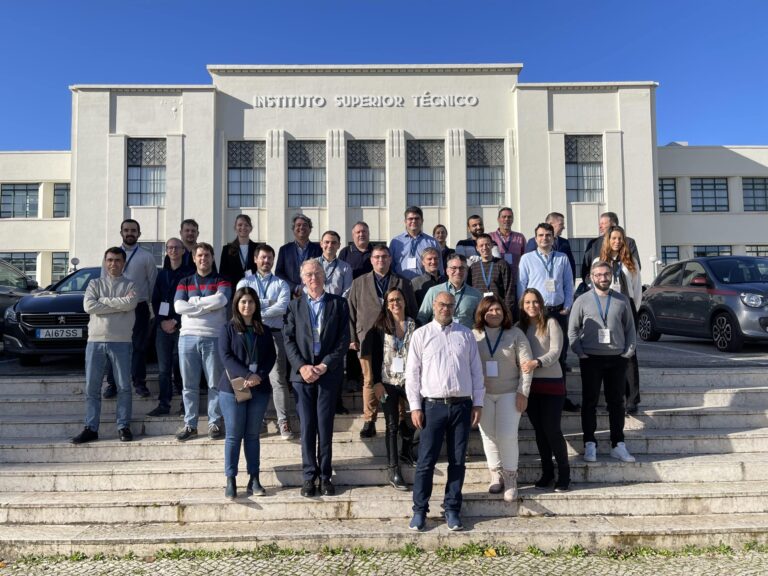
    The SHIFT to Direct Current (SHIFT2DC) project, a Horizon Europe Programme initiative led by INESC-ID, hosted its Kick off Meeting on December 12 and 13 at Instituto Superior Técnico gathering members from the 33 partner Institutions from 13 different European countries, both onsite and remotely. With a substantial funding of over 11 million euros and supported by the European Climate, Infrastructure and Environment Executive Agency (CINEA), the SHIFT2DC project has the goal of creating smarter, more efficient, and environmentally friendly energy infrastructures through direct current (DC) solutions.

    The event gathered over 40 participants from the consortium, with an Opening by the project Coordinator and researcher at INESC ID, Hugo Morais, who will lead the consortium throughout the project’s 42 months.

    We are thrilled to be launching a new project that will carry several challenges but also high expectations. Our main goal is to create a greener and smarter energy landscape for the benefit of communities, industries, and to be used worldwide using effective DC solutions.”, Hugo Morais.

    The European Climate, Infrastructure, and Environment Executive Agency (CINEA) was represented remotely at the meeting by Project Advisers Antonios Marinopoulos, who was involved throughout the Grant Agreement preparation and presented a general overview of the European Commission and CINEA, of the grant agreement and expected actions from the SHIFT2DC consortium; and Andrea Feltrin who is now taking the role as SHIFT2DC Project Officer.


    INESC ID will be responsible for leading the WP2 “DC Solutions Integrations: Tools, methods and applications” focused on developing a tool for the design of DC solutions, specific libraries for DCs, Buildings, Industries, Ports etc., and the WP6 “Knowledge transfer and Dissemination”, responsible for documenting all dissemination and communication activities of the project. Under the WP7, INESC ID will lead the project management and coordination, ensuring financial, administrative, data and risk management while securing the quality of the project outputs.

    More about SHIFT to Direct Current (SHIFT2DC)

    The SHIFT to Direct Current (SHIFT2DC) project aims to transform the way direct current (DC) solutions are used in our power systems. To do so, the consortia will establish comprehensive guidelines and a roadmap for the widespread application of DC in diverse energy scenarios.

    The EU initiative will implement a top-down, application-agnostic approach to design, simulate, test, validate, and apply DC solutions at both medium (MV) and low voltage (LV) levels. To guarantee the promotion of greener energy alternatives, the consortium will conduct thorough analyses, including feasibility, cost-benefit, life cycle, and environmental impact assessments. This will ensure that the proposed DC solutions are not only practical and cost-effective, but also sustainable.

    Over the course of the project, three field-test demonstration sites will be implemented: two DC living Labs and one digital twin demonstrator centered on testing solutions for Data Centres, Buildings, Industry and Ports.

    It will be crucial to demonstrate the effectiveness and adequacy of these DC solutions to enhance confidence in their use and in the planning and conception of systems based on DC. With this in mind, the SHIFT2DC will develop, integrate, and demonstrate several solutions specifically designed for DC applications including:

    – Sustainable and smart DC Cables, developed for DC installations,
    – Micro Solar DC Systems
    – LVDC measurement device
    – Pre-Charging Units for DC circuit breakers
    – LVAC-LVDC Interlink converter
    – high density power sources,
    – Smart PDU High Density V2X DC stations, among others. 

    Funded through the Horizon Europe Programme, SHIFT2DC is planned for 42 months, bringing together a group of 21 beneficiary partners, 6 affiliated entities, and 6 associated partners for a total of 33 partners including: a certification laboratory (Laboratoire National de Métrologie et D´Essais; LNE, France), a system operator (Empresa de Electricidade da Madeira, SA; EEM, Portugal) that will collaborate in the port demonstrator, an engineering office (SETEC BATIMENT, France) that will test the DC design tools, and the two most important DC promoters namely, Stichting Current OS (Netherlands) and ODCA (represented in the project by ZVEI e.v., Germany).

    List of 33 partners (by Country):

    Austria (1): Eaton Industries
    Belgium (1): EUROPEAN HEAT PUMP ASSOCIATION (EHPA)
    Czech Republic (1): EATON ELEKTROTECHNIKA SRO
    Estonia (1): TALLINN UNIVERSITY OF TECHNOLOGY (Taltech)
    France (6): SETEC BATIMENT; LABORATOIRE NATIONAL DE MÉTROLOGIE ET D’ESSAIS (LNE) ; ELECTRICITÉ DE FRANCE (EDF);  SCHNEIDER ELECTRIC INDUSTRIES (SCHN), NEXANS FRANCE (NEXANS), WATT & WELL; SETEC BATIMENT
    Germany (8): ZVEI e. V.RHEINISCH-WESTFAELISCHE TECHNISCHE HOCHSCHULE AACHEN (RWTH AACHEN); FRAUNHOFER GESELLSCHAFT ZUR FORDERUNG DER ANGEWANDTEN (FRAUNHOFER); Bachmann GmbH; EATON INDUSTRIES (EATON); PHOENIX CONTACT ELECTRONICS (Phoenix Contact); Phoenix Contact Power Supplies; PHOENIX CONTACT GMBH & CO KG
    Hungary (1): PCB DESIGN
    Italy (1): FINCANTIERI SI SPA
    Netherlands (3): Stichting Current OS; HIRO MICRODATA; DC Systems B.V.;
    Portugal (5): INESC ID; EMPRESA DE ELECTRICIDADE DA MADEIRA (EEM); CNET CENTRE FOR NEW ENERGY TECHNOLOGIES SA (EDP CNET); ADMINISTRAÇÃO DOS PORTOS DA REGIÃO AUTÓNOMA DA MADEIRA AS (APRAM); IST ID
    Associated partner: EMPRESA DE ELECTRICIDADE DA MADEIRA
    Spain (3): FUNDACION TECNALIA RESEARCH & INNOVATION (TECNALIA); FUNDACION CIRCE CENTRO DE INVESTIGACION DE RECURSOS Y CONSUMOS ENERGETICOS (CIRCE); Hitachi Energy Spain (Hitachi)
    Sweden: NEXANS Sweden
    Switzerland (1): JJCooling Innovation SARL

    Shift2DC Linkedin Page

  • INESC ID Interview with Aleksandar Ilic and Ricardo Nobre from the HPCAS Research Group

    INESC ID Interview with Aleksandar Ilic and Ricardo Nobre from the HPCAS Research Group

    The High-Performance Computing Architectures and Systems (HPCAS) Research Group at INESC-ID, works on state-of-the-art topics in High-Performance Computing (HPC), performance modeling, and bioinformatics. This includes epistasis detection which involves identifying combinations of specific gene mutations that may increase the likelihood of expressing a disease and have adverse effects on health (e.g. Alzheimer’s disease, breast cancer, and others). Epistasis analysis in disease research is proving crucial for a better understanding of complex illnesses.

    In this INESC ID interview, HPCAS researchers Aleksandar Ilic and Ricardo Nobre explain the core of their research work and the progress made in Epistasis detection using Intel Software. The achievements of this research counted on the support of numerous researchers and students from INESC-ID and Técnico, including Leonel Sousa, Frederico Pratas, Diogo Marques, Rafael Campos, Sergio Jimenez-Santander, Miguel Graça, among others.

    Briefly, what is the core of the INESC ID High-Performance Computing Architectures and Systems (HPCAS) research work?

    Although tackling many different aspects of high-performance computing, the core HPCAS research work addresses the performance and efficiency of computational systems and applications both at the software and hardware level. At the software level, some of the key aspects that we focus on include parallel algorithms, scheduling, and load-balancing methods targeting systems with state-of-the-art devices, such as multi-core CPUs, GPUs, Deep-Learning Accelerators, FPGAs, etc. At the hardware level, the focus is often on the design of accelerators and application-specific processors and systems.

    Epistasis detection has been at the center of your recent research. Can you briefly explain what epistasis is and the main goals/achievements of your research in this field?”

    Epistasis detection is a bioinformatics application that is concerned with the identification of which combinations of single nucleotide polymorphisms (SNPs) are most correlated with a given condition. SNPs represent a variation of a single nucleotide at a given position in DNA. Several associations between combinations of SNPs and complex human diseases (e.g. Alzheimer’s, Breast Cancer) have been found, but many more are likely to be uncovered.

    “The main goals/achievements of our research in this field have been to develop fast and efficient methods to perform epistasis detection searches. “

    You proposed “using heterogeneous computer architectures composed of multicore CPUs and GPUs to achieve performant and energy-efficient epistasis analysis.” Briefly, what did you suggest?

    Heterogeneous computer architectures are at the core of many of today’s computing systems, from embedded devices to supercomputers. Our work involves developing efficient parallel algorithms and identifying which hardware is the most suitable to perform the different blocks of epistasis computations, as well as orchestrating them for efficient execution. Our main contribution in this research field represents one of the first studies to propose methods to efficiently exploit unconventional hardware to achieve high-performance epistasis detection, e.g., by using the NVIDIA Tensor Cores and AVX-512 POPCNT in Intel CPUs. These works currently represent the fastest approaches to epistasis detection in the literature.

    What are the main challenges that the team had to face?

    The use of hardware with novel instructions (e.g. vectorized POPCNT) and programming models/tools (e.g. Data Parallel C++ / SYCL) requires us to be at the forefront of technology in what concerns both the hardware and software methodologies. This requires investing a significant portion of the time in research, especially in cases where the hardware/software has not been previously explored, even for applications from other domains. Exploiting novel hardware/software/tools was often not straightforward and required redesigning the epistasis detection problem in ways that core operations are mapped to efficiently implemented instructions and programming primitives.

    What are the potential implications and usefulness of these results?

    Faster epistasis detection searches mean that a larger portion of today’s case-control datasets can be processed considering high-order SNP interactions. As a result, this might enable uncovering previously unknown relations between SNPs and complex conditions or diseases, which can help in better understanding causation mechanisms and have an impact on their treatment.

    You have been working within several national and international EU research projects. Can you let us know more about the international projects you are involved in? What is their common thread/theme related to optimizing this type of bioinformatics applications?

    Our explorations on epistasis detection started as part of the national FCT-funded HiPerBio project and continued in the context of other EU-funded research projects, such as SPARCITY, SYCLOPS, and multiple advanced computing projects. The common thread related to optimizing this type of bioinformatics application has been the efficient evaluation of the huge combination space. This computationally intensive task relates to many projects running at the HPCAS group, which are focused on fully exploiting the capabilities of state-of-the-art hardware.

    How does Intel come in and why? Main advantages of this collaboration?

    Intel is one of the key players and our long-term partner in what concerns our developments using both Intel hardware and software. Our recent studies show that some of the novel features introduced in recent Intel architectures are very useful for the acceleration of epistasis detection studies, e.g., AVX-512 POPCOUNT in Intel CPUs (Saphire Rapids) and data-parallel engines in Intel Datacenter Max Series GPUs (PVC).

    Furthermore, our research contribution (Cache-aware Roofline Model, CARM) has been integrated as a fully supported feature in the Intel Advisor tool, since 2017. The CARM allows for efficient characterization of performance upper bounds of different Intel CPU and GPU devices, while also providing intuitive guidance for application optimization. We relied also on this feature when optimizing epistasis detection codes, which provided speedups of up to 9x when compared to a baseline implementation.

    Ideally, where do you imagine your research going in the future?

    As for now, we have mostly focused on CPUs and GPUs, and FPGAs to some extent. However, we envision our research to extend to systems with even higher heterogeneity, including novel domain-specific accelerators, such as Tensor and Intelligence Processing Units (TPUs/IPUs). We also explore portable cross-device software solutions, based on open-standard programming languages such as DPC++ / SYCL, as well as the use of machine learning frameworks to achieve high performance and portability.

    Bios

    Aleksandar Ilic (PhD’14) is an Associate Professor at the Department of Electrical and Computer Engineering (DEEC), Instituto Superior Técnico (Técnico), Universidade de Lisboa, and a Researcher of INESC-ID, Lisbon, Portugal. He has contributed to more than 60 international journal and conference publications and has participated in many tutorials at different international venues. The integration of his scientific contribution (Cache-aware Roofline Model) in Intel Advisor received the HiPEAC Tech Transfer award. His research interests include high-performance and energy-efficient computing and modeling of parallel heterogeneous systems.

    Ricardo Nobre is a researcher at INESC ID and part of the High-Performance Computing Architectures and Systems (HPCAS) research area. His interests include high-performance computing, parallel programming, compilers and machine learning. He has contributed close to 30 papers in international journals and conferences. Ricardo Nobre received a PhD in Informatics Engineering from Faculty of Engineering of the University of Porto (FEUP).

    More Info:

    – INESC-ID Achieves 9x Acceleration for Epistasis Disease Detection using oneAPI Tools and Intel Hardware (Aleksandar Ilic and Ricardo Nobre)
    Improving the Efficacy of Patient-Centered Drug Development (Aleksandar Ilic)
    – Podcast: Accelerating Epistasis Detection – How oneAPI Supports Genetics Researchers (Aleksandar Ilic and Ricardo Nobre)

  • In the Media: Opinion article in Expresso by INESC ID researcher  Luís M. Correia

    In the Media: Opinion article in Expresso by INESC ID researcher Luís M. Correia

    Luís M. Correia, INESC-ID Researcher since 2016 under the Intelligent Networks and Communication Systems (INCS) Scientific Area, and Full Professor at Instituto Superior Técnico, authored an opinion article published in the newspaper “Expresso” titled “Security of 5G networks: secure what?” (Segurança das redes de 5G: segurar o quê?).

    The article discusses the security concerns related to 5G networks, in particular the possibility of individuals from outside organizations gaining access to or modifying information within the network. The author emphasizes the importance of considering the technical aspects of technology-related matters in the decision-making process, and highlights the potential consequences of neglecting it.

    “The concern about the cybersecurity of 5G networks is legitimate, but it should be focused on the network’s core equipment and have a broader view”, defends Luís M. Correia.

    The focus on 5G network security or “cybersecurity,” involves two dimensions: the information that is transported within the networks and the access to/management of networks.

    Regarding security issues related to user information, the researcher refers to two: unauthorized access and data modification. The article distinguishes between problems that may arise from external interference and those related to the internal management of the network.

    According to Luís M. Correia, the concerns about security should focus on the core network, referring to the recent incident that involved a main telecommunications operator in Portugal, where external individuals were able to access and modify network management information. The complexity of the programs running on these computers and their constant updates, present real challenges in monitoring and control.

    While acknowledging the legitimacy of security concerns for 5G networks, the author suggests that the focus should be on the core network equipment and offers a broader perspective on cybersecurity focused on the potential applications and implications of 5G technology.

    Full article (in PT) here.

  • INESC ID at Técnico Taguspark Open Day

    INESC ID at Técnico Taguspark Open Day

    On November 10th, INESC ID was part of Técnico Taguspark Open Day 2023, joining the celebration of its 23rd anniversary. The annual event organized by the Técnico Campus in Oeiras, welcomes the community, offering an opportunity for all to explore the institution’s labs and gain insights into Técnico’s research through lectures, scientific experiments, and demonstrations.

    INESC ID contributed to the occasion by participating in three distinct activities throughout the day. In the morning, INESC ID researcher Ana Paiva hosted the Lecture “The Impact of Artificial Intelligence on Society”, a talk addressed to a broad audience explaining the most common threats associated to the use of Artificial intelligence, its impact on the society and future opportunities & challenges.

    In the main Hall, Luísa Coheur, INESC ID researcher at the Human Language Technology Lab (HTL) and Associate Professor at Técnico, organized the demonstration “Human Language Technologies to explain how large language models, like ChatGPT and GPT-4, can create highly customized dialogues from information provided by a user. The demo also counted on two Ph.D. candidates from INESC ID and from the HTL lab, Gonçalo Raposo and John Mendonça, who is currently conducting is Ph.D. under the CMU Portugal Affiliated Ph.D. Program Initiative.

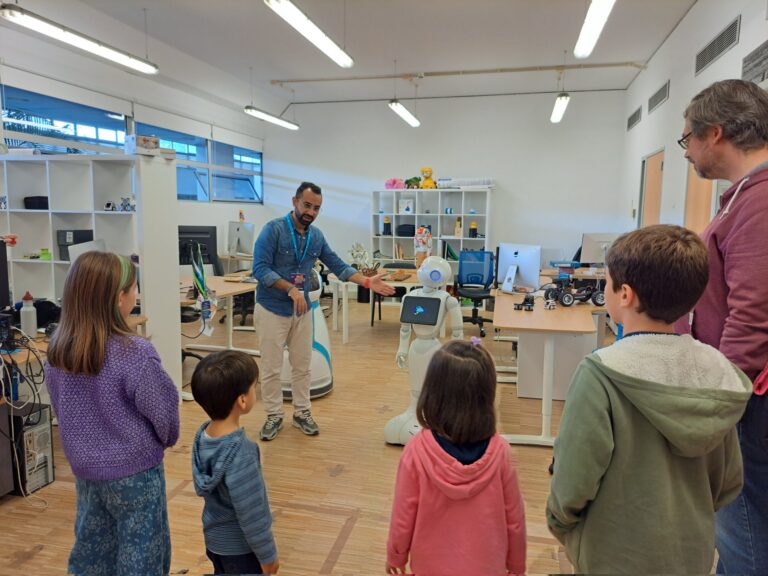
    Throughout the day, the GAIPS LAB (Research Group on AI for People and Society) warmly welcomed visitors, offering them a unique chance to meet robots such as Pepper, ASTRO, and others. Social robots can simulate human-like behaviors, interact with humans, and even give the illusion of life. Under the guidance of INESC ID researcher Ali Kordia, attendees had the opportunity to interact with the robots, who can perform tasks such as playing games with children, dancing, or even support elderly people in daily tasks.  This event provided a distinctive chance for both children and adults to spend time with these amazing robots.

    More at Técnico Website.

  • Algerian delegation visits Taguspark Campus hosted by INESC ID

    Algerian delegation visits Taguspark Campus hosted by INESC ID

    On October 31st, an Algerian delegation part of the PADICA Program, an initiative funded by the European Commission to support industrial diversification efforts and the improvement of the business climate of Algeria, visited the Técnico Taguspark Campus hosted by INESC ID.

    The Algerian Committee was headed by Mr. Djamel Halles and Mr. Roland Laval (GFA GRPUP Consulting) and eight other members of PADICA, who were welcomed by Técnico Tagus Park Vice President Helena Galhardas.

    The PADICA visit to Portugal was held with the purpose of updating the delegation on European standards and best practices in terms of development, innovation, and technology and on how they could be applied to the Program. Overall, the main objective of the Algeria-EU initiative is to improve the sustainable economic development of Algeria and to create the conditions for the expansion of the non-hydrocarbon industrial sector.

    The visit started with a welcome session by Helena Galhardas, who presented an overview of Instituto Superior Técnico activities, training offer, research laboratories and research centers, mainly focused on the activities held in the Tagus Park campus.

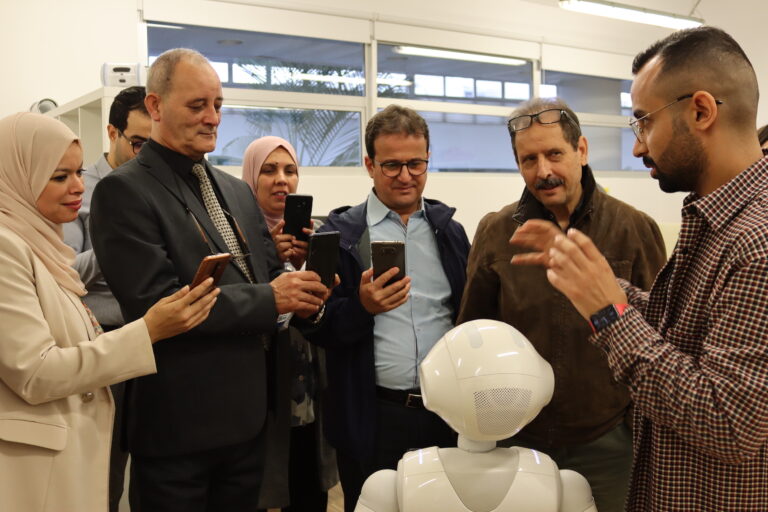
    The session was followed by a visit to the INESC ID Social Robotics Laboratory led by Ali Kordia. The Group of AI for People and Society, also known as GAIPS Lab, conducts research on Artificial Intelligence over five main areas: Affective Computing, Games, Intelligent Virtual Agents, Social Robotics, and Simulation of Complex Systems. During the visit the group presented several demonstrations with robots which help humans in various day-to-day tasks. For example, Astro robot was designed and programmed to stimulate activities to help children with autism spectrum disorders.

    The last tour Lab was to INESC ID Augmented and Virtual Reality Laboratory, led by Professor Anderson Maciel and Professor Sandra Gama, who presented an interactive computer graphics centered on humans and applied to health, social inclusion, education, architecture and manufacturing.

    According to the INESC ID researcher Sandra Gama, “the visit was a success, and the delegation was able to take the most of their experience. Apart from their interest in the different interactive solutions created by the Graphics and Interaction group, in different context such as architecture, gamification of education and civil engineering, they were particularly enthusiastic about the virtual reality solutions created by the group. Everyone without exception interacted with a virtual reality application applied to colonoscopy to aid in diagnosis and treatment, developed within the scope of one of the group’s projects.”

    More about the PADICA Program.

  • INESC ID, INOV and INESC MN together in the 1st INESC LX annual meeting

    INESC ID, INOV and INESC MN together in the 1st INESC LX annual meeting

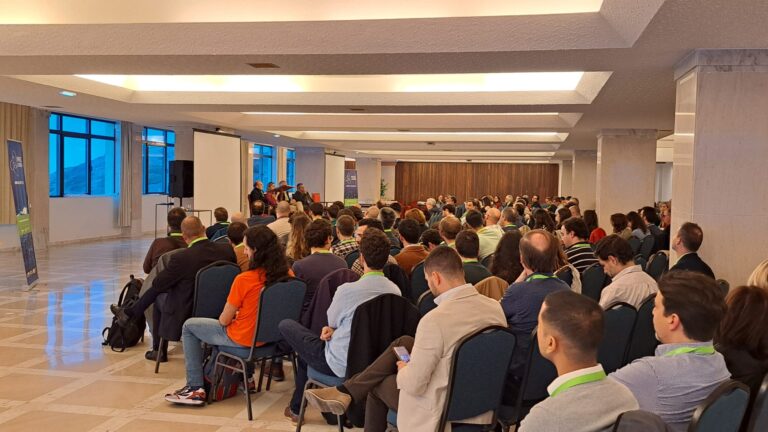
    On November 3rd, 2023, took place the first joint Meeting of INESC Lx, a consortium of the INESC institutions based in Lisbon: INESC-ID, INOV and INESC MN. Over 270 members of the three institutions met at Hotel Golf Mar, near Lisbon, for a full day of discussion and networking. The main goal of the meeting was to present the work being developed by the three R&D Institutes, all committed to advancing scientific research, technological development, and innovation, while building a networking environment to strengthen the collaborative work among the INESC Lx group.

    Leonel Sousa, President of INESC Lx, opened the Welcome Session highlighting INESC Lx mission and R&D+i activities since it was launched in 2020, followed by a video message by José Tribolet, Founder, and ex-President of INESC (Instituto de Engenharia de Sistemas e Computadores), and Instituto Superior Técnico Emeritus Professor.

    Teresa Almeida, the President of the Commission for Regional Development and Coordination of Lisbon and Tagus Valley (CCDR LVT), participated as an invited speaker and gave an overview of the Lisbon and Tagus Valley Region (RLVT) numbers and initiatives in the field of R&D. According to Teresa Almeida, the region has almost 40% of the country’s researchers and 43% of the R&E activities. In her opinion, INESC serves as an important player in this region, being involved in a high number of Agendas of the Recovery and Resilience Plan.

    The meeting featured both joint and parallel sessions, offering an overall perspective of each Institute’s competences and main accomplishments.

    After the Opening Session, INESC ID hosted its own parallel session providing an overview of the Institute’s activities by the Board of Directors. Inês Lynce, President at INESC ID, opened the session with an insightful look into the Institution’s history and main activities, followed by a presentation by Nuno Roma, Chief Financial Officer, on its financial performance. João Paulo Carvalho, Director of HR, spoke about the Institute’s human resources and presented the most recent collaborators, including researchers and support staff. Finally, Luís Rodrigues, President of the Scientific Council, introduced the main challenges expected for the next year, namely the upcoming FCT Evaluation of the R&D Units.

    At the end of the session, INESC ID presented its two annual distinctions: Rui Castro was named the Best 2023 Researcher and Ricardo Rei the Best 2023 Ph.D. student.

    In the afternoon, the second INESC ID session was fully dedicated to its Ph.D. students, being the first time, all doctoral students were invited to attend the annual event. The “Through the eyes of Ph.D. students” discussion panel, chaired by Susana Vinga, member of INESC ID Board of Directors, was an opportunity for students Ana Rita Baião, Catarina Botelho, David Calhas, Diogo Carvalho, Diogo Nunes and Renata C. Branco to share their experience at INESC ID, talk about the main challenges they face, and offer valuable inputs to the Institution’s Governance and community of researchers on what can be done to improve their experience.

    At the end of the day, the room was again full for the Closing session that had the privilege to count on the presence of the Portuguese Minister of the Economy and Maritime Affairs, António Costa Silva. The minister highlighted the work being done by INESC Lx and the importance of its participation in several mobilizing agendas and European projects, challenging the group to keep its significant contribution to the R&D sector in Portugal.

    The first INESC Lx meeting was surely a privileged platform to share ideas and foster new research opportunities, exploring the potential for future technological advancements and collaborations between all three Institutions.

    INESC ID 2022 Annual meeting

  • In the Media: Opinion article in Jornal i by INESC ID researcher Rui Castro

    In the Media: Opinion article in Jornal i by INESC ID researcher Rui Castro

    Rui Castro, researcher at INESC ID and full Professor at Instituto Superior Técnico, authored an opinion article published in the newspaper “Jornal i” titled “Energy storage systems in the electrical grid: What are we waiting for?” (“Sistemas de armazenamento de energia na rede elétrica: Estamos à espera de quê?”).

    The article discusses the complexity of the electrical power system and its dependence on a wide variety of different generator types each one with its own characteristics, from natural gas, to hydroelectric, wind, and solar power. Rui Castro emphasizes a fundamental constraint regarding the power system, which is that the balance between electricity production and consumption must be met at every second. This restriction is pivotal for the safe operation of the electrical grid.

    The article approaches two promising alternatives for energy storage: batteries and hydrogen. The INESC ID researcher acknowledges that it is possible with current battery technology to store and later release large amounts of electrical energy at a national level, but the high cost is still an issue. Nevertheless, the author predicts that soon, as technology advances and the cost of batteries decreases, this will be a competitive and economically viable option for large-scale energy storage. Regarding hydrogen, the production process through electrolysis during periods of low energy consumption is still expensive and inefficient. However, technological advancements are expected to make it viable in the longer term.

    Both are considered viable options for energy storage and helpful for power system’s stability, with batteries expected to become competitive sooner. At the same time, hydrogen may be an alternative in the longer term, depending on technological advancements and cost reductions.

    According to Rui Castro, Portugal needs to anticipate and prepare a future centered on an electrical system able to rely almost 100% on renewable energy sources. As a closing observation, the INESC ID researcher highlights that it is urgent to invest in efficient energy storage systems. The question is: what are we waiting for?

    Full article here.

  • INESC ID is part the Alliance for Energy Transition (ATE) consortium led by Efacec

    INESC ID is part the Alliance for Energy Transition (ATE) consortium led by Efacec

    The Alliance for Energy Transition (ATE) and IAPMEI – the main governmental agency for economic policies targeted to Portuguese companies – signed an acceptance agreement in the scope of the Recovery and Resilience Plan, to support the development of an ecosystem for energy transition and decarbonization.

    ATE is integrated in the agenda of RNC2050 – Roteiro para a Neutralidade Carbónica (Roadmap for Carbon Neutrality) and counts on a network of 80 partners, including 52 companies and 28 Institutions of the Research & Innovation System. The consortium is led by Efacec in partnership with industry partners like MC (Sonae), Capwatt, Smarternergy, Etermar, SEL (Smart Energy Lab), Tekever, PRF and Research Institutions such as INEGI, INESC ID and INESC TEC, among many others.

    INESC ID will contribute to four key work packages: developing advanced protection algorithms for high renewable energy penetration, creating innovative electric vehicle charging and management solutions, introducing novel methods and services to encourage flexibility usage in residential and commercial buildings. Following this, INESC ID will take the lead in establishing a National Network of Research Laboratories aimed at fostering cooperation to expedite Portugal’s energy transition.

    Envisioning a brighter future of energy in Portugal, ATE will create 420 qualified jobs in Portugal and generate an expected business volume of €550M/year, promoting the decrease of greenhouse gases (up to 3.4M tons of CO2) and developing a range of products, more than 80% of which are destined for exportation.

    The consortium will exploit opportunities in the context of Decarbonization, Decentralization and Digitalization in the Energy sector, promoting, a unique competitive ecosystem in Portugal but with an international scale.

    ATE projects are structured in six pillars, oriented towards strategic competitiveness and value creation in different aspects of the energy sector: energy communities and microgrids, renewable-based generation, energy efficiency and transition in industrial, commercial and residential users, and sustainable mobility and interconnection infrastructures.

    INESC ID will actively contribute to three of the pillars, namely in energy efficiency and transition in industrial, commercial and residential users, and sustainable mobility and interconnection infrastructures.

    According to ATE “this new value proposition will contribute to creating infrastructures that will allow the decrease of emissions in the energy sector in Portugal and in multiple international geographies”.

    Original article (in PT).


  • INESC ID researchers among the World’s Top 2% Most Influential Scientists

    INESC ID researchers among the World’s Top 2% Most Influential Scientists

    Stanford has released the World’s Top 2% Most Influential Scientists lists, featuring fourteen INESC ID researchers among the 200 thousand World’s most cited scientists.

    This annual recognition comprises two lists naming top scientists, doctors, engineers, and mathematicians, one referring to 2022 most influential scientists and the other focusing on a career-long impact.

    Compiled by Stanford University (USA) and published by Elsevier, scientists are classified in 22 scientific fields and 174 subfields. The lists are based on data from Scopus – the reference database of article abstracts and citations for journals and other academic publications – which covers nearly 36 377 titles (22,794 active titles and 13,583 inactive titles) from approximately 11,678 publishers.

    This year, a total of fourteen INESC-ID researchers have been appointed, some of them featuring in both categories:

    INESC ID’s most influential scientists in 2022 (7):

    INESC ID scientists included in the career-long database (14:

    More about last year INESC ID awardees list.

    Most influential 2022 scientists (full lists)

  • ER 2023 in Lisbon between November 6-9

    ER 2023 in Lisbon between November 6-9

    This year’s edition of the International Conference on Conceptual Modeling (ER 2023) will be held between November 6 and 9 in Lisbon, at the Congress Center of the Instituto Superior Técnico (Alameda Campus)

    ER 2023 is the main international forum for discussing the state of the art, emerging issues, and future challenges in research and practice on conceptual modeling.

    Topics of interest span the entire spectrum of conceptual modeling, including research and practice in areas such as theories of concepts and ontologies, techniques for transforming conceptual models into effective implementations, and methods and tools for developing and communicating conceptual models.

    The event is being jointly organized by INESC-ID, Instituto Superior Técnico and University of Twente.

    Keynote speakers:

    • Daniel Jackson, “Software Design, Concepts and AI”
    • Maurizio Lenzerini, “Conceptual Modeling and Knowledge Representation: a journey from Data Modeling to Knowledge Graphs”
    • Walid S. Saba, “Reverse Engineering of Language at Scale: Towards Symbolic and Explainable Large Language Models”
    • Catia Pesquita, “True or False? The impact of negative knowledge in biomedical artificial intelligence”

    The event’s agenda is available here and online registration. 

    More on ER 2023 Website.