Category: Lectures

  • Promoting health, reinventing care: INESC-ID hosts session to explore opportunities for interdisciplinary collaboration

    Promoting health, reinventing care: INESC-ID hosts session to explore opportunities for interdisciplinary collaboration

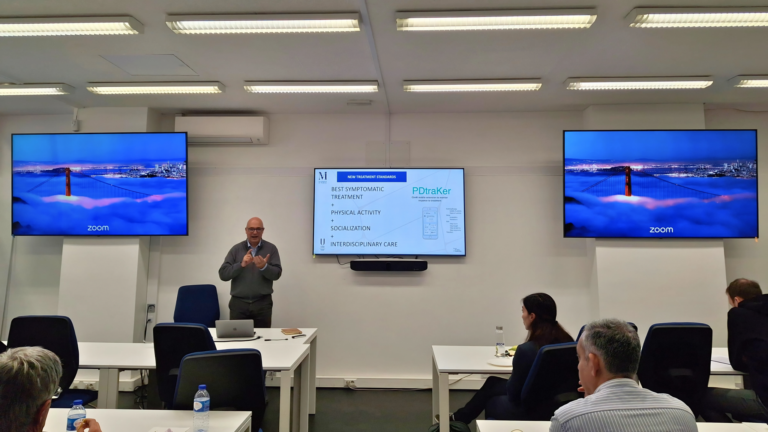
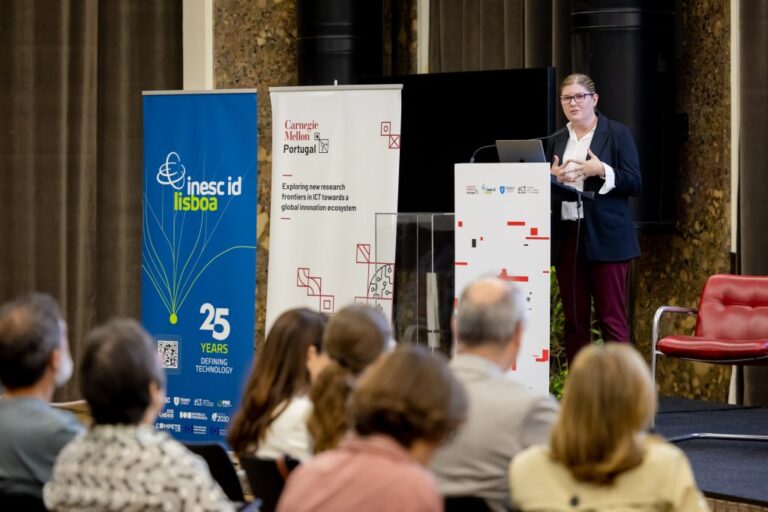
    “We need to seduce others into joining this project,” said neurologist and professor at Faculdade de Medicina da Universidade de Lisboa, Joaquim Ferreira, referring to the ambitious new clinical, academic, and research campus being developed in Torres Vedras. “I’m here to identify windows of opportunity for collaboration.”

    This was the spirit of the most recent session of Bring Your Challenge to Us, a series hosted by INESC-ID thematic line Life and Health Technology (LHT), with the aim of connecting external researchers in the life sciences and health domains with our own community of experts. The goal is to explore how INESC-ID’s knowledge in areas such as data analysis, algorithms, artificial intelligence, augmented reality, and high-performance computing can be leveraged to tackle pressing health-related challenges.

    Joaquim Ferreira’s invitation was compelling: to be part of a paradigm shift in health and community care. With nearly 2% of Portugal’s population currently living with dementia—a figure projected to double by 2050—the urgency to act is clear. “We are failing to prepare for what lies ahead,” he warned. “We are not developing new drugs for these pathologies, nor are we improving the way we approach brain diseases. So, the real challenge is to optimise what we already know works. The brain is an intriguing organ.”

    Ferreira, known for his pioneering work in movement disorders and neurodegenerative diseases, is the driving force behind the so-called Hospital Maravilha (“Wonder Hospital”) in Torres Vedras—an innovative project that aims to reinvent how interdisciplinary healthcare is delivered. “Today, we treat patients more and more like football coaches treat athletes,” he said, stressing that the medical community needs to rewrite its approach to care.

    At the heart of this reinvention is the future Health Technology Research Center, a major research facility within the Torres Vedras campus of the Faculty of Medicine of the University of Lisbon. With a strong emphasis on community health and clinical research, this center will link technological innovation with clinical needs, offering a unique testbed for solutions in biomedical engineering, AI, computer science, and medical devices—domains where INESC-ID has extensive expertise.

    For INESC-ID researchers, this represents an exceptional opportunity. “The interdisciplinarity is not optional,” Ferreira noted. “Especially in healthcare.” The Hospital Maravilha project and its challenges offer fertile ground for joint initiatives, including participation in European-funded collaborative projects focused on addressing real-world clinical issues.

    From the perspective of INESC-ID’s LHT thematic line — which brings together over 50 PhD researchers across various scientific domains, under the leadership of researcher Ana Teresa Freitas  and the executive coordination of Ruxandra Barbulescu — the session with Ferreira was a perfect match. The thematic line aims to foster multidisciplinary research in life and health sciences, and its strategy strongly aligns with three of INESC-ID’s institutional pillars: Internationalization, Technology Transfer, and Societal Impact.

    In this context, the LHT has defined three priorities for the coming years: strengthen the sense of belonging within the community of researchers; explore opportunities for technology transfer from research to practice; promote interdisciplinary projects and external collaborations.

    As we can clearly see, Joaquim Ferreira’s vision, and his invitation to contribute to the Torres Vedras campus, is fully aligned with this third priority, offering an opportunity for INESC-ID researchers to work in a field that increasingly depends on the convergence of medicine, engineering, and computing.

    As the session concluded, the message was clear: the challenges are urgent, the opportunities are many, and the time to act is now.

    Images | © 2025 INESC-ID

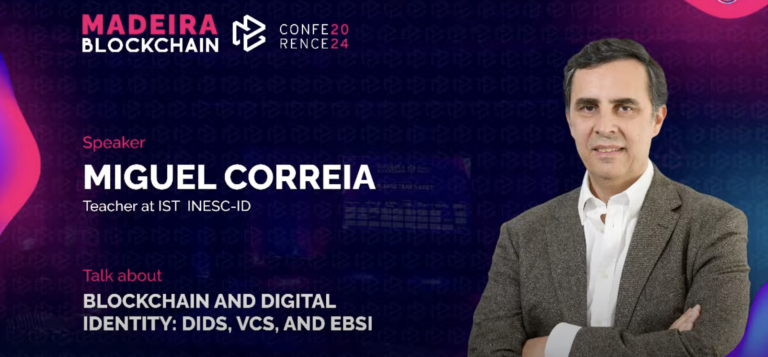
  • “Blockchain and Digital Identity: DIDs, VCs, and EBSI” – Keynote speech by Miguel Pupo Correia at the Madeira Blockchain Conference

    “Blockchain and Digital Identity: DIDs, VCs, and EBSI” – Keynote speech by Miguel Pupo Correia at the Madeira Blockchain Conference

    “If you pick a grain of sand, what is the probability that two of us pick the same one?” With this example, Miguel Pupo Correia, President of the INESC-ID Executive Committee, illustrates the probabilistic uniqueness of DIDs (Decentralised Identifiers), during his keynote “Blockchain and Digital Identity: DIDs, VCs, and EBSI”. This intervention took place during the Madeira Blockchain Conference 2024, which happened in Funchal at the end of the last year. 

    When asked about his participation, Miguel Pupo Correia adds: “This yearly conference brings together experts from all Web 3 areas — startup founders, academics, legal experts, etc. — both national and international, showcasing the state of the ecosystem and bringing inspiration for people interested in the topic.”

    The video is now available on the conference’s Youtube Channel. If you are curious to know more about blockchain, digital identity and related use cases, we encourage you to follow the link and watch the full presentation.

  • INESC Lisboa Annual Meeting keynote speaker, Dejan Milojicic, on Technology Megatrends and the role of AI as an equalizer

    INESC Lisboa Annual Meeting keynote speaker, Dejan Milojicic, on Technology Megatrends and the role of AI as an equalizer

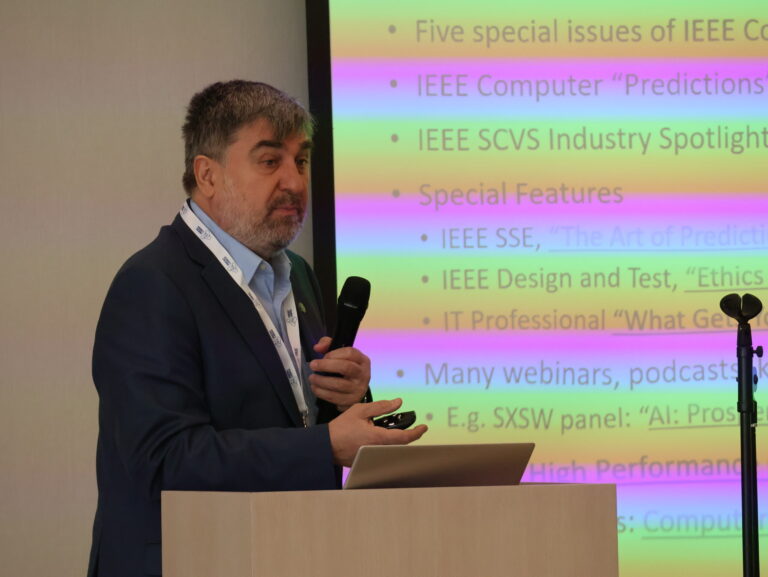
    It took Dejan Milojicic more than twenty years to understand the way of life in the United States. “Now I am at peace”, he shares, before delivering the keynote lecture at INESC Lisboa Annual Meeting. For the last 15 years, the HPE Fellow and VP, and former President of the IEEE Computer Society, has been involved in the production of the IEEE Technology Megatrends Report, which identifies the technologies with the greatest opportunities and potential impact for the future. Compiled annually by 50 experts, the report draws data from three different sources: the United States Patent Office, Google and IEEE digital library. The meticulous work pays off, he believes, since “it appeals to people.”

    A megatrend influences the evolution of multiple trends, making it crucial to understand these overarching patterns—it is both the sum of individual trends and a guiding force, often shaping perceptions that then influence its components. A megatrend impacts multiple factors—technological, economic, social, and ecological, he explains.

    This year’s report identifies three major areas of focus: Sustainability, Artificial General Intelligence and Digital Transformation – topics that were discussed in the meeting’s parallel sessions. Under these three topics we can find wearables and computer brain interface, digital twins, space technologies and also energy storage and autonomous technologies.  For Milojicic, the report is followed by the industry – timely productization of near-horizon technologies – governments – early regulation of technologies that cause concern – academia – globally train trainers for key megatrends – and professional organizations – help develop standards suited for increased speed of tech introduction. Of course, sometimes there are “strong mistakes”, such as the overemphasis on combating misinformation in the 2023 report. But, as he says, there are factors that can disrupt everything—war, COVID—but this shouldn’t stop us from making predictions.

    Discussing the dual nature of technology, Milojicic emphasizes that “any technology can be an enabler or a weapon,” which underscores the need for careful governance. Governments play a crucial role, he noted, by creating regulations that manage risks while fostering innovation. This is particularly relevant in fields like AI, where rapid advances can either reduce inequalities (AI as an equalizer) or exacerbate them if left unchecked. For this reason, Milojicic stresses the importance of regulatory frameworks that balance the benefits of technological adoption with ethical considerations and societal impacts.

    Companies and the educational system also should have a role to play on this. “All schools should forbid using AI for exams or to write articles”, he defends, giving the example of some companies where people are not allowed to use AI, at least external tools for confidentiality concerns.

    Looking at the trends identified in the 2024 report—sustainability, artificial general intelligence (AGI), and digital transformation—Milojicic describes these as “richness-blind” trends, meaning they offer potential for widespread adoption without requiring significant infrastructural changes. He draws on the example of mobile phones, which transformed communication in regions like India without the extensive infrastructure overhaul required in Western countries. Similarly, some developing nations could be ideal environments for testing new megatrends related to sustainability, AI, and digital transformation, potentially helping to bridge inequalities.

    On his way to visit his hometown, Belgrade, Serbia, Milojicic notes that he feels at home wherever he goes in Europe.

    Text by Sara Sá, Science Writer | Communications and Outreach Office, INESC-ID / © 2024 INESC-ID

    Images | © 2024 INESC-ID

  • Addressing Gender Imbalance in Academia: Insights from CMU’s Jeria Quesenberry

    Addressing Gender Imbalance in Academia: Insights from CMU’s Jeria Quesenberry

    “Fighting gender imbalance is not hard. In fact, it is much easier than nuclear physics or Artificial Intelligence,” states Jeria Quesenberry, professor of Information Systems at Carnegie Mellon University (CMU) and author of the book “Kicking Butt in Computer Science: Women in Computing at Carnegie Mellon University”. Jeria was speaking during the roundtable that followed the talk “Breaking Barriers in Technology: Women in Computing at Carnegie Mellon and Global Perspectives,” held on June 26 at Instituto Superior Técnico in Lisbon, an event co-organized by INESC- ID and the Técnico Gender Balance Group.

    Jeria shared the outcomes of her research on women in computing, highlighting best practices and challenges from her experience at CMU and showcasing examples from the Computer Science undergraduate program at CMU over the years. According to the researcher, “Gender imbalance is a topic that requires work. It is a multifaceted problem that demands a multi-layered approach.” She added: “When I started my research 25 years ago, this was a new topic. Now there is a broader recognition of the problem; speaking about gender balance is no longer a question.”

    As of 2019, in the US, women represent just over half of the professional workforce but only 27% of computing jobs, and African American and Latinx women hold less than 10% of computing occupations. The highest representation of women in ICT work can be found in the Asia-Pacific region (30.4% women) and Africa (31.3% women).

    Regarding Carnegie Mellon University’s reality, CMU SCS undergrad gender diversity has been higher than national averages for 15+ years. In 2019, 49% of new CS students were women. Since 2022, that percentage has been divided between women and nonbinary; in 2023, it was registered at 46% and 3%, respectively. Regarding major graduates, females and males are at about the same rate – women are 93%, and men are 92%. In the mid to late 90s, female students only represented 5-12% of the students in the field.

    The roundtable themed “Gender Imbalance in STEM: The Portuguese Academic Experience” gathered Ana Paiva, Portuguese Secretary of State for Science; Anália Cardoso Torres, Professor at Instituto Superior de Ciências Sociais e Políticas, Universidade de Lisboa; Inês Lynce, National co-Director of the CMU Portugal Program and President of INESC-ID; Jeria Quesenberry; João Peixoto, Vice-Rector of Universidade de Lisboa; Leonor Barreiros, a master student at Instituto Superior Técnico; and Luís Lemos Alves, Professor at Instituto Superior Técnico. Sara Sá, science writer at INESC-ID, moderated the discussion.

    Fresh out of the oven, Anália Cardoso Torres presented findings from the study “Gender Equality in Higher Education Institutions,” which analyzed gender equality policies in Portuguese higher education. The study revealed that despite late efforts, Portugal is making strides in addressing gender inequalities in academia. Inês Lynce shared her personal experience and discussed the underrepresentation of women in academic leadership and the importance of fostering self-confidence in young girls from an early age. Ana Paiva highlighted the need to guarantee gender balance in the law, but supporting education, awareness, and cultural activities can have a big impact. The Secretary of State mentioned some activities that have been developed, such as the RESTART Program.

    Jeria’s trip to Portugal included a visit to INESC TEC in Porto and is part of the tradition of bringing Carnegie Mellon University speakers to Portugal to share best practices and experiences on the topic of gender balance in academia. A subject that (unfortunately) still needs to be discussed.

    Text adapted from

    Images | © CMU Portugal

  • Exploring programming languages at Philip Wadler’s Distinguished Lecture. From Ancient Greece to modern cryptography

    Exploring programming languages at Philip Wadler’s Distinguished Lecture. From Ancient Greece to modern cryptography

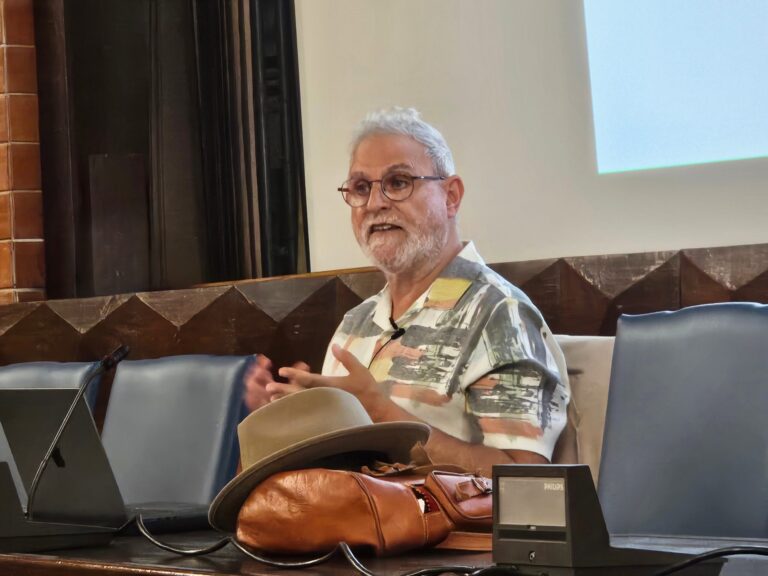
    Wearing a khaki suit and a Panama hat, Philip Wadler meets his audience for the Distinguished Lecture (Programming Languages) in Agda = Programming (Languages in Agda), organized within the scope of the BIG ERA Chair Project. This time, we got the explorer’s look. For other attendees, the professor of Computer Science at the University of Edinburgh and a Fellow of the Royal Society has chosen the Superman costume.

    Regardless of the cover, the expertise – spiced up with a touch of humour – is always assured. Wadler, a key developer of several programming languages, like Haskell and Java, is a notable figure in the field. “One of the most important personalities in the area”, Luís Caires, INESC-ID Information and Decision Support Systems and ERA Chair Holder, states while introducing the talk, which happened on June 4, at Instituto Superior Técnico (Alameda).

    Wadler’s connection to Portugal comes through both the brain and the heart. “It’s a very strong place in programming languages!”, he notes. The emotional bond comes from his wife, a Brazilian native and a big fan of the country.

    Author of several books on programming languages, the researcher and teacher has specialized in linear programming languages, “which is a tiny subfield of a subfield.” While talking about the subject, he often goes back to Ancient Greece and to the origins of the studies on logic, relating it to concepts like propositions as types and foundational logic ideas. “We’re working on programming languages that we’re designing now, but the designs are based on ideas and logic that go back to the turn of the 1900s or sometimes go back to Ancient Greece two thousand years ago.” Lewis Carroll, under his real name Charles Dodgson, also did some work on logic, Wadler exemplifies. “It is said that after Alice in Wonderland came out, the Queen of England said she wanted to see that author next book and it was on symbolic logic.”

    Explaining the title of his talk, he explains Agda is one of a family of “what are called proof assistants”, that also go back in time, to the cryptography genius, Alan Turing. “Everybody is aware of this notion that programmes have bugs, right? You see this all the time: You’re using the web and all of a sudden, the website dies and puts up a little message saying ‘Please contact service or something’. So wouldn’t it be nice if you could demonstrate that would never happen?”, he questions. The sort of systems used by Amazon, for example, and that come in very handy in the cryptocurrency world and that is where his cooperation, as a consultant, with the platform Cardano comes from.

    Writing proofs is not as simple as writing code. It requires highly trained individuals, who are not in abundance. “Artificial intelligence and machine learning classes and so on have around 400 students. My class has forty”, he compares.

    Another sector that might benefit considerably from the use of proof assistants is Large Language Models. “What does a large language model do? It’s a neural network trained on a very large body of texts. What it does is given a group of words, what word should come next to sound good? So it’s just trained to sound good, to impress and therefore they have the tendency to confabulate”, Wadler notes. The integration of proof assistants on the programming of these models gives us the possibility to avoid these mistakes. But always with “people involved”, he stresses. “To check the specifications and come up with new ways of doing proofs and teach them to the machines.” Bulletproof logic.

    Text by Sara Sá, Science Writer | Communications and Outreach Office, INESC-ID

    Images | © 2024 INESC-ID

  • Distinguished Lecture – Keshab K. Parhi

    Distinguished Lecture – Keshab K. Parhi

    Técnico – Alameda campus

    “Accelerator Architectures for Deep Neural Networks: Inference and Training”. – 2 pm – EA3

    We are pleased to announce a new IST Distinguished Lecture, on 19th November, with the support of the “Distinguished Lecturer Program (DLP)” at the Institute of Electrical and Electronics Engineers (IEEE), namely the IEEE CAS Society DLP.

    • 19th November 2021, 2 p.m., in EA3 amphitheatre (North Tower).
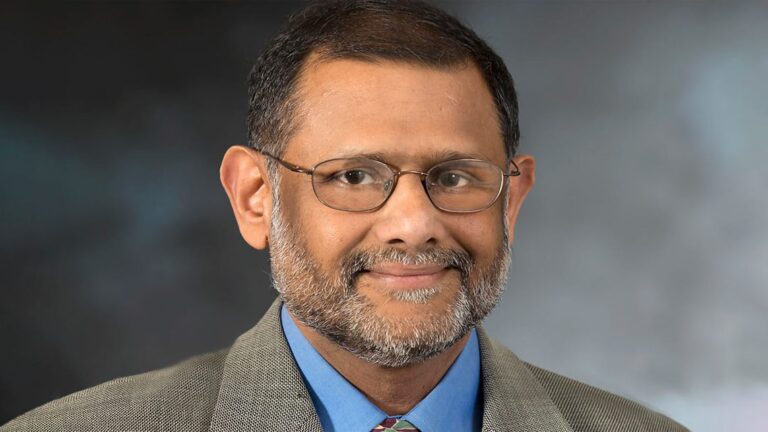
    • Speaker: Keshab K. Parhi (University of Minnesota, Minneapolis, USA)*
    • Title: “Accelerator Architectures for Deep Neural Networks: Inference and Training”.
    • Abstract: Machine learning and data analytics continue to expand the fourth industrial revolution and affect many aspects of our lives. The talk will explore hardware accelerator architectures for deep neural networks (DNNs). I will present a brief review of history of neural networks. I will talk about our recent work on Perm-DNN based on permuted-diagonal interconnections in deep convolutional neural networks and how structured sparsity can reduce energy consumption associated with memory access in these systems (MICRO-2018). I will then talk about reducing latency and memory access in accelerator architectures for training DNNs by gradient interleaving using systolic arrays (ISCAS-2020). Then I will present our recent work on LayerPipe, an approach for training deep neural networks that leads to simultaneous intra-layer and inter-layer pipelining (ICCAD-2021). This approach can increase processor utilization efficiency and increase speed of training without increasing communication costs.
    • *Bio: Keshab K. Parhi received the B.Tech. degree from the Indian Institute of Technology (IIT), Kharagpur, in 1982, the M.S.E.E. degree from the University of Pennsylvania, Philadelphia, in 1984, and the Ph.D. degree from the University of California, Berkeley, in 1988. He has been with the University of Minnesota, Minneapolis, since 1988, where he is currently Distinguished McKnight University Professor and Edgar F. Johnson Professor of Electronic Communication in the Department of Electrical and Computer Engineering. He has published over 650 papers, is the inventor of 32 patents, and has authored the textbook VLSI Digital Signal Processing Systems (Wiley, 1999) and coedited the reference book Digital Signal Processing for Multimedia Systems (Marcel Dekker, 1999). His current research addresses VLSI architecture design of machine learning systems, hardware security, data-driven neuroscience and molecular/DNA computing. Dr. Parhi is the recipient of numerous awards including the 2017 Mac Van Valkenburg award and the 2012 Charles A. Desoer Technical Achievement award from the IEEE Circuits and Systems Society, the 2004 F. E. Terman award from the American Society of Engineering Education, and the 2003 IEEE Kiyo Tomiyasu Technical Field Award. He served as the Editor-in-Chief of the IEEE Trans. Circuits and Systems, Part-I during 2004 and 2005. He is a Fellow of IEEE, ACM, AAAS and the National Academy of Inventors.

    Moderator: Leonel Sousa (Full professor, IST/DEEC; INESC-ID/SiPS).

  • 40 Years of Science and Knowledge

    40 Years of Science and Knowledge

    Celebrating INESC 40th anniversary, three sessions will take place in Lisbon, Porto and Coimbra:

    • Porto – Empowering companies to face new challenges – July 6
    • Lisbon – Creating new technology-based companies – October 8
    • Coimbra – Relation with the academic world – October

    The first session is also associated with INESC TEC 35th anniversary, and will take place on July 6, at 2:30 pm, at the Faculty of Engineering, University of Porto. This session will be transmitted by Zoom Webinar.

    The event is free, but a registration is required in order to receive a link.

    Programme

    Website

  • Bioinformatics: a Servant or the Queen of Molecular Biology? (INESC-ID and IST Distinguished Lecture)

    Pavel A. Pevzner,

    Department of Computer Science and Engineering

    University of California at San Diego

    Abstract

    While some experimental biologists view bioinformatics as a servant, I argue that it is rapidly turning into the queen of molecular biology. I will illustrate this view by showing how recent computational developments brought down biological dogmas that remained unchallenged for at least three decades. Specifically, I will discu

    ss the N-end theory connecting the protein half-life with N-terminal Methionine Excision, the Master Alu Theory explaining repeat proliferation in the human genome, and Random Breakage Model of genome rearrangements.

    In the second part of the talk, I will discuss a century-old dogma about the traditional classroom and describe the recent efforts to repudiate it using Intelligent Tutoring Systems. I will describe a new educational technology called a Massive Adaptive Interactive Text (MAIT) that can prevent individual learning breakdowns and outperform a professor in a classroom.  I will argue that computer science is a unique discipline where the transition to MAITs is about to happen and will describe a bioinformatics MAIT that has already outperformed me. In difference from existing Massive Online Open Courses (MOOCs), MAITs will capture digitized individual learning paths of all students and will transform educational psychology into a digital science. I will argue that the future MAIT revolution will profoundly affect the way we all teach and will generate large population-wide datasets containing individual learning paths through various MAITs.

    Bio

    Pavel Pevzner is Ronald R. Taylor Professor of Computer Science and Engineering and Director of the NIH Center for Computational Mass Spectrometry at University of California, San Diego. He holds Ph.D. from Moscow Institute of Physics and Technology, Russia. He was named Howard Hughes Medical Institute Professor in 2006. He was elected the Association for Computing Machinery Fellow in 2010, the International Society for Computational Biology Fellow in 2012, European Ac

    ademy of Sciences member (Academia Europaea) in 2016, and the American Association for Advancement in Science Fellow in 2018. He was awarded a Honoris Causa (2011) from Simon Fraser University in Vancouver and the Senior Scientist Award (2017) by the International Society for Computational Biology. Dr. Pevzner authored textbooks  “Computational Molecular Biology: An Algorithmic Approach”, “Introduction to Bioinformatics Algorithms” (with Neal Jones) and “Bioinformatics Algorithms: an Active Learning Approach” (with Phillip Compeau). He co-developed the Bioinformatics and Data Structure and Algorithms online specializations on Coursera as well as the Algorithms Micro Master Program at edX.

    Host

    Arlindo Oliveira

    Venue:

    Sala de Reuniões do IST


  • Distinguished Lecture Series

    Distinguished Lecture Series

    AI for Social Good: Learning and Planning in the End-to-End, Data-to-Deployment Pipeline

    Prof. Milind Tambe

    University of Southern California 

    17/04/2019

    Room 0.19/0.20, IST – Pavilhão de Informática II, Alameda | 13:30H

    Abstract

    With the maturing of AI and multiagent systems research, we have a tremendous opportunity to direct these advances towards addressing complex societal problems. I will focus on the problems of public safety and security, wildlife conservation and public health in low-resource communities, and present research advances in multiagent systems to address one key cross-cutting challenge: how to strategically deploy our limited intervention resources in these problem domains. I will discuss the importance of conducting this research via building the full data to field deployment end-to-end pipeline rather than just building machine learning or planning components in isolation. Results from our deployments from around the world show concrete improvements over the state of the art. In pushing this research agenda, we believe AI can indeed play an important role in fighting social injustice and improving society.

    Bio

    Milind Tambe is Helen N. and Emmett H. Jones Professor in Engineering at the University of Southern California(USC) and the Founding Co-Director of CAIS, the USC Center for Artificial Intelligence in Society, where his research focuses on advancing AI and multiagent systems research for Social Good. He is recipient of the IJCAI (International Joint Conference on AI) John McCarthy Award, ACM/SIGAI Autonomous Agents Research Award from AAMAS (Autonomous Agents and Multiagent Systems Conference), AAAI (Association for Advancement of Artificial Intelligence) Robert S Engelmore Memorial Lecture award, INFORMS Wagner prize, the Rist Prize of the Military Operations Research Society, the Christopher Columbus Fellowship Foundation Homeland security award, International Foundation for Agents and Multiagent Systems influential paper award; he is a fellow of AAAI and ACM. He has also received meritorious Commendation from the US Coast Guard and LA Airport Police, and Certificate of Appreciation from US Federal Air Marshals Service for pioneering real-world deployments of security games. Prof. Tambe has also co-founded a company based on his research, Avata Intelligence , where he serves as the director of research. Prof. Tambe received his Ph.D. from the School of Computer Science at Carnegie Mellon University.

    Venue:

    1.30PM Room 0.19/0.20, IST – Pavilhão de Informática II, Alameda

  • Distinguished Lecture Series

    Distinguished Lecture Series

    Generating Software Tests

    Andreas Zeller

    CISPA Helmholtz Institute for IT Security

    15/04/2019

    Anfiteatro VA4 no piso-1 do Edificio de Civil – IST/Alameda | 11:00H

    Abstract

    Software has bugs. What can we do to find as many of these as possible? In this talk, I show how to systematically test software by generating such tests automatically, starting with simple random “fuzzing” generators and then proceeding to more effective grammar-based and coverage-guided approaches. Being fully automatic and easy to deploy, such fuzzers run at little cost, yet are very effective in finding bugs: Our own Langfuzz grammar-based test generator for JavaScript runs around the clock for the Firefox, Chrome, and Edge web browsers and so far has found more than 2,600 confirmed bugs. Our latest test generator prototypes are even able to automatically learn the input language of a given program, which allows to generate highly effective tests for arbitrary programs without any particular setup. In the past months, we have collected our tools and techniques in an interactive textbook (www.fuzzingbook.org) with 10,000 well-documented lines of Python code for highly productive fuzzing.

    Bio

    Andreas Zeller is Faculty at the CISPA Helmholtz Center for Information Security, and professor for Software Engineering at Saarland University, both in Saarbrücken, Germany. In 2010, Zeller was inducted as Fellow of the ACM for his contributions to automated debugging and mining software archives, for which he also obtained the ACM SIGSOFT Outstanding Research Award in 2018. His current work focuses on specification mining and test case generation, funded by grants from DFG and the European Research Council (ERC).

    Host

    António Manuel Ferreira Rito da Silva