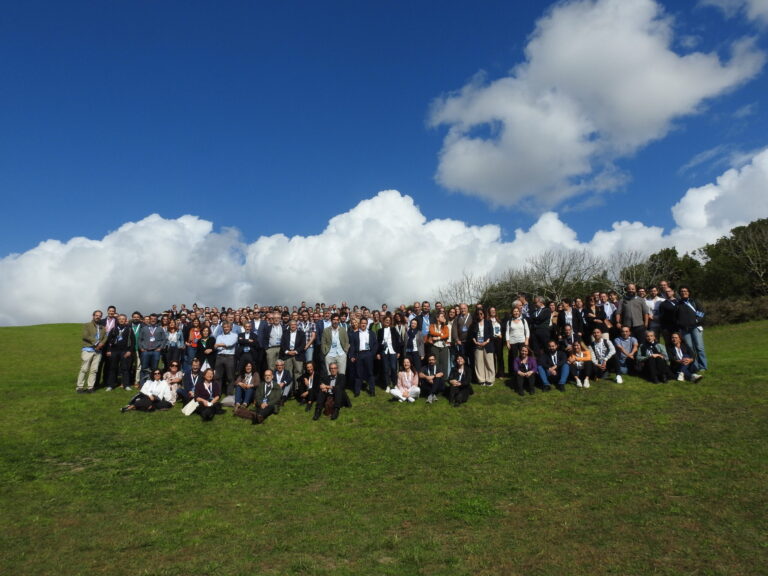
On October 24, INESC-ID researchers Ruxandra Barbulescu and Alessandro Gianola were hounored with the Outstanding PC Member Award at the 27th European Conference on Artificial Intelligence (ECAI 2024).
ECAI is the premier conference in the field of Artificial Intelligence in Europe, and the Outstanding PC Member Award aims to highlight the vital contributions of committee members of this research community. The recipients of the ECAI-2024 Outstanding PC Member Award represent only 2-3% of all regular PC members supporting the conference.
A robot dog greeted visitors at the Técnico Innovation Summit, drawing a heart in the air with its front paws. It charmed everyone, and the research team behind the Sustainable Stoneby Portugal project looked on proudly at their “pet.”
The first edition of the Técnico Innovation Summit, held on November 4 and 5 at the Técnico Innovation Center during the PhD Open Days, showcased projects with significant economic impact, particularly those funded through Portugal’s Recovery and Resilience Plan (PRR).
INESC-ID was well-represented with four of its five projects:
Accelerat.ai: driving digital transformation in Portugal’s public and private sectors through technologies like conversational systems for the national health helpline SNS24;
Over the two-day event, numerous visitors passed through the venue, including students, entrepreneurs, researchers, and government representatives who also attended the nomination ceremony for the 21 new members of the National Council for Science, Technology, and Innovation (CNCTI).
“We were visited by Pedro Dominguinhos, President of the National Monitoring Committee for PRR, and Carla Branco Santos from the Executive Committee of IAPMEI,” shared Rubén Solera-Ureña, a researcher in Human Language Technologies involved in the Accelerat.ai project.
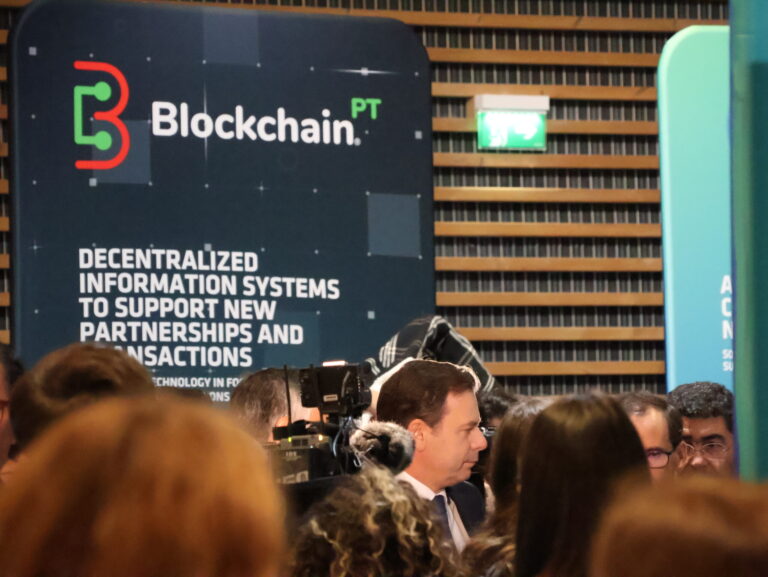
During their visit to the expo site, Prime Minister Luís Montenegro and his team visited various booths, including that of CRAI. Here, researchers demonstrated AI products developed under the project, such as a home physical therapy platform, a communication solution for ALS patients, and a platform to help hospital doctors automate administrative tasks.
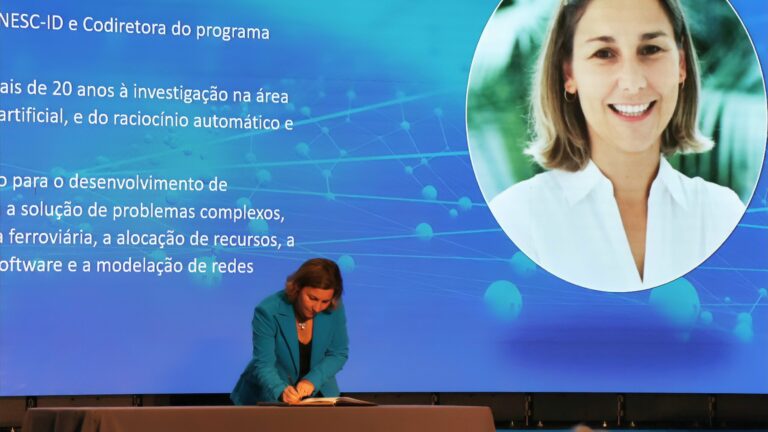
Carlos Oliveira, Adélio Mendes, Amélia Santos… Inês Lynce. INESC-ID’s President became the ninth figure in science, technology, and innovation to be called to the stage at the Técnico Innovation Centre on the afternoon of November 5. In a ceremony attended by the Prime Minister of Portugal, Luís Montenegro; the Minister of Economy, Pedro Reis; the Minister of Education, Science, and Innovation, Fernando Alexandre; and the Secretary of State for Science, Ana Paiva, an INESC-ID researcher, the 21 new members of the National Council for Science, Technology, and Innovation (CNCTI) were formally appointed.
This advisory body is tasked with supporting the development and sustainability of the national scientific and technological system, fostering the internationalization of Portuguese science, and promoting Portuguese as a working language in scientific fields, as outlined in the Diário da República. It is also responsible for providing scientific advice and enhancing cross-sectoral and inter-ministerial coordination in science and technology policies. Additionally, the CNCTI is expected to collaborate in parliamentary debates on science, technology, and innovation whenever requested by the Assembly of the Republic.
“It is crucial to have a council that can serve the Government and the country, so that what is created in universities can be translated into value,” emphasized the rector of Universidade de Lisboa, Luís Ferreira. “It often happens that those making decisions are not aware of what is being produced. We need a bridge between the foundations, where knowledge is created, and those who can leverage it to create value.” Entrepreneur and council president Carlos Oliveira highlighted the goal of making Portugal a country where science, technology, and innovation form the basis for growth by fostering dialogue between research centres, innovation hubs, and companies. As noted by Prime Minister Luís Montenegro, the world’s largest and most complex challenges, such as climate change, can only be tackled with the help of science.
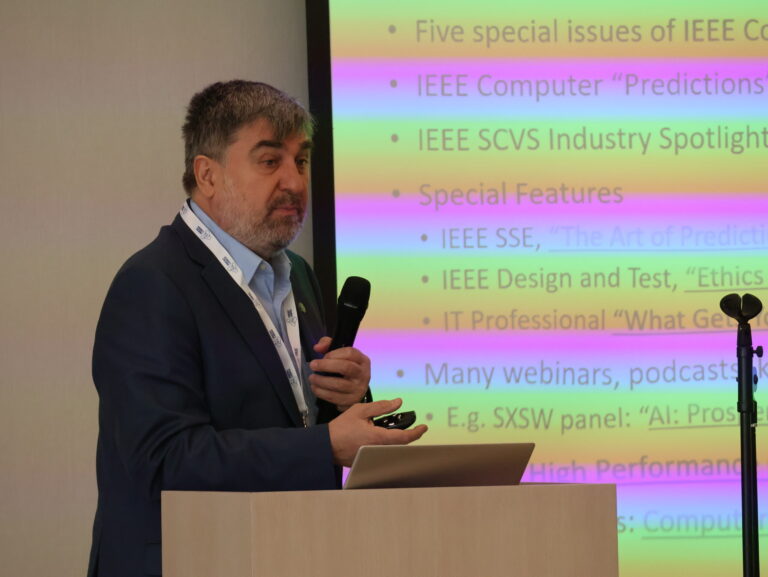
It took Dejan Milojicic more than twenty years to understand the way of life in the United States. “Now I am at peace”, he shares, before delivering the keynote lecture at INESC Lisboa Annual Meeting. For the last 15 years, the HPE Fellow and VP, and former President of the IEEE Computer Society, has been involved in the production of the IEEE Technology Megatrends Report, which identifies the technologies with the greatest opportunities and potential impact for the future. Compiled annually by 50 experts, the report draws data from three different sources: the United States Patent Office, Google and IEEE digital library. The meticulous work pays off, he believes, since “it appeals to people.”
A megatrend influences the evolution of multiple trends, making it crucial to understand these overarching patterns—it is both the sum of individual trends and a guiding force, often shaping perceptions that then influence its components. “A megatrend impacts multiple factors—technological, economic, social, and ecological,“ he explains.
This year’s report identifies three major areas of focus: Sustainability, Artificial General Intelligence and Digital Transformation – topics that were discussed in the meeting’s parallel sessions. Under these three topics we can find wearables and computer brain interface, digital twins, space technologies and also energy storage and autonomous technologies. For Milojicic, the report is followed by the industry – timely productization of near-horizon technologies – governments – early regulation of technologies that cause concern – academia – globally train trainers for key megatrends – and professional organizations – help develop standards suited for increased speed of tech introduction. Of course, sometimes there are “strong mistakes”, such as the overemphasis on combating misinformation in the 2023 report. But, as he says, “there are factors that can disrupt everything—war, COVID—but this shouldn’t stop us from making predictions.“
Discussing the dual nature of technology, Milojicic emphasizes that “any technology can be an enabler or a weapon,” which underscores the need for careful governance. Governments play a crucial role, he noted, by creating regulations that manage risks while fostering innovation. This is particularly relevant in fields like AI, where rapid advances can either reduce inequalities (AI as an equalizer) or exacerbate them if left unchecked. For this reason, Milojicic stresses the importance of regulatory frameworks that balance the benefits of technological adoption with ethical considerations and societal impacts.
Companies and the educational system also should have a role to play on this. “All schools should forbid using AI for exams or to write articles”, he defends, giving the example of some companies where people are not allowed to use AI, at least external tools for confidentiality concerns.
Looking at the trends identified in the 2024 report—sustainability, artificial general intelligence (AGI), and digital transformation—Milojicic describes these as “richness-blind” trends, meaning they offer potential for widespread adoption without requiring significant infrastructural changes. He draws on the example of mobile phones, which transformed communication in regions like India without the extensive infrastructure overhaul required in Western countries. Similarly, some developing nations could be ideal environments for testing new megatrends related to sustainability, AI, and digital transformation, potentially helping to bridge inequalities.
On his way to visit his hometown, Belgrade, Serbia, Milojicic notes that he feels at home wherever he goes in Europe.
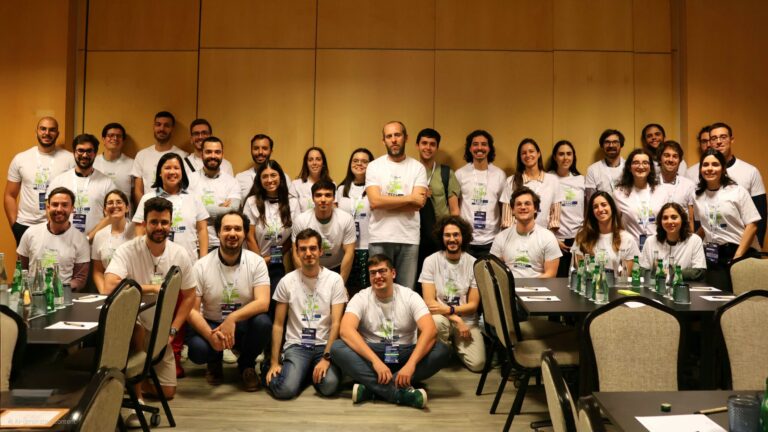
Beginnings often carry symbolic meaning. October 25 marked a memorable moment for INESC-ID’s PhD students with the holding of the first official PhD Students Annual Meeting, bringing together around 40 PhD students from 10 different Scientific Areas, across two campuses of INESC-ID.
The special event took place during an exclusive parallel segment organised by INESC-ID at the INESC Lisboa Meeting 2024. In a session prepared by the INESC-ID’s PhD Students Volunteer Team and the Communication and Outreach Office, PhD student Daniel Gonçalves presented and moderated a collaborative discussion activity to address the challenges encountered by students at the institute.
In the first half of the session, divided into groups for a rapid ideation brainstorming format, students had a few minutes to meet each other (many for the first time) before diving into sharing the main difficulties they experience. In the second half, they enthusiastically discussed and presented actionable solutions, which will be further explored in depth and implemented at INESC-ID in the future. There was no shortage of ideas, only of time, and many students felt the discussion could have lasted much longer.
“It was an inspiring day where we gained valuable insights into our challenges as PhD students and discussed solutions to create a stronger, more supportive community,” shared Sahar Cherati, PhD student and one of the newest members of the Volunteer Team.
Following the PhD Students Volunteer Team’s motto: “To build a supportive community and promote collaboration among students”, which are key ingredients for the success of research at our institution, plans are already underway to make next year’s event bigger and attract even more students, making it an annual tradition at INESC-ID. Judging by the enthusiasm and commitment demonstrated by students at this first meeting, the future looks bright.
Read more about the recent INESC Lisboa Meeting 2023 here.
“It is an important event for the entire community, especially for young researchers. An opportunity to think about things we don’t usually consider,” said Arlindo Oliveira, INESC-ID researcher and President of INESC, at the closing session of the INESC Lisboa meeting, held on Friday, October 25. His words encapsulate the spirit of this gathering, now in its second edition, bringing together researchers from the three Lisbon-based INESC institutions—INESC-ID, INOV, and INESC MN.
Under a bright autumn sun, around 300 people spent the day at the Crowne Plaza Hotel in Costa da Caparica, just across the Tagus River, engaging in discussions on career paths, institutional futures, and today’s scientific challenges. The day began with a warm welcome from INESC Lisboa President, Leonel Sousa, who expressed satisfaction with the success of this second edition and the impressive turnout.
INESC-ID President, Inês Lynce, followed by presenting key statistics for INESC-ID: 102 integrated researchers, 64 collaborators, and 140 PhD students. She also introduced planned improvements for the institute’s management system, proudly noting that INESC-ID was the largest institute to achieve a maximum rating in the latest Fundação para a Ciência e Tecnologia evaluation. “The strength of INESC-ID lies in its foundations; our greatest asset is the initiative of our researchers. It’s up to the management to motivate people,” Inês concluded.
INOV President Fernando Moreira shared insights into the institute’s history, tracing its origins back to 1980 and the centres for technology transfer. After these institutional updates, the audience turned to a talk from Dejan Milojicic, Senior Research Manager in the Strategy and Innovation Office at HP and former President of the IEEE Computer Society. Dejan, who has contributed to the annual Megatrends report for 15 years alongside 49 other distinguished experts, discussed the report’s role in guiding governments, research institutions, and industry. He noted, however, that unpredictable factors like war or COVID-19 can disrupt even the best projections. “Even so, we shouldn’t let that deter us from making predictions,” he asserted.
Drawing on trends from the 2024 Megatrends document, participants then broke into parallel sessions to explore three major areas of evolving technology: Sustainability, Artificial General Intelligence, and Digital Transformation. Attendees were randomly assigned to groups to dive into these topics further.
The afternoon included sessions organized by each institution. For INESC-ID, João Paulo Carvalho, Board Member responsible for Human Resources, provided an in-depth profile of INESC-ID members, including an exciting preview of the new building planned for the institute. Nuno Roma, also a Board Member, presented the most relevant numbers of the financial situation of our Institute.
Brief presentations from Sílvia Castro, Head of the Innovation and Management Office, Sandra Aresta, from Knowledge and Technology Transfer, Rodrigo Abreu, Communications and Outreach Office, and Vanda Fidalgo, Human Resources Manager, further enriched the day’s discussions. In a parallel session, and with notorious satisfaction from the participants, occurred the first meeting of the INESC-ID PhD. students.
The eagerly awaited announcement of awards was led by the researcher Rui Prada, from the AI for People and Society, who presented the winners of the Young Researcher category, Alessandro Gianola, of the PhD Student, Rafael Belchior, and the Researcher category, Hugo Morais.
The day concluded with a talk by Maria Mota, President and CEO of the newly formed GIMM—a research institute created from the merger of the renowned IGC and IMM institutes. Maria, a scientist with over two decades of experience in malaria research, shared the story of GIMM’s foundation, mission, operational approach, and future directions for research in biology and medical care. Arlindo Oliveira then closed the event, expressing his appreciation for this initiative.
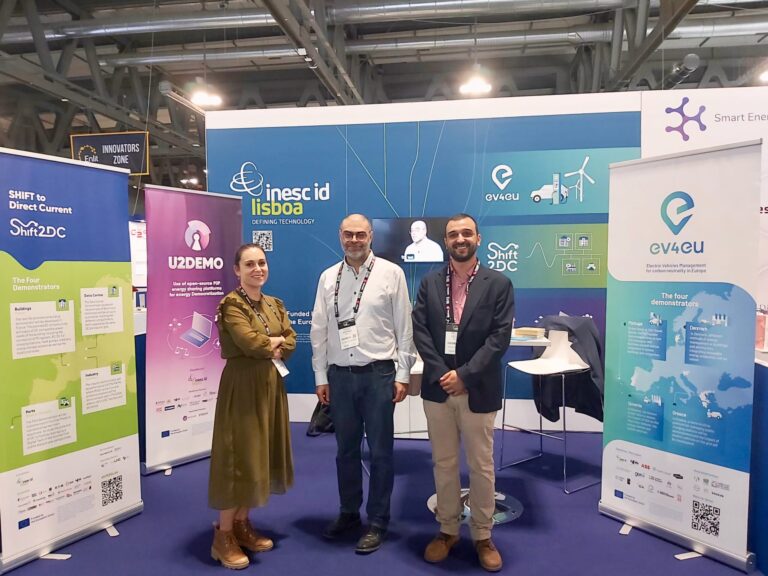
INESC-ID made a strong impact at the 2024 edition of Enlit Europe, one of the leading energy conferences and exhibitions in Europe, proudly showcasing the Horizon Europe projects EV4EU, Shift2DC, and U2Demo.
This year’s event, held from October 22 to 24 in Milan, set a new record by bringing together 15,000 energy experts from across the sector, and more than 200 sessions and 500 speakers over three days. Visitors had the opportunity to connect with the projects’ coordination team at the INESC-ID exhibition stand in the EU Projects Zone and during various sessions featuring the projects’ researchers.
Ana Rita Nunes, project manager at INESC-ID, Pedro Costa, project researcher, and Hugo Morais, senior researcher from Sustainable Power Systems and project coordinator at INESC-ID, along with colleagues from different partner institutions, shared insights and the milestones already achieved by the three ongoing projects:
EV4EU – development of user-centric V2X management strategies for houses, buildings, parking lots, and EV fleets, that will allow the massive growth of electric vehicles.
Shift2DC – a new approach on the way direct current (DC) solutions are used in power systems by creating smarter, more efficient, and eco-friendly energy systems, including ongoing research on Madeira Island and the creation of a DC Digital Port on the island.
U2Demo – development of innovative energy management strategies and technological solutions to promote equitable and democratic access to sustainable energy resources, empowering consumers to manage their energy use more effectively, save money, and take control of their energy data.
Cyberattacks are becoming increasingly frequent, as was the case with the attack on AMA. Why is that? Cyberattacks are becoming more frequent, whether motivated by financial issues or political or ideological reasons. Ransomware attacks, such as the one on AMA, are typically financially motivated. The more valuable the target, the higher the potential gain for the criminal. In AMA’s case, we are talking about critical infrastructure responsible for one of the most essential processes in the electronic world—individual identification and authentication. Specifically for AMA, this involves citizen identification, not only in relation to state services but also the entire civil society that links a service to a person’s identity. Compromising this essential service means compromising the entire chain dependent on it, which explains the impact of this attack.
Why did it take so long—over a week—to restore all functionalities? In this type of attack, the criminal blocks access to the data and, consequently, to the correct functioning of the system, then demands money for unlocking it. Typically, the attacker encrypts the data with a cryptographic key known only to them, and only after payment is this key provided, allowing the victim to decrypt and regain access to their data. In these situations, there are two main ways to recover. One is to pay the attacker, thus encouraging this kind of attack. The other is to have the capability to restore the entire system using functional system backups. In this case, the State, in my view wisely, did not pay. This left the option of restoring the system, though it appears that no functional backup was ready to immediately go online. They likely had to configure parts of the system, involving a thorough process of verification and credentialing to ensure that it could be safely and effectively restored for such a critical service.
Should citizens be concerned about the consequences of this attack and future attacks? Although I am not familiar with the specific infrastructure used by AMA, this type of service is generally divided into two main layers: the interface layer, known as the frontend, and the server layer, known as the backend. The frontend handles the outside world, receiving user requests and interacting with the backend’s functional components. The frontend, by nature, is the most exposed part of the service and consequently more susceptible to attack. The backend runs functional processes related to identity management and citizen authentication. To ensure a very high level of security, the critical core of the authentication process is handled in systems known as HSMs, or Hardware Security Modules. HSMs are very robust, simple-operating components where the cryptographic keys associated with each citizen are stored and used, never leaving these components. The simplicity of these components allows them to be designed to withstand almost any physical or logical attack, achieving an extremely high security level. It is therefore highly unlikely that these systems have been compromised.
What can we, as citizens, do to prevent this from happening again? There is little that individual citizens can do to prevent this type of attack. However, we should always be aware of the risks and act to avoid unnecessary exposure. At a national level, we can exert political pressure to encourage greater investment in security and in the people who ensure it. Only with investment can we build more resilient infrastructures ready for the increasing number of cyberattacks. In the case of AMA and similar services, preparation is crucial. While we cannot prevent such attacks from recurring, we must be prepared for immediate recovery, such as having backup systems ready to take over when the main system goes down. Naturally, this comes at a cost, but as we saw with this attack, the cost of downtime is far greater.
In a recent interview for the supplement Dinheiro Vivo (part of Diário de Notícias), INESC-ID President, Inês Lynce, highlighted crucial topics regarding student education and the societal impact of scientific research. One of the key points discussed was the importance of a well-rounded education that goes beyond academic grades. According to the President, university admission is currently based on grades, but this doesn’t always predict future success. “There are many students who aren’t necessarily the ones with the highest grades, but they end up being much more successful,” she noted.
The secret to this success, she explained, lies in a comprehensive education. The President emphasized that students’ resumes should not be limited to academic degrees but should include practical and extracurricular experiences. “I always recommend to students: the CV is not just about the academic title, but also the professional experience. Hands-on projects, like building satellites or the Formula Student, a racing car, are valuable examples of how important this practical experience is,” she added. She also emphasized the importance of extracurricular activities, such as competitive sports, highlighting the need to balance these with academic work: “A healthy body, a healthy mind, that’s the message.”
Another central theme of the interview was the role of Artificial Intelligence (AI). The President compared AI to mathematics, seeing it as an indispensable foundation, not only for engineering but also for various fields of knowledge. “AI will become a fundamental base for everything, just as mathematics is for engineering,” she observed. This vision reinforces the idea that the future of science and innovation will be deeply tied to the development of AI technologies.
The President also underscored the social responsibility that comes with conducting research, especially in high-impact areas like AI. “Doing excellent research means not only creating scientific impact but also societal impact,” she stated. She pointed out that communicating the work done by researchers is becoming increasingly important, noting that many professionals in the field weren’t trained for this task: “Researchers, by nature, weren’t shaped for this. And it’s an effort.”
On the first episode of the podcast No limite da Inteligência Artificial, by the journalist Bruno Contreiras Mateus, Inês discusses with Paulo Dimas, from Unbabel, the present and the future of AI, the threats, the benefits and the way to deal with this technology in a fruitful and responsible manner.
A line spiralling around the building of the Técnico Innovation Center (TIC), at eight in the morning of an otherwise lazy Saturday, was a good hint that we were about to experience something we had never seen before. Something worthy of the Guinness World Records.
Being a PhD student in Computer Science it was definitely not the opportunity to learn about Phython that led Pedro Orvalho, 27, and his colleagues to get up earlier last October 13 and attend the meeting. “I was curious about how the class would be managed and, of course, also about the Guinness Record”, admits the researcher at INESC-ID, in Automated Reasoning and Software Reliability. When Pedro finally entered the venue, there were no more chairs nor gift bags. Certainly, the organizers didn’t expect more than the registered participants to show up. But they did!
Three teachers were responsible for the 90-minute class: INESC-ID President, Inês Lynce, and INESC President, Arlindo Oliveira, both professors at Técnico, and Rodrigo Girão Serrão, a former student at IST.
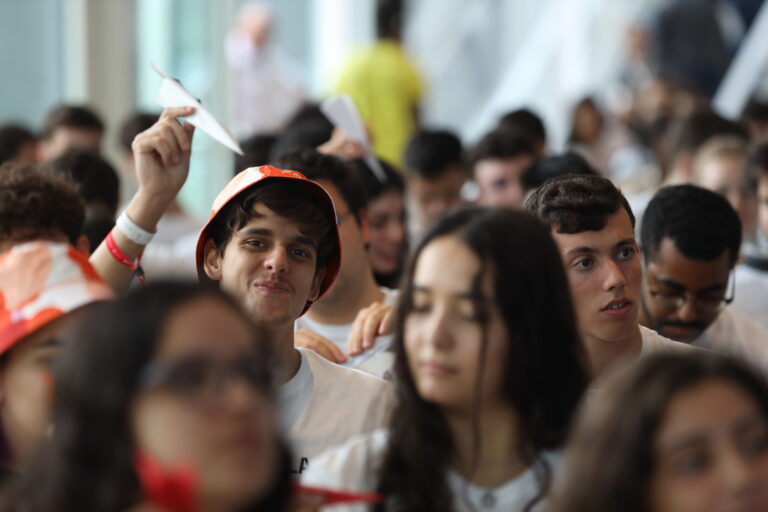
For Inês, the challenge was to plan a lesson for such a large and diverse audience. “It couldn’t be a class like the ones I teach at Técnico”, she admits. So that is why she came up with the idea of explaining the notion of an algorithm using something we have all done at least once in our lives: making a paper plane. In the gift bags, the participants could find sheets of paper in different colours and by following the instructions provided by Inês the planes came out of their hands (but they were not allowed to test their aerodynamical properties!). Rodrigo used the example of the Sudoku game, to explain the notion of programming and Arlindo brought the Game of Life and the classical book Os Maias, by Eça de Queiroz, to demonstrate a language model previously trained on the masterpiece of Portuguese literature.
The operations did not run smoothly all the time. “The access points were insufficient, and the mobile internet couldn’t handle it, resulting in a slow connection to OpenAI’s language model, which was used in the second example”, tells Arlindo Oliveira. A similar problem affected the remote control to operate the slides. “This caused the presentation to freeze more than once, putting me in a difficult position”, he regrets, admitting that “these two factors (and the sound delay in such a large room) were due to the scale of the event, and it was hard to anticipate, as classes are typically not held in such a large space.” After all, it was a first!
Despite the setbacks, the event was a huge success. The Guinness World Record Adjudicator, Paulina Sapinska was checking during the lesson to ensure that all the attendees were following the class and not checking social networks, for example. After the count, the record was set: There were 1,668 participants at the TIC (the previous record had set 724 participants in Dallas, EUA, in 2016).
Besides this, Inês Lynce highlights the festive atmosphere, the number of girls present and the general enthusiasm regarding programming. As stated by the President of Técnico, Rogério Colaço, a true “celebration of young talent.”