Category: News

  • The July 2022 INESC-ID newsletter is out!

    The July 2022 INESC-ID newsletter is out!

    The July 2022 issue of NEWS-ID — the INESC-ID Newsletter — is out!

    Containing recent news from our researchers and their projects, open positions and some extra bits of content, our monthly newsletter is a great one-stop spot for great content on computer science and electrical and computer engineering. The July 2022 newsletter is available here.

    You can subscribe to our monthly newsletter here.

  • INESC-ID researcher Francisco C. Santos elected vice-president of FCT

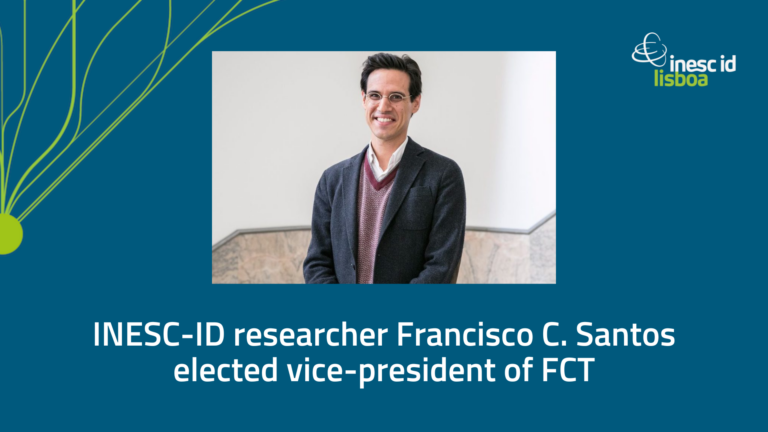
    INESC-ID researcher Francisco C. Santos elected vice-president of FCT

    Francisco C. Santos — INESC-ID Artificial Intelligence for People and Society (AIPS) researcher and Full Professor at the Department of Computer Science and Engineering of Instituto Superior Técnico — has been elected as the new vice-president of FCT, the Portuguese Foundation for Science and Technology (Fundação para a Ciência e Tecnologia). Santos joins Madalena Alves — FCT’s new president and Full Professor of Environmental Biotechnology and Bioengineering at Universidade do Minho — in the governing board of FCT.

    Before taking on the vice-presidency of FCT, Santos has led an accomplished teaching and research career focused on applying and developing computational tools to understand collective dynamics and decision-making in social and life sciences. Having received his PhD in Computer Science from the Université Libre de Bruxelles (ULB), Santos was a researcher at the Machine Learning Group of ULB and subsequently Investigador Auxiliar at the Centre for Artificial Intelligence of NOVA. In 2016 Santos was awarded the CGD / University of Lisbon prize in Computer Science and, the following year, the 2017 Young Scientist Award for Socio-Econophysics of the German Physical Society.

    Santos will be sworn in as vice-president of FCT in a ceremony attended by Elvira Fortunato, the Minister of Science, Technology and Higher Education, this afternoon.


    Photo credit: IST UL.

  • Rui Prada completes his Habilitation in Computer Science and Engineering at Instituto Superior Técnico

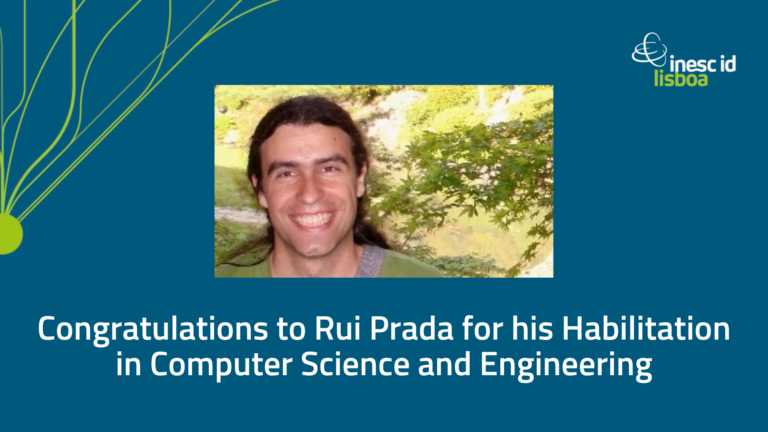
    Rui Prada completes his Habilitation in Computer Science and Engineering at Instituto Superior Técnico

    Rui Filipe Fernandes Prada INESC-ID researcher within the Artificial Intelligence for People and Society Research Area and Associate Professor at the Department of Computer Science and Engineering of Instituto Superior Técnico has today successfully completed his Habilitation (Agregação) in Computer Science and Engineering.

    Across two sessions, on 28th and 29th June 2022, Prada presented the course unit report Specialisation in Games” and the seminar “Human–Agent Interaction – Building Socially Intelligent Agents in Games.

    Our warmest congratulations to Rui!

  • HATE COVID-19.PT: Detecting hate speech in social media

    HATE COVID-19.PT: Detecting hate speech in social media

    A few weeks ago, the team that brought the FCT-funded HATE COVID-19.PT project to life met at INESC-ID. Since May 2021, HATE COVID-19.PT has developed methods for semi-automatically creating a large-scale Portuguese annotated corpus covering online hate speech, while exploring how the information in that annotated corpus can support hate speech detection, allowing users to visualize the metrics extracted from data.

    Coordinated by Paula Cristina Quaresma da Fonseca Carvalho, researcher within the INESC-ID Information and Decision Support Systems (IDSS) Research Area, and with the participation of three other IDSS researchers (Mário Jorge Costa Gaspar da Silva, Paula Cristina Quaresma da Fonseca Carvalho and Danielle Caled Vieira), two researchers from the Human Language Technologies (HLT) Research Area (Ricardo Daniel Santos Faro Marques Ribeiro and Fernando Manuel Marques Batista) and Cláudia Silva (researcher at ITI-LARSyS), HATE COVID-19.PT saw its results presented and discussed in a one-day workshop that took place on 17 May.

    We spoke with Paula Carvalho about this exciting project and the May workshop:

    How did the project come about and what were its initial objectives?

    This research project was one of the applications approved for funding by the Fundação para a Ciência e a Tecnologia (FCT), within the scope of the call for special support for projects on hate speech. The idea of ​​submitting an application for this call made perfect sense at the time, since some of the researchers that make up the HATE COVID-19.PT team were involved in projects, more directly or indirectly, related to hate speech (namely the analysis and detection of misinformation in the media and in social networks). In addition to the linguistic and computational challenges that the recognition of hate speech presents, this phenomenon, increasingly present in social networks, constitutes a clear violation of human rights, as well as one of the greatest threats to social cohesion and democratic societies. From the point of view of natural language processing, it is crucial to create resources that allow, on the one hand to understand the linguistic and discursive materialization of this phenomenon and, on the other, to support the creation of learning models that allow its automatic recognition. However, with regard specifically to the Portuguese language, the existing resources are scarce and the geographic and temporal dimensions, crucial for the characterization of the evolution of online hate speech in the Portuguese context (also one of the objectives of this project), are not normally taken into account.

    In a simplified way, the initial objectives of this project consisted in the creation of solid resources that allowed for the investigation of the main linguistic and discursive strategies underlying the materialization of direct and indirect hate speech, taking into account the different target groups studied, in the Portuguese context, as well as how to assess the impact of the pandemic on the evolution of online hate speech in Portugal. In addition, we proposed to explore semi-supervised learning approaches to address the limitations associated with manual annotation approaches. The manually and automatically annotated data would then be used to develop learning models that allow for the recognition of online hate speech in Portuguese.

    What was the purpose of the May 17th workshop, and what is your perception of how the workshop went?

    The workshop we organized had two main objectives: to share the main research results achieved during the project with the community and to involve civil society in their discussion. In our view, the dialogue between researchers and society, sometimes underestimated by the scientific community, is fundamental.

    In the initial phase of this project we created three focus groups, made up of members of communities that are frequently the target of hate speech, offline and online, in Portugal, namely the Afro-descendant community, the Roma community and the LGBTQ+ community. This work, of a qualitative nature, was crucial to better understand this phenomenon and its impact on these communities. Therefore, for the project team, it made perfect sense to once again involve these communities in the workshop, not just as guests, but as participants with an active voice. Additionally, Paula Cardoso (founder of Afrolink), Hélder Bértolo (chairman of the board of Opus Diversidades) and Vanessa Lopes (currently an intern journalist at the Público and activist for the rights of the Roma Community) participated in the round table dedicated to the discussion of the results of this project.

    We were also able to include the intervention of Portuguese specialists in the project who have been approaching the topic of hate speech in the scope of their research, namely Marisa Torres Silva, Professor at Nova FCSH and researcher at ICNOVA, and Rita Guerra, Professor at ISCTE and researcher at CIS-ISCTE.

    Personally, I believe that it was a very important event, allowing for the sharing of knowledge, in a multidisciplinary perspective, while also highlighting stimulating and enriching interventions by the audience.

    Now that the project has come to an end, what seems to be the biggest conclusions of the project and what impact did they have?

    As I mentioned earlier, one of the main objectives that we defined within the scope of this project was the creation of linguistic resources, in particular annotated corpora (that is, data collections), which are scarce for Portuguese, in order to understand and characterize this phenomenon and ultimately contribute to its automatic recognition. This objective was accomplished and, at this moment, we are able to say that we have created perhaps the largest collection of data (on hate speech) annotated for Portuguese, considering several dimensions of the problem that are typically little explored or explored in an unsystematic way in the literature. In particular, around 200,000 comments were manually recorded, focusing on three target groups (Afro-descendant community, Roma and LGBTQ+) and two social networks (Twitter and YouTube). The annotation system includes, for example, the distinction between hate speech, offensive speech and counter-narratives, as well as the main rhetorical and discursive strategies used in the analyzed comments.

    It should also be noted that the annotation process involved both individuals from the target communities and individuals who do not belong to any vulnerable or historically marginalized group. Although we cannot and should not make generalizations (taking into account the size and characteristics of the sample) there are some interesting conclusions that we can be drawn from the studies carried out. For example, we observed that indirect hate speech (implicit or covert) is as frequent or more frequent on social networks than direct hate speech. Indirect hate speech is often anchored in superficial and fallacious argumentation strategies, including the appeal to fear, the call to action (e.g., the appeal to vote in far-right parties); moreover, this type of discourse is also materialized through rhetorical figures such as irony or sarcasm. With particular reference to a study of a qualitative nature carried out in the initial phase of this project, which involved the creation of focus groups with members of the targeted communities, we were able to conclude that indirect hate speech is considered more harmful than direct hate speech by target groups, even when this type of discourse is expressed through praise or humor. These are, therefore, strategies that seek to normalize and perpetuate stereotypes associated with target groups, often present in comments identified as containing hate speech. We also observed that, according to the data we analyzed, namely on Twitter, it is not possible to establish a direct relationship between the pandemic and the increase in hate speech on social networks in Portugal. In fact, the highest peaks of online hate speech recorded during that period seem to be closely related to events, in the international and national paradigm, that involve the targeted communities (e.g., the murder of G. Floyd and the Marega case).

    The results achieved in this project are therefore fundamental to support the development of models for automatic detection of hate speech in Portuguese. At the moment, the linguistic resources created, pioneers for the analysis of hate speech in Portuguese, are being explored within the scope of the master’s work of two research fellows, hired within the scope of this project, who will present their master’s dissertations, coming soon to Instituto Superior Técnico.

  • Two robots walk into a bar: the AGENTS project is featured in Público

    Two robots walk into a bar: the AGENTS project is featured in Público

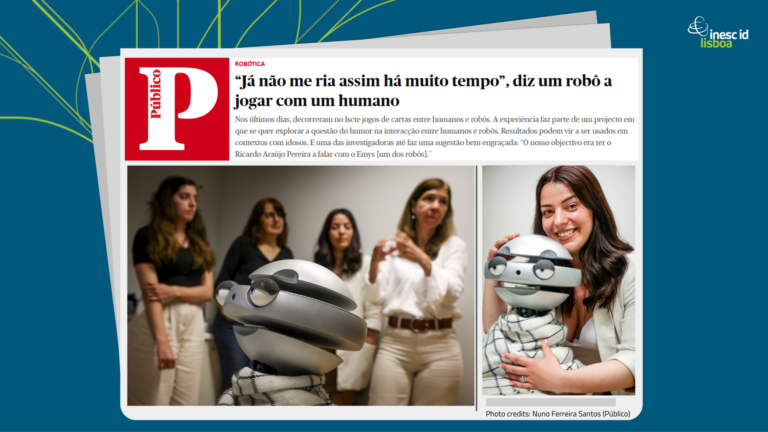
    Automatic generation of humor for social robots (AGENTS) — an FCT- and Carnegie Mellon University (CMU) Portugal-funded project — has been featured in the Portuguese newspaper Público.

    Based at INESC-ID and ISCTE and coordinated by Ana Paiva, researcher within the INESC-ID Artificial Intelligence for People and Society Research Area and Professor at Instituto Superior Técnico, AGENTS explores how humour can be used to create more naturalistic and lifelike interactions between robots and other agents. In this piece, Raquel Oliveira and Inês Batina (both early career researchers at INESC-ID), as well as Patrícia Arriaga (researcher at ISCTE) and Ana Paiva, provide a glimpse at the recent set of human-robot interaction experiments that were conducted at ISCTE with close to 60 subjects.

    The full piece can be accessed here and more details on the project can be viewed here.

  • Inês Lynce featured in Artificial Intelligence podcast

    Inês Lynce featured in Artificial Intelligence podcast

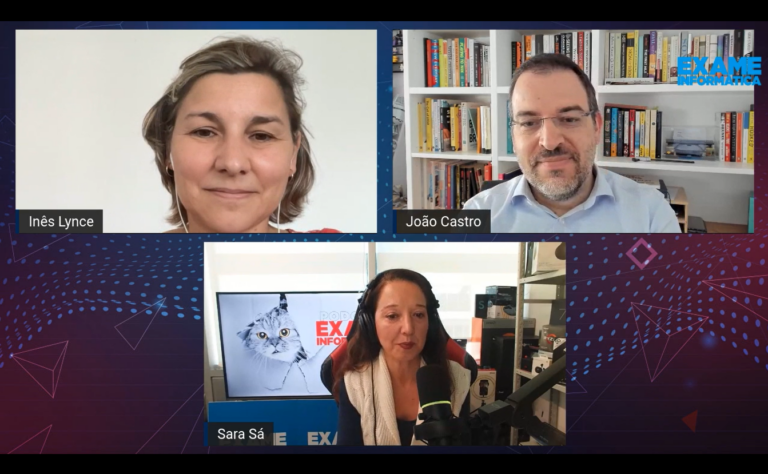
    Inês Lynce President of INESC-ID, as well as researcher within the Automated Reasoning and Software Reliability (ARSR) Research Area, Full Professor at Instituto Superior Técnico and co-director of the CMU Portugal Program has been featured in Gato de Schrödinger (“Schrödinger’s cat”), Exame Informática‘s podcast.

    In this episode, titled Inteligência Artificial: ameaça ou oportunidade? (“Artificial Intelligence: threat or opportunity”), Professor Lynce discusses the possibilities and challenges of Artificial Intelligence with João Casto, Professor at Nova School of Business and Economics, and Sara Sá, Exame Informática‘s science and technology journalist.

    Please have a listen, and a look, at this very special episode here.

  • The June 2022 INESC-ID newsletter is out!

    The June 2022 INESC-ID newsletter is out!

    The June 2022 issue of NEWS-ID — the INESC-ID Newsletter — is out!

    Containing recent news from our researchers and their projects, open positions and some extra bits of content, our monthly newsletter is a great one-stop spot for great content on computer science and electrical and computer engineering. The June 2022 newsletter is available here.

    You can subscribe to our monthly newsletter here.

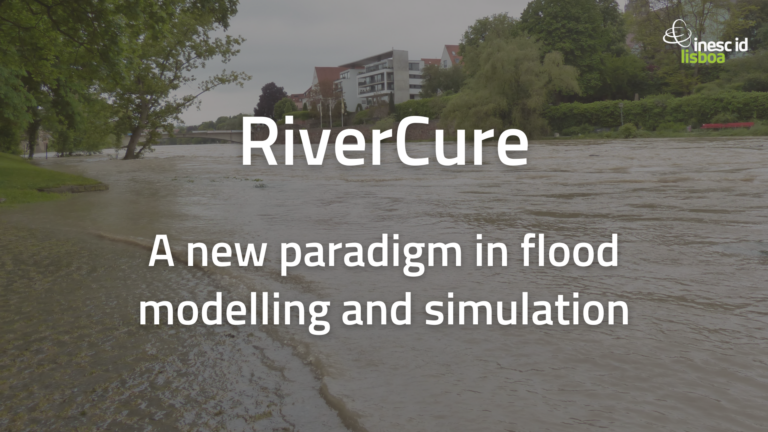
  • RiverCure: a new paradigm in flood modelling and simulation

    RiverCure: a new paradigm in flood modelling and simulation

    The second RiverCure workshop took place on 02 June 2022 at Instituto Superior Técnico, signaling the close of this four-year FCT-funded project that brought together INESC-ID, Instituto Superior Técnico and Agência Portuguesa do Ambiente (APA).

    The workshop included an overview of the RiverCure project and its main outputs, as well as the mathematical modelling research, laboratory and field work it involved and the conception, implementation and applications of the “RiverCure Portal”.

    Ran from June 2018 to June 2022, RiverCure (full title “RiverCure: Curating and assimilating crowdsourced and authoritative data to reduce uncertainty in river flow modelling”) proposed to reduce the uncertainty involved in flood simulation and forecasting, doing so by designing and implementing a novel Web Geographic Information System (GIS) platform the “RiverCure Portal” that combines observations and hydrodynamic modelling tools for the operational response, emergency preparedness, and risk assessment stages of the flood risk management cycle.

    In addition to combining observations with computer modelling, RiverCure explored recent advances in computer vision and deep learning to classify geo-referenced images of flooding events shared by citizens in social media, evaluating the use of neural networks computing systems that mimic biological neural networks by processing information through a series of interconnected mathematical functions represented by “artificial neurons” in discriminating images showing direct evidence of a flood while estimating the severity of the flooding event.

    RiverCure was coordinated by Rui Ferreira (IST/CERIS) and Alberto Silva (INESC-ID). Rui Ferreira is Associate Professor at Instituto Superior Técnico and a CERIS Hydraulics Research Group senior researcher. Alberto Silva is researcher within the INESC-ID Information and Decision Support Systems Research Area and Associate Professor at the Department of Computer Science of Instituto Superior Técnico.

  • Doctoral Symposium on Artificial Intelligence at EPIA’22

    Doctoral Symposium on Artificial Intelligence at EPIA’22

    EPIA 2022 is currently inviting submissions to its Doctoral Symposium on Artificial Intelligence (AI), with a paper submission deadline of 15 June 2022.

    The EPIA Conference on AI is a well-established European conference in the field of AI. The 21st edition of the EPIA conference will take place at Instituto Superior Técnico, University of Lisbon, from 31 August to 02 September 2022.

    As in previous editions, this international conference is hosted with the patronage of the Portuguese Association for Artificial Intelligence (APPIA). The purpose of this conference is to promote research in all areas of AI, covering both theoretical/foundational issues and applications, and the scientific exchange among researchers, engineers and practitioners in related disciplines.

    The Program Chairs for EPIA 2022 (including Ana Paiva, INESC-ID researcher and Professor at Instituto Superior Técnico), together with the International Steering Committee, have selected a number of different thematic tracks to be featured on the conference, covering a wide spectrum of AI topics.

    For more details plese check out EPIA 2020’s website and and the Doctoral Symposium webpage.

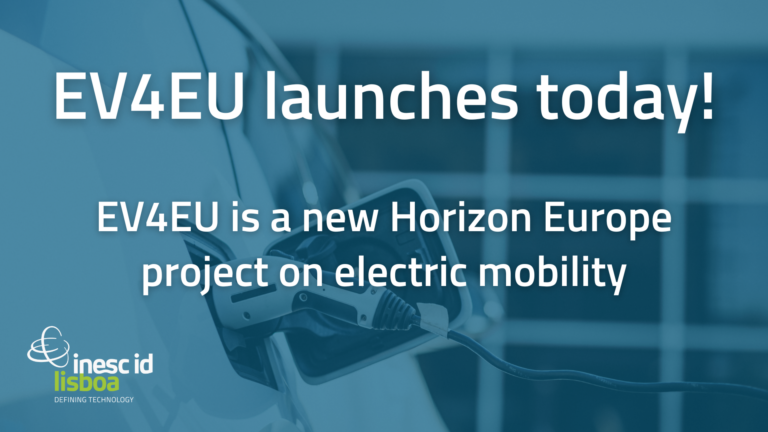
  • EV4EU launches today!

    EV4EU launches today!

    EV4EU launches today, 01 June 2022! With a duration of four years, EV4EU is funded by the European Union in 9-million euros through Horizon Europe, the new research and innovation programme for the period 2021-2027.

    Studies indicate that the massive use of electric vehicles will significantly contribute to the carbon neutrality goals set for 2050, as defined by the European Commission. However, the mass deployment of electric vehicles (EVs) still presents several challenges. To address these challenges, the “Electric Vehicles Management for carbon neutrality in Europe” (EV4EU) project will propose and implement user-centric Vehicle-to-Everything (V2X) management strategies, creating the conditions for the mass deployment of electric vehicles. The proposed V2X management strategies will be tested at four demonstration sites in Portugal on the island of São Miguel; in the Mesogia area in Greece; at Risø and Rønne, island of Bornholm, Denmark; and in Slovenia across a consortium of sixteen entities from four European countries led by INESC-ID.

    To mark the project launch, we spoke with Hugo Morais senior researcher at INESC-ID, Assistant Professor at the Department of Electrical and Computer Engineering (DEEC) of Instituto Superior Técnico, and EV4EU project coordinator about this new landmark project.

    What do you think is, currently, the biggest barrier in the massive implementation of electric mobility?

    Hugo Morais: The massive implementation of electric vehicles implies systemic changes at different levels. In addition to barriers related to the technology of the vehicles themselves, which have evolved very quickly in recent years, it is important to overcome barriers related to the diversity and complementarity of charging technologies (slow charging / fast charging), strategies for integrating charging systems in existing installations, namely in residential buildings, service buildings, car parks, energy communities and companies operating fleets of vehicles (light and heavy). Additionally, it is important to mitigate problems that may arise from a significant increase in the electrical power requested from the electrical grids, as well as the lack of planning strategies at the city level to face the massive integration of electric cars. Finally, it is important to develop interaction strategies with electric vehicle users that allow them to get the most out of their vehicles and the best way to charge them, assessing whether there are any impacts on battery performance due to bidirectional charging and with different powers.

    What are the main objectives of the EV4EU consortium?

    Hugo Morais: The consortium aims to develop a set of strategies [meant to create] solutions that [facilitate] overcoming the barriers identified above.

    How will EV4EU’s multiplicity of partners contribute to its goals?

    Hugo Morais: The consortium is made up of entities covering the entire electric mobility value chain. In addition to the R&D entities, the consortium has an electric vehicle manufacturer (Citroen), an electric charger manufacturer (ABB), a technology provider (Circle), a charging station operator (PPC), an aggregator ( GEN-i) and four distribution network operators (EDA, BEOF, HEDNO and Elektro Celje). The consortium also has a government entity (Regional Directorate of Energy of the Regional Government of the Azores), an entity focused on social sciences (SEL) and end users (Campus Bornholm). The project also has the support of the Portuguese association of public transport (ANTRAM), a manufacturer of wind systems (Vestas), a business incubator in Slovenia and municipal entities where the demonstrators will be developed.

    The demonstrators are complementary both in terms of the solutions used and the strategies to be tested. In Portugal, the demonstrator aims to develop and test V2X solutions and business models that allow the integration of EVs in buildings and companies. In particular, these solutions will be validated in private homes, at the facilities of the Regional Energy Directorate of the Regional Government of the Azores and at the Electricity Company of the Azores. In this demonstrator, a new bidirectional charger that will facilitate the charging of several vehicles simultaneously will be tested, reducing the overall cost of the installation. In Denmark, different car park management strategies will be tested considering different types and uses of car parks. Additionally, coordination methodologies between EVs and renewable production units will be tested in order to demonstrate the complementarity between the technologies. In Greece, a new platform that allows for more efficient management of charging stations, as well as greater interaction with EV users, will be tested. Several business models will be validated through this platform. Additionally, strategies to mitigate the impact of EVs on electrical networks will be investigated. In Slovenia, the demonstrator aims to demonstrate the flexibility introduced by EVs in terms of the management of electricity networks as well as to assess the value that this flexibility could have in electricity markets. These services will be coordinated between the distribution network operator and an aggregator in order to create benefits for end users.

    What do you hope will be EV4EU’s biggest impact after its four-year run?

    Hugo Morais: From the above, we can consider that the project will have an important impact on society, proposing new solutions and business models aimed at creating the right conditions for the massive integration of electric cars, contributing to more sustainable mobility.