Category: News

  • Francisco Melo completes his “Agregação” in Computer Science and Engineering at Instituto Superior Técnico
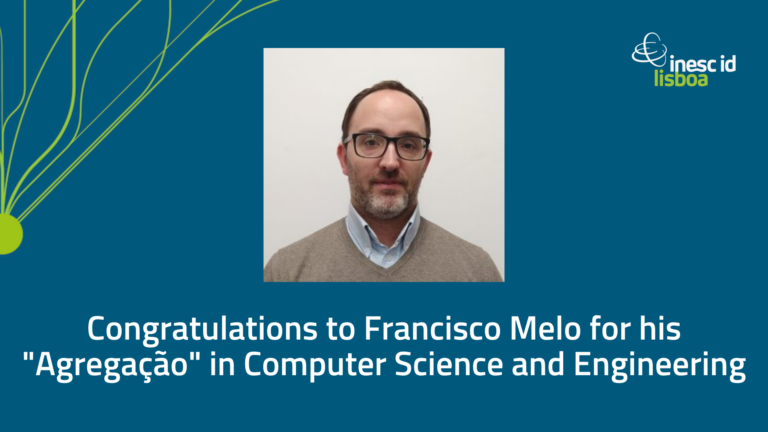
    Francisco Melo completes his “Agregação” in Computer Science and Engineering at Instituto Superior Técnico

    Francisco António Chaves Saraiva de Melo INESC-ID researcher within the Artificial Intelligence for People and Society Research Area and Associate Professor at the Department of Computer Science and Engineering of Instituto Superior Técnico has today successfully completed his Agregação in Computer Science and Engineering.

    Across two sessions, on 30th and 31st May 2022, Melo presented the course unit report Planning, Learning, and Intelligent Decision Making” and the seminar “Reinforcement learning: A dynamical systems viewpoint”.

    Our warmest congratulations to Francisco!


    (Photo credit: https://tecnicomais.pt)

  • Filipa Correia receives best PhD thesis award in Robotics

    Filipa Correia receives best PhD thesis award in Robotics

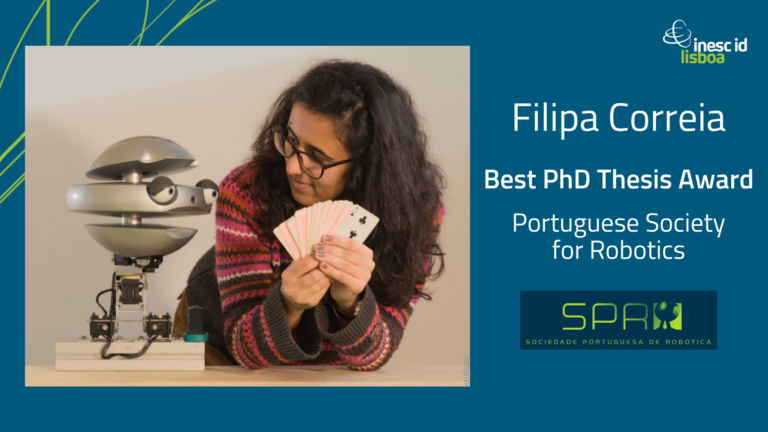
    Filipa Correia has been awarded the best national PhD thesis prize by the Portuguese Society for Robotics (Sociedade Portuguesa de Robótica) for her work “Group Intelligence in Social Robots”, supervised by Professor Ana Paiva and Professor Francisco Melo (INESC-ID researchers and professors at Instituto Superior Técnico, IST). (Pedro Vicente, from the Institute for Systems and Robotics, ISR, was equally awarded a PhD thesis prize)

    Filipa Correia is currently a postdoctoral researcher in the Artificial Intelligence for People and Society (AIPS) Research Area at INESC-ID and at the ITI). Her prize-winning doctoral research work was developed at AIPS and explored the challenges of creating social robots that sustain cohesive alliances with humans in multi-party team settings, including the creation of autonomous robotic characters.

    Filipa Correia’s thesis is available in the IST online repository here.

    Investigating AI systems (agents, robots, etc.) that are social and pro-social — with research work that spans many different topics in affective computing, planning, games & interactive storytelling, robotics, evolutionary game theory and machine learning — AIPS is one of the eleven Research Areas that make up the research tissue of INESC-ID, covering a wide range of topics in computer science and engineering and electrical and computer engineering. You can learn more about the INESC-ID Research Areas here.

  • Nuno Lopes receives research grants from Google and Woven Alpha

    Nuno Lopes receives research grants from Google and Woven Alpha

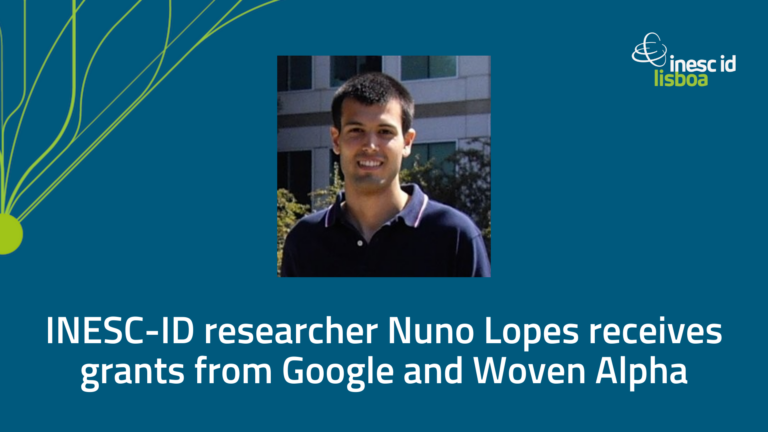
    Nuno Lopes researcher within the High Performance Computing Architectures and Systems Research Area at INESC-ID and Associate Professor at the Department of Computer Science and Engineering at Instituto Superior Técnico — has been awarded research grants from Google and Woven Alpha (a subsidiary of Toyota) worth €35,000 and $30,000, respectively.

    The grant from Woven Alpha will fund Alive2, a project that Lopes has been leading for several years and aims at verifying that a compiler a computer program that translates computer code across programming languages is working correctly. “Toyota uses LLVM (the compiler supported by Alive2) to compile the code for the cars, so they want to ensure that the generated code is correct,” Lopes explains. “For example, a bug in the compiler can cause an accident in a car because the code will behave differently from what was programmed. Alive2 has already found over a hundred bugs in LLVM and now continues to ensure that new bugs are not introduced into the compiler.” With this grant Lopes expects to increase the scope of Alive2 by supporting loop optimizations.

    The Google grant, on the other hand, will fund a new project, also in the area of ​​compilers, meant to improve interoperability between C++ and Rust, two popular programing languages. As Lopes puts it, “Rust is a newer, more secure language than C++. On the other hand, it is impossible to rewrite all the C++ code that exists. Thus, we intend to investigate the best way for libraries developed in both languages ​​to work together easily and safely.”

    Both companies offer these grants to encourage research in the area of ​​compilers and train more people in it, Lopes comments, recognizing this as a challenging area to recruit people in. As Lopes explains, research on compilers “is a very important area of ​​computing because we want software to be written in increasingly high-level languages in order to increase programmers’ productivity, but also to allow non-programmers to write small programs. On the other hand, we want the code to run fast, take up little space, and be secure. It’s a huge challenge that compilers have to solve.”

    And what do grants from Google and Woven Alpha mean for a researcher at Nuno Lopes’ career stage? “These [grants] are very important to me because I joined the academic world (and IST) only in January of this year. Before, I was working in the industry outside the country (at Microsoft Research). These grants allow me to have [some funds] to start activities at IST, namely to hire students and buy equipment.”

    High Performance Computing Architectures and Systems is one the eleven Research Areas at INESC-ID. For more details on these eleven areas, covering a wide range of topics in Computer Science and Engineering and Electrical and Computer Engineering, please pop over to our website.

  • INESC-ID celebrates Técnico’s 111th birthday with an afternoon of technology outreach

    INESC-ID celebrates Técnico’s 111th birthday with an afternoon of technology outreach

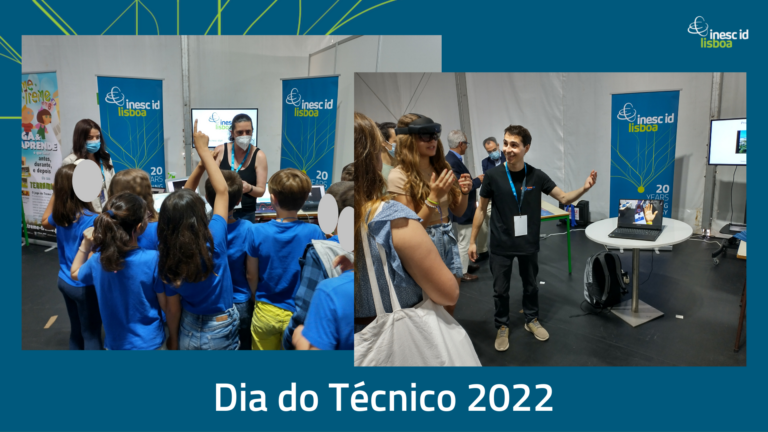
    Today — 23 May 2022 — Instituto Superior Técnico (IST) celebrates its 111th birthday while hosting Dia do Técnico, its annual Open Day.

    INESC-ID took part in Dia do Técnico by hosting games and activities on conservation biology, augmented reality and telecommunications with the collaboration of researchers from the Department of Electrical and Computer Engineering (DEEC) and the Department of Computer Science and Engineering (DEI).

    With visits from students and families of all ages, Dia do Técnico is a great opportunity for varied publics to get a flavour of the research and teaching taking place at IST, with INESC-ID joining the party with a flare of technology outreach.

  • INESC-ID researchers honoured with Universidade de Lisboa / Caixa Geral de Depósitos Scientific Awards

    INESC-ID researchers honoured with Universidade de Lisboa / Caixa Geral de Depósitos Scientific Awards

    Three INESC-ID researchers have been honoured at this year’s Universidade de Lisboa / Caixa Geral de Depósitos Scientific Awards (Prémios Científicos Universidade de Lisboa / Caixa Geral de Depósitos).

    The awardees lists recognised Professor Leonel Augusto Pires Seabra de Sousa (Full Professor at the Department of Electrical and Computer Engineering at IST), who received this year’s award  in the Electrical Engineering and Aerospace Engineering (Avionics) category, Professor Rui Manuel Gameiro de Castro (Associate Professor at the Department of Electrical and Computer Engineering at IST), who received this year’s award in the Energy and Environmental Engineering category, as well as Professor Pedro Tiago Gonçalves Monteiro (Associate Professor at the Department of Computer Science and Engineering), who received an honourable mention in the Computer Science and Computer Engineering area.

    The UL/CGD Scientific Awards and Honourable Mentions are bestowed across twenty-six areas, recognising scientific research activity while encouraging the practice of publication in international journals of recognized quality.

    On having been recognised with the Electrical Engineering and Aerospace Engineering (Avionics) award, Professor Sousa accepted it as “a recognition of the quality of the research work carried out, which is always good. But, fundamentally, I hope that it will be an incentive for the Electrical and Computer Engineering researchers of the younger generations to do even better, namely those who are at INESC-ID.” Professor Castro added that “receiving this award [in Energy and Environmental Engineering] means recognition of the work of my research team in Renewable Energies and Energy Transition, always with the aim of promoting the name of INESC-ID within the international scientific community.”

    The award ceremony will take place on 28 June 2022, 6:30pm, at Salão Nobre of Reitoria da Universidade de Lisboa.

  • INESC-ID represented at Encontro Ciência ’22

    INESC-ID represented at Encontro Ciência ’22

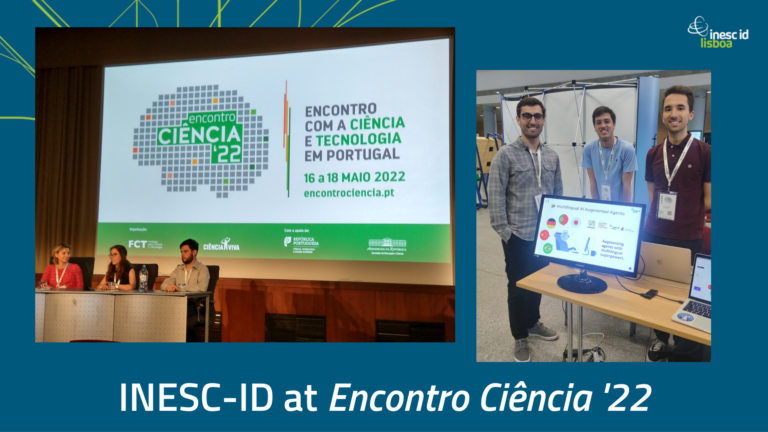
    INESC-ID researchers and their work were showcased at Encontro Ciência ’22, which took place at Centro de Congressos de Lisboa this week.

    On 16 May Professor Inês Lynce, INESC-ID researcher and Full Professor at Instituto Superior Técnico, as well as co-director of the CMU Portugal Program, participated in the session Knowledge Creation and Talent Development under the CMU Portugal Program, in which she delivered an overview of CMU Portugal Program Knowledge Educational initiatives throughout the years. This same session had the participation, among others, of Maria Casimiro and John Mendonça, PhD students and INESC-D early stage researchers.

    INESC-ID researchers also took part in practical demonstrations. The CMU Portugal-funded project Multilingual AI Agent Assistants (MAIA) which aims to develop a multilingual conversational platform, supported by machine translation and dialogue systems, where AI agents assist human agents was showcased on 18 May. MAIA is being developed in partnership between Carnegie Mellon University, INESC-ID, Instituto de Telecomunicações and Unbabel, under Principal Investigator Helena Moniz, INESC-ID researcher within the Human Language Technologies (HLT) research area.

  • NII International Internship Program (Tokyo) – Applications open until 20 May 2022

    NII International Internship Program (Tokyo) – Applications open until 20 May 2022

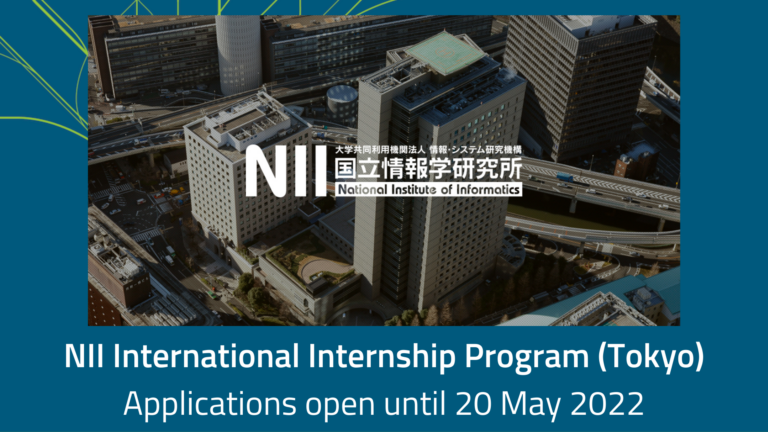
    The International Internship Program at the National Institute of Informatics (NII), Tokyo, is back following limitations due to the COVID-19 pandemic.

    The NII International Internship Program is an exchange activity with students from institutions with which NII has concluded a Memorandum of Understanding (MOU) agreement, including INESC-ID. This incentive program aims at giving interns the opportunity for professional and personal development by engaging in research activities under the guidance and supervision of NII researchers. Both MSc and PhD students are eligible.

    The internship activities should extend for a period of 2 to 6 months. A scholarship of about 171,000 yen per month is granted. However, the costs to travel to Tokyo are not included. The internship should start before the end of March 2023.

    Candidates should contact Prof. Rui Prada (rui.prada[at]gaips.inesc-id.pt) and send him the application form, a detailed CV (grades included), and a motivation letter by *May 20th*. Candidates need, to contact potential supervisors at NII, by email, for the topics they want, beforehand. This email exchange is needed in the application process as well.

    More information, including the list of topics and the application form, can be on the program’s website.


    We spoke with Prof. Prada about the NII program. Here are a few more details on this scheme:

    How did this collaboration with the NII Tokyo start?

    [Rui Prada:] It all started after a six month visit in 2009. I went to Professor Helmut Prendinger’s laboratory to work on games applied to the 3D Internet, which is currently better known as “Metaverse”. We explored the use of SecondLife and OpenSimulator for teaching games, and I developed a game about the environmental impact of agriculture. During my stay I learned about the MOUs that the NII develops around the world and I decided to start one for INESC-ID. The agreement has been in effect since 2010.

    What type of project/collaboration are you developing?

    [Rui Prada:] Initially, we developed games applied to various domains, e.g., for laboratory safety training or to collect navigation data from drivers to create models about their ecological behavior. This game was exposed to the public in several places, in a museum and online, and also involved the collaboration of an Australian institution. More recently we have been working on interaction with robots and artificial intelligence models for unmanned drones.

    I emphasize, however, that although a large part of the collaboration with the NII passes through me, the collaboration has extended to other INESC-ID researchers, for example Bruno Martins and David Matos.

    What do you see as being the value of this collaboration? What type of outcome or future directions do you expect?

    [Rui Prada:] International collaboration is always positive, but this one in particular helps us to see research problems from different perspectives due to the cultural differences that exist between the two countries. One of the current challenges we are working on focuses on the study, design and development of technology that supports a future reality, perhaps not too distant, in which we live together with different types of drones in our society. The question that arises is what infrastructure does a city need to allow millions of drones to cohabit with people. For example, you have to think of a traffic management system (probably in the air space), which is expected to be very intense.

    I want to point out that this MOU has a very important feature, as it financially supports several student internships per year at the NII. So far we have been able to send 38 INESC-ID students for 6-month internships at the NII. This collaboration therefore opens up an excellent opportunity for our students. Most return with a very enriching experience, but some stay, developing their career there. One of the first students to go under this arrangement ended up creating a company in Tokyo that has already opened an office in Lisbon and employs people who were at NII: Spider Labs.

  • Geometry Friends — join the competition!

    Geometry Friends — join the competition!

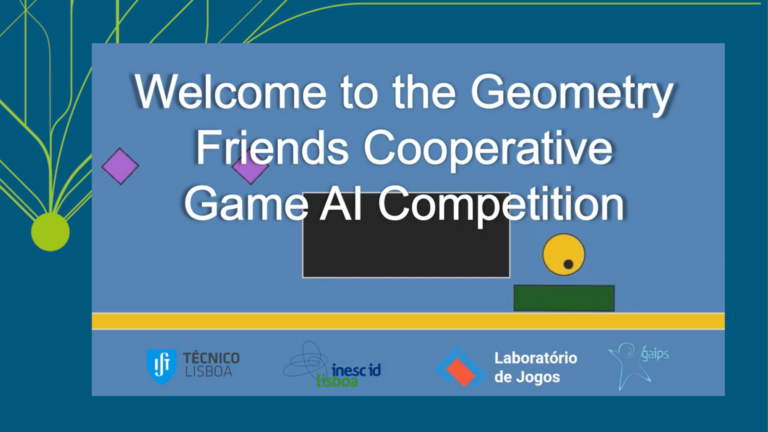
    Geometry Friends is a 2-player cooperative puzzle-platformer game, developed within the Artificial Intelligence for People and Society (AIPS) Research Area at INESC-ID, where two players control two characters — a circle and a rectangle — with distinct characteristics, that try to collect some diamonds in a set of levels as fast as possible. The game promotes collaboration between the two players and presents challenging coordinated control of the characters in a simulated physics environment. If you’re curious, you can see two agents in action here.

    Geometry Friends raises interesting problems for Artificial Intelligence (AI) agents. For example, to successfully solve a Geometry Friends level, players need to: deal with coordination at different layers, from motion control (e.g. achieving perfect timing) to level resolution (e.g. devising shared plans); deal with limited actuation situated in a simulated physics environment (with gravity and friction); solve platform (skill) based puzzles, which involves discovering the proper order to collect the diamonds and identifying the points where collaboration is needed; do all the above in real-time!

    The competition is held at the International Joint Conference on Artificial Intelligence (IJCAI/ECAI’2022) and the IEEE Conference on Games (CoG’2022). You can compete in the following tracks in the IJCAI-ECAI 2022 competition: Rectangle Track GF-IJCAI-ECAI 2022, Circle Track GF-IJCAI-ECAI 2022, and Cooperation Track GF-IJCAI-ECAI 2022. For the CoG 2022 competition, you can participate in these tracks: GF-CoG 2022 – Rectangle Track, GF-CoG 2022 – Circle Track and GF-CoG 2022 – Cooperation Track. The IJCAI-ECAI 2022 competition ends on July 22, 2022, and the CoG 2022 competition ends on August 19, 2022.

    Further details are available here.

  • World Password Day: see how you can improve yours

    World Password Day: see how you can improve yours

    Today, 05 May, we celebrate World Password Day. As Security and Privacy is one of the main research foci at INESC-ID, and one of the institute’s major Thematic Lines, we wanted to give our contribution to improving the strength and performance of everyone’s passwords.

    Miguel Correia — researcher within the Distributed, Parallel and Secure Systems (DPSS) INESC-ID Research Area and Strategic Coordinator of the Security and Privacy Thematic Line — suggests using “strings of at least 10 characters that do not appear in a dictionary as passwords, mixing letters, digits and signs”.

    “The two main problems with textual passwords are [that] most people choose predictable passwords (even the ones they think they don’t) and [that] most people reuse passwords between different services” commented João Ferreira, INESC-ID researcher within the Automated Reasoning and Software Reliability (ARSR) Research Area. João Ferreira is also one of the Principal Investigators of the PassCert Project (which aims to “build an open-source, proof-of-concept [password manager] that through the use of formal verification, is guaranteed to satisfy properties on data storage and password generation”), a CMU Portugal Exploratory Research Project.

    From the perspective of a user creating an efficient password, João Ferreira has a few suggestions:

    • Use at least 12 characters, using at least two or three different classes (between lowercase, uppercase, digits and symbols);
    • Characters must appear in unpredictable positions — i.e., avoid putting capital letters at the beginning of the password and numbers/digits at the end of the password;
    • Avoid using dictionary words or familiar expressions (e.g. sayings, parts of song lyrics, etc.);
    • Do not use patterns like “1234” or “abcd” or keyboard patterns like “qwerty” or “cvbnm” or acronyms like “SCP”, “SLB” or “FCP”;
    • Ensure the chosen password does not appear in any known “data breaches” (e.g., use something like Pwned Passwords).

    Happy World Password Day!

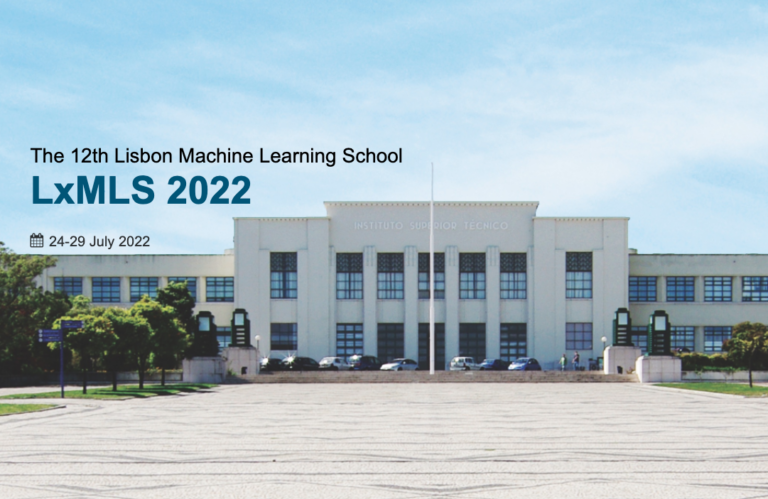
  • The 12th Lisbon Machine Learning School – LxMLS 2022

    The 12th Lisbon Machine Learning School – LxMLS 2022

    All those interested in Machine Learning and Natural Language Processing are invited to attend the 12th Lisbon Machine Learning School – LxMLS 2022, 24-29 July 2022, in-person at Instituto Superior Técnico.

    LxMLS 2022 will cover a range of machine learning topics important in solving natural language processing problems and is organized by INESC-ID, Instituto Superior Técnico, Instituto de Telecomunicações, the Lisbon ELLIS Unit for Learning and Intelligent Systems (LUMLIS), Unbabel, and Zendesk. Two of LxMLS’ organizers are INESC-ID affiliated researchers: Fernando Batista and Bruno Martins.

    The application deadline in on 15 May 2022. Further details are available here.