Category: News

  • INESC-ID welcomes EMBL Olissipo researchers
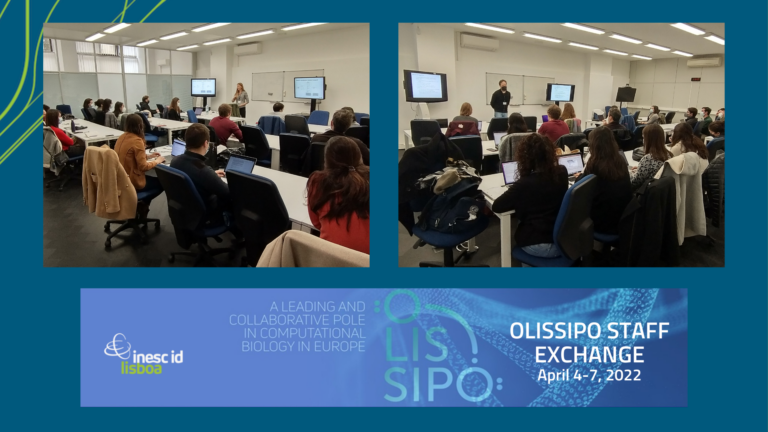
    INESC-ID welcomes EMBL Olissipo researchers

    The INESC-ID Olissipo team received some of the members of the EMBL team this week. This Staff Exchange included scientific presentations by both teams, as well as teamwork sessions and space to reflect on the future directions of this project.

    Coordinated by Susana Vinga – INESC-ID researcher and member of its Board of Directors, as well as Associate Professor at Instituto Superior Técnico – OLISSIPO is a Twinning project, funded by the European Commission within Horizon 2020, that aims to enhance the competences in Computational Biology at INESC-ID and to create an international pole of excellence in multi-disciplinary science in Portugal.

    The Olissipo consortium is composed of four research institutions: INESC-ID, EMBL, ETH Zurich and Inria.

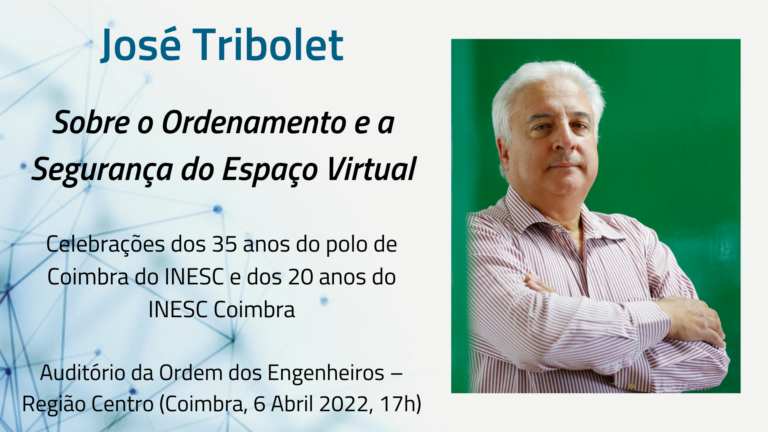
  • José Tribolet delivers talk “Sobre o Ordenamento e a Segurança do Espaço Virtual”

    José Tribolet delivers talk “Sobre o Ordenamento e a Segurança do Espaço Virtual”

    Founder and ex-President of INESC (Instituto de Engenharia de Sistemas e Computadores), and Instituto Superior Técnico Emeritus Professor José Tribolet, will deliver a talk titled “Sobre o Ordenamento e a Segurança do Espaço Virtual” on 06 April 2022 at 5pm.

    This talk will be delivered as part of the celebrations of the 35 years of INESC’s Coimbra campus and the 20th anniversary of INESC Coimbra, taking place live at Auditório da Ordem dos Engenheiros – Região Centro in Coimbra.

    Attendance is free and registration is available here.

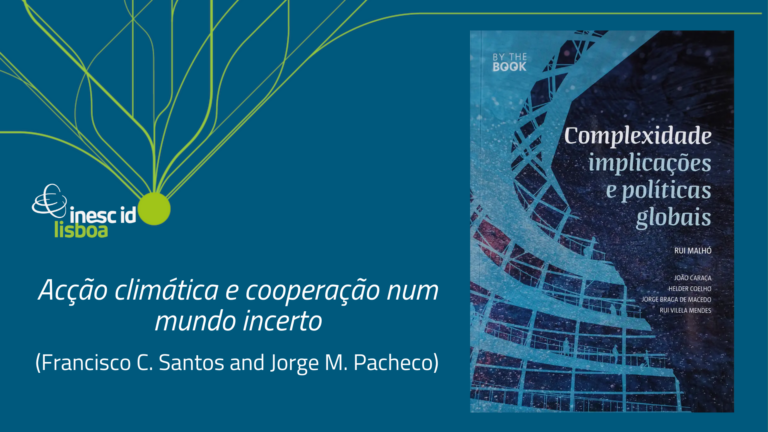
  • Climate change and cooperation: INESC-ID researcher authors a new chapter

    Climate change and cooperation: INESC-ID researcher authors a new chapter

    Francisco C. Santos — INESC-ID researcher and Coordinator of the Artificial Intelligence for People and Society (AIPS) Research Area, as well as Full Professor at the Department of Computer Science and Engineering of Instituto Superior Técnico — has co-authored a chapter titled Acção climática e cooperação num mundo incerto (“Climate action and cooperation in an uncertain world”), together with Jorge M. Pacheco (University of Minho).

    Using Game Theory, Santos and Pacheco look at how cooperation can take place within multi-agent societies and impact on climate action. This chapter is part of Complexidade: Implicações e Políticas Globais (“Complexity: Implications and Global Policies”), a book coordinated by Rui Malhó (Faculdade de Ciências da Universidade de Lisboa), only available in Portuguese, and authored by an interdisciplinary plethora of specialists, where a variety of topics of considerable societal concern, and with which complexity science intersects, are explored.

    Investigating AI systems (agents, robots, etc.) that are social and pro-social — with research work that spans many different topics in affective computing, planning, games & interactive storytelling, robotics, evolutionary game theory and machine learning — AIPS is one of the eleven Research Areas that make up the research tissue of INESC-ID, covering a wide range of topics in computer science and engineering and electrical and computer engineering. You can learn more about the INESC-ID Research Areas here.

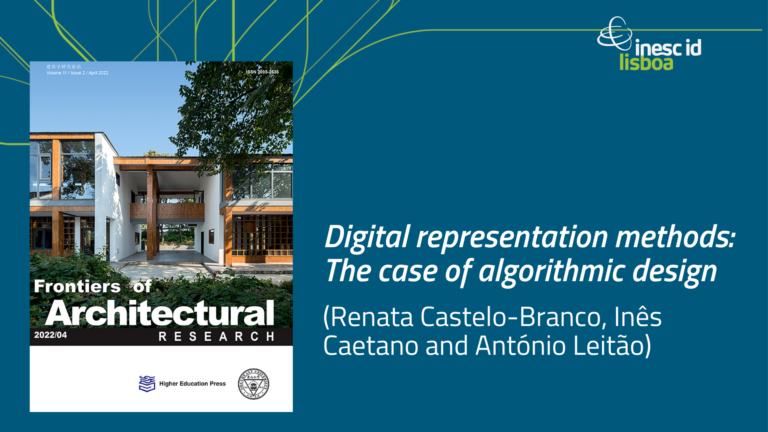
  • Picture a building: algorithmic design in architectural representation

    Picture a building: algorithmic design in architectural representation

    What does a line of computer code have in common with a brick — or a wall, or a window? According to the latest computational techniques applied to architecture, a lot.

    In her paper Digital representation methods: The case of algorithmic design (recently published in the journal Frontiers of Architectural Research with Inês Caetano and António Leitão), Renata Castelo-Branco — an early career researcher in the Graphics and Interaction Research Area — weighs the many ways in which algorithmic design (AD) is changing the day-to-day of architects. As a tool that breathes new air into what’s possible in describing and representing architectural entities — e.g., a building — AD follows a decades-long history of technological innovations in computer-based methods for architectural design: from computer-aided drafting (CAD) to building information modeling (BIM). AD applies algorithms — a finite set of rules and steps to solve a certain problem — to create a description of the object they want to materialize, with the added advantage that, due to its very nature, AD multiplies the possible number of solutions to a particular architectural question.

    When asked what she considers as the most substantial impact of AD in architectural design, Renata reminds us that “Architecture, like many other art forms, frequently mirrors the technological advancements of its time, and computational design approaches, such as AD, reflect the increasing integration of computer science in the architectural domain,” adding that “As the article shows, AD excels in the production of complex designs, which has been motivating its use in large-scale and non-conventional design problems, such as the Morpheus Hotel in Macau or the Louvre in Abu Dhabi, to name some recent examples.”

    Renata has a good hunch on where the field of AD will move and recognizes some of the hindrances what will have to be overcome, as she expects it to “evolve towards the use of context-specific tools that facilitate its adoption in architecture. Despite the numerous advantages, AD requires programming, a concept with which practitioners often struggle; more so when dealing with models of complex building structures. As a result, the adoption of computational methods has mostly been limited to large architectural studios that resort to expert hiring.” Computational literacy will play a big part in the wider adoption of AD, and here INESC-ID has a big part to play. As Renate concludes “For architecture to benefit from AD at large, we still need to close the existing comprehension gap between AD programs and their behavior, making this representation method more akin to the traditional architectural practice. Our team is currently investigating methods of bridging this gap with more adequate programming environments that can promote a flexible and comprehensible design exploration.”

    Renata is one of the approximately one-hundred-and-fifty early stage researchers currently working at INESC-ID.

    Investigating interactive computer graphics and human-centered computing applied to health, social inclusion, education, architecture, CAD and manufacturing, the Graphics and Interaction Research Area combines computer science, computer graphics, HCI, behavioral and social sciences to address real-world challenges. GI is one of the eleven Research Areas that make up the research tissue of INESC-ID. You can learn more about the INESC-ID Research Areas here.

  • INESC-ID researchers recognized in Research.com rankings

    INESC-ID researchers recognized in Research.com rankings

    Several INESC-ID researchers have recently been recognized across multiple thematic Research.Com rankings, both nationally and internationally.

    In the fields of Computer Science and Electrical and Computer Engineering we find a number of INESC-ID researchers: Ana Paiva, Joaquim Jorge, Miguel Pupo Correia, Luís Rodrigues, Rodrigo Rodrigues, Arlindo Oliveira, Isabel Trancoso, Hugo Morais, LuísFerreira and Leonel Sousa. Once again, INESC-ID researchers are credited as major figures in their respective scientific and technological fields.

    Research.com is a portal created by scientists for scientists to help researchers keep track of relevant conferences and research, as well as providing rankings of individuals and institutions worldwide.

  • ISTSAT-1: the first satellite fully developed in Portugal will be in space in 2022

    ISTSAT-1: the first satellite fully developed in Portugal will be in space in 2022

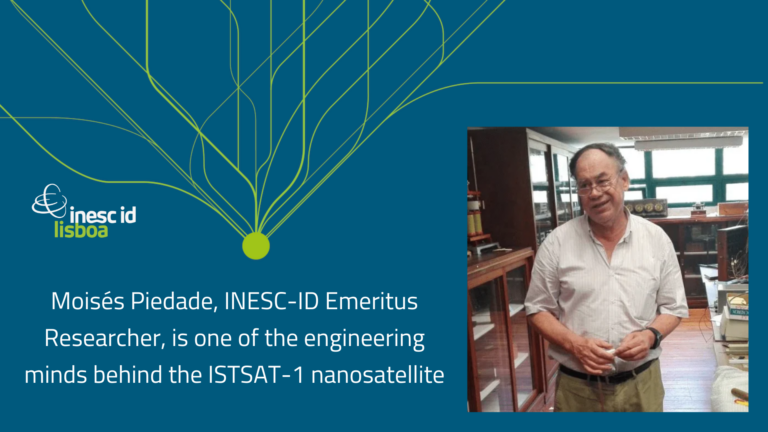
    ISTSAT-1 — the first nanosatellite to be fully developed, from scratch, in Portugal — is set to be launched from the Ariane 6 rocket later this year. ISTSAT-1 has been developed by researchers and students from Instituto Superior Técnico (IST), including Moisés Piedade (retired full Professor at IST and INESC-ID Emeritus Researcher) and coordinated by Rui Rocha (Professor at IST).

    The ISTSAT-1 nanosatellite began its development in 2017 and has its digital eyes set on the remote detection of airplanes from space. Mission control for ISTSAT-1 will be implemented at IST TagusPark, and so fully controlled from Portugal.

    ISTSAT-1 has also been featured in IST’s 110 Histórias, 110 Objetos podcast.

    Moisés Piedade was honoured last year by INESC-ID as Emeritus Researcher in recognition of his outstanding career in the Department of Electrical and Computer Engineering of IST.

  • Luis Miguel Silveira chosen as President-Elect of the IEEE Council on Electronic Design Automation (CEDA)

    Luis Miguel Silveira chosen as President-Elect of the IEEE Council on Electronic Design Automation (CEDA)

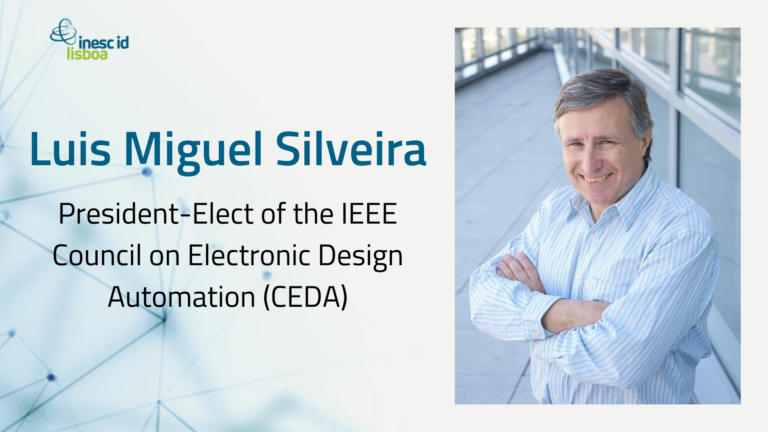
    Luis Miguel Silveira — INESC-ID researcher in the High Performance Computing Architectures and Systems Research Area and Full Professor at Instituto Superior Técnico has been chosen as President-Elect of the IEEE Council on Electronic Design Automation (CEDA) with a mandate for 2022-2023.

    Formed in 2005, CEDA is an Institute of Electrical and Electronics Engineers (IEEE) Technical Council and aims to foster design automation of electronic circuits and systems at all levels and enable the exchange of technical information via conferences — e.g., the prestigious Design Automation Conference (DAC), Design & Test Automation in Europe (DATE), the International Conference on Computer-Aided Design (ICCAD) and the Asian-South Pacific DAC (ASP-DAC) as well as workshops and journals (amongst them IEEE Transactions on Computer-Aided Design of VLSI Circuits, IEEE Embedded System Letters and IEEE Design and Test Magazine).

    This recognition succeeds two mandates, over the span of four years, as Vice-President for Publications. As President-Elect, Silveira is a Strategy Committee member and represents the Council in several IEEE fora.

  • On games and tales: two papers in “Interactive Storytelling”

    On games and tales: two papers in “Interactive Storytelling”

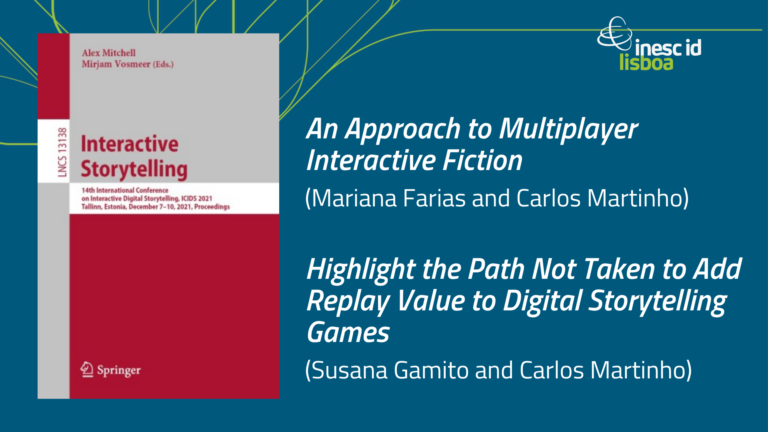
    What is the role of storytelling when multiple players are interacting? That question drove two back-to-back research papers recently authored by INESC-ID researchers – Mariana Farias, Susana Gamito and Carlos Martinho, members of the Artificial Intelligence for People and Society (AIPS) Research Area – in Interactive Storytelling, the proceedings of the 14th International Conference on Interactive Digital Storytelling, ICIDS 2021.

    In An Approach to Multiplayer Interactive Fiction, Mariana Farias and Carlos Martinho generated an interactive fiction experience for two players where both were protagonists of a story while embodying different characters. That experience incorporated the need to guide the players’ attention, significantly improving the fictional experience while helping them follow the story. “It’s very interesting to see how new and innovative ways of interaction are emerging within the field of interactive storytelling,” Farias commented, adding that she is “very excited to see what new experiences we will have in the future that deviate from the classical text format of presenting these stories and to explore what new ways, choices and actions that influence the course of the story can be made within the medium.”

    In their paper, Susana Gamito and Carlos Martinho looked at those decision-making moments that open multiple narrative doors within an interactive storytelling format. In Highlight the Path Not Taken to Add Replay Value to Digital Storytelling Games, Gamito and Martinho used the psychology of regret to look at how players reflect upon their choices and replay a game. By highlighting the path not taken, Gamito and Martinho showed that the game experience could be improved by indicating to players the alternative of what could have been. On their paper, Carlos Martinho commented that “In spite of – in the specific case of this work – being applied to the domain of digital games, the metaphor of interactive narrative has a more transversal importance to human behavior. It is often by telling stories that we explain our surroundings and communicate our ideas.” Martinho also highlighted that “Understanding better how our behavior, in the context of this metaphor, varies from person to person and is sensitive to certain forms of communication, can inform or even pave the way for new formats of interaction between humans and machines. In the case of digital entertainment, it can help to create enriched experiences by adapting to the individual needs of each user, which is one of the main lines of research on which this work is anchored.”

    Investigating AI systems (agents, robots, etc.) that are social and pro-social — with research work that spans many different topics in affective computing, planning, games & interactive storytelling, robotics, evolutionary game theory and machine learning — AIPS is one of the eleven Research Areas that make up the research tissue of INESC-ID, covering a wide range of topics in computer science and engineering and electrical and computer engineering. You can learn more about the INESC-ID Research Areas here.

  • INESC Brussels Hub featured in AICEP magazine “Portugalglobal”

    INESC Brussels Hub featured in AICEP magazine “Portugalglobal”

    INESC Brussels Hub has been featured in Portugalglobal, AICEP’s flagship magazine. AICEP is a government entity focused on encouraging foreign investment in Portugal as well as in potentiating the success, internationalization and export activities of Portuguese companies abroad.

    The Hub represents and promotes the European interests of the five INESC institutes (INESC-ID, INOV, INESC MN, INESC Coimbra and INESC TEC), placing INESC as a research and innovation leader on the European stage. As this piece highlights, “Participation in European research and innovation programs and initiatives is absolutely critical,” and INESC has an equally fundamental role to play in defining research policies moving into an ever-more complex future.

    You read the entire feature on pages 41 and 42 of the March 2022 issue of Portugalglobal.

  • The INESC-ID March 2022 Newsletter is out!

    The INESC-ID March 2022 Newsletter is out!

    The March 2022 issue of NEWS-ID — the INESC-ID Newsletter — is out!

    Containing recent news from our researchers and their projects, as well as upcoming events, open positions and some extra bits of content, our monthly newsletter is a great one-stop spot for great content on computer science and electrical and computer engineering.

    You can subscribe to our monthly newsletter here.