Category: Research Highlights

  • RiverCure: a new paradigm in flood modelling and simulation
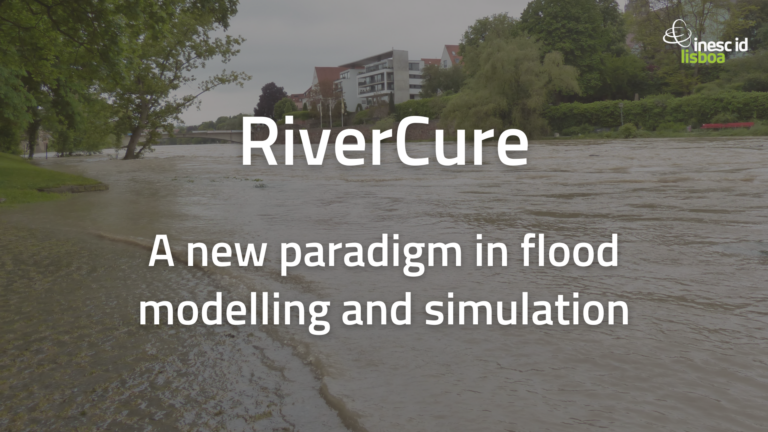
    RiverCure: a new paradigm in flood modelling and simulation

    The second RiverCure workshop took place on 02 June 2022 at Instituto Superior Técnico, signaling the close of this four-year FCT-funded project that brought together INESC-ID, Instituto Superior Técnico and Agência Portuguesa do Ambiente (APA).

    The workshop included an overview of the RiverCure project and its main outputs, as well as the mathematical modelling research, laboratory and field work it involved and the conception, implementation and applications of the “RiverCure Portal”.

    Ran from June 2018 to June 2022, RiverCure (full title “RiverCure: Curating and assimilating crowdsourced and authoritative data to reduce uncertainty in river flow modelling”) proposed to reduce the uncertainty involved in flood simulation and forecasting, doing so by designing and implementing a novel Web Geographic Information System (GIS) platform the “RiverCure Portal” that combines observations and hydrodynamic modelling tools for the operational response, emergency preparedness, and risk assessment stages of the flood risk management cycle.

    In addition to combining observations with computer modelling, RiverCure explored recent advances in computer vision and deep learning to classify geo-referenced images of flooding events shared by citizens in social media, evaluating the use of neural networks computing systems that mimic biological neural networks by processing information through a series of interconnected mathematical functions represented by “artificial neurons” in discriminating images showing direct evidence of a flood while estimating the severity of the flooding event.

    RiverCure was coordinated by Rui Ferreira (IST/CERIS) and Alberto Silva (INESC-ID). Rui Ferreira is Associate Professor at Instituto Superior Técnico and a CERIS Hydraulics Research Group senior researcher. Alberto Silva is researcher within the INESC-ID Information and Decision Support Systems Research Area and Associate Professor at the Department of Computer Science of Instituto Superior Técnico.

  • EV4EU launches today!

    EV4EU launches today!

    EV4EU launches today, 01 June 2022! With a duration of four years, EV4EU is funded by the European Union in 9-million euros through Horizon Europe, the new research and innovation programme for the period 2021-2027.

    Studies indicate that the massive use of electric vehicles will significantly contribute to the carbon neutrality goals set for 2050, as defined by the European Commission. However, the mass deployment of electric vehicles (EVs) still presents several challenges. To address these challenges, the “Electric Vehicles Management for carbon neutrality in Europe” (EV4EU) project will propose and implement user-centric Vehicle-to-Everything (V2X) management strategies, creating the conditions for the mass deployment of electric vehicles. The proposed V2X management strategies will be tested at four demonstration sites in Portugal on the island of São Miguel; in the Mesogia area in Greece; at Risø and Rønne, island of Bornholm, Denmark; and in Slovenia across a consortium of sixteen entities from four European countries led by INESC-ID.

    To mark the project launch, we spoke with Hugo Morais senior researcher at INESC-ID, Assistant Professor at the Department of Electrical and Computer Engineering (DEEC) of Instituto Superior Técnico, and EV4EU project coordinator about this new landmark project.

    What do you think is, currently, the biggest barrier in the massive implementation of electric mobility?

    Hugo Morais: The massive implementation of electric vehicles implies systemic changes at different levels. In addition to barriers related to the technology of the vehicles themselves, which have evolved very quickly in recent years, it is important to overcome barriers related to the diversity and complementarity of charging technologies (slow charging / fast charging), strategies for integrating charging systems in existing installations, namely in residential buildings, service buildings, car parks, energy communities and companies operating fleets of vehicles (light and heavy). Additionally, it is important to mitigate problems that may arise from a significant increase in the electrical power requested from the electrical grids, as well as the lack of planning strategies at the city level to face the massive integration of electric cars. Finally, it is important to develop interaction strategies with electric vehicle users that allow them to get the most out of their vehicles and the best way to charge them, assessing whether there are any impacts on battery performance due to bidirectional charging and with different powers.

    What are the main objectives of the EV4EU consortium?

    Hugo Morais: The consortium aims to develop a set of strategies [meant to create] solutions that [facilitate] overcoming the barriers identified above.

    How will EV4EU’s multiplicity of partners contribute to its goals?

    Hugo Morais: The consortium is made up of entities covering the entire electric mobility value chain. In addition to the R&D entities, the consortium has an electric vehicle manufacturer (Citroen), an electric charger manufacturer (ABB), a technology provider (Circle), a charging station operator (PPC), an aggregator ( GEN-i) and four distribution network operators (EDA, BEOF, HEDNO and Elektro Celje). The consortium also has a government entity (Regional Directorate of Energy of the Regional Government of the Azores), an entity focused on social sciences (SEL) and end users (Campus Bornholm). The project also has the support of the Portuguese association of public transport (ANTRAM), a manufacturer of wind systems (Vestas), a business incubator in Slovenia and municipal entities where the demonstrators will be developed.

    The demonstrators are complementary both in terms of the solutions used and the strategies to be tested. In Portugal, the demonstrator aims to develop and test V2X solutions and business models that allow the integration of EVs in buildings and companies. In particular, these solutions will be validated in private homes, at the facilities of the Regional Energy Directorate of the Regional Government of the Azores and at the Electricity Company of the Azores. In this demonstrator, a new bidirectional charger that will facilitate the charging of several vehicles simultaneously will be tested, reducing the overall cost of the installation. In Denmark, different car park management strategies will be tested considering different types and uses of car parks. Additionally, coordination methodologies between EVs and renewable production units will be tested in order to demonstrate the complementarity between the technologies. In Greece, a new platform that allows for more efficient management of charging stations, as well as greater interaction with EV users, will be tested. Several business models will be validated through this platform. Additionally, strategies to mitigate the impact of EVs on electrical networks will be investigated. In Slovenia, the demonstrator aims to demonstrate the flexibility introduced by EVs in terms of the management of electricity networks as well as to assess the value that this flexibility could have in electricity markets. These services will be coordinated between the distribution network operator and an aggregator in order to create benefits for end users.

    What do you hope will be EV4EU’s biggest impact after its four-year run?

    Hugo Morais: From the above, we can consider that the project will have an important impact on society, proposing new solutions and business models aimed at creating the right conditions for the massive integration of electric cars, contributing to more sustainable mobility.

  • Nuno Lopes receives research grants from Google and Woven Alpha

    Nuno Lopes receives research grants from Google and Woven Alpha

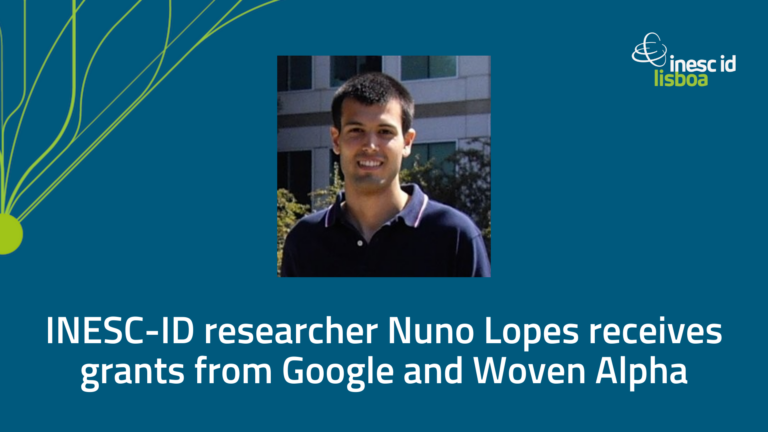
    Nuno Lopes researcher within the High Performance Computing Architectures and Systems Research Area at INESC-ID and Associate Professor at the Department of Computer Science and Engineering at Instituto Superior Técnico — has been awarded research grants from Google and Woven Alpha (a subsidiary of Toyota) worth €35,000 and $30,000, respectively.

    The grant from Woven Alpha will fund Alive2, a project that Lopes has been leading for several years and aims at verifying that a compiler a computer program that translates computer code across programming languages is working correctly. “Toyota uses LLVM (the compiler supported by Alive2) to compile the code for the cars, so they want to ensure that the generated code is correct,” Lopes explains. “For example, a bug in the compiler can cause an accident in a car because the code will behave differently from what was programmed. Alive2 has already found over a hundred bugs in LLVM and now continues to ensure that new bugs are not introduced into the compiler.” With this grant Lopes expects to increase the scope of Alive2 by supporting loop optimizations.

    The Google grant, on the other hand, will fund a new project, also in the area of ​​compilers, meant to improve interoperability between C++ and Rust, two popular programing languages. As Lopes puts it, “Rust is a newer, more secure language than C++. On the other hand, it is impossible to rewrite all the C++ code that exists. Thus, we intend to investigate the best way for libraries developed in both languages ​​to work together easily and safely.”

    Both companies offer these grants to encourage research in the area of ​​compilers and train more people in it, Lopes comments, recognizing this as a challenging area to recruit people in. As Lopes explains, research on compilers “is a very important area of ​​computing because we want software to be written in increasingly high-level languages in order to increase programmers’ productivity, but also to allow non-programmers to write small programs. On the other hand, we want the code to run fast, take up little space, and be secure. It’s a huge challenge that compilers have to solve.”

    And what do grants from Google and Woven Alpha mean for a researcher at Nuno Lopes’ career stage? “These [grants] are very important to me because I joined the academic world (and IST) only in January of this year. Before, I was working in the industry outside the country (at Microsoft Research). These grants allow me to have [some funds] to start activities at IST, namely to hire students and buy equipment.”

    High Performance Computing Architectures and Systems is one the eleven Research Areas at INESC-ID. For more details on these eleven areas, covering a wide range of topics in Computer Science and Engineering and Electrical and Computer Engineering, please pop over to our website.

  • Picture a building: algorithmic design in architectural representation

    Picture a building: algorithmic design in architectural representation

    What does a line of computer code have in common with a brick — or a wall, or a window? According to the latest computational techniques applied to architecture, a lot.

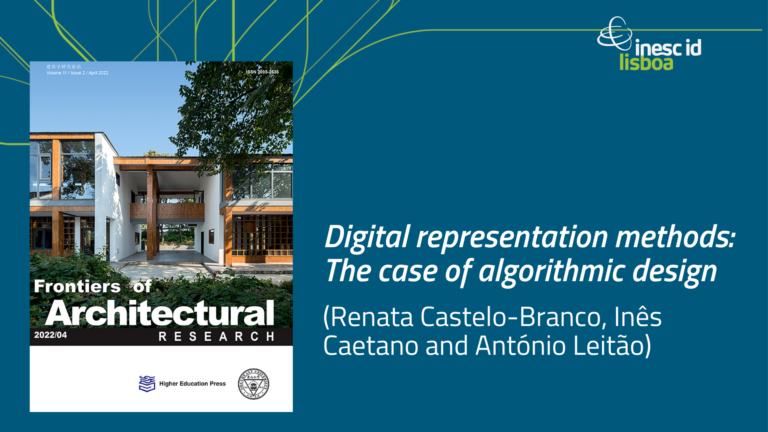
    In her paper Digital representation methods: The case of algorithmic design (recently published in the journal Frontiers of Architectural Research with Inês Caetano and António Leitão), Renata Castelo-Branco — an early career researcher in the Graphics and Interaction Research Area — weighs the many ways in which algorithmic design (AD) is changing the day-to-day of architects. As a tool that breathes new air into what’s possible in describing and representing architectural entities — e.g., a building — AD follows a decades-long history of technological innovations in computer-based methods for architectural design: from computer-aided drafting (CAD) to building information modeling (BIM). AD applies algorithms — a finite set of rules and steps to solve a certain problem — to create a description of the object they want to materialize, with the added advantage that, due to its very nature, AD multiplies the possible number of solutions to a particular architectural question.

    When asked what she considers as the most substantial impact of AD in architectural design, Renata reminds us that “Architecture, like many other art forms, frequently mirrors the technological advancements of its time, and computational design approaches, such as AD, reflect the increasing integration of computer science in the architectural domain,” adding that “As the article shows, AD excels in the production of complex designs, which has been motivating its use in large-scale and non-conventional design problems, such as the Morpheus Hotel in Macau or the Louvre in Abu Dhabi, to name some recent examples.”

    Renata has a good hunch on where the field of AD will move and recognizes some of the hindrances what will have to be overcome, as she expects it to “evolve towards the use of context-specific tools that facilitate its adoption in architecture. Despite the numerous advantages, AD requires programming, a concept with which practitioners often struggle; more so when dealing with models of complex building structures. As a result, the adoption of computational methods has mostly been limited to large architectural studios that resort to expert hiring.” Computational literacy will play a big part in the wider adoption of AD, and here INESC-ID has a big part to play. As Renate concludes “For architecture to benefit from AD at large, we still need to close the existing comprehension gap between AD programs and their behavior, making this representation method more akin to the traditional architectural practice. Our team is currently investigating methods of bridging this gap with more adequate programming environments that can promote a flexible and comprehensible design exploration.”

    Renata is one of the approximately one-hundred-and-fifty early stage researchers currently working at INESC-ID.

    Investigating interactive computer graphics and human-centered computing applied to health, social inclusion, education, architecture, CAD and manufacturing, the Graphics and Interaction Research Area combines computer science, computer graphics, HCI, behavioral and social sciences to address real-world challenges. GI is one of the eleven Research Areas that make up the research tissue of INESC-ID. You can learn more about the INESC-ID Research Areas here.

  • ISTSAT-1: the first satellite fully developed in Portugal will be in space in 2022

    ISTSAT-1: the first satellite fully developed in Portugal will be in space in 2022

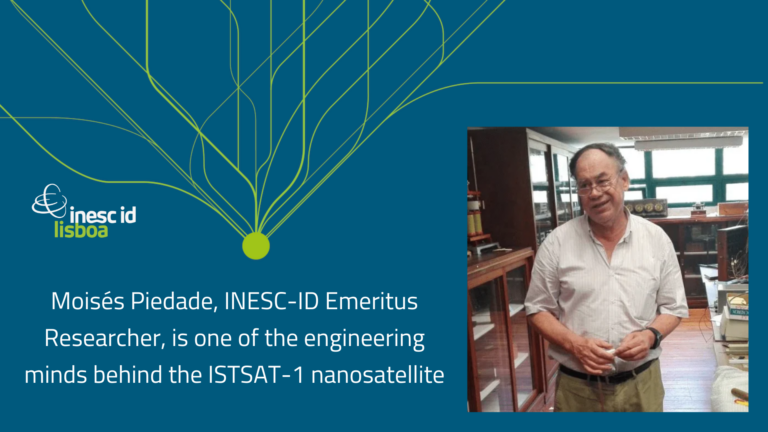
    ISTSAT-1 — the first nanosatellite to be fully developed, from scratch, in Portugal — is set to be launched from the Ariane 6 rocket later this year. ISTSAT-1 has been developed by researchers and students from Instituto Superior Técnico (IST), including Moisés Piedade (retired full Professor at IST and INESC-ID Emeritus Researcher) and coordinated by Rui Rocha (Professor at IST).

    The ISTSAT-1 nanosatellite began its development in 2017 and has its digital eyes set on the remote detection of airplanes from space. Mission control for ISTSAT-1 will be implemented at IST TagusPark, and so fully controlled from Portugal.

    ISTSAT-1 has also been featured in IST’s 110 Histórias, 110 Objetos podcast.

    Moisés Piedade was honoured last year by INESC-ID as Emeritus Researcher in recognition of his outstanding career in the Department of Electrical and Computer Engineering of IST.

  • On games and tales: two papers in “Interactive Storytelling”

    On games and tales: two papers in “Interactive Storytelling”

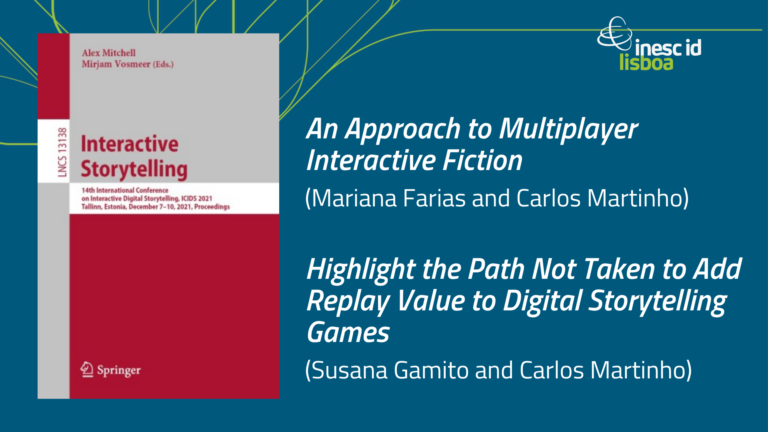
    What is the role of storytelling when multiple players are interacting? That question drove two back-to-back research papers recently authored by INESC-ID researchers – Mariana Farias, Susana Gamito and Carlos Martinho, members of the Artificial Intelligence for People and Society (AIPS) Research Area – in Interactive Storytelling, the proceedings of the 14th International Conference on Interactive Digital Storytelling, ICIDS 2021.

    In An Approach to Multiplayer Interactive Fiction, Mariana Farias and Carlos Martinho generated an interactive fiction experience for two players where both were protagonists of a story while embodying different characters. That experience incorporated the need to guide the players’ attention, significantly improving the fictional experience while helping them follow the story. “It’s very interesting to see how new and innovative ways of interaction are emerging within the field of interactive storytelling,” Farias commented, adding that she is “very excited to see what new experiences we will have in the future that deviate from the classical text format of presenting these stories and to explore what new ways, choices and actions that influence the course of the story can be made within the medium.”

    In their paper, Susana Gamito and Carlos Martinho looked at those decision-making moments that open multiple narrative doors within an interactive storytelling format. In Highlight the Path Not Taken to Add Replay Value to Digital Storytelling Games, Gamito and Martinho used the psychology of regret to look at how players reflect upon their choices and replay a game. By highlighting the path not taken, Gamito and Martinho showed that the game experience could be improved by indicating to players the alternative of what could have been. On their paper, Carlos Martinho commented that “In spite of – in the specific case of this work – being applied to the domain of digital games, the metaphor of interactive narrative has a more transversal importance to human behavior. It is often by telling stories that we explain our surroundings and communicate our ideas.” Martinho also highlighted that “Understanding better how our behavior, in the context of this metaphor, varies from person to person and is sensitive to certain forms of communication, can inform or even pave the way for new formats of interaction between humans and machines. In the case of digital entertainment, it can help to create enriched experiences by adapting to the individual needs of each user, which is one of the main lines of research on which this work is anchored.”

    Investigating AI systems (agents, robots, etc.) that are social and pro-social — with research work that spans many different topics in affective computing, planning, games & interactive storytelling, robotics, evolutionary game theory and machine learning — AIPS is one of the eleven Research Areas that make up the research tissue of INESC-ID, covering a wide range of topics in computer science and engineering and electrical and computer engineering. You can learn more about the INESC-ID Research Areas here.

  • From player’s strategies to natural language interactions: two back-to-back publications in “Videogame Sciences and Arts”

    From player’s strategies to natural language interactions: two back-to-back publications in “Videogame Sciences and Arts”

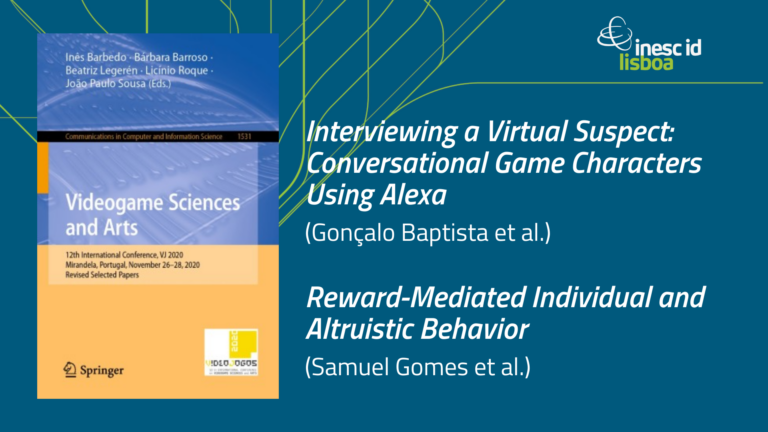
    Samuel Gomes and Gonçalo Baptista — two early stage researchers from the Artificial Intelligence for People and Society (AIPS) Research Area at INESC-ID — have recently published back-to-back research papers in Videogame Sciences and Arts, part of the Springer Communications in Computer and Information Science book series. This issue is comprised of selected papers from the 12th International Conference on Videogame Sciences and Arts (VJ 2020; initially to be held in Mirandela, Portugal, but instead hosted online by the Polytechnic Institute of Bragança, EsACT, on 26 to 28 November 2020).

    In his paper Reward-Mediated Individual and Altruistic Behavior (with the participation of Tomás Alves, João Dias and Carlos Martinho), Samuel Gomes — a PhD student at AIPS — delved into the long-scrutinized balance between individual and altruistic behaviours, an issue of substantial interest in everyday social dilemmas. By examining the extent to which individual and altruistic score functions led players to vary their strategies and interaction motives within Message Across, an in-loco two-player videogame, Gomes and colleagues were able to demonstrate the value of incentive-based strategies in moderating the emergence of in-game behavior perceivable as either individual or altruistic.

    In Interviewing a Virtual Suspect: Conversational Game Characters Using Alexa (a paper authored with Diogo Rato and Rui Prada), Gonçalo Baptista — an alumnus of the AIPS group, where he performed his master’s research — applied a new medium to facilitate the interaction between players and a videogame environment. Using the tools provided by Amazon Alexa, Baptista and his collaborators employed a natural language conversational interaction within the Virtual Suspect game (reported on an earlier publication by Diogo Rato et al.), showing that the use of natural language to support the interaction with game characters has the potential to improve a player’s experience.

    On the novelty his paper represents, Samuel Gomes highlighted that “by exclusively using different reward functions in a two-player game, we could implicitly lead people to assume either individual or altruistic task completion strategies, and to self-report their experience as reflecting those styles of interaction,” adding that his paper “sheds light on how to characterize group interaction styles, contributing to the validation of a model of motives behind interaction (between self-oriented and others-oriented),” ultimately resulting in a model that “can be used to characterize people’s interaction preference, and expanded to reflect the interaction styles allowed in other occasions.” Discussing his paper, Gonçalo Baptista pointed out that its major advancement sits with “the exploration of the incorporation of natural language conversational systems to improve user experience when interacting with video game characters,” elaborating that this study “will enable further research into […] improving the user experience, either with a different conversational system or with a revamped agent, as well as the potential integration of this system in a video game.”

    These two research papers are an exemplary output from the community of approximately one-hundred-and-fifty early stage researchers currently working at INESC-ID.

    Investigating AI systems (agents, robots, etc.) that are social and pro-social — with research work that spans many different topics in affective computing, planning, games & interactive storytelling, robotics, evolutionary game theory and machine learning — AIPS is one of the eleven Research Areas that make up the research tissue of INESC-ID, covering a wide range of topics in computer science and engineering and electrical and computer engineering. You can learn more about the INESC-ID Research Areas here.

  • INESC-ID AI researchers ranked as some of the best in Europe

    INESC-ID AI researchers ranked as some of the best in Europe

    AI Rankingsa metric-based ranking that provides insights into Artificial Intelligence (AI) research worldwide — has ranked the University of Lisbon as 22nd in Europe and 125th worldwide. This placement includes six researchers from the Artificial Intelligence for People and Society (AIPS) Research Area at INESC-ID: Ana Paiva, Francisco S. Melo, Manuel Lopes, Francisco C. Santos, Rui Prada and Andreas Wichert.

    Recognizing that the explosion of AI raises valid concerns regarding its transformational power in our current society, AIPS investigates AI systems (agents, robots, etc.) that are social and pro-social, with research work that spans many different topics in affective computing, planning, games & interactive storytelling, robotics, evolutionary game theory and machine learning.

    AIPS is one of the eleven Research Areas that make up the research tissue of INESC-ID, covering a wide range of topics in computer science and engineering and electrical and computer engineering. You can learn more about the INESC-ID Research Areas here.

  • Collaborative study on innovative breast cancer surgery with augmented reality selected for Elsevier’s World Cancer Day article collection

    Collaborative study on innovative breast cancer surgery with augmented reality selected for Elsevier’s World Cancer Day article collection

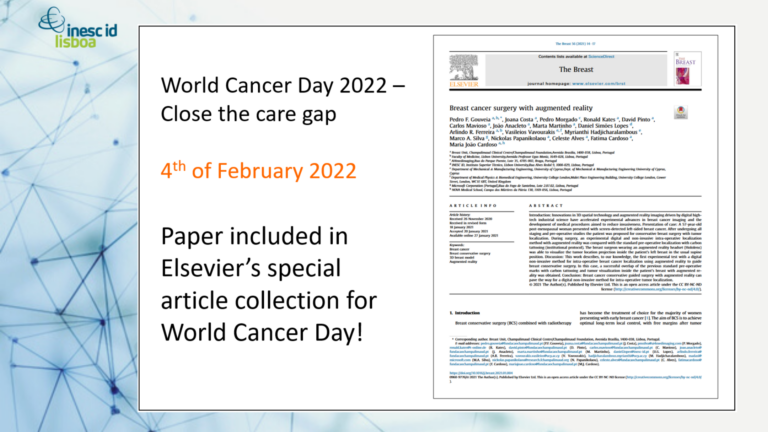
    Breast cancer surgery with augmented reality, a clinical research paper published in April 2021 in the medical journal The Breast, has been selected for inclusion in Elsevier’s World Cancer Day 2022 article collection. This collection includes a curated line-up of some of the top research papers published in Elsevier’s Oncology journal portfolios.

    Daniel Simões Lopes – an INESC-ID researcher within the Graphics and Interaction Research Area and an Assistant Professor at the Department of Computer Science and Engineering of Instituto Superior Técnico – is one of the authors of this paper, the pioneering digital technology of which had already been recognized with the “Best and Greatest in Portuguese Technology” award in the Innovation category by the Portuguese technology magazine Exame Informática in 2020.

    This landmark paper described the first use of an “augmented reality” headset by a surgeon – Pedro Gouveia, a physician from the Breast Unit of the Champalimaud Clinical Centre who performed the surgery and the corresponding author of this study – so they could visualize a virtual representation of the tumor in real time while extracting it from the patient. As the research paper itself states, it described “the first experimental test with a digital non-invasive method for intra-operative breast cancer localization using augmented reality to guide breast conservative surgery”, concluding that this type of surgery with augmented reality “can pave the way for a digital non-invasive method for intra-operative tumor localization.”

    World Cancer Day, marked on 04 February, is an international campaign to raise awareness of cancer, encouraging its prevention, detection, and treatment, while supporting all those living with cancer.

  • New book on electricity production from renewable energy sources

    New book on electricity production from renewable energy sources

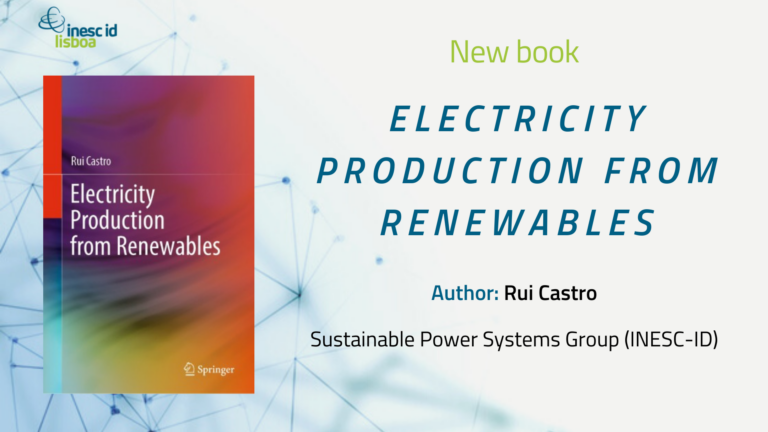
    Rui Castro — a researcher in the Sustainable Power Systems Group at INESC-ID and Associate Professor at the Department of Electrical and Computer Engineering of Instituto Superior Técnico — has published a new book: Electricity Production from Renewables (Springer Nature, 2022).

    In Electricity Production from Renewables, Rui Castro explores economically competitive renewable energy sources (RES), including onshore and offshore wind, solar and small-hydro plants, while focusing on the electricity production from these sources. Presenting theoretical concepts related to the electrical framework associated with RES (alongside examples and solved problems), this book introduces the topic of renewable power sources to graduate students, researchers and practitioners alike.

    Electricity Production from Renewables follows Castro’s two previous volumes on Power Systems (co-autored with Eduarda Pedro; IST Press, 2015) and Renewable Energy (IST Press, 2018), both in Portuguese.


    Full publication details:

    Book title: Electricity Production from Renewables

    Authors: Rui Castro

    Year of publication: 2022

    Publisher: Springer Nature

    DOI: https://doi.org/10.1007/978-3-030-82416-7

    Hardcover ISBN: 978-3-030-82415-0

    Softcover ISBN: 978-3-030-82418-1

    eBook ISBN: 978-3-030-82416-7

    Number of pages: 388