Tag: AI

  • Navigating the Grey Areas: AI and Uncertainty at IPMU 2024
    Navigating the Grey Areas: AI and Uncertainty at IPMU 2024

    Almost nothing in life is black or white, rather a diversity of shades of grey. This is to say that uncertainty is everywhere, including in computational problems. But most of the time, engineers ignore this component of uncertainty, transforming it into zero/one solutions. “And then mistakes happen,” notes João Paulo Carvalho, from the Human Language Technologies research area, a board member of INESC-ID and a professor at Técnico. “When we move to real life, uncertainty takes on a different significance.”

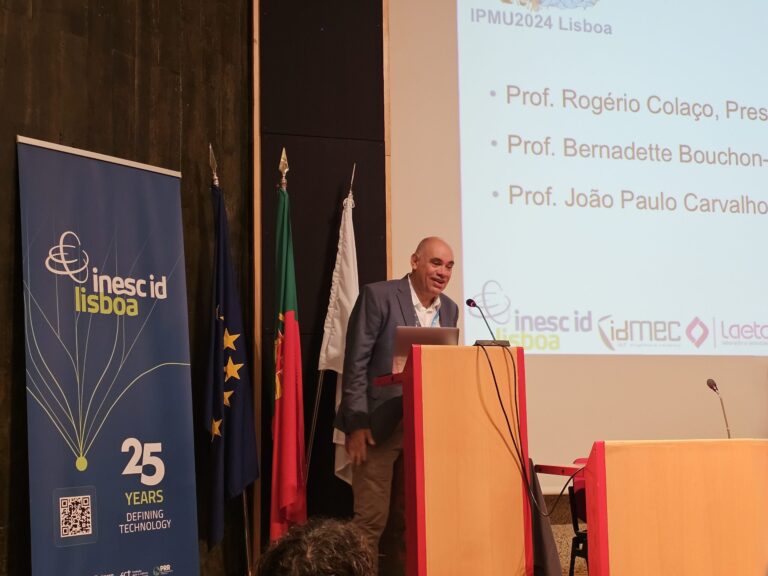
    Since 1986, computational scientists, mathematicians, and engineers gather every two years to discuss this topic at the International Conference on Information Processing and Management of Uncertainty in Knowledge-Based Systems (IPMU). It brings together everyone interested in developing methods for the management of uncertainty and aggregation, which allows for the management of data from multiple models and origins. IPMU2024, the 20th edition, happened from July 22 to 26 at Técnico, Lisbon, under the supervision of João Paulo Carvalho, the General Chair of the event.

    Many things in the area have changed since João Paulo first attended an IPMU. “In 2008, hardly anyone in this area focused on Neural Networks (NN) or Artificial Intelligence (AI). Many thought they were dying,” João Paulo recalls. Now, with the rise and dominance of Large Language Models (LLM) it is what we all know. Both expressions have reached the mainstream, and every year and a half there is a jump in the area that turns previous knowledge outdated. Hence, uncertainty in AI has become one of the main topics in IPMU.

    IPMU represents a privileged forum for the exchange of ideas between theoreticians and practitioners in these and related areas. Around 200 people, from 31 nationalities, attended the conference, with “very positive feedback,” João Paulo mentions. The event was also an opportunity to present some out-of-the-box topics, like the one introduced to a curious audience just on the first morning, by the keynote speaker Keeley Crockett, from Manchester Metropolitan University, UK, who gave a talk under the topic “People Powered AI – Challenges and opportunities in responsible and trustworthy AI development”.

    Apart from a career in computational science, Keeley is very interested in bringing topics such as AI to the public. “I am a people person,” she confesses during a conversation after the talk. “I want to empower people to have a voice,” Keeley adds, referring to the roadshows she used to do, speaking to senior communities. “The challenge is making sure things are done ethically. It is a different level to talk companies into doing it properly. It takes time, and resources.” Money that SMEs may not have to invest in this, she notes. “It is a triangle and the key is legislation.” Recognizing there are lots of people working in the field of ethics in AI – “that has grown in the last three to four years” – there is still a gap to fill, and “it is the people.”

    Text by Sara Sá, Science Writer | Communications and Outreach Office, INESC-ID / © 2024 INESC-ID

    Images | © 2024 INESC-ID

  • Key Insights from the “Leadership in Research and Innovation in the Age of AI” event

    Key Insights from the “Leadership in Research and Innovation in the Age of AI” event

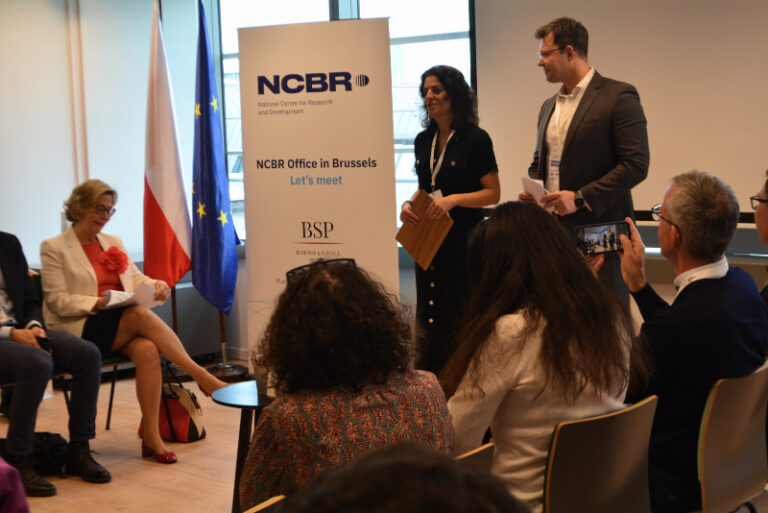
    “AI-driven science extends beyond academia, fostering both innovation and economic growth,” declared the Deputy Director-General for Research and Innovation, Signe Ratso, while participating in the event “Leadership in Research and Innovation in the Age of AI”, an initiative of INESC Brussels HUB, co-organized with the European Commission and the NCBR Office in Brussels.

    Over 60 leading R&D administrators, managers, researchers, and policymakers gathered in Brussels, on June 5 and 6, to discuss this crucial topic in a workshop format, sharing insights and developing strategies to face the challenges posed by AI. INESC-ID President, Inês Lynce, who was one of the six INESC-ID community members participating in the event, emphasized the “diversity of the attendees” and the “strong expertise in public policies some of them possess.”

    The meeting was also an opportunity to discuss the EU strategy on AI since 2018 and initiatives like GENAI4EU and AI Factories and the “Living guidelines on the responsible use of generative AI in research”, as presented by Liviy Stirbat, Head of Unit for AI in Science in the DG for Research and Innovation at the European Commission. From the companies’ side, Ondrej Socuvka, Senior EU Public Policy and Government Affairs Manager at Google EU, shared how Google scientists are pushing AI’s boundaries responsibly.

    “Listening to different perspectives concerning the use of AI in research institutions, in order to help us work better and improve the way they function, is what I cherish the most from the two days with the Brussels Hub,” said Rui Prada, INESC-ID researcher within the Artificial Intelligence for People and Society research area. “These events give us the opportunity to reflect on subjects that we often do not have time to consider in our daily lives.”

    Inês Lynce also stressed the relevance of these immersive experiences: “It forces you to leave your comfort zone and think about the future of the institution and how we can make a difference.”

    Images | © 2024 INESC Brussels HUB

  • INESC-ID Board members and researchers participate in Summer School on leadership in the age of AI

    INESC-ID Board members and researchers participate in Summer School on leadership in the age of AI

    Artificial Intelligence is forcing us to rethink and reshape everything, from leadership to research and innovation. It presents both a challenge and an opportunity. In this defiant and exciting context, INESC Brussels HUB is inviting 25 top R&I administrators, managers, researchers, and policymakers from across Europe to a highly dynamic “lunch to lunch” participatory workshop, taking place on June 5 and 6.

    With an emphasis on active engagement, this summer school ensures valuable and actionable outcomes for all attendees.

    The methodology includes presentations, collaborative discussions and workshops enabling participants to benchmark their practices against leading AI standards; gain insights and innovative strategies for their institutions; network with top experts from academia, industry and policy-making.

    INESC-ID President, Inês Lynce, along with other Board members and researchers from our institution will attend the Brussels meeting, joined by representatives from all other four INESC Group institutions. The list of participants includes AICEP Portugal Global, the European Research Council and various European research institutions.

  • From player’s strategies to natural language interactions: two back-to-back publications in “Videogame Sciences and Arts”

    From player’s strategies to natural language interactions: two back-to-back publications in “Videogame Sciences and Arts”

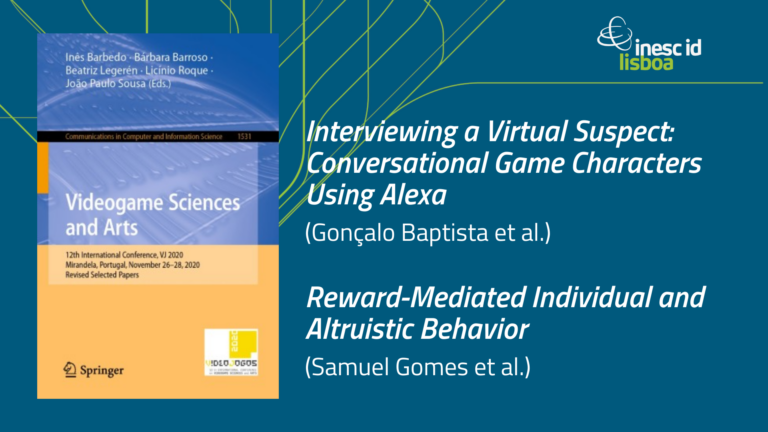
    Samuel Gomes and Gonçalo Baptista — two early stage researchers from the Artificial Intelligence for People and Society (AIPS) Research Area at INESC-ID — have recently published back-to-back research papers in Videogame Sciences and Arts, part of the Springer Communications in Computer and Information Science book series. This issue is comprised of selected papers from the 12th International Conference on Videogame Sciences and Arts (VJ 2020; initially to be held in Mirandela, Portugal, but instead hosted online by the Polytechnic Institute of Bragança, EsACT, on 26 to 28 November 2020).

    In his paper Reward-Mediated Individual and Altruistic Behavior (with the participation of Tomás Alves, João Dias and Carlos Martinho), Samuel Gomes — a PhD student at AIPS — delved into the long-scrutinized balance between individual and altruistic behaviours, an issue of substantial interest in everyday social dilemmas. By examining the extent to which individual and altruistic score functions led players to vary their strategies and interaction motives within Message Across, an in-loco two-player videogame, Gomes and colleagues were able to demonstrate the value of incentive-based strategies in moderating the emergence of in-game behavior perceivable as either individual or altruistic.

    In Interviewing a Virtual Suspect: Conversational Game Characters Using Alexa (a paper authored with Diogo Rato and Rui Prada), Gonçalo Baptista — an alumnus of the AIPS group, where he performed his master’s research — applied a new medium to facilitate the interaction between players and a videogame environment. Using the tools provided by Amazon Alexa, Baptista and his collaborators employed a natural language conversational interaction within the Virtual Suspect game (reported on an earlier publication by Diogo Rato et al.), showing that the use of natural language to support the interaction with game characters has the potential to improve a player’s experience.

    On the novelty his paper represents, Samuel Gomes highlighted that “by exclusively using different reward functions in a two-player game, we could implicitly lead people to assume either individual or altruistic task completion strategies, and to self-report their experience as reflecting those styles of interaction,” adding that his paper “sheds light on how to characterize group interaction styles, contributing to the validation of a model of motives behind interaction (between self-oriented and others-oriented),” ultimately resulting in a model that “can be used to characterize people’s interaction preference, and expanded to reflect the interaction styles allowed in other occasions.” Discussing his paper, Gonçalo Baptista pointed out that its major advancement sits with “the exploration of the incorporation of natural language conversational systems to improve user experience when interacting with video game characters,” elaborating that this study “will enable further research into […] improving the user experience, either with a different conversational system or with a revamped agent, as well as the potential integration of this system in a video game.”

    These two research papers are an exemplary output from the community of approximately one-hundred-and-fifty early stage researchers currently working at INESC-ID.

    Investigating AI systems (agents, robots, etc.) that are social and pro-social — with research work that spans many different topics in affective computing, planning, games & interactive storytelling, robotics, evolutionary game theory and machine learning — AIPS is one of the eleven Research Areas that make up the research tissue of INESC-ID, covering a wide range of topics in computer science and engineering and electrical and computer engineering. You can learn more about the INESC-ID Research Areas here.