Tag: Blockchain

  • “What is missing in Web3 is trust.” CMU Professor, Seth Goldstein, reflects on Blockchain and the future of work
    “What is missing in Web3 is trust.” CMU Professor, Seth Goldstein, reflects on Blockchain and the future of work

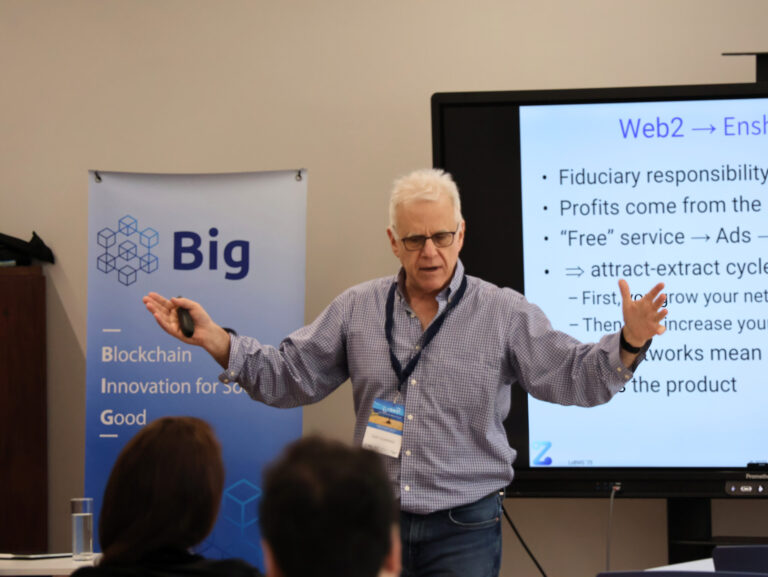
    With its decentralized systems and the potential to reshape how we interact with the internet and conduct business, web3 sounds almost like an El Dorado. At the centre of it lies the technology that powers blockchain. Seth Goldstein, Professor at CMU School of Computer Science, is a committed thinker about the topic. During the Lisbon Blockchain Winter School 25, organized by the BIG Era Chair Project, he shared his mind-opening insights with the attendees, on a keynote under the title Web 3: trust, reputation and the future of money.

    For the specialist, that shared the story of the three technological revolutions mankind has been through, what we are now living is unlike anything we have seen before and therefore a conversation about what is going on is crucial. “With the development of Web3, blockchain, and cryptocurrency, we are entering the third technological revolution (TR3) — one that will transform the labour market, redefine productivity, and fundamentally alter how we work.”

    Web3: The technology of trust

    Web3 is more than just a technological shift; it’s a new social technology that addresses trust in digital interactions. For Goldstein, the heart of blockchain’s innovation lies in the idea that, with it, you don’t have to trust the individual actors involved, but you can trust the results they produce.

    In the past, trust has been central to transactions. From banking to everyday exchanges, we rely on systems and intermediaries to validate and secure transactions. Goldstein compares this to a simple example of money transfer: Imagine a world where individuals didn’t rely on intermediaries like banks but instead could exchange money directly, knowing their transactions would be validated by others in the network, who are incentivized to do so honestly.

    This decentralized validation system is the backbone of blockchain. It operates without a central authority and ensures the authenticity of every transaction, allowing people to trust the results even if they don’t trust each other. As Goldstein puts it, blockchain is “a social technology” where individuals are incentivized to behave honestly, not because of goodwill, but because their economic interests are aligned with maintaining the system’s integrity.

    Is Blockchain for social good?

    One of the most common criticisms of blockchain and cryptocurrency is that they might be used for illicit purposes. Goldstein, however, counters that the transparency inherent in blockchain actually makes it difficult to misuse. Every Bitcoin transaction, for example, is recorded on the blockchain and publicly visible, making it clear who is transferring funds to whom. This transparency might be one of the technology’s most significant strengths in ensuring accountability and trust in the system.

    Goldstein also highlights the broader social impact of these technologies. Just as roads and public infrastructure provide societal benefits, blockchain, Web3, and cryptocurrency can be seen as a public good, accessible to everyone. They allow for decentralized governance and voting, enabling individuals to participate in decision-making processes without the need for centralized power structures.

    Technological revolutions and the future of work

    Goldstein draws parallels between Web3 and earlier technological revolutions. The First Industrial Revolution saw a massive increase in productivity and improvements in living standards. The Second Industrial Revolution, fueled by electricity, further transformed society. However, the third revolution, which is driven by technologies like Web3, artificial intelligence, and blockchain, presents a unique challenge: it will not only increase productivity but also lead to massive disruption in the labour market.

    With the rise of automation and AI, many traditional jobs are being replaced by machines. But there’s a twist: as productivity increases, labour costs are approaching zero. In Goldstein’s view, Web3 represents the solution to this problem by creating new forms of money and economic systems that don’t rely on the traditional methods of trust and control. As the cost of production continues to decrease, individuals may no longer need to depend on traditional jobs to sustain their livelihoods.

    Goldstein also provocatively suggests that the key skills for the future won’t be programming or technical expertise, but rather philosophy, time management, and human-centric skills like empathy, creativity, and social intelligence. As machines take over cognitive and physical tasks, humans will be needed more for their emotional and creative capabilities.

    As Web3 continues to evolve, there’s a need for regulation to ensure that it doesn’t devolve into a system ripe for exploitation. While Goldstein believes that governments shouldn’t be the ones to innovate, their role is critical in establishing boundaries and ensuring that individuals and institutions act within those boundaries. This is where the concept of Adam Smith’s “invisible hand” comes into play — government intervention should be designed to address externalities, like pollution, by setting appropriate costs and regulations.

    In the case of cryptocurrency and blockchain, governments should aim to create a framework where people can innovate but also be held accountable for their actions. With the right regulations, blockchain could remain a force for good — offering transparency and security while providing individuals with the freedom to innovate.

    Reputation-based currency

    Looking ahead, Goldstein envisions a future where reputation is more important than currency. In this new economic model, the currency will be based not on the trust in a central authority but on the trust that people place in each other’s reputations. People will “print” their own money, and the value of that money will be determined by their fiscal reputation — not the government or central bank.

    However, there are challenges ahead. As the labour market changes, Goldstein warns that the transition could be painful, with mass unemployment and social unrest as traditional jobs disappear. Yet, he remains optimistic. If we approach this revolution with the right mindset and adapt to these changes, the future could be bright — even if it requires us to rethink what work means and how we value human skills.

    Goldstein’s greatest fear, however, is the potential end of innovation. With the rise of automation and AI, fewer people may choose to invest the time and effort needed to become experts in their fields. If the pursuit of expertise becomes increasingly irrelevant, we might lose the very drive that has led to humanity’s greatest advancements. This presents a paradox — we’re entering an era of unprecedented technological progress, but we also risk undermining the very factors that drive that progress.

    In conclusion, the Web3 revolution is not just about blockchain or cryptocurrency — it’s about rethinking how we organize and value work, trust, and money in a world where traditional systems are no longer sufficient. While the future may be uncertain, one thing is clear: the changes happening now will define the future of work, society, and how we interact with the digital world. Whether it becomes a utopia or dystopia depends on how we navigate this new frontier.


    Text by Sara Sá, Science Writer | Communications and Outreach Office, INESC-ID
    © 2025 INESC-ID. Credit INESC-ID and the author, and link to the original source when sharing or adapting this article.

    Images | © 2025 INESC-ID

  • From theory to practice, the experience of the first Lisbon Blockchain Winter School

    From theory to practice, the experience of the first Lisbon Blockchain Winter School

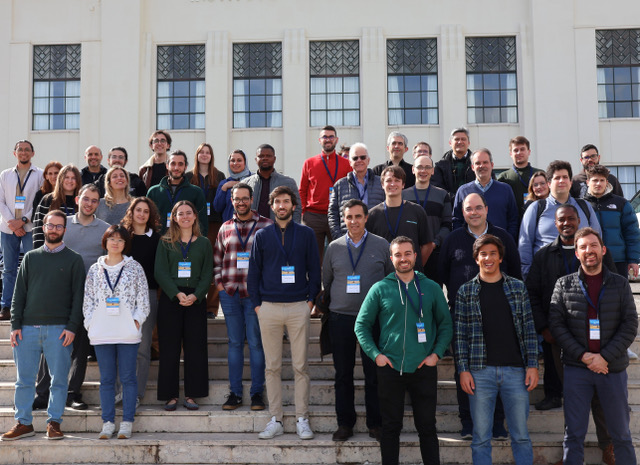
    Experts, professors, and students—some just beginning their journey into blockchain—came together in an environment where distinctions quickly blurred. The first edition of the Lisbon Blockchain Winter School (LxBWS), organized by the BIG ERA Chair project, provided a comprehensive training experience on blockchain technology through lectures, hands-on workshops, and keynotes by leading experts. The event also promoted networking, encouraging collaboration across different levels of expertise.

    “Since the sessions were designed to accommodate varying levels of knowledge—with introductory lectures alongside cutting-edge keynotes—participation was high across the board,” noted David R. Matos, an INESC-ID researcher and coordinator of the event’s organizing team. “For instance, even university professors actively engaged in the blockchain labs, despite their introductory nature”, says David, who is part of the BIG ERA Chair team, which is dedicated to unlocking the full potential of interdisciplinary blockchain research.

    One of the most engaging lab exercises involved creating a cryptocurrency from scratch. The session proved so captivating that even Seth Goldstein, a Carnegie Mellon University professor and renowned expert, enthusiastically took part—despite also delivering a surprising keynote on the future of money.

    “The first Lisbon Blockchain Winter School stands out among the many initiatives of the BIG ERA Chair Laboratory on Blockchain Innovation for Social Good. This lab fosters cutting-edge research, advanced education, and collaborative innovation within an international academic and industrial network,” emphasized INESC-ID researcher, Luís Caires, BIG ERA Chair coordinator and professor at Instituto Superior Técnico, which hosted the event from February 10 to 14.

    Blockchain, well beyond DeFi

    On the industry panel, participants had the opportunity to hear from entrepreneurs representing four exciting tech companies—Unlockit, Anchorage, SenseFinity, and Void—who shared insights into the triumphs and challenges of launching a company in today’s rapidly evolving technological landscape.

    INESC-ID researchers also played a key role in the event, that gathered 50 participants. Miguel Correia, President of INESC-ID’s Executive Committee, delivered a talk on Blockchain Applications and Digital Identity, while Miguel Pardal, coordinator of the Blockchain PRR-funded project, presented a lecture on Food Traceability with Blockchain.

    “While blockchain is often narrowly associated with decentralized finance (DeFi), its potential as a trustworthy, transparent, and consensus-based technology extends far beyond that. Sectors such as healthcare, public governance, and business are beginning to see its transformative impact,” noted Luís Caires.

    Participants’ feedback was very positive, with many describing the experience as “extremely enriching.” They praised the quality of speakers and presentations, the variety of sessions (which included both advanced and introductory content), and the event’s overall organization. Many even suggested that the initiative should be repeated next year. And while it wasn’t explicitly mentioned, it’s fair to assume that Lisbon’s winter sunshine may have also played a role in the event’s success.

    Images | © 2025 INESC-ID

  • INESC-ID’s PRR projects on display at Técnico Innovation Summit

    INESC-ID’s PRR projects on display at Técnico Innovation Summit

    A robot dog greeted visitors at the Técnico Innovation Summit, drawing a heart in the air with its front paws. It charmed everyone, and the research team behind the Sustainable Stoneby Portugal project looked on proudly at their “pet.”

    The first edition of the Técnico Innovation Summit, held on November 4 and 5 at the Técnico Innovation Center during the PhD Open Days, showcased projects with significant economic impact, particularly those funded through Portugal’s Recovery and Resilience Plan (PRR).

    INESC-ID was well-represented with four of its five projects:

    • Accelerat.ai: driving digital transformation in Portugal’s public and private sectors through technologies like conversational systems for the national health helpline SNS24;
    • Centre for Responsible AI (CRAI): developing fair, explainable, and sustainable AI solutions;
    • Blockchain.pt: establishing a national blockchain network to position Portugal as a global leader in blockchain innovation;
    • Alliance for Energy Transition (ATE): fostering an ecosystem for energy transition and decarbonization.

    Over the two-day event, numerous visitors passed through the venue, including students, entrepreneurs, researchers, and government representatives who also attended the nomination ceremony for the 21 new members of the National Council for Science, Technology, and Innovation (CNCTI).

    “We were visited by Pedro Dominguinhos, President of the National Monitoring Committee for PRR, and Carla Branco Santos from the Executive Committee of IAPMEI,” shared Rubén Solera-Ureña, a researcher in Human Language Technologies involved in the Accelerat.ai project.

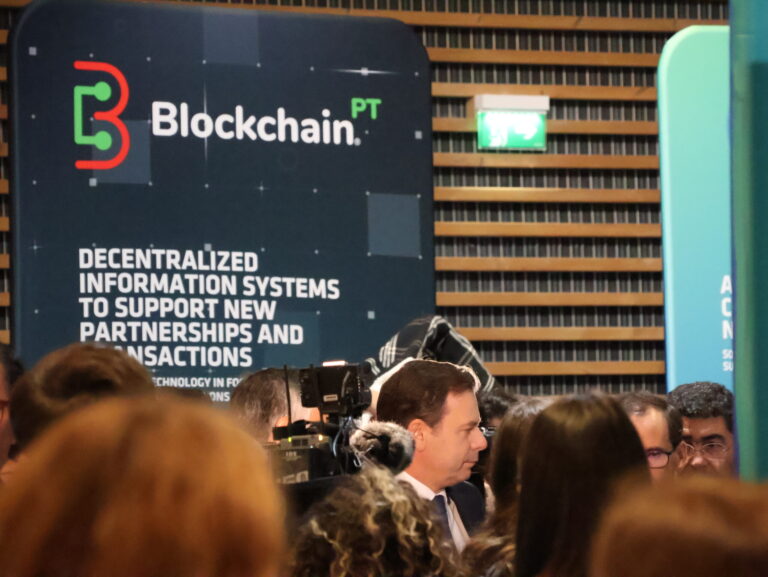
    During their visit to the expo site, Prime Minister Luís Montenegro and his team visited various booths, including that of CRAI. Here, researchers demonstrated AI products developed under the project, such as a home physical therapy platform, a communication solution for ALS patients, and a platform to help hospital doctors automate administrative tasks.

    Images | © 2024 INESC-ID

  • PRR Projects:                                                    Mirror, mirror on the wall, am I real or am I fake?

    PRR Projects: Mirror, mirror on the wall, am I real or am I fake?

    Working in agriculture is exhausting, unpredictable, and sometimes not financially rewarding. Miguel Batista is a son, grandson and a great-grandson of cherry producers and he surely knows what he is talking about when mentioning the hardships, and also the joy, of living off farming. “I am afraid my son will not be a cherry producer”, he admits while talking at a debate taking place at Festa da Cereja, in Alcongosta, Fundão. Under the name “Cherry 4.0 – on the road to modernization”, organized by the Ciência Viva Agency and the Fundão Municipality, the gathering joined cherry producers, scientists and technology people. Batista, from the company Sota e Lino, provided the motto for the discussion. “When I started 30 years ago, no one checked the labels. Nowadays, everybody does.”

    And there is a lot of information that can be added to a label, like the origin, carbon footprint, fertilizers used during cultivation, all of this weighs increasingly more when the consumer decides. The Agenda “Decentralize Portugal with Blockchain”, funded under the PRR (Programa de Recuperação e Resiliência), in which INESC-ID is one of the promoters, aims to create a national blockchain network, preparing the country to be a world leader in the technology. It was also showcased during the debate.

    Coordinated by VOID Software and comprising 56 entities, including companies, research institutions, associations, and public bodies, “Decentralize Portugal with Blockchain” is organized into ten work packages addressing sectors like agriculture, digital asset management, and interoperability. With an investment exceeding 72 million euros, the agenda aims to launch 26 scalable products with significant export potential. Key focuses include “farm-to-fork” traceability integrating IoT with blockchains, managing digital assets in real estate and beyond, and interoperability solutions for data exchange between diverse blockchain systems and technologies across sectors. The end goal, as described on the project’s website, is “to propel Portugal to the forefront of blockchain technology in Europe and advance the country’s digital transformation.”

    Tracing the origins of Cereja do Fundão

    One of the proposed applications – Work Package 1 – is concerning the traceability of Cereja do Fundão. Fundão Cherries, cultivated in the Cova da Beira region of Portugal, stand out for their superior quality and unique characteristics that make them valuable in the market. However, it is important that they are authentic and monitored from origin to consumer. So, the goal of this demonstrator is to develop a first version of an innovative information system to ensure the traceability of Fundão cherries from harvest to consumer, with the vision of the “importance of technology as a driver of innovation and taking advantage of global business opportunities made possible by this technology”, notes the coordinator of the project, Miguel Pardal, an INESC-ID researcher, from Distributed Parallel and Secure Systems, and a professor at Técnico. “The use of Blockchain aims to ensure the integrity of the collected data, providing a reliable source of information about the origin and quality of cherries”, Pardal explains. “Unlike traditional databases, it is not under the control of a single entity but rather involves a network of partners, including producers, distributors, retailers, and technology providers.”

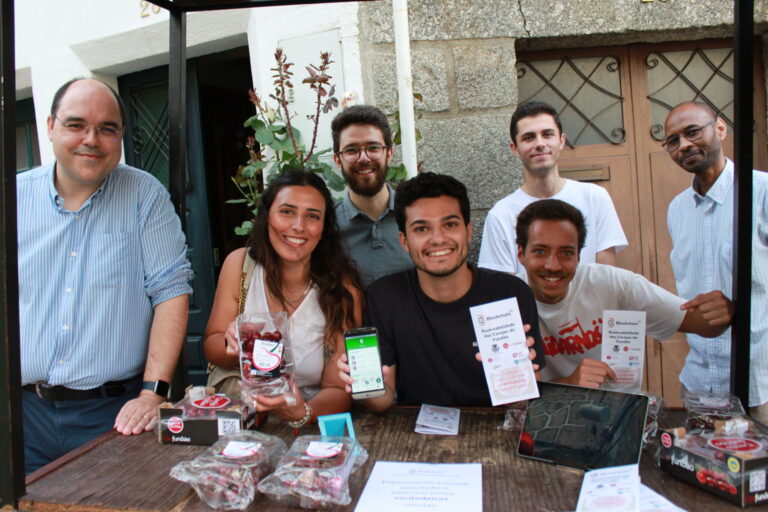
    Festa da Cereja, in Alcongosta, was the perfect opportunity to demonstrate it to the population and test its impact. The demonstrator, developed in collaboration with the organization of cherry producers Cerfundão, the retailer Sonae MC and the technology company Sensefinity, included an app through which consumers can have access to the information.

    Visitors passing through the main street of the mountain village during Festa da Cereja were looking for the traditional cherry products, like pies and liquors. But they also found technology. For two days, on the stand of Blockchain.pt people could test the system and become familiar with the main aspects of the project. By reading the QR code on the box, the app would show the community area (freguesia) in which it was produced and all the steps the fruits have gone through to reach the customer. “The focus of this initial demonstrator is the assurance of origin and, therefore, the locations involved in the supply chain. In the future, the system will include integrated sensors for temperature, humidity, light, and vibration, for example, in field boxes and packaging labels, to enable better monitoring of transportation and storage conditions”, Miguel Pardal explains.

    Where technology meets tradition

    The project involves a group of master students, working on the app in order for it to be appealing to end users, with a gamification component. All the server programming is also with INESC-ID. The smart label is being developed by Sensefinity with the data sent through LoRa net. The position, detected by GPS, is communicated every five minutes, from the fields to Cerfundão, and then on every thirty minutes. The labels are attached to the boxes and pallets and the sensor also registers temperatures and humidity. “These data can be relevant in case there is some sort of sanitary problem”, underlines the CEO of Sensefinity, Orlando Remédios.

    The system will be integrated with the enterprise information systems of the partners involved in the supply chain. The use of Blockchain aims to ensure the integrity of the collected data, providing a reliable source of information about the origin and quality of the cherries. “Unlike traditional databases, this information is not controlled by a single entity, but by the group of partners involved in the system, including producers, distributors, and retailers, as well as the technology providers involved”, Miguel Pardal explains.

    “This approach enables the construction of shared systems even in environments where there is only partial trust between partners, which often hindered the adoption of new technologies. By using blockchain, we can ensure that data and code are managed securely and transparently, eliminating single points of failure and preventing fraud. This model can be applied to various sectors and help boost the economy.” Miguel Pardal

    Cherries were only a start. Other food products might follow, like almonds and meat. “This project is building a food traceability system that provides guarantees about the origin of products”, Miguel Pardal summarizes. “It can also monitor their storage and transport conditions to protect quality and freshness.”

    According to Miguel Pardal, this project can have a significant impact on the agriculture sector, protecting and adding value to Portuguese products. “From a research perspective, it allows for experimenting with new business integration architectures by implementing a logically centralized system—simpler, with which all participants communicate and with common data schemes—but with technological guarantees that data storage and code execution are performed in a decentralized and consensual manner among all business partners. This approach enables the construction of shared systems even in environments where there is only partial trust between partners, which often hindered the adoption of new technologies. By using blockchain, we can ensure that data and code are managed securely and transparently, eliminating single points of failure and preventing fraud. This model can be applied to various sectors and help boost the economy.” A new dawn is rising.

    Text by Sara Sá, Science Writer | Communications and Outreach Office, INESC-ID / © 2024 INESC-ID

    Images | © 2024 INESC-ID

    A team of INESC-ID was at Festa da Cereja, Alcongosta, with a demo of the Blockchain.Pt project