Tag: gaips

  • Science, families and fun. European Researcher’s Night had it all!
    Science, families and fun. European Researcher’s Night had it all!

    To celebrate science across Europe is the goal of the European Commission’s initiative, European Researchers’ Night (NEI). And that’s exactly how it felt last Friday, the 27th, at Marina de Oeiras – a celebration!

    At 12 years old, Renata is very sure of what she wants to be when she grows up. The eighth-grader likes Biology the most and wants to be a scientist or an astronaut. Accustomed to attending science outreach events, Renata visited INESC-ID’s booth at NEI, where she tested the Alien Bar game  developed at Group of Artificial Intelligence for People and Society (GAIPS Lab), to explore cooperation between people. Throughout the afternoon, the researchers Samuel Gomes and Luís Costa, both regulars at such events, explained to visitors the concept behind these so-called serious games.

    Spread across three tables, INESC-ID’s participation at NEI, which has been celebrated throughout Europe since 2005, included a demonstration of platforms to study the psychology behind cooperation and teamwork, games to help cope with psoriatic arthritis and a demo of a social robot, interacting with the attendees. We also had the project Engenharia para Todos, aimed at promoting skills in the fields of Science and Technology.

    Although it was her first time participating in such events, PhD student and researcher Bárbara Ramalho from HUMAN Lab in Graphics and Interaction appeared completely at ease. Together with the master’s students Marta Vicente and Hugo Escobar, they showcased the game iPROLEPSIS, inviting volunteers to play while explaining how its tasks are designed to train wrist rotation or breathing—movements that are often affected in people with psoriatic arthritis.

    Also in the games section, we had Inês Lobo, from GAIPS, displaying the collaborative game Geometry Friends, highlighting a study that explores human interaction with agents, exhibiting different levels of initiative – leader, follower, shift initiative.

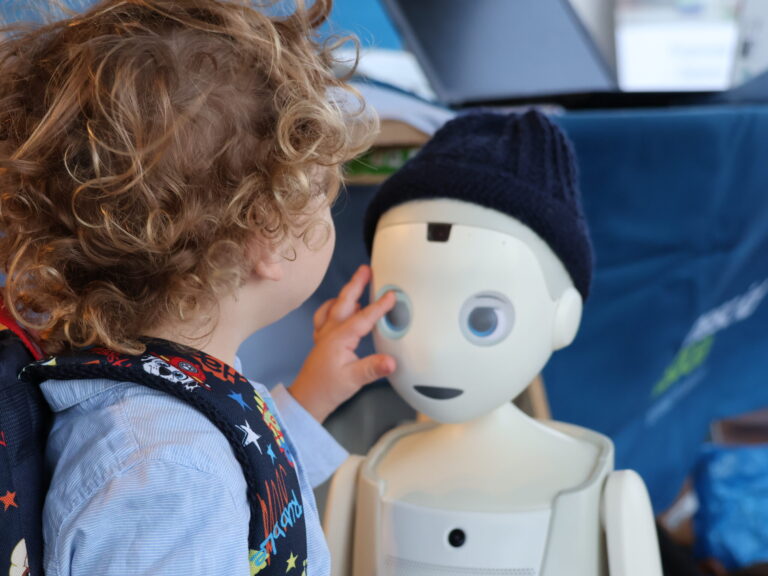
    Undoubtedly, the star of the show was Navel, our social robot, easily recognisable with its blue beanie and blinking eyes. Developed at GAIPS, Navel simulates a curious little boy and is designed to engage in social interactions in hospitals, elderly care institutions, or any setting where human contact is needed. Research assistant Haohua Dong proudly and enthusiastically took care of Navel throughout the event.

    INESC-ID’s participation in NEI Marina, an event promoted by António Xavier Institute of Chemical and Biological Technology of the NOVA University of Lisbon (ITQB NOVA), in partnership with the Município de Oeiras, offered a dynamic and interactive experience, showcasing the intersection of technology, human interaction, and social good. And was definitely a rewarding experience to all of the people involved.

    Text by Sara Sá, Science Writer | Communications and Outreach Office, INESC-ID / © 2024 INESC-ID

    Images | © 2024 INESC-ID

  • Tokyo within reach of an internship: opportunity for INESC-ID PhD students

    Tokyo within reach of an internship: opportunity for INESC-ID PhD students

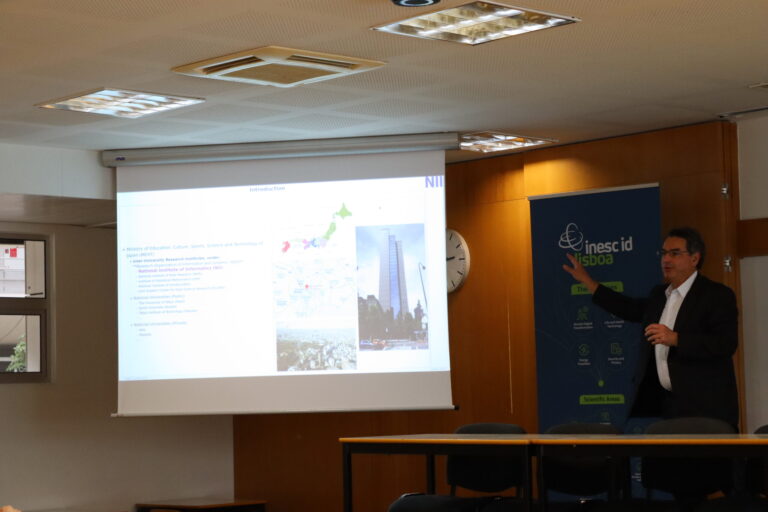
    It starts with an internship and it may end up in marriage. “Portuguese students love Japan,” reveals Emmanuel Planas, the professor in charge of the International Internship Program at NII- National Institute of Informatics, in Tokyo. “In some cases, after the internship they get a job and get married”, he adds after his presentation, last week, at Técnico Oeiras, to present the Memorandum of Understanding (MOU) signed between INESC-ID and the NII. Through this agreement, INESC-ID’s and IST’s Master’s in Computer Science students are invited to apply to an internship.

    This MOU with INESC-ID has been in place since 2011, after Rui Prada, from Artificial Intelligence for People and Society research area and a teacher at Técnico, became aware of this possibility, while completing a post-doc at NII. “I realised it was a good opportunity for students.”

    Finishing his tour around Europe to present this competitive program, established with the most reputable institutes in the world, the acting director of the Global Liaison Office explained to the audience the main aspects of the MOU. Every year, the NII receives 140 masters’ and doctoral students to this paid internship, lasting 2 to 6 months.

    At NII, located in the centre of the metropolis, very close to the Ministry of Education from Japan, there are 350 scientists, working in three research areas. Before applying, candidates must choose a topic and approach a senior researcher to work with during the internship. There are two calls every year, one in April and another in September, with 60 to 70 interns accepted per call. In each institute there is a referee who receives the applications, selects them and sends them to NII. AT INESC-ID, Rui Prada is the person in charge.

    Ana Carrasco, a PhD student, working in social robotics at GAIPS, has spent six months at NII under the MOU and highly recommends it. So much so that she is considering applying once more. “It’s an amazing experience”, she summarizes. “People are so friendly that I hardly felt the language barrier”, Ana adds, anticipating what might be felt as an obstacle by potential candidates.

    So far, around 40 students from INESC-ID/Técnico have joined the programme, Rui Prada estimates. ‘Ja ne’ Tokyo.

  • The world needs more girls and women in tech and INESC-ID is helping to achieve that goal

    The world needs more girls and women in tech and INESC-ID is helping to achieve that goal

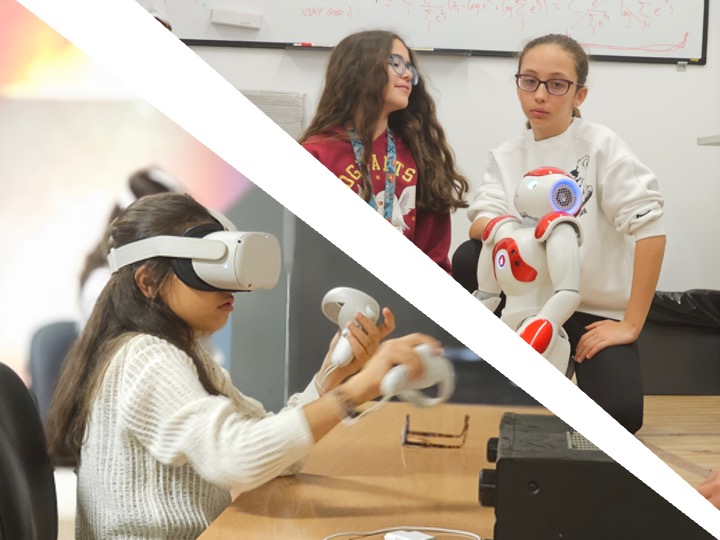
    It is inevitable! There is a natural urge to hold the dancing robot when it interrupts the choreography, falling down as programmed. This act, performed at INESC-ID Social Robotics Lab, from the Group of AI for People and Society (GAIPS), captured the full attention of elementary students from Agrupamento de Escolas de Miraflores, Oeiras, who were participating in the International Girls in ICT Day, celebrated at Técnico’s Taguspark Campus, on April 24th.

    If gender equality were attained in the Information and Communications Technology (ICT) sector, a market of up to 50 billion euros would open up, according to UNESCO. And this in only one of the reasons to celebrate and encourage girls to enrol in a career in this area.

    Since 2011, the International Telecommunication Union (ITU) has been promoting the event to raise awareness and stimulate girls and women to pursue a career in Science Technology Engineering Art and Math (STEAM). To mark the date, the GIRLSTEAM’24 received 150 students, who participated in activities promoted by INESC-ID and other research centres, such as the Institute for Bioengineering and Biosciences (IBB) and the Games Lab.

    During the visit, the students learned that besides entertaining, robots can also help children with autism navigate a world of sensory overload or accompany impaired people complete some tasks. And even solve some complicated math calculations. “Can they divide by zero?”, asked young Mateo.

    We could wager 100% of the youngsters that visited us are, in a way, gamers. But it certainly came as a surprise to realize that games can be a way to study altruism, as Samuel Gomes, also from GAIPS, does, or to cope with diseases, as the INESC-ID researcher, Sandra Gama, from the Human Lab, at the Graphics and Interaction (GI) group, pursues.

    In Europe, women hold just 22% of the tech industry’s positions and worldwide, out of the 7 million people who work in the ICT sector, only 30% are women. It is widely recognised technology is the language of tomorrow, cutting across many different professions, from health to economics. Girls must have a role in the future – for the sake of mankind.

    (Image: students participating in GI and GAIPS activities at GIRLSTEAM24 | © 2024 INESC-ID)