Tag: Gender Balance

  • In the Media: Inês Lynce discusses Educational and Societal challenges in Computer Science at Visão newsmagazine

    In the Media: Inês Lynce discusses Educational and Societal challenges in Computer Science at Visão newsmagazine

    In a profound interview at Visão newsmagazine, INESC-ID President, Inês Lynce, discusses the evolution of computational sciences, particularly in relation to Artificial Intelligence (AI), and why the perception of radical change might not be entirely accurate, despite visible advancements. Inês details that while the foundations of AI and machine learning have been around since 1956, the real game-changer has been the increase in computational power and the vast amounts of data now available, making these technologies much more effective.

    The conversation also touches on the importance of demystifying AI and the need to explain how algorithms reach their conclusions, due to their inherent opacity. The concept of “Reinforcement Learning” is mentioned, likening it to Pavlov’s experiments, where rewards are used to train algorithms. The interview further explores the contrast between apocalyptic and awe-struck views of AI, emphasizing the significance of scientific communication for the general public.

    On a topic that is particularly important to her, Inês expresses concern about increasing female representation, breaking the stereotype that certain fields are predominantly male, and highlighting the positive impact of having women in leadership roles.

    Confessing her enthusiasm for the interaction with students, the professor at Técnico also reflects on the role of persistence and passion in scientific research and teaching. While research is portrayed as a solitary endeavour that heavily depends on peer acceptance, teaching is seen as offering immediate rewards. The ongoing shift in the education system, with a greater focus on autonomous learning by students, is a topic that is also of great relevance to Inês and that has been expressed clearly.

    The interview is on the printed edition of Visão newsmagazine, August 15, and is also available here.

  • Addressing Gender Imbalance in Academia: Insights from CMU’s Jeria Quesenberry

    Addressing Gender Imbalance in Academia: Insights from CMU’s Jeria Quesenberry

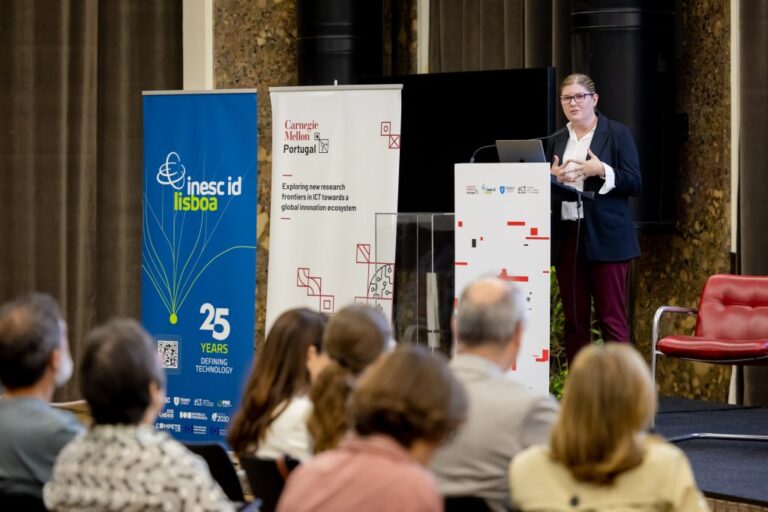
    “Fighting gender imbalance is not hard. In fact, it is much easier than nuclear physics or Artificial Intelligence,” states Jeria Quesenberry, professor of Information Systems at Carnegie Mellon University (CMU) and author of the book “Kicking Butt in Computer Science: Women in Computing at Carnegie Mellon University”. Jeria was speaking during the roundtable that followed the talk “Breaking Barriers in Technology: Women in Computing at Carnegie Mellon and Global Perspectives,” held on June 26 at Instituto Superior Técnico in Lisbon, an event co-organized by INESC- ID and the Técnico Gender Balance Group.

    Jeria shared the outcomes of her research on women in computing, highlighting best practices and challenges from her experience at CMU and showcasing examples from the Computer Science undergraduate program at CMU over the years. According to the researcher, “Gender imbalance is a topic that requires work. It is a multifaceted problem that demands a multi-layered approach.” She added: “When I started my research 25 years ago, this was a new topic. Now there is a broader recognition of the problem; speaking about gender balance is no longer a question.”

    As of 2019, in the US, women represent just over half of the professional workforce but only 27% of computing jobs, and African American and Latinx women hold less than 10% of computing occupations. The highest representation of women in ICT work can be found in the Asia-Pacific region (30.4% women) and Africa (31.3% women).

    Regarding Carnegie Mellon University’s reality, CMU SCS undergrad gender diversity has been higher than national averages for 15+ years. In 2019, 49% of new CS students were women. Since 2022, that percentage has been divided between women and nonbinary; in 2023, it was registered at 46% and 3%, respectively. Regarding major graduates, females and males are at about the same rate – women are 93%, and men are 92%. In the mid to late 90s, female students only represented 5-12% of the students in the field.

    The roundtable themed “Gender Imbalance in STEM: The Portuguese Academic Experience” gathered Ana Paiva, Portuguese Secretary of State for Science; Anália Cardoso Torres, Professor at Instituto Superior de Ciências Sociais e Políticas, Universidade de Lisboa; Inês Lynce, National co-Director of the CMU Portugal Program and President of INESC-ID; Jeria Quesenberry; João Peixoto, Vice-Rector of Universidade de Lisboa; Leonor Barreiros, a master student at Instituto Superior Técnico; and Luís Lemos Alves, Professor at Instituto Superior Técnico. Sara Sá, science writer at INESC-ID, moderated the discussion.

    Fresh out of the oven, Anália Cardoso Torres presented findings from the study “Gender Equality in Higher Education Institutions,” which analyzed gender equality policies in Portuguese higher education. The study revealed that despite late efforts, Portugal is making strides in addressing gender inequalities in academia. Inês Lynce shared her personal experience and discussed the underrepresentation of women in academic leadership and the importance of fostering self-confidence in young girls from an early age. Ana Paiva highlighted the need to guarantee gender balance in the law, but supporting education, awareness, and cultural activities can have a big impact. The Secretary of State mentioned some activities that have been developed, such as the RESTART Program.

    Jeria’s trip to Portugal included a visit to INESC TEC in Porto and is part of the tradition of bringing Carnegie Mellon University speakers to Portugal to share best practices and experiences on the topic of gender balance in academia. A subject that (unfortunately) still needs to be discussed.

    Text adapted from

    Images | © CMU Portugal