Tag: girls in ICT

  • In the Media: Fixing the system, not the women. Ana Teresa Freitas writes in Público, on Girls in ICT Day

    In the Media: Fixing the system, not the women. Ana Teresa Freitas writes in Público, on Girls in ICT Day

    On International Girls in ICT Day, Ana Teresa Freitas, INESC-ID researcher and President of the Department of Computer Science and Engineering (DEI) at Instituto Superior Técnico, published an opinion article in Público that highlights a persistent and often overlooked issue in the digital transformation: the underrepresentation and under recognition of women in Information and Communication Technologies (ICT).

    The researcher, that has been actively involved in this subject, begins by reminding readers that the history of ICT is rich with the contributions of pioneering women. From Ada Lovelace, who wrote the first algorithm, to programming pioneers like Grace Hopper, Ida Rhodes, Jean Bartik, Kathleen Antonelli, and many others, women have played a foundational role in shaping the digital world. Yet their names are often left out of the narrative, and their legacies remain under-celebrated.

    Despite this long-standing contribution, Ana Teresa points out that women and girls continue to be a minority in ICT, not because of a lack of ability or interest, but because of structural and cultural barriers that persist in education, hiring, promotion, and workplace environments. Too often, efforts to address this imbalance have focused on encouraging women to adapt to male-dominated models of behaviour and success—what she calls “fixing the women.” Instead, the author argues, we must fix the system.

    “The rules of the game need to be rewritten,” Ana Teresa insists, “so that success no longer depends on fitting into outdated moulds but on valuing diverse profiles and work styles.” Diverse teams, she explains, are more innovative and better equipped to design solutions that reflect the needs of diverse populations. In a sector where talent is scarce, attracting and retaining women isn’t just about fairness, it’s a competitive imperative.

    There are, however, reasons for optimism. In 2024, 40% of PhD theses defended at DEI were presented by women.

    “Talent has no gender, and the technology of the future needs every brilliant mind. It’s up to all of us to fix the system so that this talent is not wasted, but empowered.”

    The article is available here (under paywall).

  • The world needs more girls and women in tech and INESC-ID is helping to achieve that goal

    The world needs more girls and women in tech and INESC-ID is helping to achieve that goal

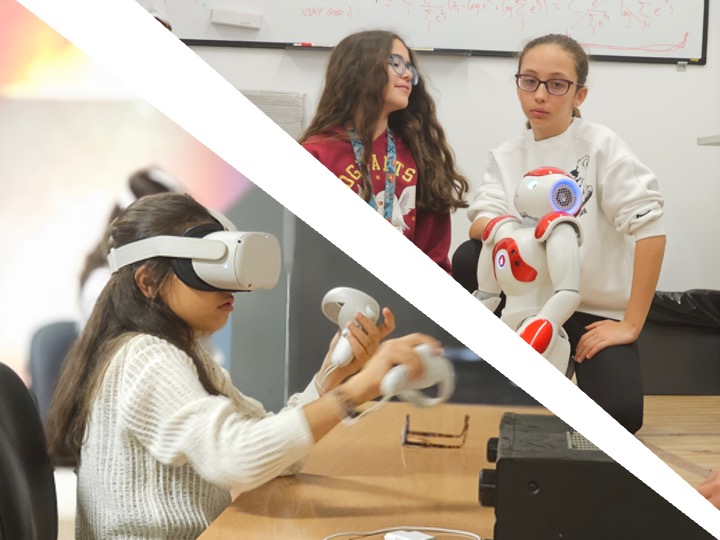
    It is inevitable! There is a natural urge to hold the dancing robot when it interrupts the choreography, falling down as programmed. This act, performed at INESC-ID Social Robotics Lab, from the Group of AI for People and Society (GAIPS), captured the full attention of elementary students from Agrupamento de Escolas de Miraflores, Oeiras, who were participating in the International Girls in ICT Day, celebrated at Técnico’s Taguspark Campus, on April 24th.

    If gender equality were attained in the Information and Communications Technology (ICT) sector, a market of up to 50 billion euros would open up, according to UNESCO. And this in only one of the reasons to celebrate and encourage girls to enrol in a career in this area.

    Since 2011, the International Telecommunication Union (ITU) has been promoting the event to raise awareness and stimulate girls and women to pursue a career in Science Technology Engineering Art and Math (STEAM). To mark the date, the GIRLSTEAM’24 received 150 students, who participated in activities promoted by INESC-ID and other research centres, such as the Institute for Bioengineering and Biosciences (IBB) and the Games Lab.

    During the visit, the students learned that besides entertaining, robots can also help children with autism navigate a world of sensory overload or accompany impaired people complete some tasks. And even solve some complicated math calculations. “Can they divide by zero?”, asked young Mateo.

    We could wager 100% of the youngsters that visited us are, in a way, gamers. But it certainly came as a surprise to realize that games can be a way to study altruism, as Samuel Gomes, also from GAIPS, does, or to cope with diseases, as the INESC-ID researcher, Sandra Gama, from the Human Lab, at the Graphics and Interaction (GI) group, pursues.

    In Europe, women hold just 22% of the tech industry’s positions and worldwide, out of the 7 million people who work in the ICT sector, only 30% are women. It is widely recognised technology is the language of tomorrow, cutting across many different professions, from health to economics. Girls must have a role in the future – for the sake of mankind.

    (Image: students participating in GI and GAIPS activities at GIRLSTEAM24 | © 2024 INESC-ID)