Tag: Hugo Morais

  • The Chicken-and-Egg Dilemma of Electric Mobility: Reflections from the EV4EU Conference
    The Chicken-and-Egg Dilemma of Electric Mobility: Reflections from the EV4EU Conference

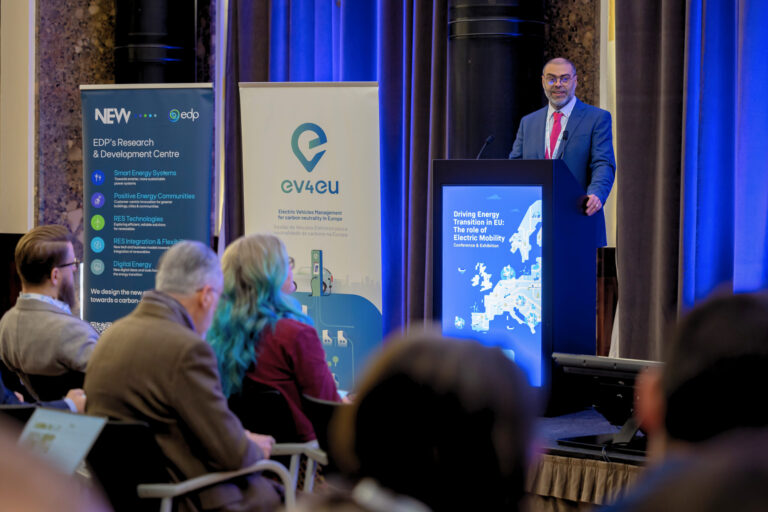
    It was a cold winter morning, blessed with sunshine that lured people to the main entrance of Instituto Superior Técnico, in Lisbon, enjoying the warm rays while chatting about … energy. Their badges revealed a shared purpose, the conference Driving Energy Transition in EU: The Role of Electric Mobility, promoted by the INESC-ID project EV4EU.

    The event gathered on January 15 specialists from around the world, coming both from research institutes and companies, to discuss electric mobility and the energy transition in Europe. An issue that INESC-ID project coordinator and Conference Chair, Hugo Morais, described as the “chicken-and-egg” dilemma of EV adoption: “no cars without infrastructure, and no infrastructure without cars.”

    Some of the projects in focus are intended to solve the riddle, such as the Scale Project – a user-centric approach, involving seven countries, to address the complexities of scaling EV infrastructure; DRIVE2X, with demos in Maia, Portugal, and Amsterdam, the Netherlands, highlighting real-world applications of EV technology, the project aims to accelerate the uptake of vehicle electrification through new bi-directional smart charging technologies; FLOW Project, that tackles the increase in energy efficiency through energy exchange with buildings, vehicles and the grid and XL-Connect, in which the main goal is to optimize the entire charging process, from the energy generation until the end user, by developing a digital twin of the entire system and developing optimal smart charging technologies.

    At the opening session, Inês Lynce, President of the Board of Directors, aptly remarked that we are living in the best time in history to discuss such a relevant topic. “We are in the right place, at the right time,” she said, emphasizing the importance of attracting young people to contribute to this transformative journey. Rogério Colaço, President of Instituto Superior Técnico, added that the shift to electric vehicles (EVs) represents “one of the greatest challenges of our time”, but one that is critical. He noted that EVs are inherently “more efficient than internal combustion engine vehicles”, a fact that underpins their central role in the energy transition.

    Voices from Portugal and Beyond

    Admitting the problem is more than ten years old, Jorge Martins from REN, presented the new Fast charging using transmission network Speed-E, with the belief that “this time, the market will take off”. “Electric trucks, though fewer in number, hold immense relevance due to the extensive kilometres they cover.

    “The issue is not energy availability but power capacity, especially during peak demand”, stressed Hugo Morais, while Rui Gonçalves, from E-Redes, emphasized the need for significant grid upgrades, with planned investments increasing by 50% between 2026 and 2030. “Flexibility”, he argued, is key to address the challenges of energy transition for grids.

    Portugal was celebrated as a case study in electric mobility. Débora Melo Fernandes, lawyer and Partner at Pérez-Llorca, specialized in energy, highlighted the country’s pioneering 2010 regulatory framework, which fostered a user-centric and competitive ecosystem. Débora outlined challenges such as fragmented regulations and lengthy permitting processes but emphasized the opportunities offered by aggregators and mechanisms like E-credits mandated by the latest Renewable Energy Directive, RED III, set for implementation by 2025.

    Bruno Vieira, from EDA, brought the unique challenges of the Azores into focus. With nine islands and no capacity to export energy, the region faces distinct hurdles in adopting EVs and enhancing infrastructure. Meanwhile, Luís Prazeres, from Brisa, underscored the importance of education and training to boost performance and efficiency in the mobility sector.

    Key Takeaways

    With a large experience in the energy sector, the independent consultant António Vidigal sustained that electric vehicles have a significant role to play in the electrical systems of the future. And regulation can help. “Portugal is already recognized as a leading example in the adoption of renewable energy. It should also be a model for regulation that supports the energy transition”, he defended. The concept of “vehicles as batteries on wheels” offers immense potential for grid support, but current legislation limits V2G (vehicle-to-grid) applications, the specialist noted.

    As Gonçalo Castelo Branco, from EDP Comercial, aptly put it, “whatever there is to come, we are still at the very beginning of what is going to be.” And as highlighted by INESC-ID’s President, Miguel Pupo Correia, the institute’s thematic lines and scientific areas underscore the societal importance of these efforts. Miguel noted that on a context of war, like the war in Ukraine, the energy systems are a target, including for cyberattacks.

    And for great endeavours, collaboration is always the key, underlined Hugo Morais. “The future of electric mobility depends on interdisciplinary collaboration—regulators, consumers, and developers working hand in hand.”

    Text by Sara Sá, Science Writer | Communications and Outreach Office, INESC-ID / © 2025 INESC-ID

    Images | © EV4EU

  • PRR Projects: Driving the Future of Energy – the Alliance that will change the landscape

    PRR Projects: Driving the Future of Energy – the Alliance that will change the landscape

    Undoubtedly, the biggest challenge facing humankind today is the energy transition. It is urgent that this ever-present topic moves from intentions to real action. This is precisely the aim of the PRR-funded project, Alliance for Energy Transition (ATE), with strong involvement from INESC-ID.

    This collaborative initiative was designed to enhance the competitiveness and resilience of Portugal’s energy sector, positioning the country as a leader in sustainable and digital energy solutions. “It emphasizes how prioritized this area is and the strategic positioning of the country, as it touches on many strategic areas both nationally and internationally—from mobility to consumer services, electrical grids, offshore energy, solar power, and hydrogen,” notes Hugo Morais, a researcher in Sustainable Power Systems and Professor at Técnico.

    Led by Efacec, with a consortium of 80 entities, 13 strategic partners, and a €274 million investment (€157M from PRR), ATE encompasses 16 work packages (WPs), each advancing key areas from smart grids to sustainable mobility and renewable energy integration. “It’s gigantic!” says Hugo.

    This project is so large in scale that a dedicated association was created—Associação Aliança para a Transição Energética—to manage its 60 companies, 14 R&D institutes, six universities, 11 associations, clusters, public entities, and two laboratories.
    “ATE arises from the need to strengthen the competitiveness and resilience of companies in Portugal’s energy sector, with the clear goal of leading decarbonization and driving an effective energy transition. Thus, it becomes essential to create innovative, sustainable products, processes, and services with export potential, covering the entire value chain,” summarizes Rui Lameiras, Head of Product Management at Efacec, in an interview with Jornal Sol.

    INESC-ID in four work packages

    There are six areas of intervention: decarbonization of the energy system, reindustrialization and circular resource use, digitalization of the energy sector, decentralization and democratization of energy, sustainable mobility and industry, and business acceleration in the new economy. INESC-ID plays an essential role in four of the WPs, contributing innovative solutions and technologies aimed at driving both the energy transition and digital transformation of the sector.

    “When we talk about the virtualization of functions, we’re referring to a completely new philosophy in substation development. A substation costs around ten million euros, and what we’re discussing is a complete shift in design philosophy—something that will have an impact five or ten years from now.” – Hugo Morais

    To improve protections within electric grids, INESC-ID is developing solutions for intermittent fault detection, renewable-based systems, and virtualized protection functions—a shift from traditional Intelligent Electronic Devices (IEDs) to virtualized systems that allow for centralized management and reduced installation costs. “When we talk about the virtualization of functions, we’re referring to a completely new philosophy in substation development. A substation costs around ten million euros, and what we’re discussing is a complete shift in design philosophy—something that will have an impact five or ten years from now,” explains Hugo Morais. “This is to show that we have tangible results ready for the near future—a new station, a new concept for mobility management. We’re already entering the commercialization phase of prototype one and two, with the goal of reaching the market within three years,” Hugo adds.

    The project is also working on a flexibility services considering different market architectures that hare available in different countries. Afterwards, new services are being designed and will be available in a near future. “Some things will be important now, while others will be relevant in five or ten years. Many outcomes will emerge from the project,” notes Hugo Morais.
    A significant part of this work results from the collaboration with the Smart Energy Lab. Here, INESC-ID is developing end-user solutions, including cost-effective strategies for electric mobility, battery control, and flexibility services that allow consumers to contribute to grid stability. One ongoing project is the Living Energy platform—a unique tool designed to engage both people and devices. With a user-friendly and visually appealing interface, Living Energy offers real-time data presentation, interactive capabilities, and options for gathering both quantitative and qualitative information.

    No crystal balls

    The platform can be easily adapted to specific needs, allowing for the collection, analysis, and reporting of key indicators, as well as stakeholder engagement through customization options. With more than 50 registered users across the country and a team of engineers and data scientists, it is possible to gather detailed information about new technologies before they are launched on the market—because, as we can read on the website, “we do not trust crystal balls.”

    INESC-ID is also managing the implementation of a platform for digitalizing the energy sector and a support laboratory, essential for accelerating product testing and validation to reach the necessary Technology Readiness Levels (TRL) for commercialization. “The goal is to create a network of laboratories from various entities with multiple capabilities, thus avoiding the need for companies to rely on international laboratories,” explains Rui Lameiras.
    In such a challenging and vast endeavour, continuous training is crucial. INESC-ID focuses on reskilling and upskilling consortium partners, aiming to bolster expertise and adaptability among the professionals involved in ATE projects.
    Other segments of the ATE include solutions for energy communities, with some focused on offshore wind, which is “quite active,” according to Hugo. Other areas include solar energy, the integration of photovoltaic systems in agriculture, and PV integration in ports to support maritime mobility. In total, there will be 45 new products—80% of these destined for the international market—a turnover estimated at €550 million, generating 700 new jobs and avoiding 3.4 million tons of CO₂ emissions.

    The goal is ambitious, as well as the challenge. The moment is now. As ATE continues to unfold, it will not only have a significant impact on Portugal’s energy landscape but also contribute to global efforts toward a more sustainable and interconnected world.


    Text by Sara Sá, Science Writer | Communications and Outreach Office, INESC-ID
    © 2025 INESC-ID. Credit INESC-ID and the author, and link to the original source when sharing or adapting this article.

    Images | © 2024 INESC-ID, ATE