Few expressed pain and longing with the intensity of Amália Rodrigues, the iconic fado singer who became a symbol of Portuguese cultural identity. Her voice, her language, and her emotion are all part of a legacy that continues to shape Portugal’s artistic and emotional landscape. Drawing inspiration from that deep cultural well, AMALIA (Automatic Multimodal Language Assistant with Artificial Intelligence) is the name chosen for the first Portuguese Large Language Model (LLM) designed from scratch to reflect and preserve the richness of the Portuguese language and identity – with INESC-ID playing a crucial role, particularly in the area of speech processing.
Derived from the Latin word for “fate,” fado conveys a broad spectrum of emotions, from heartbreak and nostalgia to joy and resilience. Similarly, AMALIA is being designed to understand, process, and generate content in European Portuguese, capturing nuances in both language and culture. “This tool will serve a wide range of applications across essential sectors such as education, media, science, cultural heritage, and public administration”, anticipates INESC-ID researcher and Professor at Técnico, Alberto Abad, from Human Language Technologies.
A strategic national investment
Supported under Portugal’s Recovery and Resilience Plan (PRR) and coordinated by the Foundation for Science and Technology (FCT), AMALIA is being developed by a national consortium of top academic and research institutions. This includes Universidade de Lisboa, via Instituto Superior Técnico, Universidade NOVA, the Universidade do Porto, Universidade de Coimbra, Universidade do Minho, and the national laboratories NOVA LINCS, IT, INESC TEC, CISUC/LASI, and ALGORITMI/LASI. Experts from the University of Beira Interior and the University of Évora are also contributing.
Under the coordination of Alberto Abad, INESC-ID’s contribution focuses on multimodal language processing, particularly the integration of spoken language. This means AMALIA will not only be able to interpret text but also receive and process speech and images – giving it “ears” and “eyes,” with the “brain” generating accurate and contextually aware text responses.
Unlike commercial AI models primarily optimized for global markets, AMALIA is trained from the scratch using resources such as Arquivo.pt and is specifically tailored for European Portuguese. It will be open source and designed to operate in closed and secure environments, ensuring data protection and reinforcing national technological sovereignty.
AMALIA will serve as a strategic asset for Portugal – not just as a language model, but as a digital guardian of linguistic and cultural heritage. In an age when companies tend to prioritize broader language variants like Brazilian Portuguese, AMALIA’s focus on the European variant is both a cultural imperative and a technical challenge.
Filling a niche
By September 2025, the consortium aims to release a public version of the model. A first internal version was successfully launched on March 31, 2025, already capable of engaging in contextual conversations and demonstrating knowledge of Portuguese culture and language.
“AMALIA will not replace general-purpose models like ChatGPT”, Alberto Abad underlines. “Instead, it fills a vital niche: delivering specialized, context-sensitive responses in domains where language, culture, and data privacy matter.” Its potential spans education, public service, cultural preservation, and more.
As Fernando Pessoa once said, “My homeland is the Portuguese language (A minha pátria é a língua portuguesa).” With AMALIA, that homeland now has a voice in the digital future. One that speaks, understands, and respects its unique identity.
Who hasn’t had a frustrating experience with a chatbot? If you haven’t, either you’ve never used one, or you’ve interacted in American English or any other of the preferred languages of the big tech companies.
It may not be obvious, but developing a conversational agent could be a powerful way to promote inclusion. This is precisely one of the goals of the consortium Accelerat.ai, created to advance the digital transformation of the public and private sectors in Portugal, with active participation from INESC-ID. “We intend to develop technology in Portugal to support sectors that are particularly important, such as a conversational system for SNS24 (Portuguese National Health Service’s helpline) and customer support solutions for businesses”, describes Alberto Abad from Scientific Area Human Language Technologies and the leader of INESC-ID’s participation in the consortium, which is supported under the Recovery and Resilience Plan (RRP).
As seen in other areas of technology, the need to improve the quality and reliability of conversational agents was stressed during the Covid-19 pandemic, due to the transformation of services that previously provided in-person assistance and had to close. Consequently, there was a shortage of personnel to handle requests coming through contact centres, which were often not designed for that purpose. “Such circumstances created a need for, whenever possible, automated assistance,” notes Abad, a professor at Técnico, which is also a member of the consortium.
In this world of ours, there are about 7 000 spoken languages. According to Defined.ai, an AI marketplace for tools, data and models, and the leader of Accelerat.ai consortium, “29% of business has lost clients due to a lack of multilingual support and 70% of end-users express greater loyalty to companies offering support in their native language.” And so, the mission of this ambitious project, with a budget of 35 million euros, 2.18 million of which is allocated to INESC-ID, is to develop a conversational assistant for languages outside the top 15 language roadmaps of the big 5 tech companies, starting with European Portuguese.
The solutions in development are based on Conversational Artificial Intelligence Agents and CCaaS (Contact Centre as a Service). At INESC-ID, we will investigate and explore the capacity to mutually convert from speech to text and text to speech – an area known as Automatic Speech Recognition and Speech Synthesis. “It is a technology that has existed for many years, with several components – speech-to-text, and the reverse, text-to-speech”, Abad notes. “Additionally, there is the ‘brain’ of the system, which involves dialogue management and task handling, and this has evolved significantly in recent times with the advent of large language models (LLMs) that have transformed the landscape.”
To public and private organizations
Some of this technology is already on the market, typically dominated by major tech companies such as Microsoft, Google, and Apple. These corporations have a business vision and often overlook niche languages, such as European Portuguese, spoken by ten million people. Consequently, the level of maturity and the amount of data available to develop these systems for minority languages is lower. “Therefore, the goal of the project is to provide Portuguese companies with technology specifically tailored to the Portuguese context, including its variants”, like dialects or regional forms of the language.
Together on this mission, Defined.ai states that the project represents a strategic effort to cater the needs of the public and private sectors in Portugal and related markets, enhancing communication and accessibility in digital platforms. “If a developer intends to use voice systems in the Portuguese market, they must rely on generic models with a considerable margin of error, or in English and Brazilian Portuguese, languages that are not the preferred options for Portuguese speakers”, defended Daniela Braga, from Defined.ai, in a press release.
Over the past ten years, errors on this kind of systems have been drastically reduced. “The systems are improving so much that we may be approaching a situation where, in certain tasks, it will be difficult to distinguish a human from a machine. The components are the same, but they work much better”, explains Alberto Abad. And so synthetic speech may end up being indistinguishable from recordings in terms of naturalness and fluidity. “Today, it is possible to have dialogue systems that solve many problems”, he adds. But still there is margin for improvement, by pushing the boundaries of the state of the art.
Picking up on emotional cues
One of the research goals is to extract emotional cues from speech to create more empathetic, human-like responses, moving further away from a robotic response. Another purpose is to improve speech recognition in non-ideal conditions, such as low-resource languages (with relatively less data available for training), or atypical speech. “Systems are tested for normative speech – such as children, where the lexicon is different, pitch is different and there are more fluctuations”, says the researcher. Elderly and people with any type of disability that affects speech are also in the scope of Accelerat.ai. The system may be trained to speak slower when interacting with elderly, use youthful speech with youngsters or adapting the accent, to create more closeness to the user.
“Speech can be considered private information. If used maliciously, it is easy to create synthesis systems with our voice”, he alerts. “There can be a set of automatically extracted information that we might want to protect” – Alberto Abad.
It is becoming increasingly evident that voice data can contain valuable information that may be used to detect health conditions, such as Parkinson’s disease. “Depending on the type of client and the circumstances, this information can be useful for characterizing the patient, as in a hospital setting”, exemplifies Abad.
However, the more valuable the data, the greater the concern about privacy. “Speech can be considered private information. If used maliciously, it is easy to create synthesis systems with our voice”, he alerts. “There can be a set of automatically extracted information that we might want to protect.” To guarantee this, INESC-ID’s team is also working in ways to extract information while ensuring user privacy. And for this there are several approaches. “One idea is to use encryption. Another is to allow users to control which information they want to be leaked—such as being okay with their gender being known but not wanting anything else to be disclosed, or only allowing their speech to be used to understand what they are saying.”
Presence at Interspeech
Privacy is also a significant part of the project, with PhD students working in this area. “Currently, when we use such a system, the speech is stored, and we don’t know what might be done with it. We are working on improving speech recognition, on extracting features and health biomarkers, and in the future, on making interactions more private, addressing security and ethical concerns.”
Six senior researchers, five post-doc, three PhD students, a master student are part of the project, a team that had a notable presence in the last Interspeech conference (the largest one on speech and language technologies in the world), with the participation of several members, the presentation of three scientific works related to the improvement of automatic speech recognition in low-resource settings and the use of LLMs as speech annotators to characterize speakers, the participation of a junior PhD as an expert pannellist in the special session “Connecting Speech-science and Speech-technology for Children’s Speech”. and above all, with the recognition of Professor Isabel Trancoso who received the ISCA Medal for Scientific Achievement, an annual distinction that honors each year an individual who has made extraordinary contributions to the field of speech communication science and technology.
Projects like Accelerat.ai bring progress to conversational AI, prioritizing inclusiveness and accessibility. With applications ranging from healthcare to customer support, innovations in speech recognition and synthesis will increasingly become part of our everyday lives, bringing human-centered solutions at the base of AI development in Portugal and beyond.
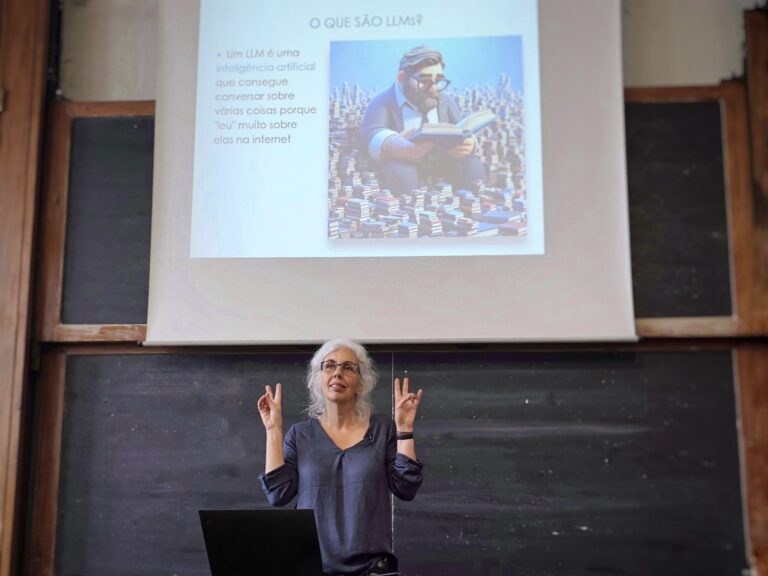
The auditorium was completely full, mostly of youngsters, who wanted to listen to Luísa Coheur’s talk at Técnico Open Day: “ChatGPT – potentials and risks.” And there was no disappointment, since a good share of the participants stayed beyond schedule in a very vivid conversation with the researcher at INESC-ID’s Human Language Technologies (HLT) lab and a teacher at Técnico.
The talk started with a retrospective on the origins of the now ubiquitous Large Language Models (LLM). “They were not born today, they are the result of many years of study in natural language processing, and also machine learning”, the researcher noted.
Starting on the sixties of past century, the field has grown ever since, with an impressive evolution after the first public presentation of the most famous LLM, GPT, in 2019. “The first versions generated text that was correct, but still a bit confusing”, Luísa told the audience. “But with GPT-3 it is madness!”
Assuming herself as a great enthusiast of the models, the researcher and teacher urged the students to incorporate this tool in their lives, including to fulfil their academic tasks. “I use it all the time, to prepare classes or to make presentations like this one”, Luísa revealed, giving the example of the illustrations, all created through instructions given to the model.
But if first half of the conference was devoted to the advantages of using LLM, the second was focused on the risks. “Never trust it completely, always check.” Voice and image manipulation, made up sentences, invented sources, are the most critical aspects of this technology. But there is only one way to fight it: is to know it well and be aware of its faults.
As the former President of USA, Franklin D. Roosevelt, famously said: “the only thing we have to fear is fear itself.”
Another presentation that also generated interest from the participants, was the one about the first University CubeSat, a satellite entirely conceived and developed in Portugal, in a collaborative team that includes INESC-ID researchers, Gonçalo Tavares and Moisés Piedade. The conference was delivered by João Paulo Monteiro, one of the researchers responsible the project, who will likely be at French Guiana in September, to assist the launch event.