Tag: NanoSat Lab

  • Yes, ISTSat-1 solar panels are charging in space
    Yes, ISTSat-1 solar panels are charging in space

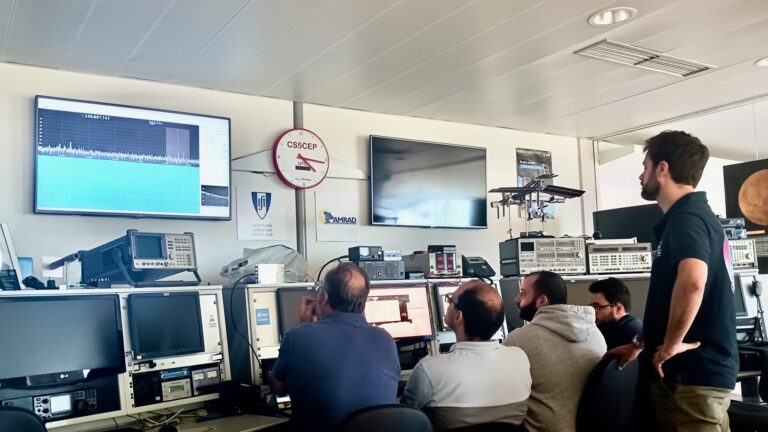
    It is confirmed! The ISTSat-1 solar panels are working properly and charging the batteries. “It made my day,” says João Paulo Monteiro, a researcher at IST Nanosat Lab, minutes after the team received another piece of data from the first university CubeSat entirely developed and built in Portugal, launched on July 9.

    Since the CubeSat departed from French Guiana aboard the Ariane 6’s maiden flight, the project team has been working day and night, looking after ISTSat-1. “It’s almost like taking care of a newborn,” admits João Paulo, as the satellite may ‘cry’ at one in the morning, at noon, or at seven PM.

    Every 90 minutes, the satellite passes over the antennas placed at Técnico Oeiras, each time at a different angle. And amidst the noise captured by the equipment, the researchers are able to extract determinant information about the satellite. Only when the inclination of the satellite’s orbit is around 60 degrees is it a good chance to gather data. Usually, there are four good chances per 24 hours, and the amount of good news has been increasing, signal after signal, like baby steps.

    So far, the team knows it is cold out there – at 580 km from Earth – around 6 °C, as expected. The system is performing the predicted reboots, and the small cube is rotating at the desired speed. And fresh out of the bottle, we now know the energy system is fully operational. “It was a critical aspect,” admits João Paulo.

    Developed at Técnico, under the coordination of Rui Rocha, professor at IST and researcher at Instituto de Telecomunicações (IT), the ISTSat-1 project involved a team of around 50 people since its inception.

    As the pieces were being put together, a consortium was created to maximize the benefits of this pioneering event and others to come, and thus the NanosatLab consortium came to light, gathering IST, IT, INOV, INESC-MN, IDMEC, IST-ID/ISR-Lisboa, with INESC-ID as the leader.

    This week, the NanosatLab consortium had its first meeting, with the participation of Fernando Mira da Silva (IST), Carlos António Cardoso Fernandes (IT), António Gomes Leal (INOV), Susana Cardoso de Freitas (INESC-MN), Afzal Suleman (IDMEC), Rodrigo Ventura (IST-ID/ISR), Inês Lynce (INESC-ID) and the consortium directors Rui Rocha and Gonçalo Tavares.

    Regarding ISTSat-1, it is expected that during its five-year mission lifespan, the nanosatellite will capture and transmit messages from an air traffic monitoring system called ADS-B. This system involves aircraft broadcasting their positions, enabling other aircraft and ground terminals to receive this information.

    Text by Sara Sá, Science Writer | Communications and Outreach Office, INESC-ID / © 2024 INESC-ID

    Images | © 2024 INESC-ID

  • 10, 9, 8…Ariane 6 is set for liftoff and we’re onboard

    10, 9, 8…Ariane 6 is set for liftoff and we’re onboard

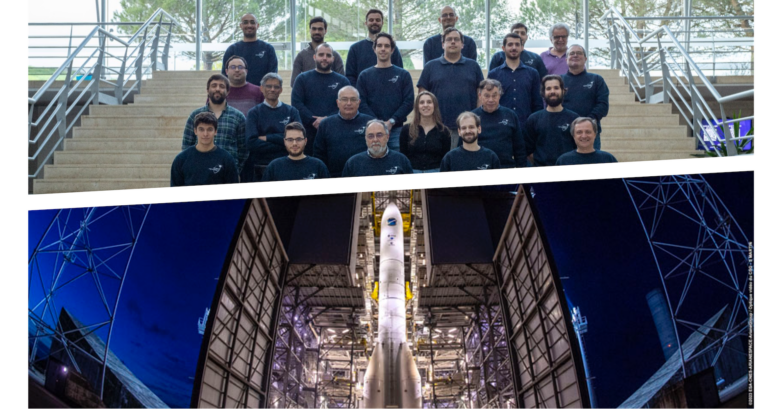
    We are on the verge of a new dawn for European space exploration and for Portuguese academia. On its maiden flight, Ariane 6, the new European heavy lift launch vehicle, is carrying our ISTSat-1, the first university CubeSat satellite entirely conceived in Portugal. Handwritten on the coating of the rocket’s head, the so called fairing, are three names: João Paulo Monteiro, Manuel Santos and Tiago Santos – the junior researchers who travelled to the European Spaceport in French Guiana and signed the fairing before it was integrated on the rocket. “It was the most striking moment of our expedition”, confesses Manuel, part of the team of researchers and teachers at Técnico, members of the NanosatLab, a consortium led by INESC-ID.

    Besides this emotional moment, the team also had some technical work to do, like checking the nanosatellite battery status (spoiler alert: it was perfect!)

    The much-antecipated launch date – July 9 – was announced by ESA Director General, Josef Aschbacher, at the Berlin Air Show, one of the most prestigious events in the aerospace sector, happening this week.

    There was a lot to overcome to reach this phase. The idea of building a university satellite came to light back in 2010, with technical and legislation questions to surmount and a pandemic that contributed to the delay in the construction of the Ariane 6, initially meant to be ready by 2020.

    Modular and agile, as reinforced by Aschbacher, Ariane 6 has a reignitable upper stage, allowing it to launch multiple missions into different orbits on a single flight. “This inaugural flight is considered an experimental one; it is a test flight, not a commercial one”, stresses the coordinator of the ISTSat-1 project, Rui Rocha. Fingers crossed!


    Text by Sara Sá, Science Writer | Communications and Outreach Office, INESC-ID

    Image caption: The NanoSat Lab team and Ariane 6. Image credits: Técnico, NanoSat Lab and ArianeGroup