Tag: STEAM

  • In the Media: Inês Lynce discusses Educational and Societal challenges in Computer Science at Visão newsmagazine

    In the Media: Inês Lynce discusses Educational and Societal challenges in Computer Science at Visão newsmagazine

    In a profound interview at Visão newsmagazine, INESC-ID President, Inês Lynce, discusses the evolution of computational sciences, particularly in relation to Artificial Intelligence (AI), and why the perception of radical change might not be entirely accurate, despite visible advancements. Inês details that while the foundations of AI and machine learning have been around since 1956, the real game-changer has been the increase in computational power and the vast amounts of data now available, making these technologies much more effective.

    The conversation also touches on the importance of demystifying AI and the need to explain how algorithms reach their conclusions, due to their inherent opacity. The concept of “Reinforcement Learning” is mentioned, likening it to Pavlov’s experiments, where rewards are used to train algorithms. The interview further explores the contrast between apocalyptic and awe-struck views of AI, emphasizing the significance of scientific communication for the general public.

    On a topic that is particularly important to her, Inês expresses concern about increasing female representation, breaking the stereotype that certain fields are predominantly male, and highlighting the positive impact of having women in leadership roles.

    Confessing her enthusiasm for the interaction with students, the professor at Técnico also reflects on the role of persistence and passion in scientific research and teaching. While research is portrayed as a solitary endeavour that heavily depends on peer acceptance, teaching is seen as offering immediate rewards. The ongoing shift in the education system, with a greater focus on autonomous learning by students, is a topic that is also of great relevance to Inês and that has been expressed clearly.

    The interview is on the printed edition of Visão newsmagazine, August 15, and is also available here.

  • The world needs more girls and women in tech and INESC-ID is helping to achieve that goal

    The world needs more girls and women in tech and INESC-ID is helping to achieve that goal

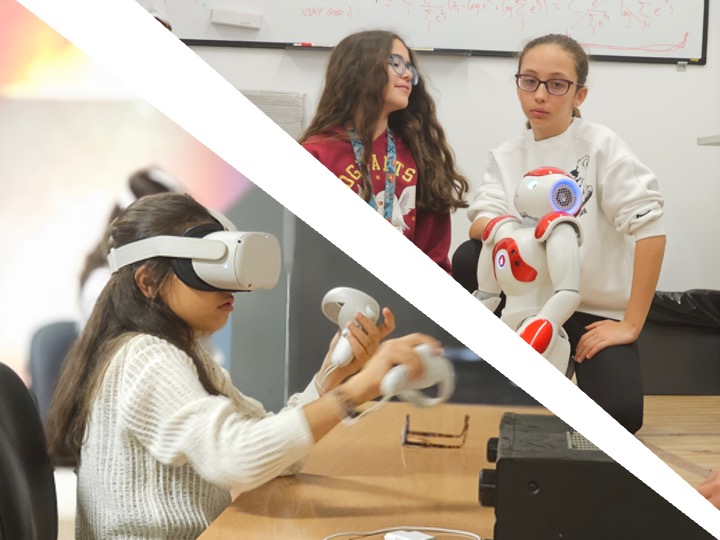
    It is inevitable! There is a natural urge to hold the dancing robot when it interrupts the choreography, falling down as programmed. This act, performed at INESC-ID Social Robotics Lab, from the Group of AI for People and Society (GAIPS), captured the full attention of elementary students from Agrupamento de Escolas de Miraflores, Oeiras, who were participating in the International Girls in ICT Day, celebrated at Técnico’s Taguspark Campus, on April 24th.

    If gender equality were attained in the Information and Communications Technology (ICT) sector, a market of up to 50 billion euros would open up, according to UNESCO. And this in only one of the reasons to celebrate and encourage girls to enrol in a career in this area.

    Since 2011, the International Telecommunication Union (ITU) has been promoting the event to raise awareness and stimulate girls and women to pursue a career in Science Technology Engineering Art and Math (STEAM). To mark the date, the GIRLSTEAM’24 received 150 students, who participated in activities promoted by INESC-ID and other research centres, such as the Institute for Bioengineering and Biosciences (IBB) and the Games Lab.

    During the visit, the students learned that besides entertaining, robots can also help children with autism navigate a world of sensory overload or accompany impaired people complete some tasks. And even solve some complicated math calculations. “Can they divide by zero?”, asked young Mateo.

    We could wager 100% of the youngsters that visited us are, in a way, gamers. But it certainly came as a surprise to realize that games can be a way to study altruism, as Samuel Gomes, also from GAIPS, does, or to cope with diseases, as the INESC-ID researcher, Sandra Gama, from the Human Lab, at the Graphics and Interaction (GI) group, pursues.

    In Europe, women hold just 22% of the tech industry’s positions and worldwide, out of the 7 million people who work in the ICT sector, only 30% are women. It is widely recognised technology is the language of tomorrow, cutting across many different professions, from health to economics. Girls must have a role in the future – for the sake of mankind.

    (Image: students participating in GI and GAIPS activities at GIRLSTEAM24 | © 2024 INESC-ID)