Author: admin

  • INESC Brussels Hub featured in AICEP magazine “Portugalglobal”

    INESC Brussels Hub featured in AICEP magazine “Portugalglobal”

    INESC Brussels Hub has been featured in Portugalglobal, AICEP’s flagship magazine. AICEP is a government entity focused on encouraging foreign investment in Portugal as well as in potentiating the success, internationalization and export activities of Portuguese companies abroad.

    The Hub represents and promotes the European interests of the five INESC institutes (INESC-ID, INOV, INESC MN, INESC Coimbra and INESC TEC), placing INESC as a research and innovation leader on the European stage. As this piece highlights, “Participation in European research and innovation programs and initiatives is absolutely critical,” and INESC has an equally fundamental role to play in defining research policies moving into an ever-more complex future.

    You read the entire feature on pages 41 and 42 of the March 2022 issue of Portugalglobal.

  • The INESC-ID March 2022 Newsletter is out!

    The INESC-ID March 2022 Newsletter is out!

    The March 2022 issue of NEWS-ID — the INESC-ID Newsletter — is out!

    Containing recent news from our researchers and their projects, as well as upcoming events, open positions and some extra bits of content, our monthly newsletter is a great one-stop spot for great content on computer science and electrical and computer engineering.

    You can subscribe to our monthly newsletter here.

  • INESC institutes in full solidarity with war displaced researchers

    INESC institutes in full solidarity with war displaced researchers

    Across INESC we strongly believe in science as a driver of peace, inclusion and a better world. That is why, with more than 40 nationalities from all over the world collaborating and sharing knowledge, culture and creativity across the 5 INESC institutes, we want to express our support to all those affected by the war in Ukraine.

    Nearly 50 thousand Ukrainians are living in Portugal currently, and in the past few days, nearly 2 thousand more asked for support and residence in our country. We remain open to supporting the integration of researchers who have/had to leave Ukraine, in any of our areas of expertise. See the links and contact details below for further information.

    INESC Coimbra | INESC ID | INOV | INESC MN | INESC TEC
    INESC Brussels HUB

  • José Carlos Príncipe awarded fellowship of the AAAS

    José Carlos Príncipe awarded fellowship of the AAAS

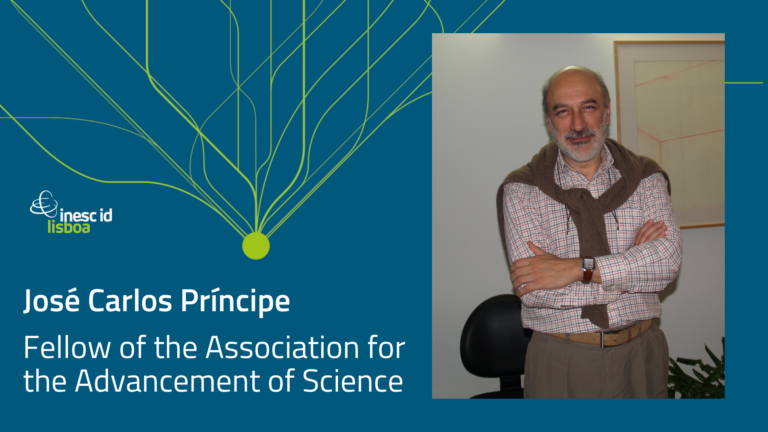
    José Carlos Príncipe, member of the INESC-ID Advisory Board, has been awarded Fellowship of the American Association for the Advancement of Science (AAAS), the world’s largest general scientific society. The Advisory Board of INESC-ID comprises international prominent research experts that provide independent guidance and strategic assessment.

    This recognition signals José Carlos Príncipe’s contributions to the field of statistical signal processing, especially as it applies to computational neuroscience.

    José Carlos Príncipe is Distinguished Professor of Electrical and Biomedical Engineering in the Herbert Wertheim College of Engineering at the University of Florida.

    Photo credit INESC-TEC.

  • EV4EU featured in “Exame Informática”

    EV4EU featured in “Exame Informática”

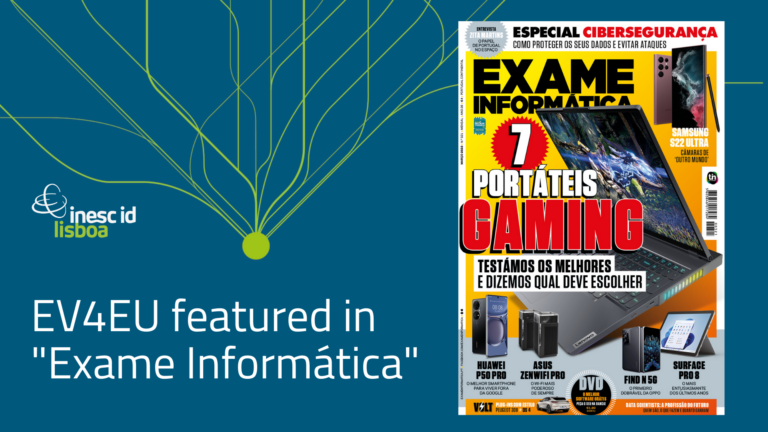
    The EV4EU project — a 4-year venture funded by the European Union in 9 million euros through Horizon Europe and coordinated by INESC-ID — has been featured in the March 2022 issue of Exame Informática.

    Electric Vehicles Management for carbon neutrality in Europe” (EV4EU) will propose and implement user-centric Vehicle-to-Everything (V2X) management strategies, creating the conditions for the mass deployment of electric vehicles, a move that should significantly contribute to the carbon neutrality goals set for 2050, as defined by the European Commission. EV4EU will be coordinated by Hugo Morais, senior researcher within the Sustainable Power Systems Research Area at INESC-ID and Assistant Professor at the Department of Electrical and Computer Engineering (DEEC) of Instituto Superior Técnico.

    You can read the piece on EV4EU on page 18 of issue 321 of Exame Informática.

  • First issue of the OLISSIPO newsletter now available

    First issue of the OLISSIPO newsletter now available

    The first issue of the OLISSIPO Newsletter is out. In the newsletter — available through this link — you will have access to updates on the project’s activities, achievements and upcoming events.

    Coordinated by Susana Vinga – INESC-ID researcher and member of its Board of Directors, as well as Associate Professor at Instituto Superior Técnico – OLISSIPO is a Twinning project, funded by the European Commission within Horizon 2020, that aims to enhance the competences in Computational Biology at INESC-ID and to create an international pole of excellence in multi-disciplinary science in Portugal.

  • From player’s strategies to natural language interactions: two back-to-back publications in “Videogame Sciences and Arts”

    From player’s strategies to natural language interactions: two back-to-back publications in “Videogame Sciences and Arts”

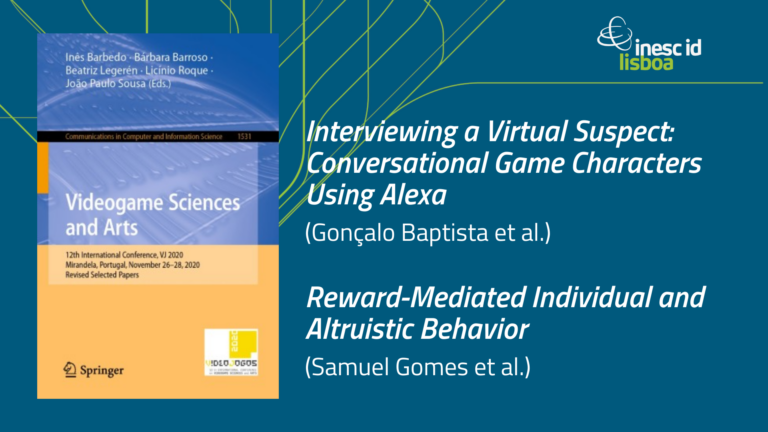
    Samuel Gomes and Gonçalo Baptista — two early stage researchers from the Artificial Intelligence for People and Society (AIPS) Research Area at INESC-ID — have recently published back-to-back research papers in Videogame Sciences and Arts, part of the Springer Communications in Computer and Information Science book series. This issue is comprised of selected papers from the 12th International Conference on Videogame Sciences and Arts (VJ 2020; initially to be held in Mirandela, Portugal, but instead hosted online by the Polytechnic Institute of Bragança, EsACT, on 26 to 28 November 2020).

    In his paper Reward-Mediated Individual and Altruistic Behavior (with the participation of Tomás Alves, João Dias and Carlos Martinho), Samuel Gomes — a PhD student at AIPS — delved into the long-scrutinized balance between individual and altruistic behaviours, an issue of substantial interest in everyday social dilemmas. By examining the extent to which individual and altruistic score functions led players to vary their strategies and interaction motives within Message Across, an in-loco two-player videogame, Gomes and colleagues were able to demonstrate the value of incentive-based strategies in moderating the emergence of in-game behavior perceivable as either individual or altruistic.

    In Interviewing a Virtual Suspect: Conversational Game Characters Using Alexa (a paper authored with Diogo Rato and Rui Prada), Gonçalo Baptista — an alumnus of the AIPS group, where he performed his master’s research — applied a new medium to facilitate the interaction between players and a videogame environment. Using the tools provided by Amazon Alexa, Baptista and his collaborators employed a natural language conversational interaction within the Virtual Suspect game (reported on an earlier publication by Diogo Rato et al.), showing that the use of natural language to support the interaction with game characters has the potential to improve a player’s experience.

    On the novelty his paper represents, Samuel Gomes highlighted that “by exclusively using different reward functions in a two-player game, we could implicitly lead people to assume either individual or altruistic task completion strategies, and to self-report their experience as reflecting those styles of interaction,” adding that his paper “sheds light on how to characterize group interaction styles, contributing to the validation of a model of motives behind interaction (between self-oriented and others-oriented),” ultimately resulting in a model that “can be used to characterize people’s interaction preference, and expanded to reflect the interaction styles allowed in other occasions.” Discussing his paper, Gonçalo Baptista pointed out that its major advancement sits with “the exploration of the incorporation of natural language conversational systems to improve user experience when interacting with video game characters,” elaborating that this study “will enable further research into […] improving the user experience, either with a different conversational system or with a revamped agent, as well as the potential integration of this system in a video game.”

    These two research papers are an exemplary output from the community of approximately one-hundred-and-fifty early stage researchers currently working at INESC-ID.

    Investigating AI systems (agents, robots, etc.) that are social and pro-social — with research work that spans many different topics in affective computing, planning, games & interactive storytelling, robotics, evolutionary game theory and machine learning — AIPS is one of the eleven Research Areas that make up the research tissue of INESC-ID, covering a wide range of topics in computer science and engineering and electrical and computer engineering. You can learn more about the INESC-ID Research Areas here.

  • Ana Freitas featured in Expresso’s profile “100 ideias de 100 mulheres para o novo Governo de António Costa”

    Ana Freitas featured in Expresso’s profile “100 ideias de 100 mulheres para o novo Governo de António Costa”

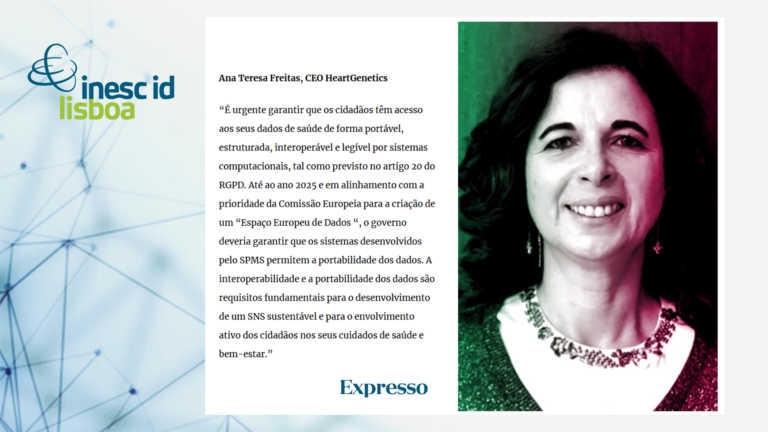
    Ana FreitasInformation & Decision Support Systems (IDSS) researcher at INESC-ID and Full Professor at Instituto Superior Técnico — has been featured in Expresso’s piece “100 ideias de 100 mulheres para o novo Governo de António Costa” (100 ideas from 100 women for António Costa’s new Government).

    In this polyphonic collage, Expresso invited one-hundred notable women to present ideas they would like to see supported by the new governmental programme. Professor Freitas, who is also Chief Executive Officer at HeartGenetics (a company founded in 2013 and dedicated to applying genetic tests and reports in defining personalised lifestyle plans), highlighted the importance of structured and portable access to health data in developing a sustainable national health system and actively engaging citizens in their wellness and healthcare programmes.

    You can read the full piece here.

  • INESC-ID AI researchers ranked as some of the best in Europe

    INESC-ID AI researchers ranked as some of the best in Europe

    AI Rankingsa metric-based ranking that provides insights into Artificial Intelligence (AI) research worldwide — has ranked the University of Lisbon as 22nd in Europe and 125th worldwide. This placement includes six researchers from the Artificial Intelligence for People and Society (AIPS) Research Area at INESC-ID: Ana Paiva, Francisco S. Melo, Manuel Lopes, Francisco C. Santos, Rui Prada and Andreas Wichert.

    Recognizing that the explosion of AI raises valid concerns regarding its transformational power in our current society, AIPS investigates AI systems (agents, robots, etc.) that are social and pro-social, with research work that spans many different topics in affective computing, planning, games & interactive storytelling, robotics, evolutionary game theory and machine learning.

    AIPS is one of the eleven Research Areas that make up the research tissue of INESC-ID, covering a wide range of topics in computer science and engineering and electrical and computer engineering. You can learn more about the INESC-ID Research Areas here.

  • Rui Prada speaks about the project “Engenharia para Todos”

    Rui Prada speaks about the project “Engenharia para Todos”

    In an interview for Oeiras Valley, Rui Prada — researcher at the Artificial Intelligence for People and Society Research Area at INESC-ID, and Associate Professor at Instituto Superior Técnico — spoke about “Engenharia para Todos”, a project developed by Câmara Municipal de Oeiras and Instituto Superior Técnico which aims to promote scientific and technological literacy within Oeiras.

    You can read the full interview here.


    Em entrevista ao Oeiras Valley, Rui Prada — investigador da Área de Investigação em Inteligência Artificial para Pessoas e Sociedade do INESC-ID, e Professor Associado do Instituto Superior Técnico — falou sobre o “Engenharia para Todos”, um projeto desenvolvido pela Câmara Municipal de Oeiras e o Instituto Superior Técnico que visa promover a literacia científica e tecnológica em Oeiras.

    Poderá ler a entrevista completa aqui.