
Author: admin

  • COVID-19 detection from coughs and speech

    COVID-19 detection from coughs and speech

    A team of researchers from IST (Instituto Superior Técnico – Universidade de Lisboa) and INESC-ID (Instituto de Engenharia de Sistemas e Computadores – Investigação e Desenvolvimento), coordinated by Isabel Trancoso, is developing a new project to explore the possibility of automatically detecting COVID-19 from its effects on cough and speech.

    This project would allow developing a cheap, fast and easy to use artificial intelligence-based tool (deployed as a web platform and/or a mobile application) that could provide a preliminary assessment of potential infection by COVID-19. Although not a clinical diagnosis, this is valuable information that would help individuals to adopt preventive measures, and public and private healthcare operators, institutions, companies, etc. to optimize their screening campaigns by allowing them to focus their attention on suspected infected individuals.

    For this goal, it is fundamental to collect an extensive dataset with representative examples of speech and simulated coughs and snores from both COVID-19 positive (symptomatic and asymptomatic) and negative individuals (ideally including also participants with respiratory conditions other than COVID-19, such as flu, cold, asthma, etc.). Then, signal processing and machine learning techniques will be used to assess the presence of biomarkers indicative of COVID-19 in coughs and speech, and to develop robust systems for the detection of COVID-19.

    “We hope that this work will not end with the current pandemic and will allow us to continue studying clues of diseases that affect the respiratory system through acoustic signals that can be collected in a non-intrusive way”, said Isabel Trancoso, The Project Coordinator.

    Your participation in this study is essential and warmly appreciated. To participate, just follow this link (where you can find the informed consent form), or use the following QR code.

    More info: https://www.hlt.inesc-id.pt/w/COVID19

  • Arlindo Oliveira is one of the new members of STOA International Advisory Board

    Arlindo Oliveira is one of the new members of STOA International Advisory Board

    Arlindo Oliveira, President of INESC and Researcher at INESC-ID was invited to be one of the new members of the STOA (European Parliament Panel for the Future of Science and Technology) Advisory Board.

    “The European Parliament panel for the future of science and technology will define and propose, to the Parliament and to the Commission, the policies and strategies that will be adopted in Europe, for a number of key digital technologies, including Artificial Intelligence, Quantum Computing and Nanotech. It is to me an honor to have been invited to the advisory board of this panel, which will play a significant role in the definition of the key choices and includes a number of people with an enormous experience in the development and adoption of transforming technologies”, said Arlindo Oliveira.

    The also distinguished professor of Instituto Superior Técnico is now part of the list of world-renowned individuals, including personalities from academia, international organisations, the private sector, civil society and think tanks. During the 2020-2024 mandate, the Board will focus in particular upon STOA activities in the area of artificial intelligence (AI), including its Centre for AI (C4AI).

    List of STOA International Advisory Board members (2020-2024 mandate)


    About Arlindo Oliveira

    Arlindo Oliveira is a distinguished professor of Instituto Superior Técnico, with the Department of Computer Science and Engineering. He obtained a PhD from UC Berkeley in 1994, under a Fulbright fellowship, after a BSc and a MSc from IST, in 1986 and 1989, respectively. His major areas of interest are Algorithms and Complexity, Machine Learning, Bioinformatics and Digital Circuit Design. He has worked at CERN, Cadence Laboratories and INESC-ID. He is a member of the Portuguese Academy of Engineering and a senior member of IEEE.

  • Nine INESC-ID researchers are among the most cited top scientists in the world

    Nine INESC-ID researchers are among the most cited top scientists in the world

    Nine INESC-ID researchers are among the most cited top scientists at the top 2% of their respective areas.

    Portugal is represented in this list compiled by Stanford University with 385 scientists affiliated to several national institutions.

    The rankings are based upon a researcher’s citations for both a single year (2019) and cumulative across their careers. Titled “Updated science-wide author databases of standardized citation indicators,” the list uses algorithms that quantify and systematically rank individuals into consistent scientific fields.

    The scores are provided both with and without self-citations to lessen the impact of researchers employing extreme self-citations or the use of citation farms (small clusters of researchers massively citing each other’s work).

    Ranked within the careerlong citation impact list are these INESC-ID researchers:

    The article and list of leading scientists can be consulted at: https://journals.plos.org/plosbiology/article?id=10.1371/journal.pbio.3000918

  • João Madeiras Pereira is a new senior member of ACM

    João Madeiras Pereira is a new senior member of ACM

    João Madeiras Pereira was nominated Senior Member of the ACM – Association for Computing Machinery.

    As mentioned by the Senior Member Committee “we are delighted that you will be among the inductees honored with this designation and wish to congratulate you on this well-deserved recognition”.

  • INESC-ID President Inês Lynce is also the new National Co-Director of CMU Portugal Program

    INESC-ID President Inês Lynce is also the new National Co-Director of CMU Portugal Program

    Inês Lynce was appointed on January 27th as co-director of the CMU Portugal Program by Fundação para a Ciência e Tecnologia (FCT). The Associate Professor with habilitation at Instituto Superior Técnico and Presidente of INESC-ID assumes the national co-direction of the international partnership alongside Nuno Nunes, replacing Rodrigo Rodrigues who has been in office since the renewal of the Program in 2018.

    According to the newly appointed co-director, “It is with great pleasure and some expectation that I assume this position. I have been connected to the CMU Portugal Program for several years as a researcher, having already belonged to the team of several projects supported under the Program. Now the commitment will be entirely different and focused on helping the partnership to achieve its strategic goals by 2023 ”. “Personally, I am honored to have been appointed to this position and join such a prestigious and dynamic team with remarkable results achieved in recent years,” she says.

    Inês Lynce, who will be the first woman to lead the CMU Portugal Program, is highly recognized for her work in the field of Artificial Intelligence, namely in the area of ​​problem solving with restrictions and optimization. Her main contributions refer to the development of algorithms and computational tools and their application to solve practical problems as diverse as developing timetables in universities, software package upgradability, the functioning of biological networks and the automatic creation of programming code from examples.

    Since 2021, she has been a member of the Editorial Board of the prestigious scientific magazine “Journal of Artificial Intelligence Research” and is a recurring member of international conferences committees on Artificial Intelligence. This year she will be also part of the “Women in Science” initiative, promoted by Ciência Viva, the National Agency for Scientific and Technological Culture.

    Inês Lynce is also the President of INESC ID, the Portuguese research center for combined Computer Science/Engineering (CSE) and Electrical and Computer Engineering (ECE), a role she assumed last year and where she already was a senior researcher.

  • IObundle IP at 2020 Design&Reuse top10

    IObundle IP at 2020 Design&Reuse top10

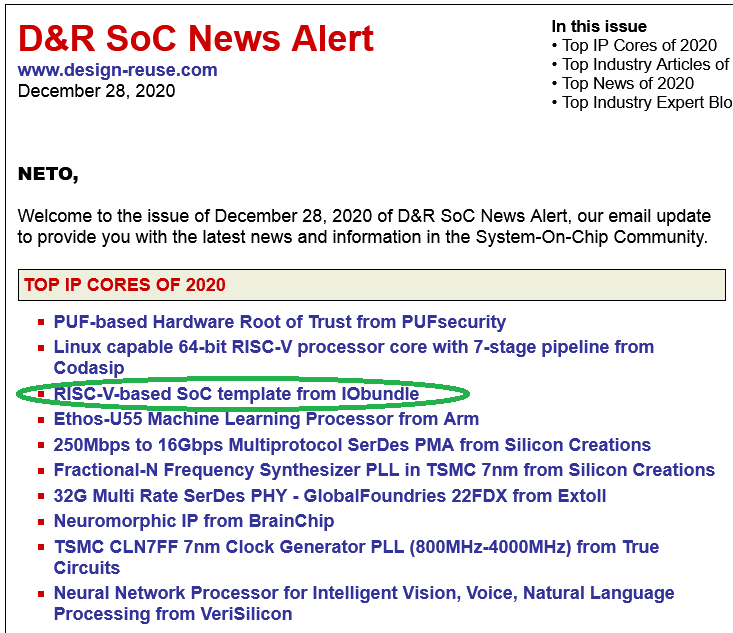
    IOb-SoC is a System-on-Chip template equipped with a CPU, a memory system and a serial communications module. By democratising the use of CPUs in electronic design, IOb-SoC is at the forefront of enabling powerful AI and machine learning algorithms in all sorts of electronic equipments, especially ultra low-poer ones. Users can easily customise IOb-SoC to implement more complex and specific SoCs. It uses RISC-V processors at its core, dispensing with cumbersome and expensive solutions such as ARM processors. By democratising the use of CPUs in electronic design, IOb-SoC is at the forefront of enabling powerful AI and machine learning algorithms in all sorts of electronic equipment, especially ultra-low-power ones. It is released in the public domain under the MIT permissive license and distributed using the Github platform. By providing the code publicly, and at no charge, stakeholders can easily use IOb-SoC for teaching, research, and industrial innovation.

    The motivation for IOb-SoC is that of a speedy and straightforward setup, quickly grasped by students, instructors, researchers and innovators. The IOb-SoC hardware uses the System Verilog language, and its software uses the C/C++ languages.

    The design is straightforward: the processor reads instructions and accesses data from the memory system and peripherals, and executes the program. The system has been used in several master’s dissertations and is being used in one PhD work, supervised by our researcher José Teixeira de Sousa.

    IOb-SoC has also been used as a research tool and industrial applications.

  • Alumnus Paulo Martins received the Cor Baayen Young Researcher Award

    Alumnus Paulo Martins received the Cor Baayen Young Researcher Award


    Paulo Martins was awarded an honorable mention "Cor Baayen Young Researcher Award", by the European Research Consortium for Informatics and Mathematics (ERCIM).
    
    Paulo Martins finished his PhD in 2019 "Arithmetic and Algorithms for Emerging Cryptography" under the guidance of Leonel Sousa at INESC-ID and currently holds positions at Samsung R&D Institute United Kingdom. He was one of the distinguished in a total of 13 finalists of this special award, which annually recognizes the promising work developed by a young researcher in the fields of computing and mathematics.
    
    Paulo Martins revealed that the distinction surprised him, since this is a “very competitive prize”. “I see this mention as a validation of my doctoral thesis and cause for enthusiasm for future work”, he says. Emphasizing the importance of the award “in the area of ​​computer science and applied mathematics”, Paulo mentions that he has “a special appreciation for this contest” since its founder “stimulated research in the area of ​​cryptography, which is one of my main research interests ”.
  • Researchers team on top 5 in International Timetabling Competition

    Researchers team on top 5 in International Timetabling Competition

    The 4th edition of the International Timetabling Competition took place during the last year and brought together researchers and enthusiasts from 57 countries to solve complex scheduling problems.

    From all the participants, only 15 teams managed to solve the competition instances, among which is a team of Portuguese researchers from IST / INESC-ID. The team composed by the Ph.D. student Alexandre Lemos, and Professors Pedro Monteiro and Inês Lynce, managed to collect 79 points and reach a place on top 5.

    The great challenge of this competition was to schedule the timetables of large universities with different characteristics and restrictions. The competition instances were obtained from 10 different universities from 9 different countries spread across 5 continents. The competition is now over, however, the work goes on and the results are continuously compared within the scientific community on the competition website.

    The ITC 2019 ranking can be consult here.

  • Artificial Intelligence and COVID-19: new research project between HL Learning Health, IST and INESC-ID

    Artificial Intelligence and COVID-19: new research project between HL Learning Health, IST and INESC-ID

    The goal is to create AI models to assist in the analysis of thoracic radiographies in patients in a context of emergency.

    A consortium integrating Hospital da Luz Learning Health, Instituto Superior Técnico (IST) and INESC-ID has an innovative project in progress, with the purpose of developing a solution composed of artificial intelligence (AI) models for the analysis of thoracic radiographies undertaken by patients in hospital emergency units, estimating the probability of presenting the characteristics of covid-19 infection. In case of high probability, the models enable to estimate the degree of severity of the disease.

    The early identification and characterization of patients with covid-19 in emergency units is crucial to provide the best health care, the thoracic radiography being a complementary global means of diagnosis, which is fast and easy to perform. The creation of these AI models, applied to the analysis of thoracic radiographies in patients in emergency units, assists, in combination with further clinical data, the medical professionals in the detection of suspected cases of covid-19.

    The aim is to respond to the following needs:

    1. Optimize the work of radiologists, identifying and prioritizing in work schedule those radiographies suspected of covid-19;
    2. Assist physicians of other specialties in the context of emergency, when radiologists are not available, with a tool for the analysis of thoracic radiographies;
    3. Simplify the decision making for health professionals in the definition of the clinical protocol.

    This project is being developed by a multidisciplinary team of radiologists, physicians from the emergency services of Hospital da Luz Lisboa and Hospital Beatriz Ângelo, specialists in ergonomics and human factors, researchers in the areas of machine learning and artificial intelligence, specialists in information systems and managers. The project is financed under the program Portugal 2020 and results will be presented during the first semester of 2021.

  • CESAER appoints Arlindo Oliveira as ERA & EEA Envoy

    CESAER appoints Arlindo Oliveira as ERA & EEA Envoy

    Our researcher Arlindo Oliveira was recently appointed CESAER’s envoy on the European Research Area (ERA) and the European Education Area (EEA).

    The appointment ensures CESAER association ongoing and strong commitment to the shaping of the ERA and the EEA, through positions ‘Towards a truly reinforced European Research Area’ and ‘Towards a dynamic European Education Area driven by excellence’, which provide concrete recommendations in response to the European Commission’s communications on the topics earlier this year.

    Know more here.