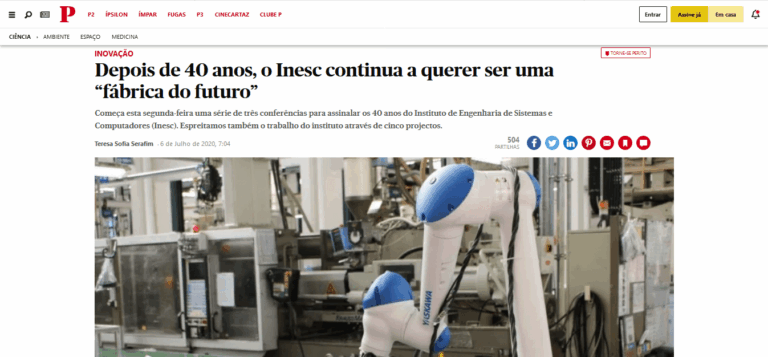
Celebrating INESC 40th anniversary, three sessions will take place in Lisbon, Porto and Coimbra:
Porto – Empowering companies to face new challenges – July 6
Lisbon – Creating new technology-based companies – October 8
Coimbra – Relation with the academic world – October
The first session is also associated with INESC TEC 35th anniversary, and will take place on July 6, at 2:30 pm, at the Faculty of Engineering, University of Porto. This session will be transmitted by Zoom Webinar.
The event is free, but a registration is required in order to receive a link.
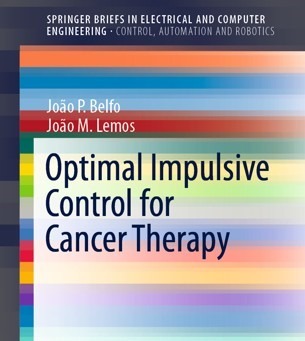
Springer recently published the book “Optimal Impulsive Control for Cancer Therapy “, written by João Pedro Belfo and João Miranda Lemos.
The book approaches the optimization of cancer therapies based on optimal impulsive control.
Three researchers from INESC-ID were recognized in the 6th edition of the annual ranking for the world’s best scientists in Computer Science and Electronics, released by Guide2Research.
The researcher’s Ana Paiva, Joaquim Jorge, and Luís Rodrigues were distinguished together with thirteen Portuguese scientists.
This ranking from Guide2Research has the goal to inspire researchers, entrepreneurs, and decision-makers around the world to explore where leading experts are heading and also provide an opportunity for all of us to know the principal experts in diverse research areas, different countries, and research institutions.
Researcher Ana Paiva was recently selected as Radcliffe Fellow for 2020-2021. The Radcliffe Institute Fellowship Program selects and supports, each year, scholars, artists, and scientists from different countries who “have both exceptional promise and have demonstrated accomplishments.”
INESC fully supports a RD&I framework programme based on excellence. However, we believe this can only be achieved across Europe if, among other, synergies between European programmes and instruments are effectively and /de facto/ implemented, supported by strong incentives and with a simplified framework.
INESC-ID had just recently
approved 5 research projets under the FCT Call for the Carnegie Mellon Portugal
program, under a total of 7 research projets that will be funded under this
call. These 5 exploratory research projects where submitted in 2019 and will be
supported with a total fund of around 300k€.
Nuno Nunes, co-director of
CMU Portugal Program, says: “we hope that these projects could serve to explore
ideas born from needs identified by the scientific community, in a bottom-up
way, that may in the future be a foundation to larger ones.”
In the words of Rodrigo
Rodrigues, co-director of CMU Portugal Program: “it is expected that the impact
of these exploratory projects goes beyond publishing articles and other
metrics. We hope that that above all, these projects lead to the construction
of systems to respond to real problems”
The selected projects are
listed below.
AGENTS: Automatic generation of humor for social robots
Principal Researcher in Portugal: Ana Paiva
Institutions involved: Instituto de Engenharia
de Sistemas e Computadores, Investigação e Desenvolvimento em Lisboa, Instituto
Superior Técnico, Universidade de Lisboa; ISCTE – Instituto Universitário de
Lisboa; Language Technologies Institute – Carnegie Mellon University
PassCert: Exploring the Impact of Formal Verification on the Adoption of
Password Security Software
Principal Researcher in Portugal: João
Fernando Ferreira
Institutions involved: Instituto de Engenharia
de Sistemas e Computadores, Investigação e Desenvolvimento em Lisboa, Instituto
Superior Técnico, Universidade de Lisboa; Inesc Tec – Instituto de Engenharia
de Sistemas e Computadores, Tecnologia e Ciência; Department of Computer
Science – Carnegie Mellon University
PRIVADIA: Privacy in speaker diarization:
Detecting “who spoke when” privately
Principal Researcher in Portugal: Isabel
Trancoso
Institutions involved: Instituto de Engenharia
de Sistemas e Computadores, Investigação e Desenvolvimento em Lisboa, Instituto
Superior Técnico, Universidade de Lisboa; Language Technologies Institute –
Carnegie Mellon University
SECURITYAWARE: Fine-grained approach to detect
and patch vulnerabilities
Principal Researcher in Portugal: Rui Maranhão
Institutions involved: Instituto de
Engenharia de Sistemas e Computadores, Investigação e Desenvolvimento em
Lisboa, Instituto Superior Técnico, Universidade de Lisboa ; Department of
Electrical and Computer Engineering – Carnegie Mellon University
SyNAPSE: Synthetizing Network Accelerators using Programmable Switching
Equipment
Principal Researcher in Portugal: Luís Pedrosa
Institutions involved: Instituto de Engenharia
de Sistemas e Computadores, Investigação e Desenvolvimento em Lisboa, Instituto
Superior Técnico, Universidade de Lisboa; FCiências.ID – Associação para a
Investigação e Desenvolvimento de Ciências; Department of Computer Science –
Carnegie Mellon University
INESC-ID is
looking forward to work in these projects!
The Scientific Computing World Magazine published an article about the progress in the project EPEEC – European Programming Environment for Programming Productivity of Heterogeneous Supercomputers.
This article is an interview with Antonio Peña, project coordinator, and Senior Researcher from Barcelona Supercomputing Center (BSC).
The project EPEEC, coordinated by BSC, results from a collaboration with 10 European research institutions and companies, where INESC-ID is one of the members.