Author: admin

  • Promoting health, reinventing care: INESC-ID hosts session to explore opportunities for interdisciplinary collaboration

    Promoting health, reinventing care: INESC-ID hosts session to explore opportunities for interdisciplinary collaboration

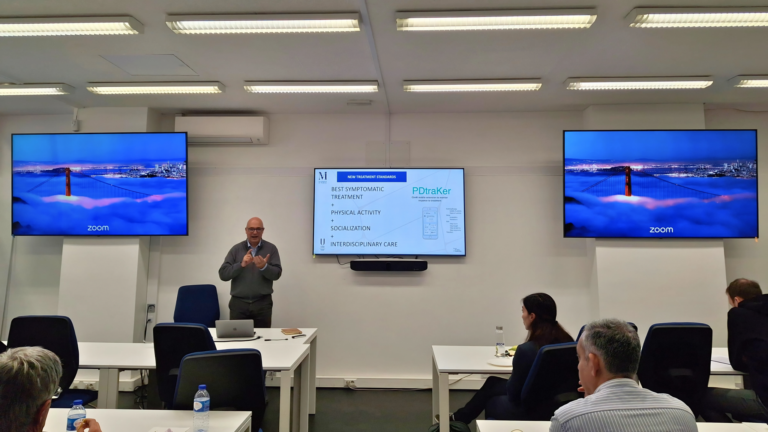
    “We need to seduce others into joining this project,” said neurologist and professor at Faculdade de Medicina da Universidade de Lisboa, Joaquim Ferreira, referring to the ambitious new clinical, academic, and research campus being developed in Torres Vedras. “I’m here to identify windows of opportunity for collaboration.”

    This was the spirit of the most recent session of Bring Your Challenge to Us, a series hosted by INESC-ID thematic line Life and Health Technology (LHT), with the aim of connecting external researchers in the life sciences and health domains with our own community of experts. The goal is to explore how INESC-ID’s knowledge in areas such as data analysis, algorithms, artificial intelligence, augmented reality, and high-performance computing can be leveraged to tackle pressing health-related challenges.

    Joaquim Ferreira’s invitation was compelling: to be part of a paradigm shift in health and community care. With nearly 2% of Portugal’s population currently living with dementia—a figure projected to double by 2050—the urgency to act is clear. “We are failing to prepare for what lies ahead,” he warned. “We are not developing new drugs for these pathologies, nor are we improving the way we approach brain diseases. So, the real challenge is to optimise what we already know works. The brain is an intriguing organ.”

    Ferreira, known for his pioneering work in movement disorders and neurodegenerative diseases, is the driving force behind the so-called Hospital Maravilha (“Wonder Hospital”) in Torres Vedras—an innovative project that aims to reinvent how interdisciplinary healthcare is delivered. “Today, we treat patients more and more like football coaches treat athletes,” he said, stressing that the medical community needs to rewrite its approach to care.

    At the heart of this reinvention is the future Health Technology Research Center, a major research facility within the Torres Vedras campus of the Faculty of Medicine of the University of Lisbon. With a strong emphasis on community health and clinical research, this center will link technological innovation with clinical needs, offering a unique testbed for solutions in biomedical engineering, AI, computer science, and medical devices—domains where INESC-ID has extensive expertise.

    For INESC-ID researchers, this represents an exceptional opportunity. “The interdisciplinarity is not optional,” Ferreira noted. “Especially in healthcare.” The Hospital Maravilha project and its challenges offer fertile ground for joint initiatives, including participation in European-funded collaborative projects focused on addressing real-world clinical issues.

    From the perspective of INESC-ID’s LHT thematic line — which brings together over 50 PhD researchers across various scientific domains, under the leadership of researcher Ana Teresa Freitas  and the executive coordination of Ruxandra Barbulescu — the session with Ferreira was a perfect match. The thematic line aims to foster multidisciplinary research in life and health sciences, and its strategy strongly aligns with three of INESC-ID’s institutional pillars: Internationalization, Technology Transfer, and Societal Impact.

    In this context, the LHT has defined three priorities for the coming years: strengthen the sense of belonging within the community of researchers; explore opportunities for technology transfer from research to practice; promote interdisciplinary projects and external collaborations.

    As we can clearly see, Joaquim Ferreira’s vision, and his invitation to contribute to the Torres Vedras campus, is fully aligned with this third priority, offering an opportunity for INESC-ID researchers to work in a field that increasingly depends on the convergence of medicine, engineering, and computing.

    As the session concluded, the message was clear: the challenges are urgent, the opportunities are many, and the time to act is now.

    Images | © 2025 INESC-ID

  • New INESC-ID projects approved in FCT Call for SR&TD Projects in all Scientific Domains 2023

    New INESC-ID projects approved in FCT Call for SR&TD Projects in all Scientific Domains 2023

    Recently, seven INESC-ID projects were approved by the Foundation for Science and Technology (FCT) in the Call for SR&TD Projects in all Scientific Domains 2023. The call will support internationally recognised scientific research and technological development (SR&TD) projects, in all scientific domains, aiming to contribute to innovative processes, with market purpose, and increase knowledge creation to respond to business and societal challenges.

    It was launched in conjunction with Innovation and Digital Transition Programme – COMPETE 2030 and the Regional Programmes of the North, Centre, Lisbon, Alentejo and Algarve, and the projects may be promoted in the form of individual projects or in co-promotion, with a maximum duration of 36 months and with a maximum eligible investment of € 250,000.

    INESC-ID had the following projects approved:

    Serverless High-density Environment for eLastic cLouds
    PI: Rodrigo Bruno
    Cloud computing is currently in an impasse. While hardware efficiency is improving at an exponentially lower rate, the demand for elastic and scalable cloud resources keeps growing, as evidenced by the emergence of popular cloud computing models such as Serverless. This demand cannot be met with existing virtualization technology, and to tackle this challenge, the project will propose Shell, a new virtualized runtime environment that has the potential to unlock the new cloud era.

    VERSACOMP: VERSAtile COMPuting with Advanced Processor Architectures
    PI: Ricardo Nobre
    The advent of processors with Artificial Intelligence (AI) capabilities represents a significant leap forward. This project aims at redefining the boundaries of what is possible with general-purpose computing. Unlocking the full capabilities of modern heterogeneous systems with AI-enhanced processors for a broader range of computational tasks can result in substantial improvements in performance, energy efficiency, and cost-effectiveness.

    GLOG: A shared log for building distributed applications
    PI: Luís Rodrigues
    This project aims at designing and implementing a highly efficient distributed shared log, a data structure that allows the view of events occurring in a distributed system, named Global LOG (GLOG). It will combine features of classical logs with features of publish-subscribe systems, in a unique combination of flexibility and global consistency, able to support for geo-distributed operation, subscribers with different consistency requierements and clients concerned with a subset of the information in the log.

    SYNTHESIS: Mosaic interaction and synthetic generation of multi-omics data for the discovery of precision medicines for cancer
    PI: Emanuel Gonçalves
    Despite remarkable progress in cancer precision medicine, drug resistance and low success rates underscore the urgent need for data-driven clinical trial designs. SYNTHESIS uses generative deep learning to integrate multi-omic data from pre- and clinical cancer databases, generating synthetic tumor profiles. This will aid the identification of druggable breast cancer subtypes and their molecular signatures, ultimately boosting clinical trials.

    SafeIaC: Reliable Analysis and Automated Repair for Infrastructure as Code
    PI: João Ferreira
    Software systems are foundational to the functioning of critical infrastructure, but errors in specific pieces of their code are a significant source of system failures and degradation, compromising the stability and reliability of essential services. In collaboration with INESC-TEC, SafelaC aims to develop methodologies for the reliable analysis and automated repair of software configuration and infrastructure code, contributing to a more resilient digital infrastructure. In the end, it has the potential of benefiting industries and end-users alike by enhancing the stability and security of critical services.

    SWATE: Socially-Aware AI for Teamwork Enhancement and Training
    PI: Joana Campos
    Assessing embodied interactions in physical environments over time can provide valuable insights of team dynamics. SWATE explores the creation of a Socially-Aware AI agent to enhance team training by providing real-time insights and actionable feedback from 3D articulated bodies and audio signals, as descriptors of teamwork dynamics. SWATE promises to revolutionize team dynamics understanding and applications across various domains.

    Configurable Neural Processing Unit for Embedded Intelligence
    PI: Mário Véstias
    The goal of the project is to prototype a configurable neural processing unit for embedded AI inference and training. The expected results include a configurable Neural Processing Unit and a hardware-oriented model design framework for embedded AI. The novel Neural Processing Unit will contribute to embedded AI expansion by improving computing and energy efficiency and allowing the adaptation of the architecture to the heterogeneity of the models.

    More information about the Call (in Portuguese) here

  • “Thinking machines are a promise or a threat?”: A presentation at the Lisbon Book Fair

    “Thinking machines are a promise or a threat?”: A presentation at the Lisbon Book Fair

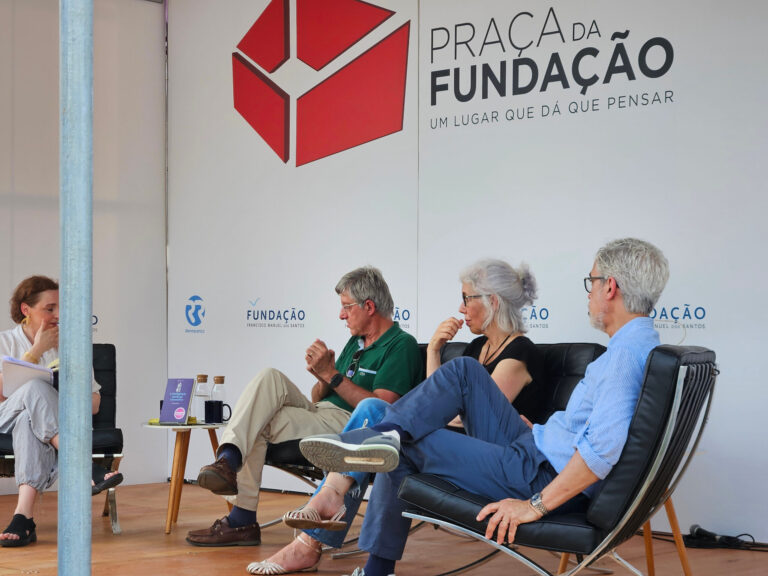
    Last Sunday, June 8, INESC-ID brought AI into the spotlight at the Feira do Livro Lisboa 2025 (Lisbon Book Fair 2025) as researcher Arlindo Oliveira presented his book, “Generative Artificial Intelligence”, at the Fundação Francisco Manuel dos Santos stage. The presentation, in a roundtable format, featured insights from fellow INESC-ID researcher Luísa Coheur and Instituto de Telecomunicações researcher Mário Figueiredo.

    Throughout the one-hour talk, the three researchers delved into the definition of Generative Artificial Intelligence, its potential risks regarding privacy, security, and the spread of misinformation, and the many questions it raises. They reflected on whether AI could one day experience emotions, delve into creativity and reasoning, develop a conscience, and what ethical and philosophical challenges might arise if it does. As it is stated in the book’s synopsis: “Will machines one day have rights and obligations like the rest of us? It’s worth thinking about.”

    Generative Artificial Intelligence is a technology built on several decades of research in the area of automatic learning and has captured attention since the launch of ChatGPT. The interest, however, now extends beyond the research community. The book, which followed an essay on the topic and an invitation from Fundação Francisco Manuel dos Santos, aims to address this matter, presenting and contextualising artificial intelligence, the methodologies within, and its applications and potential risks, in a way that’s accessible to a general audience.

  • In Memoriam: Professor Marcelino Ferreira

    In Memoriam: Professor Marcelino Ferreira

    It is with deep sadness that INESC-ID marks the passing of Professor Luís Marcelino Ferreira, a distinguished researcher, educator, and mentor who leaves a lasting legacy in the field of energy systems.

    Professor Marcelino Ferreira graduated in Electrical Engineering from Instituto Superior Técnico (IST) in 1977. He earned his MSEE and PhD degrees from the Georgia Institute of Technology, USA, in 1984 and 1986, respectively.

    Between 1986 and 1989, he worked as a Systems Engineer at Pacific Gas and Electric Company, in San Francisco, where he played a leading role in the development of HTO — a hydrothermal optimization program that became a reference in the coordination of energy resources.

    Upon returning to Técnico in 1989, he brought with him a deep knowledge of systems optimization and a forward-looking vision of the opportunities enabled by the exponential growth in computational processing. He introduced the first postgraduate courses in electric power distribution networks and played a pivotal role in undergraduate teaching, particularly in the fields of Power Systems Control and Optimization and Network Analysis — courses where his high standards and scientific rigor left a lasting impression on generations of students.

    As Full Professor, he took on many academic and scientific leadership roles from 2007 onwards. He served as Coordinator of the Energy Scientific Area at the Department of Electrical and Computer Engineering (DEEC) and, from 2013, as the Coordinator of the Sustainable Power Systems Research Group at INESC-ID — a responsibility he embraced when the Energy Group joined INESC-ID, and which he held until the end of his life, even after retiring as Full Professor.

    Professor Marcelino Ferreira will be remembered for his intellectual clarity, his commitment to scientific excellence, and the profound influence he had on colleagues and students alike. His passing is a great loss to our community, and he will be deeply missed.

    INESC-ID extends its heartfelt condolences to his family, friends, and all who had the privilege to work with him.

  • INESC-ID rated “Excellent” — pass the dwarf basil!

    INESC-ID rated “Excellent” — pass the dwarf basil!

    The news came on the morning of April 15, through an email sent by our President of the Board of Directors, Inês Lynce: INESC-ID had been rated “Excellent” — the highest possible rating — in the latest national evaluation of Research and Development (R&D) Units by the Portuguese Science and Technology Foundation (FCT), achieving the maximum score in all evaluation criteria.

    Even though it was not a debut — the previous evaluation (2017/18) had reached exactly the same result — it still called for a celebration. And so we did!

    And how do we celebrate in Portugal? With food, of course — and also with music (in this case, a band made up of Técnico students).

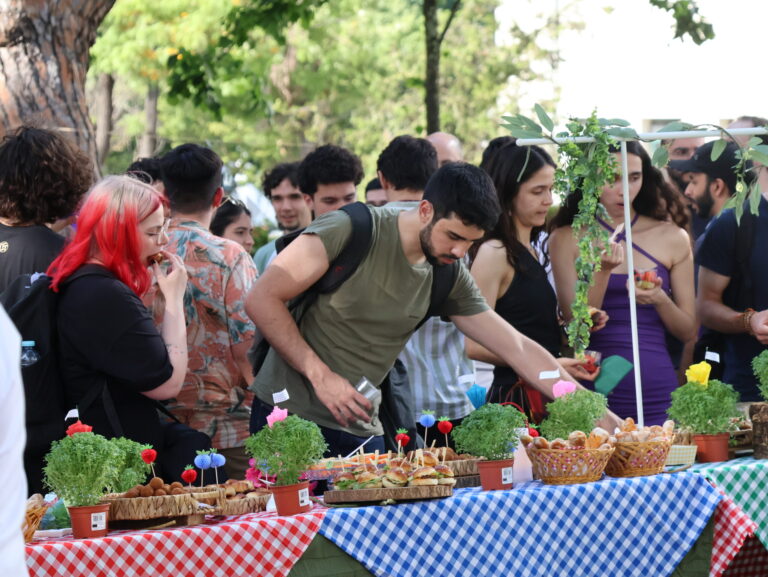
    On May 29, at the Jardim Norte of IST, we had it all: hot dogs and bolas de Berlim, guitars playing, and fresh drinks. The decoration was Santos Populares style, with dwarf basil plants over checked tablecloths, anticipating the Lisbon festivities that fill the capital throughout the month of June.

    According to the FCT evaluation panel, INESC-ID has “outstanding international-level research, excellence in scientific publications,” contributing to “both theoretical and applied domains.” The panel also highlighted our “strong role in international collaboration, industry partnerships, and public engagement, as well as [our] firm commitment to ethical research practices and gender equality.”

    It didn’t mention the quality of the events we organize — but that’s surely because the evaluators haven’t attended one yet.

    Images | © 2025 INESC-ID

  • To Infinite Possibilities and Beyond Publications: Patents, Startups, and Career Paths for PhDs

    To Infinite Possibilities and Beyond Publications: Patents, Startups, and Career Paths for PhDs

    On May 19, a group of PhD students gathered for their 8th INESC-ID PhD Students Meetup and were introduced to Sandra Aresta, Knowledge Transfer Manager at INESC-ID, who presented the topic “Beyond Publications: Patents, Spin-offs, and Alternative Paths for PhDs”. During the session, Sandra shared her personal journey and professional experience, offering insights into what it means to work in the field of technology transfer. She then explained the processes within INESC-ID and how PhD students can benefit from this field, including filing patents or even founding a startup.

    After an hour and a half of absorbing what was brand-new information for some of the participants, the questions kept coming. What followed was a lively coffee break with even more questions for the speaker, and animated discussions between the students themselves, as their conversations remained focused on how their research could lead to broader impact beyond academia.

    The PhD journey can be challenging, and concerns about the future can be a significant source of anxiety for many students. With career-oriented meetups like this, the Communications and Outreach Office at INESC-ID aims to give PhD students an overview of the diverse opportunities beyond academia and strengthen their CVs, while also building a sense of community.

    Images | © 2025 INESC-ID

  • “Will it fly if I light a match?” — INESC-ID at the Oeiras Science Festival

    “Will it fly if I light a match?” — INESC-ID at the Oeiras Science Festival

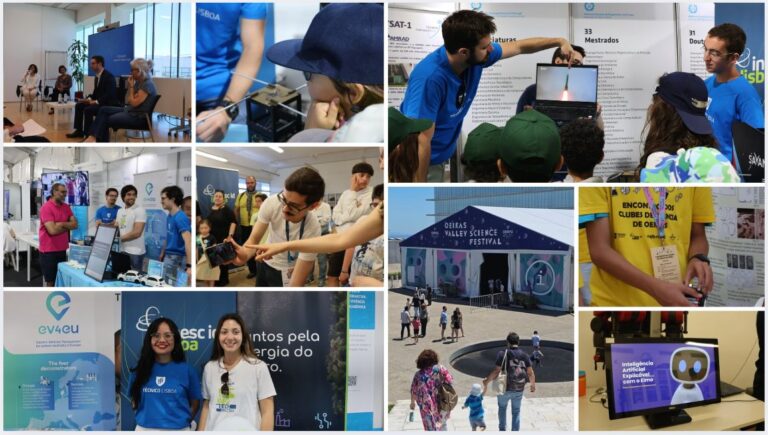
    “If I light a match, will it fly too?” Eliane is “seven and a half” years old and has a curious mind that shines through in her sharp questions and wide-eyed wonder. Her inquiry came after Diogo Diniz, a third-year undergraduate student in Computer Science and a volunteer at Técnico’s booth (where INESC-ID was also present), explained how rockets ascend thanks to the downward force of fire—demonstrating this with a video of a rocket launch.

    But this wasn’t just any rocket. It was the one that lifted off from the Guiana Space Centre, carrying onboard ISTSat, the first Portuguese university-built satellite, developed under NanoSat Lab (a consortium gathering IST, IT, INOV and other research institutes, with INESC-ID as the leader).

    Eliane wasn’t entirely convinced. With a slightly skeptical look, she added: “I’m going to build a machine that goes down, with matches pointing up.”

    Without knowing it, Eliane was perfectly embodying the motto of the Oeiras Science Festival: Discover, Question, Imagine. Organized by the Municipality of Oeiras and co-hosted by Taguspark, this science celebration ran from May 21 to 25 and brought together schools, researchers, and families to engage in hands-on science, interactive demos, and open-ended exploration.

    As expected, INESC-ID was present with contributions in both formats: exhibition stands with demos and multiple talks across the event’s five-day agenda. In parallel, on May 24, the festival also hosted the Técnico Oeiras Campus Open Day.

    While Diogo Diniz was making his outreach debut, Pedro Amado—currently a master’s student supervised by INESC-ID researcher, Gonçalo Tavares—was already a seasoned participant in public engagement. “I really enjoy talking with kids,” he shared. “There’s a lack of natural vocation in students, and coming to Técnico without a sense of purpose requires extra effort,” he reflected.

    Rockets, robots, and electric cars

    João Paulo Monteiro, from the ISTSat project team, is also no stranger to this kind of event, especially after the satellite’s successful launch in July 2024. Between answering questions, he received a real-time alert on the project’s satellite tracking platform: something had passed within 400 meters of ISTSat. “Probably Starlink,” he guessed. “It happens all the time.” And he was right.

    Explaining to a group of 7th graders from Agrupamento de Escolas Aquilino Ribeiro, in Porto Salvo, Oeiras, Pedro Amado described the new space landscape: “Today’s satellites are much smaller and can be launched by private companies.”

    At the same stand, the project EV4EU – Exploring Electric Mobility raised awareness about the ongoing energy transition. Visitors could test their knowledge through a quiz designed by INESC-ID researcher Marcelo Braço Forte, with the chance to win a miniature electric car. In total, 114 participants tried their luck.

    The Mushroom Game, developed by GAIPS, focused more on knowledge than chance. Alongside its AI companion, ELMO the Robot, the game tested how much visitors trusted artificial intelligence systems while teaching them how to identify safe and poisonous mushrooms. Students from 6th and 7th grade proved to be keen technophiles, answering nearly all of Miguel Belbote’s questions correctly. Belbote, a researcher at GAIPS, already an experienced outreach participant, enjoyed the enthusiastic responses.

    “Guess how much this robot dog weighs,” he asked, pointing to the GO2 Robot Dog. “Twelve kilos?” ventured one of the seven boys in the group. “Fifteen,” he replied. Not a bad guess.

    But in the end, this isn’t about getting all the answers right. What matters most is wanting to know.

    And in that respect, every single student—Eliane included—passed with flying colors.

    Oeiras Valley Science Festival was also an opportunity to celebrate the cooperation between   students, teachers, and researchers, who came together for two afternoons, on the 2nd Meeting of the Oeiras Science Clubs. Co-organised by Técnico Oeiras and ITQB NOVA with the support of the Engenharia para Todos project (INESC-ID and Oeiras Municipality), it was a moment of exchange that featured presentations, a science fair, a roundtable discussion, and a poster exhibition showcasing the “Mentorias” project, in which scientists work closely with students.

    What about us? Culture, language and sovereignty in the Age of AI

    The final day of the festival saw four INESC-ID researchers actively participating in three roundtable sessions focused on the promises and challenges of Artificial Intelligence.

    Early in the morning, Helena Moniz joined the session “Artificial Intelligence and Us”, where she and fellow speakers Paulo Novais (University of Minho), Pedro Bizarro (Feedzai), and Mário Figueiredo (IST) reflected on the growing role of AI in our lives and in shaping the decisions that will define our future. Helena emphasised the importance of being aware of the cultural and ideological biases often embedded in these models, highlighting the need to represent cultural diversity and the many ways of living and thinking found across societies.

    Shortly after, Isabel Trancoso and Luísa Coheur took part in the session “Artificial Intelligence in Written and Spoken Language: Applications in Health, Education and Industry”. Isabel explored the human voice as an identity marker in the digital age, while Luísa brought attention to the challenges AI presents in the educational context. The session was moderated by André Peralta (NOVA) and also featured Liliana Ferreira (Fraunhofer Portugal), who added a complementary perspective to the panel’s reflections.

    In the afternoon, Arlindo Oliveira took the stage for one of the festival’s final sessions — “Generative AI and European Sovereignty in AI”. Alongside André Martins (IST) and Paulo Dimas (Center for Responsible AI), Arlindo explored the rapid rise of large language models (LLMs), their technological impact, and the far-reaching challenges they pose — not only at the economic, political, and social levels, but also in terms of strategic autonomy. It was a conversation that brought the pressing theme of innovation and sovereignty to the table with critical insight and a sense of urgency – giving voice to the central message of the festival.

    Images | © 2025 INESC-ID

  • In the Media: Research with societal impact – INESC-ID featured on CNN Inovação

    In the Media: Research with societal impact – INESC-ID featured on CNN Inovação

    “If someone had told me, when I started, that this would be the future, I wouldn’t have easily believed it”, reflects Inês Lynce at the opening of this week’s CNN Inovação –  a sentiment that captures how far INESC-ID has come. 

    INESC-ID was featured in this week’s episode, broadcast on CNN Portugal, a programme that explores innovative science, technologies and ideas that are shaping the future. The episode offers viewers an inside look into INESC-ID and its efforts to drive societal impact through research.

    Inês Lynce, President of the Board of Directors, opens the episode with an overview of INESC-ID’s mission, vision, and research focus. Researcher Rui Prada then presents All Sustainable: a digital serious game that empowers citizens with intellectual disabilities to engage with sustainability issues,  and that “It’s also a social inclusion tool for a population often excluded from the discussion,” he explains. Finally, researcher Hugo Morais introduces EV4EU, a European project led by INESC-ID that is advancing the electric mobility revolution and, as he notes, “a critical factor for achieving the objectives of Europe’s governments concerning carbon neutrality.”

    This feature provides a glimpse into how INESC-ID’s research is shaping a more digital, inclusive, and sustainable society – and a broader reflection on the role of engineering and technology in addressing global challenges. 

    Watch the full CNN Inovação episode on our Youtube channel: here

    (CNN Inovação is produced by Bubble Creative Studio. This episode was developed in collaboration with INESC-ID)

    Images | © 2025 INESC-ID and Bubble Creative Studio

  • PRR Projects: From shopping to smartness. Project PT Smart Retail redesigned the future of retail

    PRR Projects: From shopping to smartness. Project PT Smart Retail redesigned the future of retail

    What if buying a snack, grabbing lunch, or doing the weekly groceries didn’t require queues, cashiers, or even a checkout line?

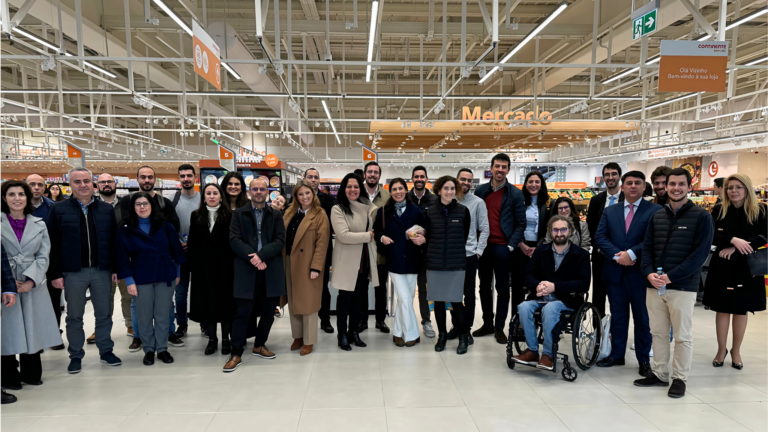
    This is not a scene from a sci-fi movie. It is already happening, in Portugal! The world’s largest intelligent retail store— a 1,200 square meter space operated by Continente—opened earlier this year in Leiria, showcasing the very technologies being developed through PT Smart Retail. This PRR-funded mobilizing project will transform the way we shop, consume, and interact with physical retail spaces.

    On this project, INESC-ID has a key role in dealing with the privacy and security of this future. Under the internal coordination of researcher Nuno Santos, from Distributed, Parallel and Secure Systems, the initiative brings together 19 partners, from startups to tech providers, universities, and major retailers like Continente and Galp.

    At the helm of the consortium is Sensei, a Portuguese tech company already pioneering autonomous retail experiences. But the goal of PT Smart Retail goes far beyond existing proof-of-concept stores. With an investment of over €31 million, the project aspires to deliver a new generation of intelligent, autonomous, and sustainable retail—from futuristic vending machines to fully operational cashierless stores, all powered by national technology.

    Launched in 2022 and running through the end of 2024, PT Smart Retail is part of Portugal’s broader Recovery and Resilience Plan (PRR), aiming to build national capacity in high-tech, high-impact sectors. In the retail domain, that means: Designing autonomous and hybrid store formats, developing “pods” that can be deployed in remote or high-traffic areas, introducing Zero Waste Cabinets that reinvent the vending machine experience and creating peripheral technologies to enhance user interaction and sustainability.

    Each innovation is based in seamless, contactless, and user-centric shopping experiences—think of walking into a shop, picking up your items, and walking out without scanning a single barcode. The rest is up to the system.

    “Our role in the project is very focused. We’re working on the privacy and security side—anticipating problems that might not be critical for the pilot store today but will be essential if this technology is to scale nationally or internationally.” – Nuno Santos

    But as this vision moves closer to reality, critical questions arise: How do we ensure customer privacy? Who has access to video data? How secure is the underlying AI? That’s where INESC-ID comes in.

    “Our role in the project is very focused,” explains Nuno Santos, Principal Investigator at INESC-ID and Professor at Técnico. “We’re working on the privacy and security side—anticipating problems that might not be critical for the pilot store today but will be essential if this technology is to scale nationally or internationally.”

    Indeed, the transition to intelligent retail systems introduces layers of complexity—technically, ethically, and legally. Every sensor, every camera, and every line of code collecting customer behavior must comply with GDPR, safeguard identity, and protect sensitive data from leaks or misuse.

    To solve these challenges, the INESC-ID team is developing solutions across five research vectors:

    1. Privacy-preserving Video Processing

    In smart stores, camera footage is essential for tracking customer movement and product selection. But how can we do this without violating privacy?

    INESC-ID’s answer is to transform video feeds into anonymized skeletal models, abstracting individuals into motion paths instead of identities. In some cases, the team goes further—applying visual obfuscation techniques that reduce people to blurred silhouettes, while still enabling operators to debug the system when needed.

    2. Trusted Video Stream Processing

    The software that powers smart retail—including the AI models for object recognition and movement tracking—runs on edge servers located inside stores. These are valuable intellectual property assets for companies like Sensei. But how can they ensure this code isn’t reverse-engineered or tampered with, especially in international deployments?

    INESC-ID is exploring hardware-based secure enclaves that encrypt and shield algorithms from unauthorized access, even when deployed in less trusted environments.

    3. Data Provenance and Auditability

    With thousands of data points flowing through these systems daily, it’s essential to prove that the algorithms act fairly and legally. INESC-ID is working on cryptographic methods to ensure traceability—demonstrating that a particular transaction was computed using valid data, from legitimate sensors, using trusted code.

    This will be crucial for compliance auditing, especially in the context of the AI Act in Europe.

    4. Network and Communication Security

    A smart retail system involves dozens of sensors communicating in real-time with local servers and cloud backends. This creates vulnerabilities: from spoofing attacks that fake product scans to malicious devices planted in stores.

    To address this, INESC-ID is developing secure communication protocols and monitoring tools that can detect anomalies in sensor behavior and network traffic.

    5. Web Application Security

    The final layer of the stack includes web-based dashboards, APIs, and customer-facing apps. These are often the most visible points of contact—and the most vulnerable to attacks.

    INESC-ID’s researchers are conducting code audits and developing automated tools to detect and patch vulnerabilities in retail web applications before they can be exploited.

    “The problems we’re solving in PT Smart Retail are not just relevant to retail,” says Nuno Santos. “They apply to surveillance in public spaces, stadiums, smart cities. The anonymization and secure processing of visual data is a broader societal challenge.”

    Ultimately, PT Smart Retail is not just about automating shopping. It’s about building trust in an era where technology is everywhere and often invisible. “When we used to shop at a neighborhood store, trust was physical, the shopkeeper knew us. Today, that trust has to be engineered into the system”, Nuno Santos notes.

    By combining cutting-edge AI with responsible data practices, PT Smart Retail aims to become a global reference for intelligent, privacy-first retail. And INESC-ID’s work is central to making that happen.


    Text by Sara Sá, Science Writer | Communications and Outreach Office, INESC-ID
    © 2025 INESC-ID. Credit INESC-ID and the author, with a link to the original source, when sharing or adapting this article.

    Images | © 2025 PT Smart Retail

  • In the Media: INESC-ID researchers help explain the causes behind the April 28 blackout

    In the Media: INESC-ID researchers help explain the causes behind the April 28 blackout

    Not long ago, power outages were a familiar part of life. Some of us certainly remember those stormy nights in which the light went off. Today, electricity is so present in our daily life that even brief disruptions can feel dramatic. The blackout that hit the Iberian Peninsula on the morning of April 28 was a strong reminder that modern society is built on a grid we rarely think about. Except when it goes dark.

    Although the exact causes are still under investigation, the failure appears to have started in Spain and rapidly cascaded across the interconnected grid, resulting in a rare total blackout. Like a circuit breaker protecting your home, the system shut itself down to prevent larger damage. According to INESC-ID researchers, Rui Castro and Pedro Carvalho —both experts in power systems and energy transition—this was not a collapse of a failed system, but rather a sign of its robustness. The grid responded, isolated the issue, and restored power in phases using “black start” capabilities. However, the event also revealed the challenges of an energy transition reliant on variable renewables and decentralized production.

    There is no such thing as zero-risk infrastructure. Making the electric grid 100% fail-proof would require massive and economically unjustifiable investments. Instead, we must accept some level of risk and focus on making our systems more resilient, more intelligent, and quicker to recover.

    These insights were shared by Rui Castro and Pedro Carvalho in recent media  interventions (newspaper and TV channels), where both researchers contributed to clarifying the technical nature of the blackout and the broader implications for the energy transition and grid resilience.

    Links below:

    SIC 

    CNN

    Jornal Económico 

    O Observador