Category: Awards and Recognitions

  • Rui Henriques honoured with Universidade de Lisboa/Caixa Geral de Depósitos Scientific Award 2025

    Rui Henriques honoured with Universidade de Lisboa/Caixa Geral de Depósitos Scientific Award 2025

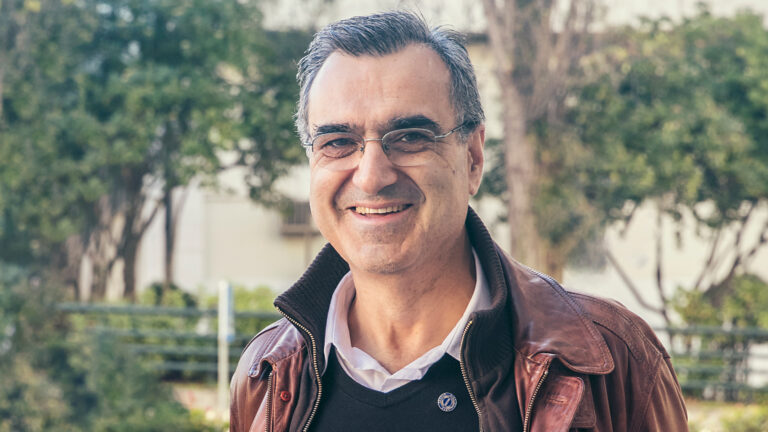
    The results for the Universidade de Lisboa/Caixa Geral de Depósitos Scientific Awards were recently announced, and INESC-ID’s Rui Henriques was among the awardees! The Information and Decision for Support Systems researcher, and Instituto Superior Técnico Professor, was recognised for his contributions in the field of Computer Science and Engineering, being one of 20 researchers awarded in their respective fields.

    The award ceremony will take place today, June 25, 2025, at 17:30, at the Congress Center of the Pavilion of Portugal, as part of the University of Lisbon’s Scientific Days.

    The UL/CGD Scientific Awards and Honourable Mentions were established in 2016 to recognise researchers from the Universidade de Lisboa, celebrating their contributions and encouraging publication in renowned international journals. Each award includes an incentive worth 6500 euros, as a manner of institutional recognition for the winner’s contribution to their respective scientific area.

  • João Ferreira wins Amazon Research Award for work on Automated Program Repair

    João Ferreira wins Amazon Research Award for work on Automated Program Repair

    João Ferreira, researcher at INESC-ID’s Automated Reasoning and Software Reliability and Professor at Instituto Superior Técnico’s Department of Computer Science and Engineering (DEI), has been named one of the recipients of the Amazon Research Award (ARA) – Fall 2024, in the highly competitive field of Automated Reasoning.

    His winning proposal, titled Polyglot Automated Program Repair for Infrastructure as Code, focuses on developing techniques for automatically repairing programs written for Infrastructure as Code (IaC) environments.

    The Amazon Research Awards are among the most prestigious recognitions in the tech research ecosystem. Every year, the program receives a large number of proposals which are rigorously evaluated by Amazon’s internal teams of scientists. Past and present awardees include researchers from world-leading institutions such as Carnegie Mellon University, MIT, Harvard, Stanford, and Yale.

    The award provides not only financial support for Ferreira’s research but also access to over 700 public datasets hosted by Amazon, as well as AWS AI/ML services and tools through AWS Promotional Credits. Moreover, Ferreira will benefit from personalized support from an Amazon research contact, who will offer guidance and facilitate participation in Amazon-led events, workshops, and training sessions.

    Automated Reasoning is an important area of research for Amazon, with potential applications across various features and applications to help improve security, reliability, and performance for our customers,” said Robert Jones, Senior Principal Scientist with Amazon’s Cloud Automated Reasoning Group.


    Images | © 2025 INESC-ID

  • INESC-ID Stands out in ACM CHI Conference

    INESC-ID Stands out in ACM CHI Conference

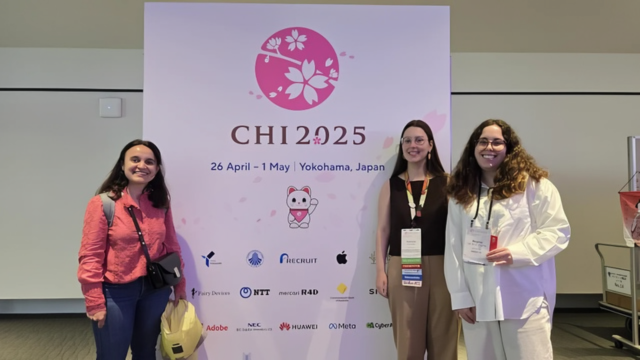
    Our institute made waves last week during the ACM (Association of Computing Machinery) CHI 2025 conference on Human Factors in Computing Systems, with several contributions presented.

    Patrícia Piedade, Artificial Intelligence for People and Society (AIPS) PhD student and Rui Prada, AIPS  researcher, co-authored a paper that received an honorable mention, placing it in the top 5% of submissions. In addition, three other papers, co-written by INESC-ID researchers, were presented at the conference. It is worth noting that one of these articles was solely authored by women, including AIPS PhD student, Regina Duarte and AIPS researchers Ana Paiva and Joana Campos; an inspiring example of the growing presence of women in computer science. Isabel Neto, former INESC-ID researcher authored two of the papers mentioned.

    ACM CHI is the world’s most important conference on human-computer interaction, where researchers and practitioners present cutting-edge work on how people interact with digital technologies. It is held annually and in 2025 it took place from 26 April to 1 May in Yokohama, Japan.

  • INESC-ID researchers receive ACM SIGSOFT Distinguished Paper Award at ICSE 2025

    INESC-ID researchers receive ACM SIGSOFT Distinguished Paper Award at ICSE 2025

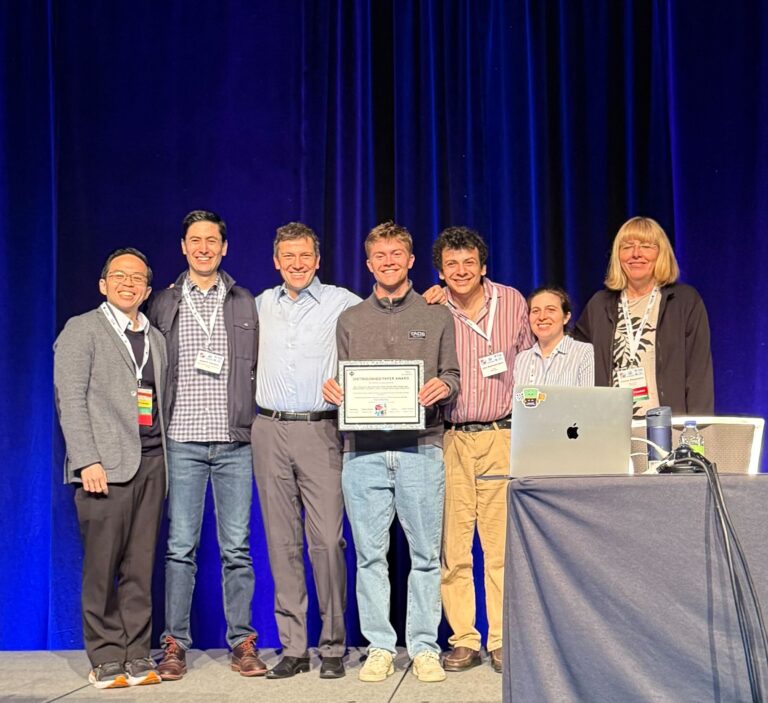
    João F. Ferreira, INESC-ID researcher and professor at the Department of Computer Science and Engineering (DEI) at Instituto Superior Técnico, and Nuno Saavedra, PhD student and INESC-ID researcher, have received the prestigious ACM SIGSOFT Distinguished Paper Award at the International Conference on Software Engineering (ICSE) 2025—the premier global event in software engineering.

    The award-winning paper, titled Rango: Adaptive Retrieval-Augmented Proving for Automated Software Verification,” presents a novel approach to proof synthesis using machine learning and large language models (LLMs), enhanced by retrieval augmentation techniques. Rango introduces a dynamic, adaptive system that identifies and integrates relevant proofs and premises at each stage of the software verification process. This allows the tool to tailor its reasoning to both the specific project and the evolving state of the proof itself.

    The effectiveness of Rango was demonstrated using a newly curated dataset, CoqStoq, which contains more than 2,200 open-source Coq projects. The tool successfully synthesized proofs for 32% of theorems, marking a 29% improvement over previous state-of-the-art systems—an impressive leap forward that could help make formal software verification more accessible and practical for developers.

    This significant achievement is the result of a strong international collaboration with the research including researchers from the University of California San Diego, the University of Massachusetts and Pedro Carrott, a former MSc student at Técnico, supervised by João F. Ferreira and presently at Imperial College London.

    The ACM SIGSOFT Distinguished Paper Award is reserved for papers of exceptional quality presented at ICSE, and this recognition reflects both the scientific impact and collaborative excellence behind the work.

  • INESC-ID rated “Excellent” in FCT evaluation with top scores in all categories

    INESC-ID rated “Excellent” in FCT evaluation with top scores in all categories

    INESC-ID has been awarded the highest possible rating—“Excellent”—in the latest national evaluation of Research and Development (R&D) Units by the Portuguese Science and Technology Foundation (FCT). Our research center achieved the maximum score in all evaluation criteria, highlighting the quality, merit, and societal relevance of its research activities.

    INESC-ID stood out as one of the most prestigious institutions in the country. With a research community that includes more than 200  research associates, and almost 200 PhD students, the unit develops cutting-edge research aligned with four thematic lines of high societal relevance: Societal Digital Transformation, Life and Health Technology, Energy Transition, Security and Privacy.

    The FCT evaluation panel praised INESC-ID for its outstanding international-level research, excellence in scientific publications—including work in Nature, NeurIPS, and ICSE—and its contributions to both theoretical and applied domains. Groundbreaking projects such as Gravitron (trusted execution environments in GPUs, adopted by NVIDIA and Microsoft) and Alive (compiler verification tools, used by Google, Apple, and Qualcomm) were recognized as proof of the unit’s technological leadership.

    In addition to scientific output, the panel highlighted INESC-ID’s strong role in international collaboration, industry partnerships, and public engagement, as well as its firm commitment to ethical research practices and gender equality. Currently, 10 spin-offs operate based on INESC-ID technologies, showcasing its impact on innovation and the broader economy.

    “This result is a recognition of the collective work of our entire community,” said Inês Lynce, President of the Board of Directors of INESC-ID. “It reflects our commitment to excellent research, our focus on societal challenges, and our long-standing values of collaboration, inclusion, and scientific integrity. We are proud to lead a center that not only advances knowledge but also strives to shape a better future for all.”

    Miguel Pupo Correia, President of the Executive Committee, notes that “INESC-ID’s Excellent rating by FCT confirms the effectiveness of the strategy we have been pursuing — and intend to continue — based on four main pillars: scientific excellence, internationalization, technology and knowledge transfer, societal impact, and talent development.”

    Looking forward, INESC-ID will place a strong emphasis on talent development, adding a new strategic pillar to its institutional mission. This includes empowering young researchers through initiatives such as PhD representation, tenure-track-like programs, and ongoing investments in ethics, training, and career progression.

    “Most of the institution’s activity consists of self-funded research projects and service provision. However, the funding received as part of this evaluation is crucial for the implementation of our strategic plan, particularly in terms of improving working conditions for researchers. This includes support for project proposal preparation and project management”, ads Miguel Pupo Correia.

    The panel also emphasized the need for robust computational infrastructure—including GPU clusters and specialized labs—to support the center’s ambitious goals in machine learning, embedded systems, and robotics. INESC-ID’s solid plan for the upcoming years positions the unit to continue delivering high-impact, technically challenging, and socially meaningful research.

    The evaluation, which determines the allocation of €634.9 million in public funding for the 2025–2029 period, reviewed a total of 336 R&D units. Of these, 313 received funding, with only one withdrawal. The rigorous process also noted that 79 units improved their classification compared to the previous evaluation.

  • INESC-ID researchers win awards at EuroSys 2025

    INESC-ID researchers win awards at EuroSys 2025

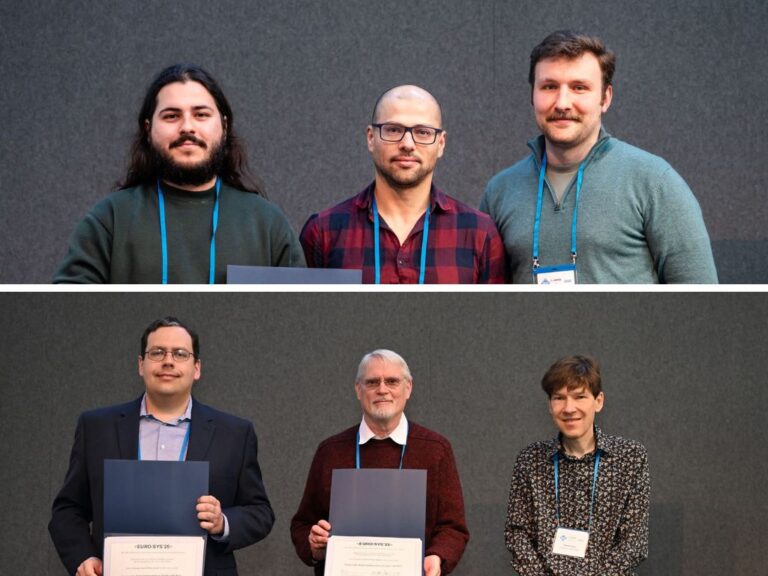
    Two papers co-authored by INESC-ID researchers, professors, and students from the Department of Computer Science and Engineering (DEI) at Instituto Superior Técnico were distinguished at EuroSys 2025, a leading European conference in computer systems, held in Rotterdam from March 30 to April 3.

    The paper HawkSet: Automatic, Application-Agnostic, and Efficient Concurrent PM Bug Detection, by João Oliveira and João Gonçalves, both PhD students in the Doctoral Program in Computer Engineering (PDEIC), and Miguel Matos, INESC-ID researcher, DEI Professor and Big Era Chair team member, received the prestigious EuroSys Gilles Muller Best Artifact Award.

    The work presents HawkSet, an innovative tool for detecting concurrent bugs in Persistent Memory (PM) systems. PM enables the development of fast, persistent applications without relying on expensive HDD/SSD-based I/O operations. However, due to the volatile nature of caches and CPU memory reordering for performance optimization, developers must use low-level instructions to ensure data consistency in case of crashes—especially in concurrent environments, where new classes of bugs can emerge.

    HawkSet stands out for being automatic, application-agnostic, and highly efficient. It employs lockset analysis and automatic binary instrumentation to detect all bugs found by state-of-the-art tools, as well as seven previously unknown bugs. It achieves this without requiring application-specific knowledge, debugging artifacts, or guided executions. HawkSet also delivers significant performance improvements—up to 159x faster detection—and consistently uncovers hard-to-reach bugs that depend on rare interleavings.

    Luís Pedrosa (DEI/INESC-ID) was also honored, alongside his co-authors, with the EuroSys Test of Time Award for the paper “Large-scale cluster management at Google with Borg.”

    The paper describes Borg, Google’s cluster management system that runs hundreds of thousands of jobs from thousands of applications across clusters with tens of thousands of machines.

    Borg achieves high resource utilization through a combination of admission control, efficient task-packing, over-commitment, and process-level performance isolation. It supports high-availability applications with runtime features that reduce fault-recovery time and scheduling policies that lower the risk of correlated failures. For users, Borg offers a declarative job specification language, integration with name services, real-time monitoring, and tools for system analysis and simulation.

    EuroSys, the European Conference on Computer Systems, is one of the most prestigious conferences in the field of systems research—particularly relevant to the Distributed, Parallel and Secure Systems (DPSS) research area at INESC-ID.

  • Finding his corner of the beach: Ricardo Rei’s path to an award-winning Ph.D.

    Finding his corner of the beach: Ricardo Rei’s path to an award-winning Ph.D.

    When Ricardo Rei started his bachelor’s degree in Computer Science and Engineering, he already knew he wanted to work in AI. But it was the people who led the former INESC-ID researcher to pursue his master’s in dialogue systems and chatbots. Under the supervision of João Graça, Unbabel’s CTO at the time — a company Ricardo discovered during Semana Empresarial e Tecnológica — he came into close contact with automatic translation algorithms. It was then he realised how hard it was to evaluate the quality of chatbots or, as we may put it, to separate the wheat from the chaff.

    It soon became clear that this would be the topic of his Ph.D. thesis, titled “Robust, Interpretable and Efficient MT Evaluation with Fine-tuned Metrics.” A thesis he completed in less than the usual four years — and one that has earned strong recognition from both industry and academia through citations, conference presentations, and awards. The latest of these is the Anthony C. Clarke Best Thesis Award by the European Association for Machine Translation (EAMT) — the first time a scientist working in Portugal has received this distinction.

    “I am not surprised at all!” says INESC-ID researcher and proud supervisor Luísa Coheur — who co-supervised the work with Alon Lavie from Carnegie Mellon University. “It’s a very robust thesis, with many publications and no fragility,” she adds.

    The Cross-lingual Optimized Metric for Evaluation of Translation, or COMET — the most visible outcome of Ricardo’s work — has been widely adopted for evaluating translation engine outputs. It’s now integrated into the Unbabel portfolio, a company specialising in AI-driven translation with human assistance, where Ricardo has worked ever since completing his master’s. He currently holds the position of Senior Research Scientist.

    “Our models are public,” he notes, “but if they are being used for commercial purposes, they must be paid for.” COMET is used to determine whether a machine translation needs human review and correction. “It ended up being adopted as the main evaluation metric,” Ricardo explains.

    Luísa recalls the same enthusiasm and dedication in Ricardo when he was just a first-year student, crediting that strong connection and drive for his remarkable achievements. As for Ricardo, it’s no surprise he uses a beach metaphor to describe how he completed his Ph.D. so quickly and smoothly: “When I started my Ph.D., I already knew my corner of the beach.” After all, he’s a former surf champion.

    The award, named after a former member of EAMT, of “exceptional human qualities”, notes INESC-ID researcher and current President of EAMT, Helena Moniz, will be delivered on a ceremony in June.

  • Overcoming the Adamastor: INESC-ID PhD Student wins third edition of the award “Vencer o Adamastor”

    Overcoming the Adamastor: INESC-ID PhD Student wins third edition of the award “Vencer o Adamastor”

    In an effort to reduce the time spent correcting errors in coding, Pedro Orvalho, who recently concluded his PhD thesis, at INESC-ID and Instituto Superior Técnico, and is now at the University of Oxford, has developed the artificial intelligence tool MENTOR, which has earned him the third edition of the award “Vencer o Adamastor” (“Overcoming the Adamastor”). On winning this recognition, the researcher shared that “it is an honour for me to receive this award, as it recognises the impact, both at a scientific and societal level, of the research work I developed during my PhD in collaboration with my supervisors, Vasco Manquinho here at INESC-ID, and Mikoláš Janota at CIIRC, at the Czech Technical University in Prague.”

    The MENTOR system helps to automatically identify errors in computer programs, offering instant, personalised feedback to the students, while encouraging them to solve the problem themselves, as the system doesn’t provide solutions. This reduces the amount of simpler doubts and questions asked to the teachers, allowing their time to be dedicated to more complex or conceptual student issues, improving pedagogical support.

    Tests have been carried out in Computer Engineering courses at Instituto Superior Técnico, with positive feedback. However, its use will not be exclusive to university level – according to Pedro “looking to the future, with the increasing digitalisation of society, programming will soon become a common subject at all levels of education, from basic to university. The MENTOR system thus appears as a learning tool that can help in the construction of this path, where each student can learn to program more autonomously.”

    The award ceremony will take place tomorrow, April 11, at 17h00, at Técnico Innovation Center, attended by Rogério Colaço, president of Instituto Superior Técnico, Arlindo Oliveira, president of INESC, Luís Ferreira, Rector of the University of Lisbon, and Fernando Alexandre, Minister of Education, Science and Innovation.

    The Prize “Vencer o Adamastor” (“Overcoming the Adamastor”), established by INESC and the newspaper “Público”, aims to reward “innovative works by young scientists, developed in Portugal, in the fields of electrical engineering , computing and the like, which reveal not only scientific excellence, but also potential for developments that benefit society”.

  • Arlindo Oliveira receives Honorary Doctorate from Macau University of Science and Technology

    Arlindo Oliveira receives Honorary Doctorate from Macau University of Science and Technology

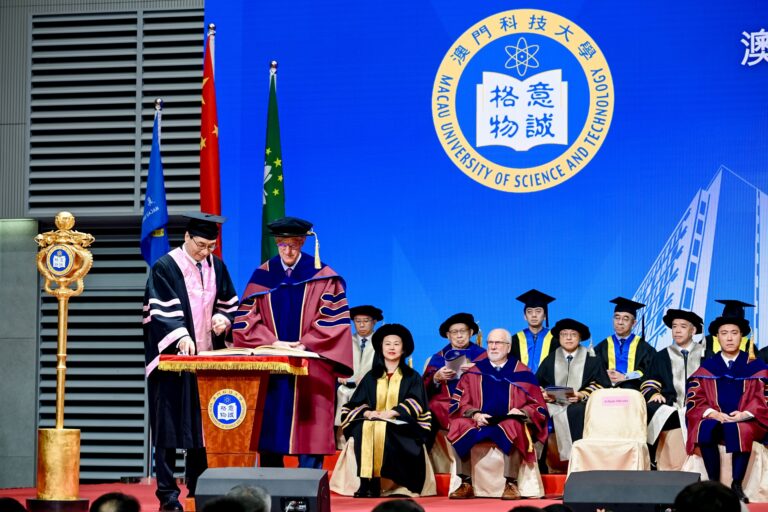
    “A distinguished engineer who has made outstanding contribution:  in Al, algorithms and complexity, and computational biology. He actively promotes China-Portugal scientific cooperation leveraging on Macao as an important bridge.“ It was with these words that Professor Joseph-Hun-wei Lee, President of Macau University of Science and Technology, justified the attribution  of the title of Doutor Honoris Causa by the Macau University of Science and Technology (MUST) to the INESC-ID researcher and Professor at Instituto Superior Técnico, Arlindo Oliveira. The event occurred on March 27, during the university’s 25th anniversary ceremony.

    Arlindo who is also President of INESC is the first Portuguese citizen to receive this distinction from MUST.

    The event also honoured two Nobel laureates: Professor Samuel Ting, awarded the Nobel Prize in Physics in 1976 for the discovery of the J particle, and Professor Sir Paul Nurse, who received the Nobel Prize in Physiology or Medicine in 2001 for his work on cell cycle regulation.

    With a distinguished career in artificial intelligence, algorithms, computational complexity, and computational biology, Arlindo Oliveira has played a leading role in advancing scientific research and education in Portugal and beyond.

    One example of this is the promotion of a partnership between China and Portugal, that resulted in the creation of the Joint Laboratory on AI and Public Health Technologies, a collaborative effort between INESC-ID, Guangzhou Laboratory, Guangzhou Medical University and MUST.

  • Joaquim Jorge Inducted into IEEE VGTC Virtual Reality Academy

    Joaquim Jorge Inducted into IEEE VGTC Virtual Reality Academy

    After being recently appointed IEEE Fellow 2025, INESC-ID researcher in the area of Graphics & Interaction, Joaquim Jorge, has now been inducted into the IEEE VGTC (Visualization and Graphics Technical Community) Virtual Reality Academy. The distinction acknowledges professionals whose contributions, in advanced human-computer interaction, surpass the usual award criteria, promoting technical and scientific excellence in Virtual Reality (VR) technologies. 

    Joaquim Jorge has focused his work on sketch-based interfaces, modelling and virtual reality, which have significantly contributed to the development of areas such as computer-aided design, multimedia content production and augmented reality. He now joins a restricted group of internationally recognised researchers, whose contributions will promote further development in  the field of VR.

    The IEEE is the world’s largest technical professional organization dedicated to advancing technology for the benefit of humanity. Its members work in various fields of engineering, computing, and technology.