Category: Highlights

  • CMU Portugal Program announces 2022 call for up to 12 Ph.D. Scholarships
    CMU Portugal Program announces 2022 call for up to 12 Ph.D. Scholarships

    The second edition of the Carnegie Mellon Portugal (CMU Portugal) “Affiliated Ph.D. Programs”, supported by Fundação para a Ciência e Tecnologia (FCT), will accept applications between February 15 to March 31 2022 for up to 12 Scholarships for the 2022/2023 academic year.

    The selected candidates will be hosted by Portuguese Universities and benefit from a research period at Carnegie Mellon University in Pittsburgh for up to 12 months. The Affiliated Ph.D. Programs initiative offers Ph.D. scholarships in selected cutting-edge areas of Information and Communication Technologies (ICT) in any Portuguese University, in the following CMU Portugal related areas:

    • Computer Science;
    • Electrical and Computer Engineering;
    • Engineering and Public Policy;
    • Human-Computer Interaction;
    • Language Technologies;
    • Robotics;
    • Software Engineering.

    Inês Lynce, National Director at Portugal of the CMU Portugal Program, is the current President of INESC-ID.

    More information on the CMU Portugal Program can be found here.

  • The third OLISSIPO Twin Seminar on Computational Biology took place today

    The third OLISSIPO Twin Seminar on Computational Biology took place today

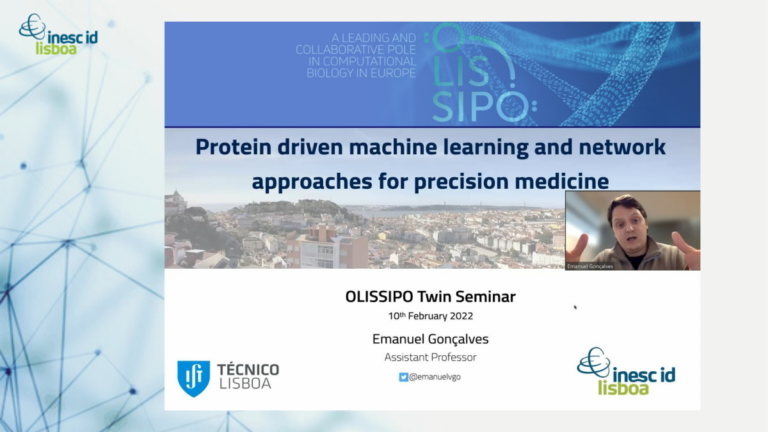
    The third OLISSIPO Twin Seminar on Computational Biology – Protein driven machine learning and network approaches for precision medicine – took place today, featuring Emanuel Gonçalves (INESC-ID and Instituto Superior Técnico) and Pedro Beltrão (ETH Zürich).

    Coordinated by Susana Vinga – INESC-ID researcher and member of its Board of Directors, as well as Associate Professor at Instituto Superior Técnico – OLISSIPO aims to enhance the competences in Computational Biology at INESC-ID and to create an international pole of excellence in multi-disciplinary science in Portugal.

    This session will soon be available on OLISSIPO’s YouTube channel.

  • INESC founder José Tribolet interviewed by RTP3

    INESC founder José Tribolet interviewed by RTP3

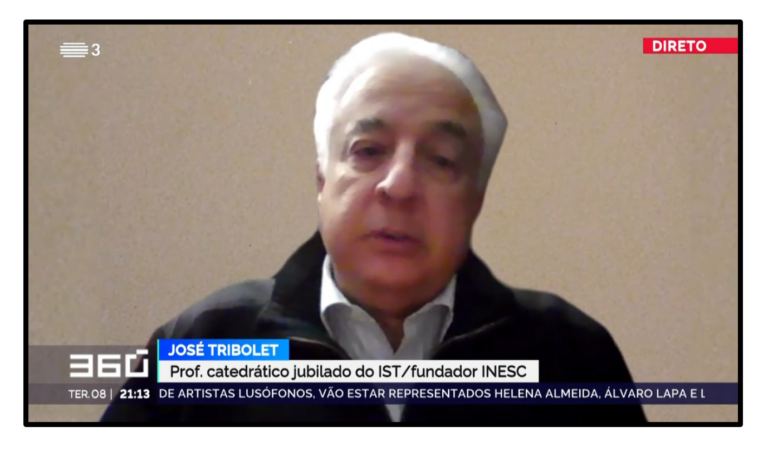
    Founder and ex-President of INESC (Instituto de Engenharia de Sistemas e Computadores), and Instituto Superior Técnico Emeritus Professor José Tribolet, was interviewed for the RTP3 information programme 360, which aired on 08 February at 9pm Lisbon-time.

    Professor Tribolet was invited to comment on the cyberattack that targeted the telecommunications company Vodafone in Portugal early that week. In his interview, Professor Tribolet reminded viewers of the pervasiveness of similar attacks on democracies worldwide, highlighting the importance of individual companies and governments building the relevant cybersecurity infrastructures in a manner that matches the needs of the 21st century.

    Security and Privacy is one of the four major Thematic Lines around which INESC-ID’s research and innovation activities take place, spanning over 20 years in this particular area. In recent times, INESC-ID has been particularly active supporting the European Commission, the Portuguese government, public entities and national companies in developing public policies and technological solutions for improving the security and privacy aspects of their presence in the Internet.

    The 08 February edition of 360 is available in this link (with Professor Tribolet’s intervention starting at 9:12pm, minute 13′ of this episode).

  • The INESC-ID February 2022 Newsletter is out!

    The INESC-ID February 2022 Newsletter is out!

    The February 2022 issue of NEWS-ID — the INESC-ID Newsletter — is out!

    Containing recent news from our researchers and their projects, as well as upcoming events, open positions and some extra bits of content, our monthly newsletter is a great one-stop spot for great content on computer science and electrical and computer engineering.

    You can subscribe to our monthly newsletter here.

  • Collaborative study on innovative breast cancer surgery with augmented reality selected for Elsevier’s World Cancer Day article collection

    Collaborative study on innovative breast cancer surgery with augmented reality selected for Elsevier’s World Cancer Day article collection

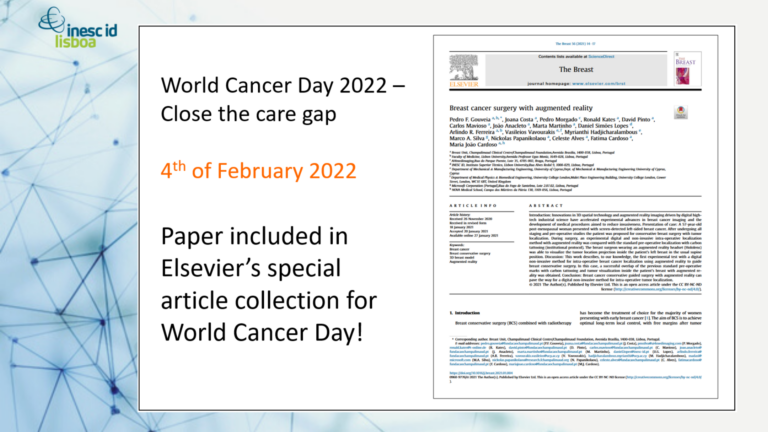
    Breast cancer surgery with augmented reality, a clinical research paper published in April 2021 in the medical journal The Breast, has been selected for inclusion in Elsevier’s World Cancer Day 2022 article collection. This collection includes a curated line-up of some of the top research papers published in Elsevier’s Oncology journal portfolios.

    Daniel Simões Lopes – an INESC-ID researcher within the Graphics and Interaction Research Area and an Assistant Professor at the Department of Computer Science and Engineering of Instituto Superior Técnico – is one of the authors of this paper, the pioneering digital technology of which had already been recognized with the “Best and Greatest in Portuguese Technology” award in the Innovation category by the Portuguese technology magazine Exame Informática in 2020.

    This landmark paper described the first use of an “augmented reality” headset by a surgeon – Pedro Gouveia, a physician from the Breast Unit of the Champalimaud Clinical Centre who performed the surgery and the corresponding author of this study – so they could visualize a virtual representation of the tumor in real time while extracting it from the patient. As the research paper itself states, it described “the first experimental test with a digital non-invasive method for intra-operative breast cancer localization using augmented reality to guide breast conservative surgery”, concluding that this type of surgery with augmented reality “can pave the way for a digital non-invasive method for intra-operative tumor localization.”

    World Cancer Day, marked on 04 February, is an international campaign to raise awareness of cancer, encouraging its prevention, detection, and treatment, while supporting all those living with cancer.

  • New book on electricity production from renewable energy sources

    New book on electricity production from renewable energy sources

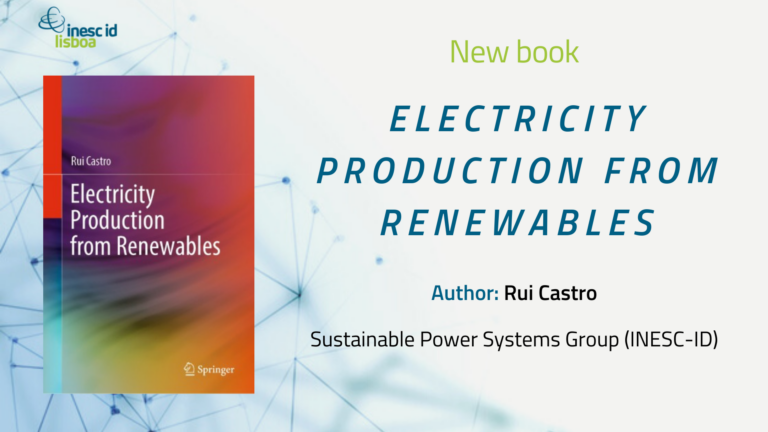
    Rui Castro — a researcher in the Sustainable Power Systems Group at INESC-ID and Associate Professor at the Department of Electrical and Computer Engineering of Instituto Superior Técnico — has published a new book: Electricity Production from Renewables (Springer Nature, 2022).

    In Electricity Production from Renewables, Rui Castro explores economically competitive renewable energy sources (RES), including onshore and offshore wind, solar and small-hydro plants, while focusing on the electricity production from these sources. Presenting theoretical concepts related to the electrical framework associated with RES (alongside examples and solved problems), this book introduces the topic of renewable power sources to graduate students, researchers and practitioners alike.

    Electricity Production from Renewables follows Castro’s two previous volumes on Power Systems (co-autored with Eduarda Pedro; IST Press, 2015) and Renewable Energy (IST Press, 2018), both in Portuguese.


    Full publication details:

    Book title: Electricity Production from Renewables

    Authors: Rui Castro

    Year of publication: 2022

    Publisher: Springer Nature

    DOI: https://doi.org/10.1007/978-3-030-82416-7

    Hardcover ISBN: 978-3-030-82415-0

    Softcover ISBN: 978-3-030-82418-1

    eBook ISBN: 978-3-030-82416-7

    Number of pages: 388

  • SenToy stars in IST’s “110 Histórias | 110 Objetos” podcast

    SenToy stars in IST’s “110 Histórias | 110 Objetos” podcast

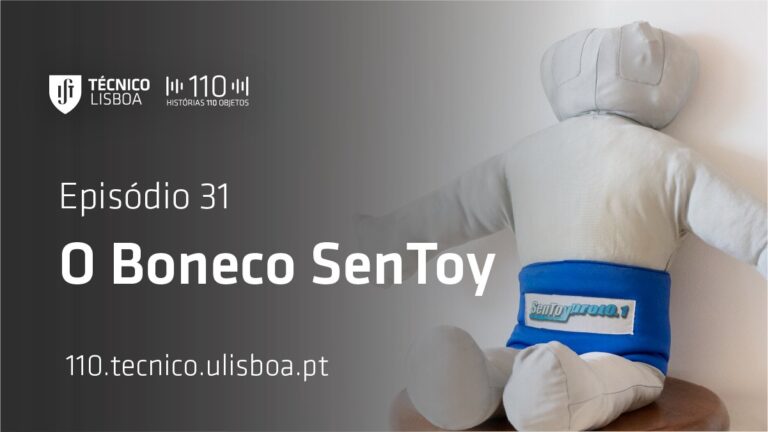
    This week’s episode of the “110 Histórias | 110 Objetos” podcast (which roughly translates to “110 Stories | 110 Objects”) features SenToy: a faceless, genderless and ageless toy, developed to communicate emotions to a computer and interact with a video game.

    SenToy originated in a European project, Safira, coordinated by Ana Paiva, researcher at the Group on Artificial Intelligence for People and Society (GAIPS) at INESC-ID and Full Professor at the Department of Computer Engineering (DEI) at Instituto Superior Técnico. Rui Prada, researcher at GAIPS and Associate Professor at Instituto Superior Técnico, also participated in this project and has a couple of tales to tell on SenToy.

    For the podcast episode and some extra bits of content, please follow this link.

  • OLISSIPO Twin Seminar III

    OLISSIPO Twin Seminar III

    We are happy to announce the next OLISSIPO Twin Seminar on Computational Biology – Protein driven machine learning and network approaches for precision medicine – which will take place online on 10 February 2022, 13:00-14:30 (WEST – Lisbon) / 14:00-15:30 (CEST). This seminar will be delivered by Emanuel Gonçalves (INESC-ID and Instituto Superior Técnico) and Pedro Beltrão (ETH Zürich), and chaired by Thomas Naake (EMBL).

    OLISSIPO – Fostering Computational Biology Research and Innovation in Lisbon – is an international research project funded by the European Commission within its H2020 Research and Innovation programme, and aims to enhance the competences in Computational Biology at INESC-ID and – through its strong link to Instituto Superior Técnico / Universidade de Lisboa – to create an international pole of excellence in multi-disciplinary science in Portugal. OLISSIPO is coordinated by Susana Vinga, INESC-ID researcher and member of its Board of Directors, as well as Associate Professor at Instituto Superior Técnico.

    The Twin Seminars contribute to disseminate the scientific work and expertise of INESC-ID and all the Consortium that includes Inria, ETH Zürich and EMBL. These seminars comprise two short presentations, one researcher from Lisbon and one from a twin international institution working on similar topics in Computational Biology, and are open to anyone interested in computational biology.

    For more details on this Twin Seminar, please check out this link.

    ZOOM link: https://videoconf-colibri.zoom.us/j/87272445544.

    No password or registration will be needed for this session.

  • Joaquim Jorge selected as an IEEE Computer Society Distinguished Visitor

    Joaquim Jorge selected as an IEEE Computer Society Distinguished Visitor

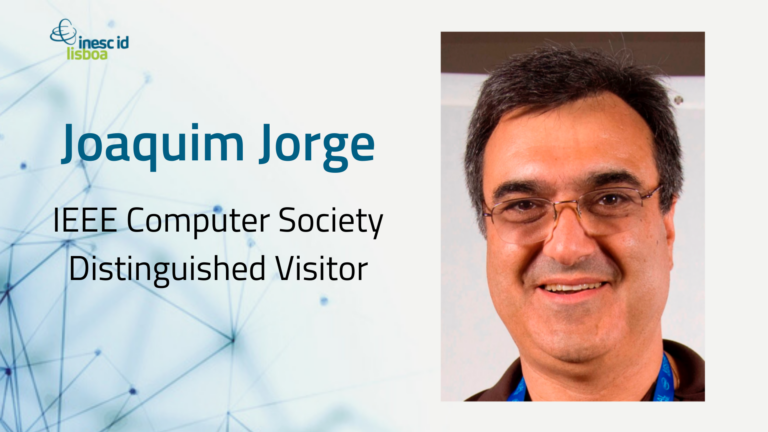
    Joaquim Jorge, a researcher at INESC-ID’s Graphics and Interaction (GI) group and Professor of Computer Science at Instituto Superior Técnico, has been selected as an IEEE Computer Society Distinguished Visitor, an honor conferred to some of the most accomplished leaders in tech.

    Selection as a Distinguished Visitor is highly competitive and is reflective of, according to IEEE, Professor Jorge’s “remarkable contributions to the profession, Computer Society, IEEE and the community in general.” This distinction follows Professor Jorge’s recognition as an ACM Distinguished Speaker since 2015.

    The IEEE Distinguished Visitor Program is organized by the IEEE Computer Society, a professional society of the Institute of Electrical and Electronics Engineers (IEEE), the world’s largest technical professional organization for electronic engineering and electrical engineering.

  • INESC-ID coordinates a European project on electric mobility

    INESC-ID coordinates a European project on electric mobility

    The EV4EU project, with a duration of 4 years, is funded by the European Union in 9 million euros through Horizon Europe, the new research and innovation programme for the period 2021-2027.

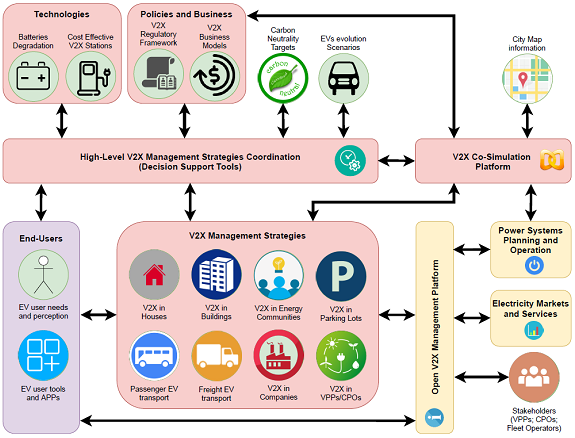
    Studies indicate that the massive use of electric vehicles will significantly contribute to the carbon neutrality goals set for 2050, as defined by the European Commission. However, the mass deployment of electric vehicles still presents several challenges: from market maturity and the cost of electric vehicles to user adoption, the charging infrastructure and the lack of policies to promote the use of these vehicles. To address these challenges, the “Electric Vehicles Management for carbon neutrality in Europe” (EV4EU) project will propose and implement user-centric Vehicle-to-Everything (V2X) management strategies, creating the conditions for the mass deployment of electric vehicles. The proposed V2X management strategies will be tested at four demonstration sites: in Portugal on the island of São Miguel; in the Mesogia area in Greece; at Risø and Rønne, island of Bornholm, Denmark; and in Slovenia.

    Hugo Morais, senior researcher at INESC-ID, Professor at the Department of Electrical and Computer Engineering (DEEC) of Instituto Superior Técnico, and project coordinator, explained: “EV4EU is expected to contribute to the implementation of the EU Sustainable and Smart Mobility Strategy and Action Plan, proposed by the European Commission. Given the diverse composition of the consortium, the main results of the project will be disseminated to various audiences, nationally, in Europe and worldwide.”

    INESC-ID leads the consortium of sixteen entities from four European countries, which comprise: three research institutions; an institution of higher education; three small and medium-sized companies; seven large companies; a government institution; and an educational establishment, which will be an end user in the EV4EU project. Among these types of partners are Distribution System Operators (DSOs), technology providers, a virtual power plant (VPP), a Charging Point Operator (CPO) and an automobile manufacturer.

    ________________________________________________________________

    O projeto EV4EU, com duração de quatro anos, é financiado pela União Europeia em 9 milhões de euros através do Horizonte Europa, o novo programa de investigação e inovação para o período 2021-2027.

    Estudos recentes indicam que o uso massivo de veículos elétricos contribuirá significativamente para as metas de neutralidade de carbono a serem atingidas até 2050, tal como definidas pela Comissão Europeia. No entanto, a implantação em massa de veículos elétricos apresenta ainda vários desafios: da maturidade do mercado e os custos associados a veículos elétricos, à adoção pelo utilizador, a infraestrutura de carregamento ou a falta de políticas que promovam a utilização destes veículos. Para abordar estes desafios, o projeto “Electric Vehicles Management for carbon neutrality in Europe” (EV4EU) irá propor e implementar e demonstrar estratégias de gestão de Vehicle-to-Everything (V2X) centradas no utilizador, criando as condições necessárias para a implantação em massa de veículos elétricos. As estratégias de gestão de V2X propostas serão testadas em quatro locais de demonstração: em Portugal na ilha de São Miguel; na área de Mesogia na Grécia; em Risø e Rønne, ilha de Bornholm, na Dinamarca; e na Eslovénia.

    Hugo Morais, investigador sénior do INESC-ID, docente do Departamento de Engenharia Eletrotécnica e de Computadores (DEEC) do Instituto Superior Técnico e coordenador deste projeto, explicou: “Espera-se que o EV4EU contribua para a implementação da Estratégia e o Plano de Ação para a Mobilidade Sustentável e Inteligente proposta pela Comissão Europeia. Dada a composição multidisciplinar do consórcio, os principais resultados do projeto serão disseminados por vários públicos, tanto a nível nacional, como europeu e mundial.”

    O INESC-ID lidera o consórcio constituído por dezasseis entidades de quatro países europeus, entre as quais: três instituições de investigação; uma instituição de ensino superior; três pequenas e médias empresas; sete grandes empresas; uma instituição governamental; e um estabelecimento de ensino, que será um utilizador final no projeto EV4EU. Entre estas tipologias de parceiros, encontram-se operadores do sistema de distribuição elétrico, fornecedores de tecnologia, um agregador (Virtual Power Plant), um operador de pontos de carregamento e um fabricante de automóveis.