On May 22, Instituto Superior Técnico celebrates its 109th anniversary with an online event in live streaming, starting at 2 pm.
Join us to celebrate with Técnico!
More information here.


On May 22, Instituto Superior Técnico celebrates its 109th anniversary with an online event in live streaming, starting at 2 pm.
Join us to celebrate with Técnico!
More information here.


On the national scientists day, we highlight the work of our team, which has evolved a lot over the last 20 years.
Our scientists develop technologies every day to serve you!

INESC-ID had just recently approved 5 research projets under the FCT Call for the Carnegie Mellon Portugal program, under a total of 7 research projets that will be funded under this call. These 5 exploratory research projects where submitted in 2019 and will be supported with a total fund of around 300k€.
Nuno Nunes, co-director of CMU Portugal Program, says: “we hope that these projects could serve to explore ideas born from needs identified by the scientific community, in a bottom-up way, that may in the future be a foundation to larger ones.”
In the words of Rodrigo Rodrigues, co-director of CMU Portugal Program: “it is expected that the impact of these exploratory projects goes beyond publishing articles and other metrics. We hope that that above all, these projects lead to the construction of systems to respond to real problems”
The selected projects are listed below.
AGENTS: Automatic generation of humor for social robots
Principal Researcher in Portugal: Ana Paiva
Institutions involved: Instituto de Engenharia de Sistemas e Computadores, Investigação e Desenvolvimento em Lisboa, Instituto Superior Técnico, Universidade de Lisboa; ISCTE – Instituto Universitário de Lisboa; Language Technologies Institute – Carnegie Mellon University
PassCert: Exploring the Impact of Formal Verification on the Adoption of Password Security Software
Principal Researcher in Portugal: João Fernando Ferreira
Institutions involved: Instituto de Engenharia de Sistemas e Computadores, Investigação e Desenvolvimento em Lisboa, Instituto Superior Técnico, Universidade de Lisboa; Inesc Tec – Instituto de Engenharia de Sistemas e Computadores, Tecnologia e Ciência; Department of Computer Science – Carnegie Mellon University
PRIVADIA: Privacy in speaker diarization: Detecting “who spoke when” privately
Principal Researcher in Portugal: Isabel Trancoso
Institutions involved: Instituto de Engenharia de Sistemas e Computadores, Investigação e Desenvolvimento em Lisboa, Instituto Superior Técnico, Universidade de Lisboa; Language Technologies Institute – Carnegie Mellon University
SECURITYAWARE: Fine-grained approach to detect and patch vulnerabilities
Principal Researcher in Portugal: Rui Maranhão
Institutions involved: Instituto de Engenharia de Sistemas e Computadores, Investigação e Desenvolvimento em Lisboa, Instituto Superior Técnico, Universidade de Lisboa ; Department of Electrical and Computer Engineering – Carnegie Mellon University
SyNAPSE: Synthetizing Network Accelerators using Programmable Switching Equipment
Principal Researcher in Portugal: Luís Pedrosa
Institutions involved: Instituto de Engenharia de Sistemas e Computadores, Investigação e Desenvolvimento em Lisboa, Instituto Superior Técnico, Universidade de Lisboa; FCiências.ID – Associação para a Investigação e Desenvolvimento de Ciências; Department of Computer Science – Carnegie Mellon University
INESC-ID is looking forward to work in these projects!


The Scientific Computing World Magazine published an article about the progress in the project EPEEC – European Programming Environment for Programming Productivity of Heterogeneous Supercomputers.
This article is an interview with Antonio Peña, project coordinator, and Senior Researcher from Barcelona Supercomputing Center (BSC).
The project EPEEC, coordinated by BSC, results from a collaboration with 10 European research institutions and companies, where INESC-ID is one of the members.
Read the article here.


The European project iv4XR brings together experts from 8 different countries, to research and develop novel ways to test Extended Reality (XR) systems using Artificial Intelligence (AI). XR systems are interactive systems such as Virtual Reality (VR) and Augmented Reality (AR), which combines real and virtual environments. These systems can be powerful tools for areas such as medicine (e.g. 3D imaging), entertainment (e.g. video games) and military (e.g. combat training).
The goal is to improve the testing of these systems in terms of functionality and user experience. The project is deploying tools that automate some testing procedures, reducing the current burden of user testing in the XR development process, which still largely requires human testers. It removes barriers from the state of the art processes and empower the development of novel XR systems.
Extended Reality (XR) has limitless possibilities to change both the digital and the real world. However, the development of XR systems is currently a big challenge, as is their verification and validation, which are key steps of the highly iterative development process.
The European joint effort aims to provide XR developers with intelligent test agents that will automatically explore and test their systems, searching for unexpected behaviors, usability concerns and helping refine configurations. Since user experience is an essential part of XR systems, this project also aims to develop socio-emotional AI in test agents to automatically assess the quality of the user experience.
This project is led by an INESC-ID team, coordinated by Rui Prada.
Other members consist of companies representing the XR industry: Gameware Europe Limited (United Kingdom), GoodAI Research SRO (Czech Republic), Thales SIX GTS and Thales AVS (France); universities: Universiteit Utrecht (Netherlands) Universitat Politècnica de València (Spain) and Umeå Universitet (Sweden); and the research institute Fondazione Bruno Kessler (Italy). The team combines decades of expertise in advanced interactive systems, AI, and software engineering and testing, and XR development.

For more information: iv4xr-project.eu | Twitter: @iv4xr


The MOOD Project started in January 2020 and intends to improve epidemic intelligence tools and services. It is is part of the European programme H2020, and has a budget of 14 million euros.
At the moment, the project is very focused on COVID-19.
In the next 4 years, 25 different research institutions, foundations, and government public health and veterinary organizations will work together in the development of new monitoring tools, as a complementary addition to those already in existence.
This project will act in four stages:
Epidemic intelligence systems or how to assess the risk of emerging pathogens
Climate change, animal and human mobility, growing populations and urbanization bring an increased risk for the emergence and global and accelerated spread of new pathogens. It is crucial that the emergence of a pathogen can be rapidly detected and assessed for the risk it poses to public health.
In response to this, public health agencies are developing epidemic intelligence systems that rely on two types of information: “official” sources reported by public health services as well as so-called “unofficial” sources, which relay information found in the media, scientific articles or laboratory data.
The MOOD project will contribute to these efforts, providing existing monitoring platforms with methodological and practical support in response to their needs. Beyond health data, other types of data will also be incorporated to better assess the risk of a pathogen spreading.
INESC-ID researchers involved are Bruno Martins and Mário Silva, which are also professors at Instituto Superior Técnico.
Partners involved:
France: Anses, Cirad, INRAE, Inserm, Université de Montpellier-LIRMM, GERDAL
Germany : Mundialis GmbH & Co KG
Belgium: Institute of Tropical Medicine, Université Libre de Bruxelles, Katolich University of Leuven, Avia-GIS
Spain: Instituto de Salud Carlos III
Italy: Fondazione Edmund Mach/Fondazione Bruno Kessler, Istituto Superiore di Sanità
Finland: Finnish Institute for Health and Welfare Netherlands: Stichting OpenGeoHub
Portugal: Instituto de Engenharia de Sistemas e Computadores, Investigação e Desenvolvimento em Lisboa
United Kingdom: University of Oxford, Environmental Research Group Oxford Limited, University of Southampton
Serbia: Institute of Public Health of Serbia
Switzerland: ETH Zürich, SIB Institut Suisse de Bioinformatique
United States of America: International Society for Infectious Diseases
Olissipo “Fostering Computational Biology Research and Innovation in Lisbon” is a twinning action, meaning that stands for institutional networking to strengthen a specific field of research. The OLISSIPO project aims to bring these disciplines together with biological and biomedical research and strengthen INESC-ID’s research profile in computational biology.
Susana Vinga is the principal researcher involved in this special widening action.
OLISSIPO is a joint effort by INESC-ID, EMBL’s Huber group , the French National Institute for Research in Digital Science and Technology (INRIA) in Lyon, and the Swiss Federal Institute of Technology in Zurich (ETH Zurich).
The project will focus on key applications of statistics in molecular biology research, for example in single cell analyses and simulations, and the mathematical modelling of cell–cell interactions.
Group leader Wolfgang Huber and his team will contribute their expertise in developing statistical methods and computational tools, and will prepare tutorials, training courses, and outreach activities, and welcome scientists from INESC-ID to EMBL Heidelberg. The ultimate goal of OLISSIPO is to establish a leading European cluster of excellence in computational biology in Lisbon.


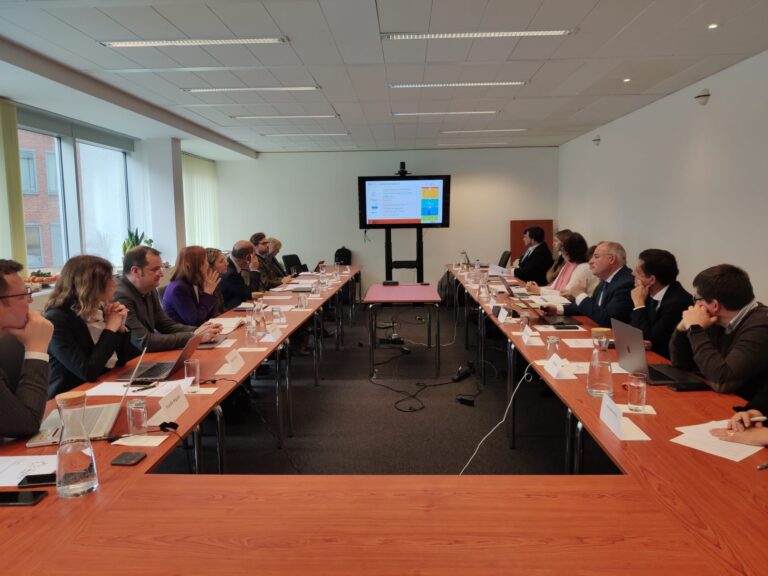
Based in Brussels, INESC Brussels HUB was created, recently, to increase the success of the five institutes from INESC Group: INESC Coimbra, INESC ID, INESC MN, INESC TEC, and INESC Inovação.
INESC Brussels HUB is an important step to raise INESC institutes to an international level.
At the beginning of March, representatives from the five institutions gathered together with Portuguese Members of the European Parliament Committee on Industry, Research and Energy (ITRE) to present INESC to all the institutions, and also, present histories of successful research and innovation with economic and social impact, with the resource to European funds.
Also, this meeting was important to discuss the contribution of INESC in different pieces of legislation and the internationalization of the INESC group.
Recently INESC Brussels Hub has launched a monthly newsletter that can be read here: Edition 1 | Edition 2.


In March this year, Instituto Superior Técnico (IST) attributed the Maria de Lourdes Pintasilgo Award to our former fellow Catarina Belém, in the category Young Alumni.
This prize rewards, annually, since 2016, two women graduated at Instituto Superior Técnico.
Congratulations Catarina Belém!