We are proud to announce that our researcher Ana Paiva, from the research group Intelligent Agents and Synthetic Characters (GAIPS), was elected EurAI Fellow by the EurAI Fellows committee 2019.
The


We are proud to announce that our researcher Ana Paiva, from the research group Intelligent Agents and Synthetic Characters (GAIPS), was elected EurAI Fellow by the EurAI Fellows committee 2019.
The

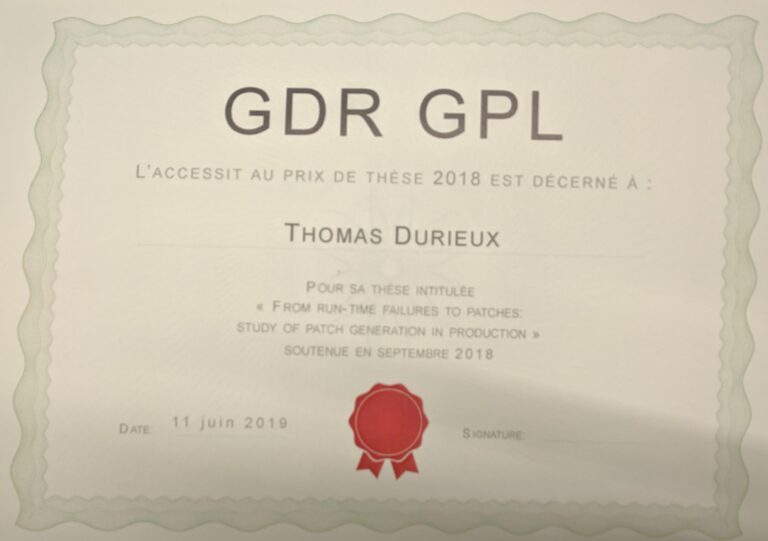
The doctoral thesis «From Runtime Failures to Patches: Study of Patch Generation in Production» of our researcher Thomas Durieux
The


INESC-ID is one of the ten partners of Qualichain, a European project focused on the assessment of the implications at technical, political, socio-economic, legal and cultural levels of Blockchain technology for verifying education and employment qualifications. Also, QualiChain specifies in the “impact – in terms of benefits and risks – of the prescribed solution’s utilization”.
QualiChain targets the creation, piloting and evaluation of a decentralised platform for storing, sharing and verifying education and employment qualifications and focuses on the assessment of the potential of blockchain technology, algorithmic techniques and computational intelligence for disrupting the domain of public education, as well as its interfaces with private education, the labour market, public sector administrative procedures and the wider socio-economic developments.
INESC-ID is in charge of designing some of the components of the platform and participates in one of the pilots. This research project is coordinated at INESC-ID by Miguel Pupo Correia.
For more information: https://qualichain-project.eu


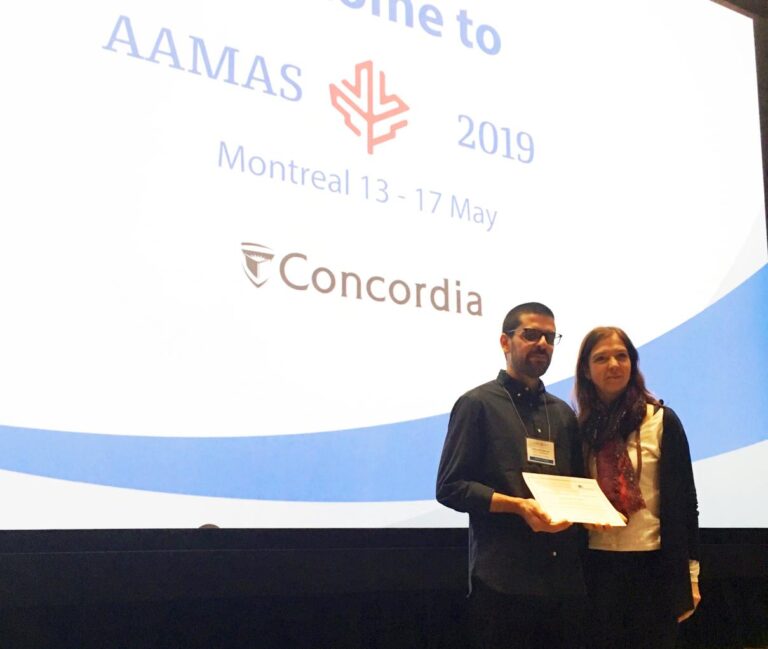
Fernando Pedro, a former student from GAIPS won the Victor Lesser distinguished dissertation award with the these ‘Reputation Dynamics and the Self-organization of Cooperation’, at AAMAS 2019.
Moreover, six members of GAIPS Team, led by the researcher Ana Paiva, presented their work at the international conference, in Montreal, Canada and one of them got nominated for the best paper award.


INESC-ID is one of the ten partners of Qualichain, a European project focused on the assessment of the implications at technical, political, socio-economic, legal and cultural levels of Blockchain technology for verifying education and employment qualifications. Also, QualiChain specifies in the “impact – in terms of benefits and risks – of the prescribed solution’s utilization”.
QualiChain targets the creation, piloting and evaluation of a decentralised platform for storing, sharing and verifying education and employment qualifications and focuses on the assessment of the potential of blockchain technology, algorithmic techniques and computational intelligence for disrupting the domain of public education, as well as its interfaces with private education, the labour market, public sector administrative procedures and the wider socio-economic developments.
INESC-ID is in charge of designing some of the components of the platform and participates in one of the pilots. This research project is coordinated at INESC-ID by Miguel Pupo Correia.
For more information: https://qualichain-project.eu

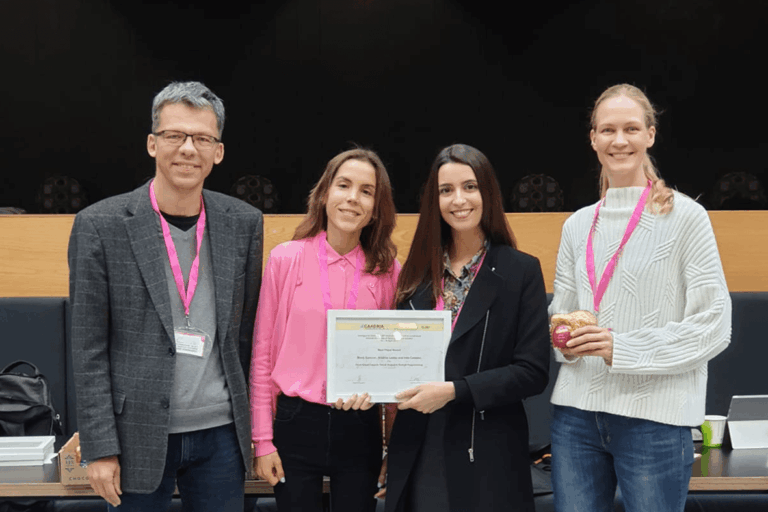
The research team led by INESC-ID Researcher António Menezes de Leitão received last week two awards during the CAADRIA conference, Best Paper Award and Best Presentation Award.

The paper From Visual Input to Visual Output in Textual Programming co-authored by Maria João Sammer, António Leitão and Inês Caetano won the best paper award. The work approaches Algorithmic Design that uses algorithms to generate designs. These algorithms are built using either a Visual Programming Language (VPL) or a Textual Programming Language (TPL). In architecture, there is a clear propensity to the use of VPLs, e.g., Grasshopper or Dynamo, over the use of TPLs, e.g., Python or AutoLisp. In addition to all the user-friendly and interactive features that make VPLs more appealing to architects, most of them already integrate components for textual programming. In contrast, TPLs have not been as successful in incorporating visual features. Given the user-friendliness of VPLs and the relevance of TPLs for large-scale and complex designs, we discuss Visual Input Mechanisms (VIMs) in the context of TPLs. In this paper, we extend previous research in this area by exploring and implementing the most valuable VIMs in a TPL adapted for architectural design.

Researcher Renata Castelo Branco was awarded best presentation paper
for the publication Game of Renders: The Use of Game Engines for Architectural Visualization. The paper shows that Good visualization mechanisms offer architects, and their clients, a better grasp of how their designs are going to turn out when built, and the experience one might have inside the constructions. This also helps the architect orient the design in a more informed manner. However, typically used modeling tools do not offer satisfactory visualization solutions. The operations available to view and navigate through the 3D space are flawed in terms of speed, interactivity, and real-time rendering quality. To solve this issue, we propose the coupling of a portable algorithmic design framework with a Game Engine (GE) to support interactive visualization of architectural models and increase the rendering performance of the framework. We explain in detail this integration, and we evaluate this workflow by implementing a case study and comparing the performance of the GE to architectural modeling tools.
The 24th Annual Conference of the Association for Computer-Aided Architectural Design Research in Asia under the theme ” ‘Informed & Intelligent” took place in New-Zeland between 15th and 18th of April and within the coverage of the call lied a broad spectrum of approaches ranging from speculative, informal investigations to conventional scientific research.


INESC ID leads European project on the use of AI for testing advanced interactive software systems as part of the H2020
The project, called iv4XR (Intelligent Verification/Validation for Extended Reality Based Systems), is led by INESC ID and will be developed by a European consortium, as part of the H2020 programme.
Project iv4XR will develop groundbreaking verification and validation technology for Extended Reality (XR) systems based on techniques from AI to provide learning and reasoning over a virtual world. With this technology XR developers can deploy powerful test agents to automatically explore and test the correctness of a virtual world as they iteratively develop and refine it. This includes testing user experience using socio-emotional AI. The project results will enable developers to conduct automated assessment of the quality of user experience, parameterized by different target groups of users, and different user experience goals.
Nowadays, Extended Reality (XR) systems (e.g. advanced interactive systems, such as, Virtual Reality (VR) and Augmented Reality (AR)) have emerged in various domains, ranging from entertainment, cultural heritage, to combat training and mission critical applications. The development and authoring of such systems is an iterative process that also includes quality assurance to make sure that the resulting systems are correct and delivering a high quality user experience. As the complexity of these systems keeps increasing, the XR industry now finds itself confronting a soaring engineering challenge: paradoxically, XR’s fine grained and high level of interactivity and realism make such systems very hard and expensive to test. The current XR authoring and development toolset poses no XR testing technology beyond rudimentary record and replay tools
that only work for simple test scenarios. The iv4XR project will address this difficult challenge.
This project will be carried out by a team consisting of four companies (large and SMEs) representing the XR industry, three universities, and two research institutes. The team combines decades of expertise in advanced interactive systems, AI, and software engineering.
Consortium includes 9 organizations from eight different nationalities
Besides INESC ID, there are eight other partners, from seven different nationalities (Spanish, Italian, Dutch, English, French, Czech, and Swedish), involved in the project: UNIVERSITEIT UTRECHT (The Netherlands), FONDAZIONE BRUNO KESSLER (Italy), JUNIVERSITAT POLITECNICA DE VALENCIA (Spain), GAMEWARE EUROPE LIMITED (UK), AGI RESEARCH SRO (Czech Republic),THALES SIX GTS FRANCE SAS (France), THALES AVS FRANCE SAS (France) and UMEA UNIVERSITET (Sweden).
INESC ID is represented in this project by the GAIPS – Intelligent Agents and Synthetic Characters Group, which will be responsible for implementing this project. Rui Prada, as project leader, highlights the expected growth of the field and market of XR systems in gaming, training and operational domains. He argues that AI will have an important contribution in the development of complex XR systems and will be crucial to support the new emerging uses of XR.
Project iv4XR is scheduled to start in October 2019, has a duration of 36 months and will be receiving an investment of approximately 3.7 million euros.

Arquivo.pt is a research infrastructure managed by the Foundation for Science and Technology, I.P. (FCT, IP) through its FCCN unit, which allows searching and accessing web pages since 1996. The main objective is the preservation of information published on the web for memory, study and research purposes.
Arquivo.pt 2019 contest aims to reward original and innovative works that demonstrate the usefulness of the Arquivo.pt service, the importance of preserving and using the information published on the web. Entries may deal with any subject, provided that Arquivo.pt is used as the main source of information, practical applications or complete research studies based on information preserved from the web by Arquivo.pt. The applications must clearly demonstrate the usefulness and unique nature of Arquivo.pt for the proposed work and the impact of the work on the society or community for which it is intended. The competition is open until May 3rd at 1PM, to all interested parties, individually or in groups, although its main recipients are members of the educational and scientific community.
Information about this competition can be obtained from:
contacto@arquivo.pt or +351 218 440 100

João Miranda Lemos, coordenador do grupo de investigação “Control of Dynamical Systems” (CSD) no INESC-ID, editou um novo livro do IST PRESS, intitulado, “Controlo no Espaço de Estados”.
Este livro foi escrito para suportar um segundo curso de Controlo baseado no modelo de estado, mas com um pouquinho de criatividade podemos incluir ( da maneira mais séria) muitos exemplos algo inesperados. O livro está organizado em quatro partes, que correspondem a grandes temas da engenharia dos sistemas de controlo:
• Modelo de estado de sistemas lineares;
• Controlo por realimentação linear de variáveis de estado
• Controlo de sistemas não lineares
• Controlo ótimo.
http://istpress.tecnico.ulisboa.pt/node/498