Category: INESC-ID

  • Leonel Sousa nominated Associate Editor for IEEE Transactions on Emerging Topics in Computing

    Leonel Sousa nominated Associate Editor for IEEE Transactions on Emerging Topics in Computing

    Leonel Sousa has been nominated for the Editorial Board of IEEE Transactions on Emerging Topics in Computing (TETC).

    President of INESC Lisboa and a researcher in the INESC-ID High Performance Computing Architectures and Systems (HPCAS) research area — as well as a Full Professor at the Department of Electrical and Computer Engineering of Instituto Superior Técnico — Professor Sousa is joining TETC as an Associate Editor.

    As an Associate Editor, Professor Sousa will play a key role in TETC’s peer-review process, aiding the Editor-in-Chief with his unique set of expertise. A world-renowned authority in high performance and parallel computing, micro-architectures for general purpose and specialized processors, as well as multimedia systems, Professor Sousa is frequently featured in Stanford’s list of the World’s top 2% most-cited researchers.

    Coordinated by Editor-in-Chief Paolo Montuschi (from Politecnico di Torino, Italy), the TETC Editorial Board includes more than forty experts and academics from all over the world who evaluate high-impact papers on emerging aspects of computer science, computing technology and computing applications: from IT for Green and synthetic and organic computing structures and systems, to advanced analytics, social/occupational computing, location-based/client computer systems or healthcare IT. A Q1 journal, TETC has been publishing some of the most groundbreaking work in computer science since 2013.

    The Institute of Electrical and Electronics Engineers (IEEE) is the world’s largest technical professional organization dedicated to advancing technology for the benefit of humanity. The IEEE Computer Society, the portfolio of which TETC is part, engages “computer engineers, scientists, academia, and industry professionals from all areas of computing, [setting] the standard for the education and engagement that fuels continued global technological advancement.”

  • The December 2022 INESC-ID newsletter is out!

    The December 2022 INESC-ID newsletter is out!

    The December 2022 issue of NEWS-ID — the INESC-ID Newsletter — is out! You can read it here.

    Containing recent news from our researchers and their projects, open positions and some extra bits of content, our monthly newsletter is a great one-stop spot for great content on computer science and electrical and computer engineering.

    You can subscribe to our monthly newsletter here.

  • How and when viruses move: predicting the spread of COVID-19 using neural network models

    How and when viruses move: predicting the spread of COVID-19 using neural network models

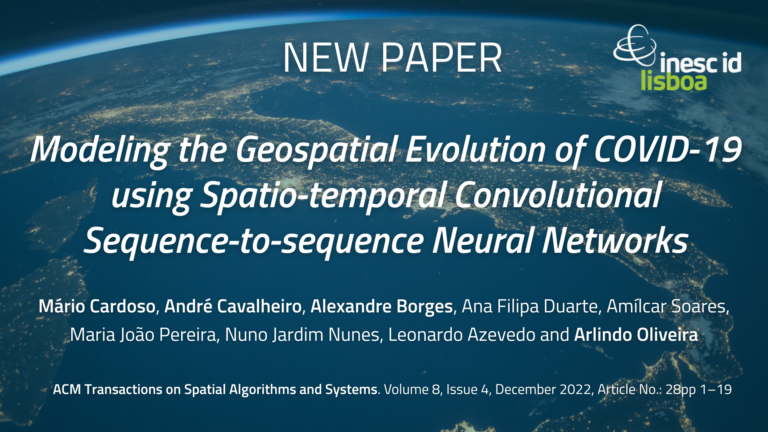
    A group of researchers, led by Arlindo Oliveira, has proposed a new method to compute the spatio-temporal dynamics of COVID-19 infections.

    In a paper published this week on ACM Transactions on Spatial Algorithms and Systems, four INESC-ID researchers (Mário Cardoso, André Cavalheiro, Alexandre Borges and Arlindo Oliveira), together with colleagues from CERENA and ITI, implemented a neural network model — a computer program that simulates complex processes based on a very simplified form of how the human brain processes information — to estimate the incidence rate of COVID-19 in mainland Portugal.

    Based on the STConvS2S (Spatiotemporal Convolutional Sequence-to-Sequence) Network architecture, and using data from the Portuguese Directorate-General for Health (DGS) across the first twelve months of the pandemic, these researchers were able to show that this type of network was the best performing method for mapping the geospatial evolution of COVID-19 (when compared to an Autoregressive Moving Average [ARMA] model, a Vector Autoregressive [VAR] model, and a Susceptible–Infected–Recovered–Dead [SIRD] model). In short, the best way to map the dynamics of this contagion between neighboring regions — an important step in making predictions about the evolution of pandemics.

    All the data used in this article, as well as the code for the SIRD and the STConvS2S models, is available here.

  • INESC-ID takes part in the world’s largest consortium on Responsible AI

    INESC-ID takes part in the world’s largest consortium on Responsible AI

    INESC-ID has been announced as one of the members of the world’s largest consortium on Responsible Artificial Intelligence (Responsible AI).

    Led by Unbabel and including a set of ten other startups, eight research institutes (in Lisbon, Porto and Coimbra, amongst them INESC-ID, Instituto Superior Técnico, the Champalimaud Foundation and the Faculty of Engineering of the University of Porto), a law firm and five industry leaders across the life sciences, tourism and retail the Centre for Responsible AI will invest 78 million euros from the Portuguese Recovery and Resilience Plan (Plano de Recuperação e Resiliência, PRR) with the goal of positioning Portugal as a world leader in Responsible AI technologies and regulation.

    INESC-ID will participate in the Centre for Responsible AI via eleven of its researchers (some of whom will also integrate the Scientific and Executive Boards of the consortium): Isabel Trancoso, Ana Paiva, Bruno Martins, Helena Moniz, João Paulo Carvalho, Francisco Melo, Paolo Romano, Luísa Coheur, David Matos, Ana Teresa Freitas and Arlindo Oliveira.

    With a predicted impact on the Portuguese economy rounding 250 million euros, the Centre for Responsible AI is set to create 210 highly qualified jobs and result in over 130 advanced academic degrees.

    As part of its ambitious plan, this consortium will develop twenty-one innovative AI products, leveraging Responsible AI technologies to reduce biases and the potentially negative impact of these applications, fostering their equitable and sustainable use. Exemplifying the groundbreaking reach of the Centre for Responsible AI, one of these products will allow the automatic translation of clinical data, resolving and bypassing current challenges that should, for instance, contribute to the acceleration of clinical trials and the rapid transition of clinically important consumables to the market.

    On this world-first Centre for Responsible AI, Paulo Dimas, Vice-President of Innovation at Unbabel, commented that “we are creating what is the biggest Responsible AI consortium in the world. In it, we will develop a virtuous circle between startups and advanced research centers, creating next-generation AI products while positioning Portugal at the forefront of Artificial Intelligence. It was for us an enormous privilege to be able to lead this consortium where some of the brightest minds in Portugal are gathered to invent the future of Artificial Intelligence.”

  • Open call for six doctoral research fellowships

    Open call for six doctoral research fellowships

    INESC-ID has an open call for six Research Grants for Doctoral Degrees in the scientific areas listed below, under the FCT Research Grant Regulation (RBI) and the Statute of the Scholarship Holder of Research (EBI).

    The impact of the research carried out at INESC-ID is focused around four Thematic Lines: Digital Transformation; Life and Health Technologies; Energy Transition; and Security and Privacy. The Thematic Lines of INESC-ID also promote synergies between eleven Scientific Research Areas.

    The grants are funded by the Foundation for Science and Technology (FCT) under the Collaboration Protocol for Financing the Multi-Annual Plan for Research Grants for Doctoral Students, signed between FCT and INESC-ID, Instituto de Engenharia de Sistemas e Computadores: Investigação e Desenvolvimento em Lisboa, with the reference UIDB/50021/2020.

    Applications and documents supporting the application provided for in the Notice of Opening of the Competition (linked to below) must be submitted by email to the following address: rh@inesc-id.pt.

    Full application details are available in the following document: BD_PhD__UIDB_50021_2022_pt_en_dec_2022.

    Further details may also be found here.

    The call is open to December 15, 2022.

  • INESC-ID researchers recognized in Stanford’s list of top 2% most-cited

    INESC-ID researchers recognized in Stanford’s list of top 2% most-cited

    Several INESC-ID researchers have been included in the comprehensive data sets comprising Stanford’s list of the World’s top 2% most-cited researchers in 2021 via Elsevier.

    Comprising two worldwide listings of 200,000 researchers (signalling those who were the most influential in 2021, as well as across their entire career), the Stanford lists bring with them mention of several INESC-ID faculty:

    This year’s Stanford lists includes researchers from nine different INESC-ID research Areas: Artificial Intelligence for People and Society, Automated Reasoning and Software Reliability, Distributed, Parallel and Secure Systems, Graphics and Interaction, Green Energy and Smart Converters, High Performance Computing Architectures and Systems, Human Language Technologies, Information and Decision Support Systems and Sustainable Power Systems.


    (Feature under current update)

  • Joaquim Jorge elected to the Board of Governors of the IEEE Computer Society

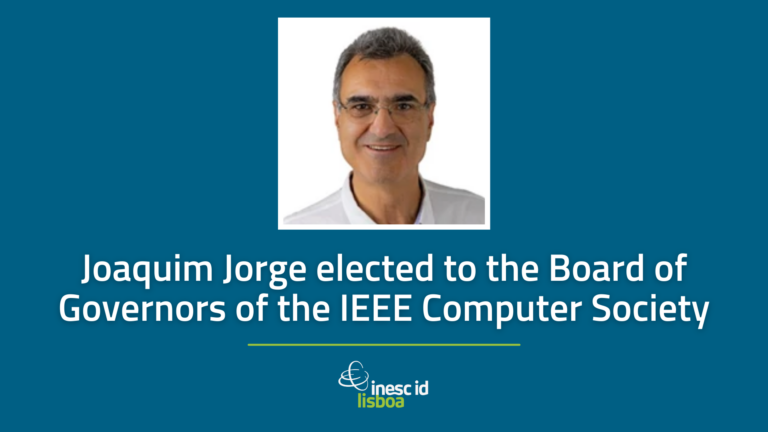
    Joaquim Jorge elected to the Board of Governors of the IEEE Computer Society

    Joaquim Jorge researcher at INESC-ID’s Graphics and Interaction Research Area and Professor of Computer Science at Instituto Superior Técnico has been elected to the 2023-2025 Board of Governors of the IEEE Computer Society (IEEE CS), a leadership position and honour conferred to some of the most accomplished figures in tech and academia.

    The IEEE CS represents the largest global community of computer scientists and engineers as a “trusted organization dedicated to engaging the engineers, scientists, academia, and industry professionals from across the globe driving continued advancements in computer science and technology”. Its Board of Governors, to which Professor Jorge has become one of six newly elected members, is the international body of renowned experts that supports the IEEE CS in driving its vision forward, providing “policy guidance to program boards and committees, and [reviewing] the performance of the organization to ensure compliance with its policy directions.”

    In his position statement, and building on a long professional service record with IEEE CS and similar associations, Professor Jorge noted that he wishes to “make a difference and contribute to trans-Atlantic and worldwide scientific cooperation within and outside the Computer Society,” adding that he intends to “contribute to defining much-needed public policies” and “will strive to make IEEE CS a more diverse, inclusive, and gender-balanced organization.

    Earlier this year Professor Jorge was selected as an IEEE Computer Society Distinguished Visitor, a distinction that followed Professor Jorge’s recognition as an ACM Distinguished Speaker since 2015.

    Photo source/credit: IEEE CS.

  • André Ribeiro and Alberto Rodrigues da Silva receive “Most Influential Paper” Award at QUATIC’22

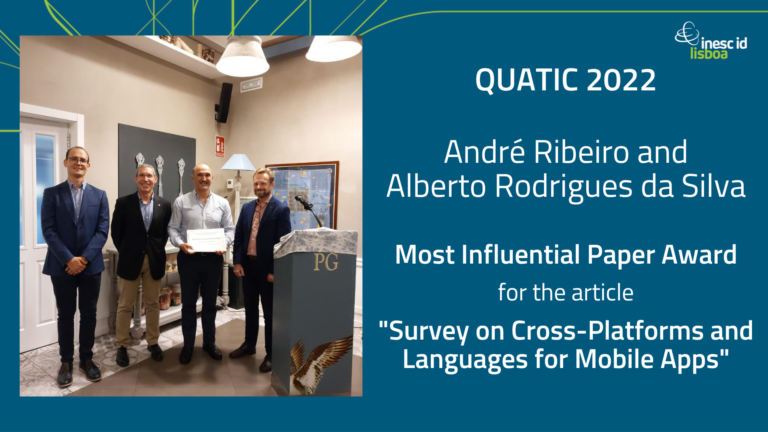
    André Ribeiro and Alberto Rodrigues da Silva receive “Most Influential Paper” Award at QUATIC’22

    André Ribeiro former masters student in computer science and engineering at Instituto Superior Técnico (IST) and Alberto Rodrigues da Silva Associate Professor at the Department of Computer Engineering at IST and researcher at INESC-ID have received the “Most Influential Paper” Award at the QUATIC 2022 conference.

    Ribeiro and Silva received the award given to the article with the greatest impact and influence in the Information Technology Quality community ten years after its publication for the article Survey on Cross-Platforms and Languages ​​for Mobile Apps. The winning paper focuses on multi or cross-platform applications and Domain Specific Languages (DSL), which facilitate the development of cross-platform mobile applications, while tackling the current state of affairs in this area.

    “A forum for disseminating advanced methods, techniques and tools for supporting quality approaches to ICT engineering and management”, the 15th International Conference on the Quality of Information and Communications Technology QUATIC 2022 — was organized by the University of Castilla-La Mancha in Talavera de la Reina, Spain, and took place from 12-14 September 2022.

  • Ana Teresa Freitas confirmed as a keynote speaker at ECCB2022

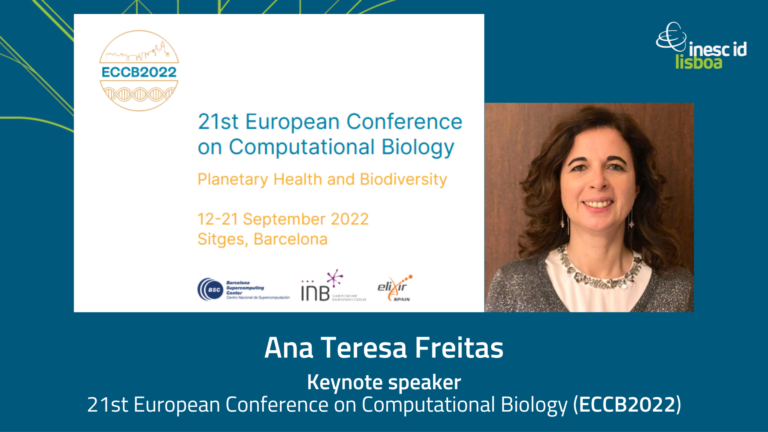
    Ana Teresa Freitas confirmed as a keynote speaker at ECCB2022

    Ana Teresa FreitasInformation & Decision Support Systems (IDSS) researcher at INESC-ID and Full Professor at Instituto Superior Técnico — has been confirmed as a keynote speaker at the 21st European Conference on Computational Biology (ECCB2022).

    Under the motto “Planetary Health and Biodiversity” and including the interdisciplinary participation of researchers from a wealth of disciplines (including bioinformatics, computational biology, systems biology, artificial intelligence, biology, medicine and environmental sciences), ECCB2022 will take place in Sitges (Barcelona, Spain) from 12 to 21 of September, 2022, and running as an in person event from 18 to 21 of September.

    Ana Teresa Freitas will deliver her talk on Monday 19 September, 16:30 – 17:30h, on the topic of “Personalized medicine in the era of artificial intelligence”. In her keynote address, Professor Freitas will “discuss different approaches that are being tested in EU hospitals with the goal to transform healthcare from reactive disease care to care that is patient or person-centered and focused on disease prevention”, how pharmacogenomics is increasingly entering clinical practice and the ethical and legal challenges posed by the increasing application of artificial intelligence in the healthcare sector.


  • Open call for six doctoral research fellowships

    Open call for six doctoral research fellowships

    INESC-ID is opening a call, starting on November 15 2022, for the attribution of six Research Grants for Doctoral Degrees in the scientific areas listed below, under the FCT Research Grant Regulation (RBI) and the Statute of the Scholarship Holder of Research (EBI).

    The impact of the research carried out at INESC-ID is focused around four Thematic Lines: Digital Transformation; Life and Health Technologies; Energy Transition; and Security and Privacy. The Thematic Lines of INESC-ID also promote synergies between eleven Scientific Research Areas.

    The grants are funded by the Foundation for Science and Technology (FCT) under the Collaboration Protocol for Financing the Multi-Annual Plan for Research Grants for Doctoral Students, signed between FCT and INESC-ID, Instituto de Engenharia de Sistemas e Computadores: Investigação e Desenvolvimento em Lisboa, with the reference UIDB/50021/2020.

    Applications and documents supporting the application provided for in the Notice of Opening of the Competition (linked to below) must be submitted by email to the following address: rh@inesc-id.pt.

    Full application details are available in the following document: BD_PhD__UIDB_50021_2022_pt_en_dec_2022.

    The call is open from November 15 2022 to 17:00 (Lisbon time) on December 15, 2022.