Category: News

  • Diogo Nunes awarded “Best Clinical Scientific Article” Prize
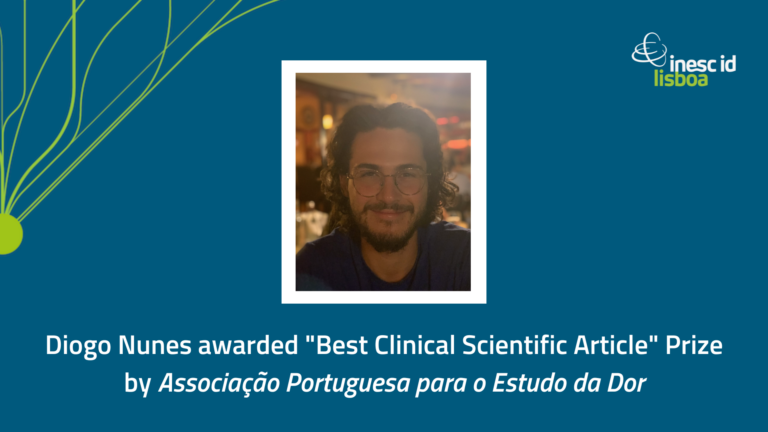
    Diogo Nunes awarded “Best Clinical Scientific Article” Prize

    Diogo Nunes has been awarded the “Best Clinical Scientific Article” Prize by Associação Portuguesa para o Estudo da Dor (the Portuguese Association for the Study of Pain).

    An Early Stage Researcher at the Human Language Technologies Research Area, Nunes was awarded his best paper prize at the 2022 Encontro Nacional das Unidades de Dor, a national meeting organized by the Portuguese Association for the Study of Pain that took place on 22 October 2022 in Aveiro. Nunes’ award-winning paper Analysis of chronic pain descriptions for base-pathology prediction: the case of rheumatoid arthritis versus spondylitis pathology prediction based on pain descriptions was published in Revista Dor.

    On being awarded the prize, Nunes commented that “Our mission is to study the verbal expression of pain and to take advantage of that knowledge in order to help those that suffer from chronic pain. I am very happy with this award, because it is an important recognition of the clinical valence of the work we have been doing and of the impact it can have.”

  • INESC-ID doctoral student awarded Maria de Lourdes Pintasilgo Award

    INESC-ID doctoral student awarded Maria de Lourdes Pintasilgo Award

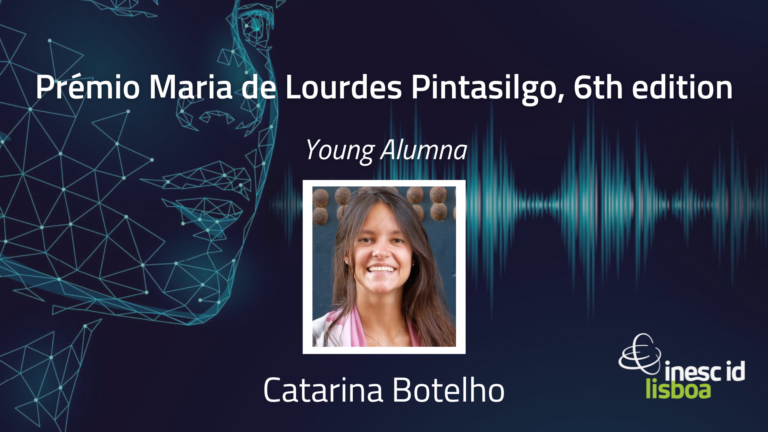
    Maria Catarina Botelho, an Early Stage Researcher at INESC-ID, has been awarded one of the Maria de Lourdes Pintasilgo Awards (Prémios Maria de Lourdes Pintasilgo, this year in their sixth edition) in the “Young Alumna” category.

    A graduate from the Integrated Masters program in Biomedical Engineering at Instituto Superior Técnico, Botelho is now a doctoral student in the Human Language Technologies Research Area at INESC-ID, where she is developing her thesis

    Asked what this award meant to her, Botelho recognized that “For me, receiving this award symbolizes the recognition of the effort and goals I have been striving for and achieving over the more than 9 years that I have belonged to this school. It is also an incentive to keep going!”

    The Maria de Lourdes Pintasilgo Awards were delivered to its three winners today, 18 November 2022, at Instituto Superior Técnico.

  • Open call for six doctoral research fellowships

    Open call for six doctoral research fellowships

    INESC-ID has an open call for six Research Grants for Doctoral Degrees in the scientific areas listed below, under the FCT Research Grant Regulation (RBI) and the Statute of the Scholarship Holder of Research (EBI).

    The impact of the research carried out at INESC-ID is focused around four Thematic Lines: Digital Transformation; Life and Health Technologies; Energy Transition; and Security and Privacy. The Thematic Lines of INESC-ID also promote synergies between eleven Scientific Research Areas.

    The grants are funded by the Foundation for Science and Technology (FCT) under the Collaboration Protocol for Financing the Multi-Annual Plan for Research Grants for Doctoral Students, signed between FCT and INESC-ID, Instituto de Engenharia de Sistemas e Computadores: Investigação e Desenvolvimento em Lisboa, with the reference UIDB/50021/2020.

    Applications and documents supporting the application provided for in the Notice of Opening of the Competition (linked to below) must be submitted by email to the following address: rh@inesc-id.pt.

    Full application details are available in the following document: BD_PhD__UIDB_50021_2022_pt_en_dec_2022.

    Further details may also be found here.

    The call is open to December 15, 2022.

  • The November 2022 INESC-ID newsletter is out!

    The November 2022 INESC-ID newsletter is out!

    The November 2022 issue of NEWS-ID — the INESC-ID Newsletter — is out! You can read it here.

    Containing recent news from our researchers and their projects, open positions and some extra bits of content, our monthly newsletter is a great one-stop spot for great content on computer science and electrical and computer engineering.

    You can subscribe to our monthly newsletter here.

  • Susana Vinga and Pedro Monteiro honoured with Universidade de Lisboa / Caixa Geral de Depósitos Scientific Awards

    Susana Vinga and Pedro Monteiro honoured with Universidade de Lisboa / Caixa Geral de Depósitos Scientific Awards

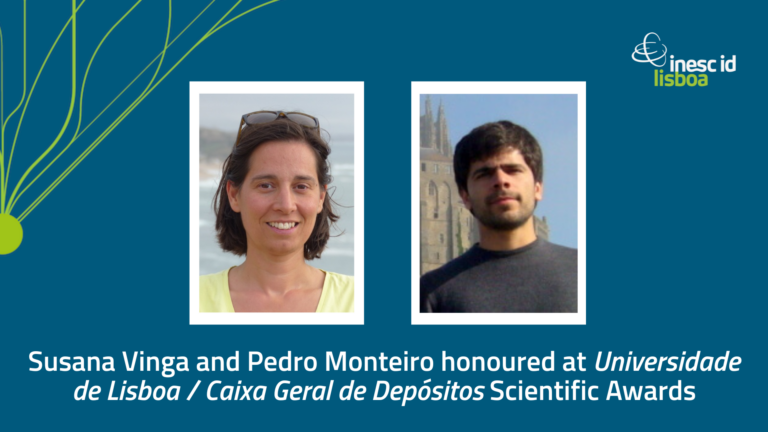
    Two INESC-ID researchers have been honoured in the 2022 Universidade de Lisboa / Caixa Geral de Depósitos Scientific Awards (Prémios Científicos Universidade de Lisboa / Caixa Geral de Depósitos).

    The awardees lists recognised Susana Vinga with a scientific award and Pedro Monteiro with an honorable mention, both in the field of Computer Science and Engineering. Susana Vinga and Pedro Monteiro are both Associate Professors at the Department of Computer Science and Engineering at Instituto Superior Técnico (with Professor Vinga also affiliated with the Department of Bioengineering).

    The UL/CGD Scientific Awards and Honourable Mentions are bestowed across twenty-six areas, recognising scientific research activity while encouraging the practice of publication in international journals of recognized quality.

    The award ceremony will take place on 28 November 2022, at 5:30pm, at Salão Nobre of Reitoria da Universidade de Lisboa.

  • INESC-ID Advisory Board 2022 visit: two days of great conversations

    INESC-ID Advisory Board 2022 visit: two days of great conversations

    These past two days — 07 and 08 November — comprised the biennial visit of the INESC-ID Advisory Board.

    Across the Alves Redol and Tagus Park INESC-ID campi, these two days of intense discussion allowed members of the Advisory Board to meet with the institute’s Board of Directors and Board of the Scientific Council, as well as with the coordinators of all four Thematic Lines and eleven Research Areas. Advisory Board members also had the opportunity to interact with INESC-ID researchers over poster sessions and explore some of the great work currently under development by our enthusiastic scientists and engineers.

    At the end of their visit, the Advisory Board left the INESC-ID community with a bounty of praise for achievements already conquered and provided invaluable insight on how to overcome challenges to come.

    Aside from its biennial on-site visit, the Advisory Board interacts on an annual basis with INESC-ID to provide an overall evaluation of the institution based on proposed reports and plans, as well as to decide on internal awards and to provide counseling on several other matters, on which the Advisory Board is consulted for medium to long-term strategic input.

    Composed of an international body of renowned researchers and academics across the ICT field who provide independent guidance and strategic assessment to the institute, the seven current members of the INESC-ID Advisory Board are:

    INESC-ID thanks the Board of its Scientific Council, its varied and brilliant group of researchers, as well as its support staff, for all the great outcomes of this Advisory Board visit, for whose members — and the generosity of their feedback — INESC-ID is indebted and immensely grateful.

  • INESC-ID researchers recognized in Stanford’s list of top 2% most-cited

    INESC-ID researchers recognized in Stanford’s list of top 2% most-cited

    Several INESC-ID researchers have been included in the comprehensive data sets comprising Stanford’s list of the World’s top 2% most-cited researchers in 2021 via Elsevier.

    Comprising two worldwide listings of 200,000 researchers (signalling those who were the most influential in 2021, as well as across their entire career), the Stanford lists bring with them mention of several INESC-ID faculty:

    This year’s Stanford lists includes researchers from nine different INESC-ID research Areas: Artificial Intelligence for People and Society, Automated Reasoning and Software Reliability, Distributed, Parallel and Secure Systems, Graphics and Interaction, Green Energy and Smart Converters, High Performance Computing Architectures and Systems, Human Language Technologies, Information and Decision Support Systems and Sustainable Power Systems.


    (Feature under current update)

  • The October 2022 INESC-ID newsletter is out!

    The October 2022 INESC-ID newsletter is out!

    The October 2022 issue of NEWS-ID — the INESC-ID Newsletter — is out! You can read it here.

    Containing recent news from our researchers and their projects, open positions and some extra bits of content, our monthly newsletter is a great one-stop spot for great content on computer science and electrical and computer engineering.

    You can subscribe to our monthly newsletter here.

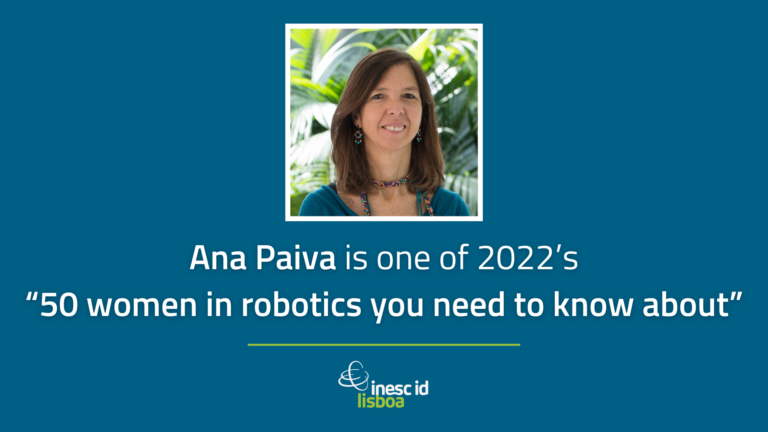
  • Ana Paiva is one of 2022’s “50 women in robotics you need to know about”

    Ana Paiva is one of 2022’s “50 women in robotics you need to know about”

    Ana Paiva has been selected as one of 2022’s “50 women in robotics you need to know about”.

    Once a year, in celebration of Ada Lovelace Day (held on the second Tuesday of October), the Women in Robotics network a global community of women who work in robotics or aspire to do so puts together a shortlist of inspiring women across the entire robotics industry that everyone should know about. And this year, Professor Paiva has been one of the fifty selectees.

    A researcher within the INESC-ID Artificial Intelligence for People and Society Research Area and Full Professor at Instituto Superior Técnico (as well as the Katherine Hampson Bessell Fellow at Radcliffe Institute), Professor Paiva is once again singled out as a role model for women of all ages and career stages aspiring to work in STEM or already building their own path as researchers and innovators.

    As the list announcement reiterates, “The role models these 50 women represent are diverse, ranging from emeritus to early career stage. Role models are important. Countess Ada Lovelace, the world’s first computer programmer and an extraordinary mathematician, faced an uphill battle in the days when women were not encouraged to pursue a career in science. Fast forward 200 years and there are still not enough women in science, technology, engineering or math (STEM).” Professor Paiva is one of the visible female role models bringing robotics to life, edging the world of STEM one career closer to equality.

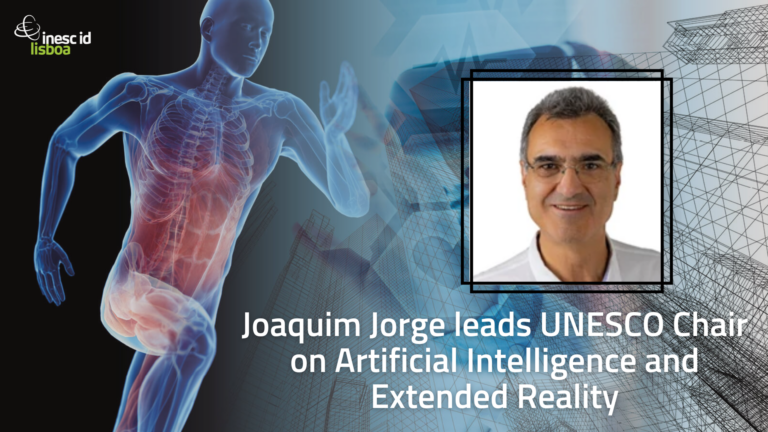
  • Joaquim Jorge leads new UNESCO Chair on Artificial Intelligence and Extended Reality

    Joaquim Jorge leads new UNESCO Chair on Artificial Intelligence and Extended Reality

    Joaquim Jorge – INESC-ID researcher within the Graphics and Interaction Research Area and Full Professor at the Department of Computer Science and Engineering of Instituto Superior Técnico – has been awarded leadership of a new UNESCO Chair on Artificial Intelligence (AI) and Extended Reality (XR), coordinated from INESC-ID and involving thirty institutions across the planet.

    The pandemic has brought the need for new methods and processes in work, education, and medical practice – including surgical techniques, as well as outpatient consultation and rehabilitation – into sharp focus. Based on the enhanced capabilities of Artificial Intelligence (AI) and Extended Reality (XR), the creation and nurturing of networks of geographically distant yet continuously linked hospitals – where experts will be able to consult, teach, monitor, and train colleagues remotely via XR – could foster a medical community more resilient to pandemics.

    Adding to the day-to-day dimension of medical practice, engineers, doctors and policy-makers increasingly rely on AI to make diagnostic and policy decisions on societal matters and public policy affairs. Here, Explainable AI (XAI) – a set of tools that help users understand the predictions and recommendations made by an AI – has the clear potential to improve human understanding of automatically generated diagnostics and policy recommendations, a technological leap that is becoming ever more vital in finding solutions to pressing societal problems.

    In order to synergistically tackle these issues, Professor Joaquim Jorge has been awarded a UNESCO Chair on Artificial Intelligence and Extended Reality to lead a world-wide consortium of thirty institutional partners (from Carnegie-Mellon and Columbia in the US to the universities of Auckland and Otago in New Zealand), steered from INESC-ID. By featuring a world-class diverse and balanced team of scientists, academics, clinicians and policymakers, the UNESCO Chair on AI and XR will implement an ambitious research and collaborative strategy by:

    • Offering advanced degree “shared diplomas”, either face-to-face or through eLearning;
    • Engaging in multidisciplinary research on AI/XR for medical applications, among others;
    • Organizing or supporting international conferences, publications and seminars around the unifying themes of the UNESCO Chair;
    • Promoting joint supervision of MSc and Ph.D. theses, as well as the mobility of students and research professors, thus stimulating north-south exchanges of expertise.

    The UNESCO Chair on AI and XR is aligned with UNESCO’s fields of competence in the exchange of experience and knowledge between universities and other higher education institutions, extending the benefits of research and development and the rapid transfer of knowledge to communities through international inter-university cooperation and twinning, networking and other linking arrangements. An integrated system of research, training, information and documentation on AI and XR is the ultimate goal of this UNESCO Chair.

    Awarding of the UNESCO Chair on Artificial Intelligence and Extended Reality follows earlier recognition of Professor Jorge’s distinguished work in the field of computer science and engineering, such as his recent election to the 2023-2025 Board of Governors of the IEEE Computer Society (IEEE CS, the largest global community of computer scientists and engineers), a leadership position and honour conferred to the most accomplished figures in tech and academia.