Category: News

  • NII International Internship Program (Tokyo) — 2nd 2022 call
    NII International Internship Program (Tokyo) — 2nd 2022 call

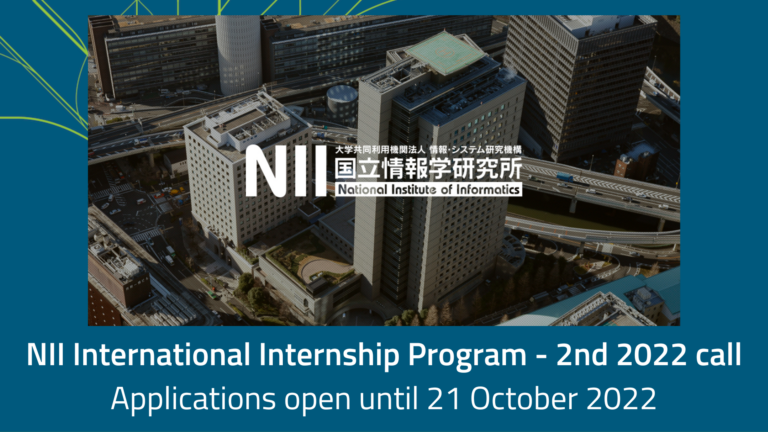
    The International Internship Program at the National Institute of Informatics, Tokyo, is back. A new call for 2022 is open.

    The internship activities should extend for a period of 2 to 6 months. A scholarship of about 171,000 yen per month is granted. However, the costs to travel to Tokyo are not included.

    Candidates should contact Prof. Rui Prada (rui.prada@gaips.inesc-id.pt) and send him the application form, a detailed CV (grades included), and a motivation letter by October 21st. Candidates need to contact potential supervisors at NII by email, for the topics they want, beforehand. This email exchange is needed in the application process as well.

    You can find more information, including the list of topics and the application form on this webpage.

    Both MSc and PhD students are eligible.

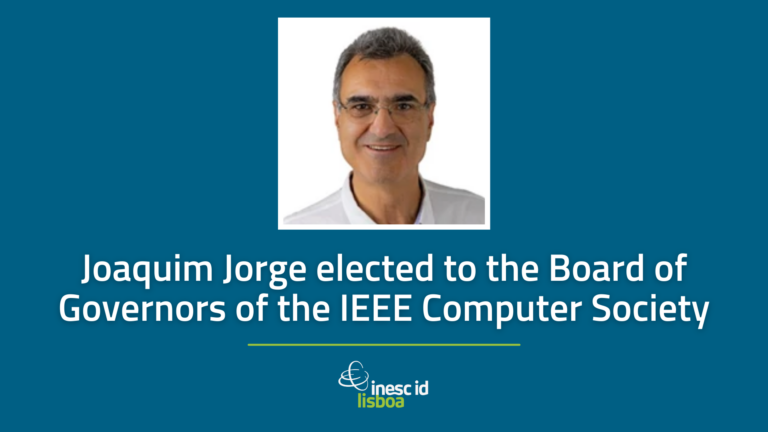
  • Joaquim Jorge elected to the Board of Governors of the IEEE Computer Society

    Joaquim Jorge elected to the Board of Governors of the IEEE Computer Society

    Joaquim Jorge researcher at INESC-ID’s Graphics and Interaction Research Area and Professor of Computer Science at Instituto Superior Técnico has been elected to the 2023-2025 Board of Governors of the IEEE Computer Society (IEEE CS), a leadership position and honour conferred to some of the most accomplished figures in tech and academia.

    The IEEE CS represents the largest global community of computer scientists and engineers as a “trusted organization dedicated to engaging the engineers, scientists, academia, and industry professionals from across the globe driving continued advancements in computer science and technology”. Its Board of Governors, to which Professor Jorge has become one of six newly elected members, is the international body of renowned experts that supports the IEEE CS in driving its vision forward, providing “policy guidance to program boards and committees, and [reviewing] the performance of the organization to ensure compliance with its policy directions.”

    In his position statement, and building on a long professional service record with IEEE CS and similar associations, Professor Jorge noted that he wishes to “make a difference and contribute to trans-Atlantic and worldwide scientific cooperation within and outside the Computer Society,” adding that he intends to “contribute to defining much-needed public policies” and “will strive to make IEEE CS a more diverse, inclusive, and gender-balanced organization.

    Earlier this year Professor Jorge was selected as an IEEE Computer Society Distinguished Visitor, a distinction that followed Professor Jorge’s recognition as an ACM Distinguished Speaker since 2015.

    Photo source/credit: IEEE CS.

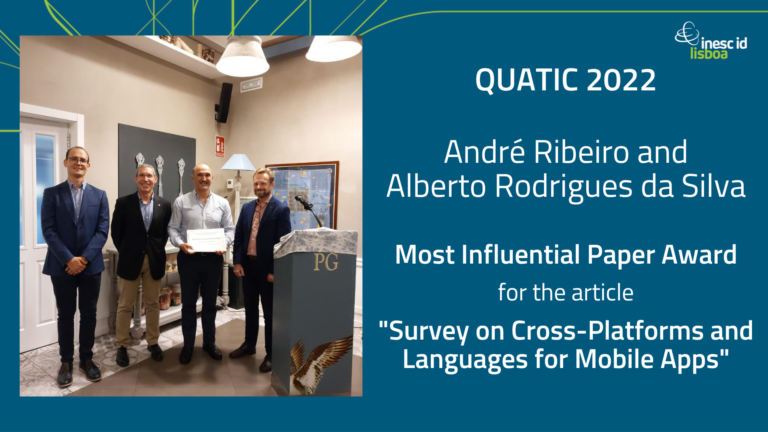
  • André Ribeiro and Alberto Rodrigues da Silva receive “Most Influential Paper” Award at QUATIC’22

    André Ribeiro and Alberto Rodrigues da Silva receive “Most Influential Paper” Award at QUATIC’22

    André Ribeiro former masters student in computer science and engineering at Instituto Superior Técnico (IST) and Alberto Rodrigues da Silva Associate Professor at the Department of Computer Engineering at IST and researcher at INESC-ID have received the “Most Influential Paper” Award at the QUATIC 2022 conference.

    Ribeiro and Silva received the award given to the article with the greatest impact and influence in the Information Technology Quality community ten years after its publication for the article Survey on Cross-Platforms and Languages ​​for Mobile Apps. The winning paper focuses on multi or cross-platform applications and Domain Specific Languages (DSL), which facilitate the development of cross-platform mobile applications, while tackling the current state of affairs in this area.

    “A forum for disseminating advanced methods, techniques and tools for supporting quality approaches to ICT engineering and management”, the 15th International Conference on the Quality of Information and Communications Technology QUATIC 2022 — was organized by the University of Castilla-La Mancha in Talavera de la Reina, Spain, and took place from 12-14 September 2022.

  • The September 2022 INESC-ID newsletter is out!

    The September 2022 INESC-ID newsletter is out!

    The September 2022 issue of NEWS-ID — the INESC-ID Newsletter — is out!

    Containing recent news from our researchers and their projects, open positions and some extra bits of content, our monthly newsletter is a great one-stop spot for great content on computer science and electrical and computer engineering.

    You can subscribe to our monthly newsletter here.

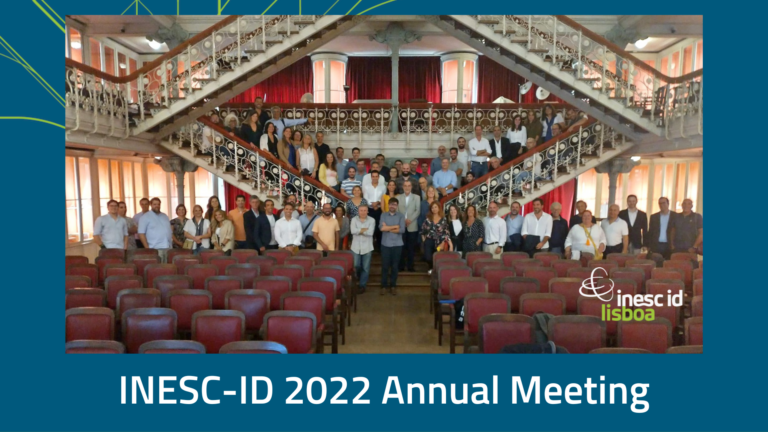
  • INESC-ID 2022 Annual Meeting: a day of sharing great ideas and research

    INESC-ID 2022 Annual Meeting: a day of sharing great ideas and research

    The 2022 INESC-ID Annual Meeting took place yesterday, 12 September 2022, in the beautiful and inspiring setting of Sociedade Portuguesa de Geografia — a not coincidental space that has witnessed many a discussion of exploration and discovery.

    During a day packed full of activities, INESC-ID researchers reviewed and discussed the inner workings of the institute, all the great things that have been accomplished and many of the exciting projects about to start and soon to come across the multitudinous Computer Science and Electrical and Computer Engineering scopes of the institute.

    Reviews of the institute’s main achievements by the Board of Directors and the Board of the Scientific Council, a round-table on the research work carried out under the four INESC-ID Thematic Lines, a session on the work of the support offices and a discussion on the INESC system were complemented by an extraordinary talk by this year’s invited speaker: Mónica Bettencourt-Dias, the Director of Instituto Gulbenkian de Ciência. In her talk “Best practices at IGC” Bettencourt-Dias shared invaluable insight into the IGC’s modus operandi and values, its ethos and the multitude of programs that stimulate its great science and the world-renowned scientific training of its researchers.

    Such a great day of sharing ideas and research, and such a great year of exciting technology!

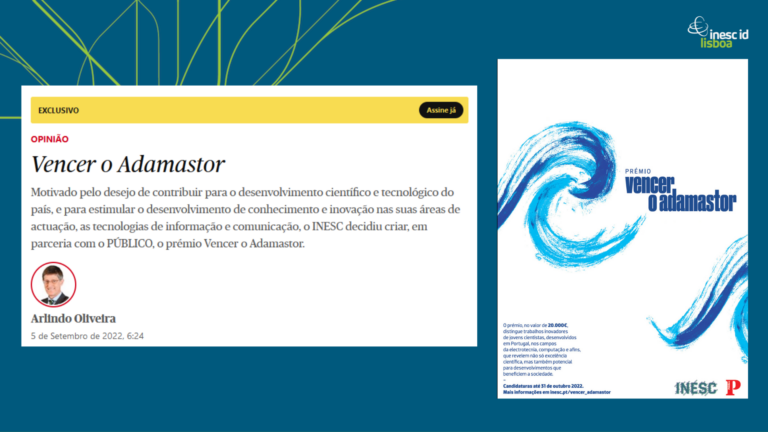
  • Arlindo Oliveira writes about “Vencer o Adamastor” in Público

    Arlindo Oliveira writes about “Vencer o Adamastor” in Público

    Arlindo Oliveira — Distinguished Professor at Técnico, INESC-D researcher and Coordinator of the institute’s Life and Health Technology Thematic Line, as well as President of INESC — has written on the “Vencer o Adamastor” Award for the newspaper Público.

    In his piece, published on 05 September, Professor Oliveira discusses how INESC and Público decided to create this award and recognize innovative work by young scientists, developed in Portugal, in the fields of Information and Communications Technology (ICT), including electrical engineering and computation.

    Vencer o Adamastor will be awarded to the candidate who demonstrates not only a clear ability to produce high quality scientific work, a vision for future scientific and technological developments in their respective area of ​​research, as well as the potential to make a significant contribution to the future scientific development of the country, as a researcher, a scientist, a teacher and a future leader.

    More details on the award are available here and the its regulations here, with an application deadline of 31 October 2022.

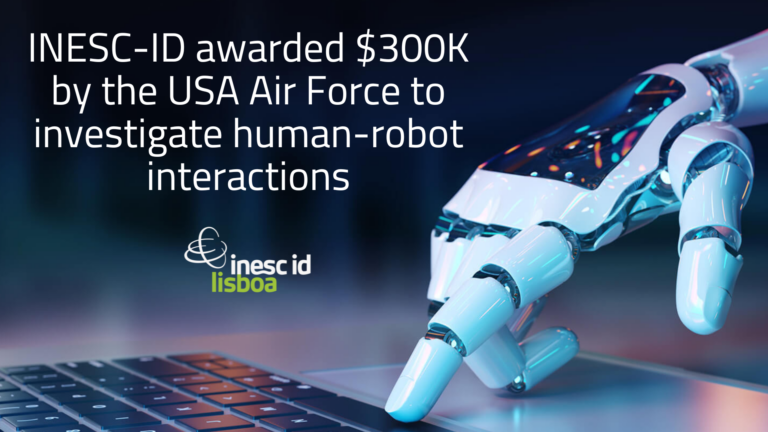
  • INESC-ID awarded $300K by the USA Air Force to investigate human-robot interactions

    INESC-ID awarded $300K by the USA Air Force to investigate human-robot interactions

    INESC-ID has been awarded $300K by the USA Air Force Office of Scientific Research (AFOSR) to investigate human-robot interactions. The funded project “Trustworthy Ad Hoc Teamwork” — officially starts today, 01 September 2022, and will be funded for two years.

    This project is led at INESC-ID by Alberto Sardinha, researcher in the Artificial Intelligence for People and Society Research Area and Assistant Professor at the Department of Computer Science and Engineering of Instituto Superior Técnico. Alberto explained: “Trust is an essential element for effective cooperation between humans and robots. However, to the best of our knowledge, no research work has analyzed trust between robots and humans within ad hoc teamwork scenarios or created tailored algorithms for trustworthy ad hoc teamwork.”

    “Trustworthy Ad Hoc Teamwork” investigates how to create an autonomous agent that can efficiently and robustly collaborate with previously unknown teammates. The project plans to achieve this through novel ad hoc teamwork algorithms to build trust within human-robot interactions and by addressing a vital question: How can a robot learn to cooperate with unknown human teammates in complex domains while fostering trust development, whereby the robot does not have any pre-coordination protocol and must learn to cooperate on the fly?

    By implementing a combination of sensors (networked within the environment – e.g., microphones, wall-mounted cameras – and the robot’s on-board sensors – e.g., lasers, cameras, RFID readers), an ad hoc robot (containing a combination of perception, decision and execution modules) and output modalities (different components or hardware that support the robot’s behavior or actions), this project aims to answer a series of additional unfolding queries: How can a robot learn, in a trustworthy way, the cooperative task in the absence of a reward signal and without full observability of states and actions? How to tailor the ad hoc teamwork algorithms in order to increase a human’s trust in robots? How can the multimodal capabilities of a robotic teammate (e.g., speech recognition and synthesis, recognition of people and intentions, social robot expression) provide valuable information to facilitate the development of trust within ad hoc teamwork scenarios?

    “Trustworthy Ad Hoc Teamwork” is Alberto Sardinha’s third research project on this topic. The first project (Ad Hoc Teams: Ad Hoc Teams With Humans And Robots) was also funded by the AFOSR and the second (HOTSPOT: Human-robOt TeamS without PrecoOrdinaTion) by FCT. Trust and Influence is one of AFOSR’s interdisciplinary basic research funding portfolios, fitting the scope of the current grant.

    Led by INESC-ID, “Trustworthy Ad Hoc Teamwork” will count with the additional participation of PUC-Rio (Brazil).

  • The 21st EPIA Conference on Artificial Intelligence takes place at IST

    The 21st EPIA Conference on Artificial Intelligence takes place at IST

    The 21st edition of the EPIA Conference on Artificial Intelligence (EPIA 2022) started today at Instituto Superior Técnico (IST), taking place until 02 September.

    The EPIA conference promotes research in all areas of AI, covering both theoretical/foundational issues and applications, and the scientific exchange among researchers, engineers and practitioners in related disciplines. This year’s keynote addresses include João Gama’s Current Trends in Learning from Data Streams (University of Porto), Luc De Raedt’s From Probabilistic Logics to Neuro-Symbolic Artificial Intelligence (KU Leuven) and Iryna Gurevych’s Comment – Link – Revise: Towards a General Framework for Modelling Interconnected Texts (Technical University of Darmstadt).

    The 2022 edition of EPIA was put together by an international body of researchers that includes Program Chair Ana Paiva (INESC-ID researcher in the Artificial Intelligence for People and Society (AIPS) Research Area and Full Professor at IST) and Local Organisers Alberto Sardinha  (INESC-ID AIPS researcher and Assistant Professor at IST) and Bruno Martins (INESC-ID researcher in the Human Language Technologies Research Area and Associate Professor at IST).

    A well-established European conference, EPIA 2022 is hosted, as in previous editions, with the patronage of the Portuguese Association for Artificial Intelligence (APPIA). INESC-ID is one of the supporters of this conference.

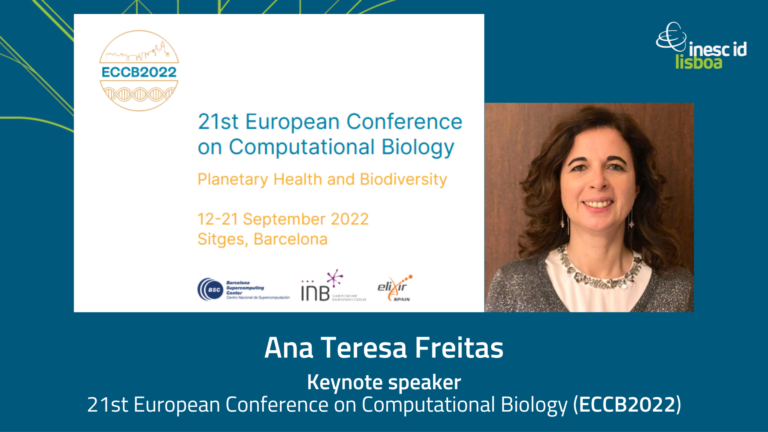
  • Ana Teresa Freitas confirmed as a keynote speaker at ECCB2022

    Ana Teresa Freitas confirmed as a keynote speaker at ECCB2022

    Ana Teresa FreitasInformation & Decision Support Systems (IDSS) researcher at INESC-ID and Full Professor at Instituto Superior Técnico — has been confirmed as a keynote speaker at the 21st European Conference on Computational Biology (ECCB2022).

    Under the motto “Planetary Health and Biodiversity” and including the interdisciplinary participation of researchers from a wealth of disciplines (including bioinformatics, computational biology, systems biology, artificial intelligence, biology, medicine and environmental sciences), ECCB2022 will take place in Sitges (Barcelona, Spain) from 12 to 21 of September, 2022, and running as an in person event from 18 to 21 of September.

    Ana Teresa Freitas will deliver her talk on Monday 19 September, 16:30 – 17:30h, on the topic of “Personalized medicine in the era of artificial intelligence”. In her keynote address, Professor Freitas will “discuss different approaches that are being tested in EU hospitals with the goal to transform healthcare from reactive disease care to care that is patient or person-centered and focused on disease prevention”, how pharmacogenomics is increasingly entering clinical practice and the ethical and legal challenges posed by the increasing application of artificial intelligence in the healthcare sector.


  • Open call for six doctoral research fellowships

    Open call for six doctoral research fellowships

    INESC-ID is opening a call, starting on November 15 2022, for the attribution of six Research Grants for Doctoral Degrees in the scientific areas listed below, under the FCT Research Grant Regulation (RBI) and the Statute of the Scholarship Holder of Research (EBI).

    The impact of the research carried out at INESC-ID is focused around four Thematic Lines: Digital Transformation; Life and Health Technologies; Energy Transition; and Security and Privacy. The Thematic Lines of INESC-ID also promote synergies between eleven Scientific Research Areas.

    The grants are funded by the Foundation for Science and Technology (FCT) under the Collaboration Protocol for Financing the Multi-Annual Plan for Research Grants for Doctoral Students, signed between FCT and INESC-ID, Instituto de Engenharia de Sistemas e Computadores: Investigação e Desenvolvimento em Lisboa, with the reference UIDB/50021/2020.

    Applications and documents supporting the application provided for in the Notice of Opening of the Competition (linked to below) must be submitted by email to the following address: rh@inesc-id.pt.

    Full application details are available in the following document: BD_PhD__UIDB_50021_2022_pt_en_dec_2022.

    The call is open from November 15 2022 to 17:00 (Lisbon time) on December 15, 2022.