On October 8th, the second session celebrating the 40 years of INESC will take place. Few things have remained unchanged in these four decades, as witnessed by those who are reading these lines and have participated in the creation of the institution, in the 1980s. Technologies, tools, people and institutions have all changed. What remains the same is the enthusiasm that led the founders of the institution to believe that knowledge, competence and hard work could make the country change for the better. INESC, which has become a group with institutions in Lisbon, Porto and Coimbra, in addition to other locations that, over time, have followed their own ways, has always been a place where knowledge was applied to create innovation and value for the society.
This first resulted of this push for innovation was the creation of a new institutional model, based on private non-profit organizations (NPOs), independent and autonomous, but with strong links with universities. In time, this model became the most popular model for research and development institutions in Portugal. There are now hundreds of NPOs that have copied or adapted the institutional model first pioneered by INESC.
But the push for innovation also led to the creation of new startups, based on the knowledge and technologies developed in the research institutions of the INESC group. The session on October 8th focuses precisely on this process of creating value by incorporating knowledge and intellectual property in new startups, created by entrepreneurs who were once part of INESC, and who have themselves become national references in entrepreneurship and innovation. We invited the CEOs of eight companies, from the more than two dozen enterprises that were created as a result of INESC’s activities since 1980. Four of these companies were created more than two decades ago, and the other four were created only in the last decade. The CEOs and founders of these companies will share with us the experience and memories that always remain from a process that is often painful but always instructive.
We hope that these four decades of experience inspire the next entrepreneurs, those who will believe enough in their ideas to push them to face the challenge of creating, promoting and developing new companies. With the evolution of technology and the different and more open economic framework of today, we now live in an environment that is increasingly competitive and challenging but also, curiously, more amenable to the creation of innovative solutions with global impact.
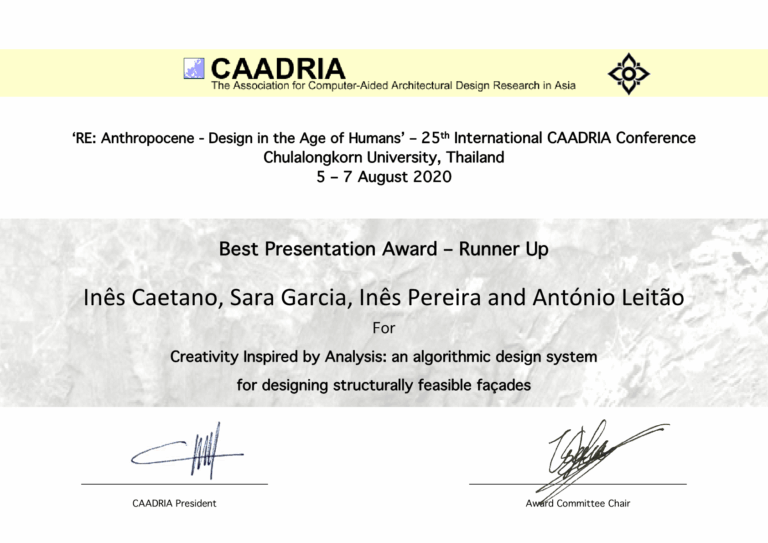
INESC-ID researchers recently received two awards at CAADRIA 2020.
The presentation “Visual meets Textual: A Hybrid Programming Environment for Algorithmic Design”, co-authored by Renata Castelo-Branco and António Leitão, was distinguished with Best Presentation Award.
The second award, Best Presentation – Runner Up Award, was granted to the presentation “Creativity by Analysis: an algorithmic design system for designing structurally feasible façades”, co-authored by Inês Caetano, Sara Garcia, Inês Pereira, and António Leitão.
25th International Conference of the Association for Computer-Aided Architectural Design Research in Asia (CAADRIA 2020) was held in August (5-6), live and online.
On October 8, Lisbon will welcome the 2nd of 3 sessions to celebrate INESC’S 40th anniversary. The event will take place at Fundação Calouste Gulbenkian, and will be made available live and online.
The 13th International Conference on the Quality of Information and Communications Technology (QUATIC’2020) will be held virtually, from 9 to 11 September 2020.
QUATIC is a forum for disseminating advanced methods, techniques and tools for supporting quality approaches to ICT engineering and management where practitioners and researchers are encouraged to exchange ideas and approaches on how to adopt a quality culture in ICT process and product improvement and to provide practical studies in varying contexts.
World Scientific recently published the 2nd edition of “Principles of Quantum Artificial Intelligence: Quantum Problem Solving and Machine Learning”, written by INESC-ID researcher Andreas Wichert.
This book provides an introduction to problem solving, information theory, statistical machine learning, stochastic methods and quantum computation.
Celebrating INESC’s 40th anniversary, a special programme with three sessions is available to the general public.
Next session will take place on October 8th, at 5 p.m., at Auditório II of Fundação Calouste Gulbenkian, Lisbon, and will be made available online streaming.
Event is free, but a registration is required in order to receive a link.
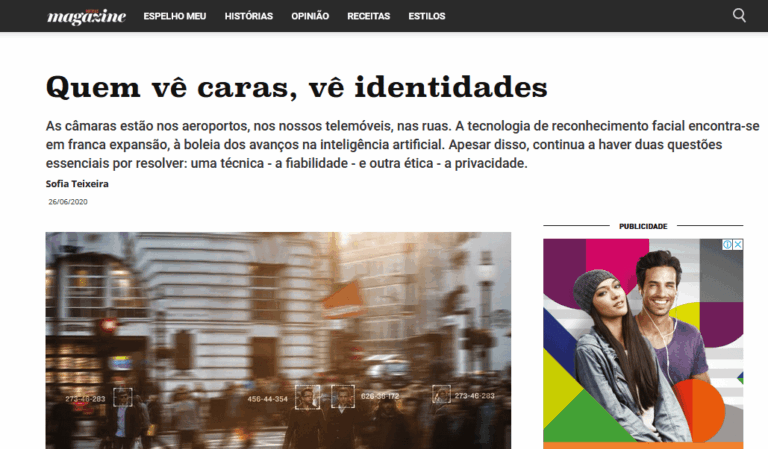
INESC-ID’s researcher Ricardo Chaves was interviewed for ‘Notícias Magazine’ about facial recognition technology.
This brief interview is focused on the rise of facial recognition technology together with artificial intelligence, and highlights two very important questions: reliability and privacy.