Category: News

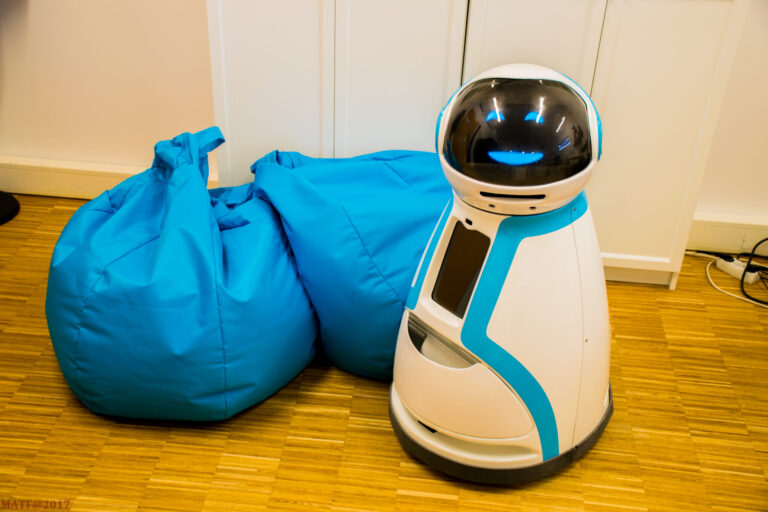
  • “Artificial Intelligence, Cooperation and Social Robotics” at the Lisbon Academy of Sciences.

    “Artificial Intelligence, Cooperation and Social Robotics” at the Lisbon Academy of Sciences.

    Lisbon Academy of Sciences promoted another  Tardes na Academia, on March 26th, at 5pm.

    On this IV Session,  INESC-ID Researcher Francisco C. Santos  invites  Ana Paiva, also researcher at INESC-ID,  for an afternoon on: “Artificial Intelligence, Cooperation and Social Robotics”.

    This initiative aims to engage distinct generations of scientists and researchers, in the various fields of science and knowledge represented in the SJC (Seminário de Jovens Cientistas).

    The SJC is integrated in the Institute of Advanced Studies of the Lisbon Academy of Sciences and seeks to maintain the link between the Academy and the younger members of the scientific community, as is happening in other European countries. The trans-disciplinary nature of the JCC allows to address the most relevant issues for society, producing tools that can be used by science policy makers and promoting the sharing of knowledge and knowledge with society in general.

  • Workshop “Computational Intelligence: some recent advances and applications”

    Workshop “Computational Intelligence: some recent advances and applications”

    The Workshop “Computational Intelligence: some recent advances and applications” took place on March 25th, from 9am to 5pm, at Abreu Faro Amphitheatre.
    https://is4.tecnico.ulisboa.pt/computational-intelligence-2019/#schedule

  • Evaluation INESC-ID

    Evaluation INESC-ID

    As Associate Laboratory since 2004,  INESC-ID is periodically evaluated by the Foundation for Science and Technology (FCT).

    This status is reserved for research institutions of great merit that have been recognized in external assessments as having the “capacity to cooperate in a stable, competent and efficient way in the pursuit of specific political, scientific and national technological objectives”.

    The review is made by an international panel of experts, based on the R&D institutions’ activity reports and proposed strategic plans as well as on direct contacts with researchers and institutions, through site visits and/or interviews by the reviewers.

    All R&D institutions are awarded a qualitative grade, which determines the level of funding to be awarded, until the next review takes place, or until a mid-term assessment is made.

    INESC-ID  most recent evaluation took place December 3rd, and with great effort of all INESC-ID members, we believe we were able to transmit all our passion and commitment.


  • New project SLICE – Combining social agent architectures and machine learning

    New project SLICE – Combining social agent architectures and machine learning

    Slice (Social Learning for Intelligent Characters) is one of the most recent projects of INESC-ID. This project’s objective is to develop and validate an authoring-friendly framework for the creation of transparent social intelligent agents capable of being deployed as virtual characters in training simulations or games, or used to drive the behavior of social robots. This framework joins two until now disparate areas of artificial intelligence research, namely, social agent architectures and machine learning.

    By using machine learning techniques over a solid social theory foundation that defines the structure of the learning task, our framework provides a new methodology where authors can create intelligent characters by providing examples of social interaction.

    The INESC-ID team is coordinated by Pedro Santos from ISS and is composed of researchers Rui Prada, João Dias, and Manuel Lopes.


  • INESC-ID participates in Workshop “Robotics in healthcare”

    INESC-ID participates in Workshop “Robotics in healthcare”

    INESC-ID Researchers Francisco Melo and Miguel Faria,  participated in the workshop “”Robotics in health”” organized by the shared Services in Ministry of Health, EPE that took place on July 17th in Lisbon.

    This workshop brought together several national project  that aims to provide better healthcare to patients.

    INSIDE Project explores symbiotic interactions between humans and robots in joint cooperative activities. It strives to develop new hardware and software solutions that will support a real-world interaction with children with ASD in a joint cooperative task with therapeutic purposes.


  • Google Faculty Research Award for Rodrigo Rodrigues

    Google Faculty Research Award for Rodrigo Rodrigues


    INESC-ID Researcher, Rodrigo Miragaia Rodrigues, received the Google Faculty Research Awards 2017, being the only Portuguese  contemplated within this prestigious list of winners 2017.  This award aims to recognize and support world-class, permanent faculty pursuing cutting-edge research in areas of mutual interest. The goal is to identify and strengthen long-term collaborative relationships with faculty working on problems that will impact how future generations use technology.

    This edition received 1033 applications from 46 countries and more than 360 universities, a selection process that resulted in the listing of the 152  funded projects, most of them linked to the areas of machine learning, computer interaction, machine perception and Systems.

    Rodrigo Miragaia Rodrigues research areas are distributed systems and cloud computing. His curriculum already includes several awards and distinctions, including the first “ERC Grant” in the field of information technology in Portugal, received in 2012.

  • HeartGenetics in “Exame Informática”

    HeartGenetics in “Exame Informática”


    All-focus


    The latest issue of “Exame Informática” highlights national startups that stand out in the healthcare fields. We are proud to announce that one of the focused startups is an INESC-ID startup: HeartGenetics, the digital health company that adds intelligence to genetic data.

    The HeartGenetics CEO and INESC-ID researcher Ana Teresa Freitas gives a brief explanation about why Portugal is a good market test for the company products, even though its a market with a sales rate very low.

  • INESC-ID researchers publish a paper in Nature

    INESC-ID researchers publish a paper in Nature

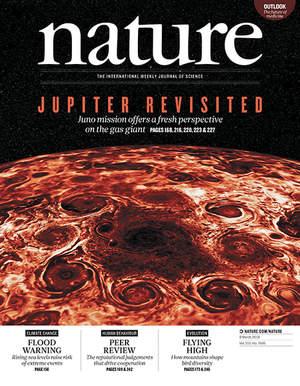
    Fernando P. Santos and Francisco C. Santos from INESC-D/GAIPS, together with Jorge Pacheco from the University of Minho, developed a new computational model that shows how simple moral principles need to be to maximize cooperation, even in complex environments. The results of this study were published in Nature on March 8, 2018.

    The model developed constitutes a new computational framework (based on Boolean algebra and game theory) to investigate the complexity of moral judgements, and the results extend the existent knowledge about the evolution of cooperation in human societies: surprisingly, the authors find that, out of the 65536 norms analyzed, and among the few cooperative norms that promote cooperation, some translate into extremely simple moral judgements, that even overlook the past reputations of individuals.

    The work may provide important clues on policy-making and the design of reputation systems – pervasive in nowadays web platforms and systems supporting sharing economies – in which is fundamental to understand the norms that are able to provide maximal levels of cooperation, while maintaining simplicity for the sake of enunciation, understanding, communication, internalization and effective implementation.

    Reference:  Fernando P. Santos, Francisco C. Santos & Jorge M. Pacheco, Social norm complexity and past reputations in the evolution of cooperation, Nature 555, 242–245 (08 March 2018)

    More info here: https://www.nature.com/articles/nature25763

    and here: http://gaips.inesc-id.pt/


  • Professor Luís Vidigal Award

    Professor Luís Vidigal Award

    The ceremony for the prestigious Prize “Prémio Prof. Luís Vidigal”  and diploma was held within the 18th Electrical and Computer Engineering Conference on March 5, 2018, Monday, at 14:00, at the IST Congress Center.


    The ceremony was attended by Prof. Luís Miguel Silveira, researcher at INESC-ID, Vice-President of IST and Member of the Management Committee for the “Prémio Prof. Luís Vidigal” award, Prof. Leonel Sousa, INESC-ID Director and  President of IST DEEC Department, and Prof. Carlos Salema, President of the Telecommunications Institute and several other members of the IST community.


    The prize “Prémio Prof. Luís Vidigal ”  annually distinguishes “the master thesis that gather the best scientific, innovation and quality features”, as pointed by Luis Miguel Silveira.

    Among the twenty four thesis submissions, the jury decided to award,  ex-aequo, the thesis  “Generalized Paxos made Byzantine, Visigoth and Less Complex” ” presented by  Miguel Pires, Aero-space Engineering MSc, advised by  Rodrigo Rodrigues, INESC-ID researcher, appointed as “the best of all master thesis”. Also  awarded, the thesis “Design and Implementation of a 20 kW, 12000 RPM Permanent Magnet Synchronous Motor (PMSM) for the IST Formula Student Powertrain” by João Sarrico, Physics Engineering MSc, advised by Profs. Paulo José da Costa Branco and João Filipe Pereira Fernandes, IST DEEC Department.

    Warmest Congratulations to the award-winning candidates, as well as their scientific advisors.


  • IT MEDEX @ JEEC 2018

    IT MEDEX @ JEEC 2018


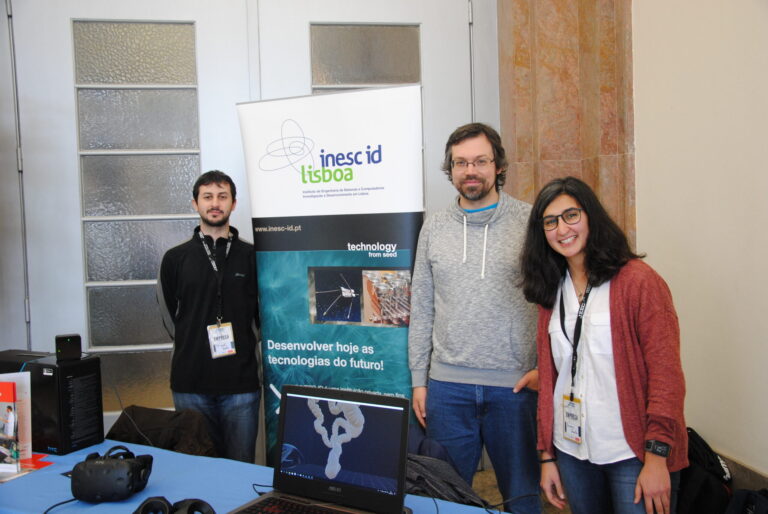
    The  team of the project IT MEDEX attended the Electrical and Computer Engineering Conference (JEEC).

    The IT-MEDEX project conducts front-line research within collaborative healthcare scenarios where 3D medical images play an important role. This project is devoted to the study and advancement of uses of technologies such as interactive surfaces (tablets, tabletops, vertical displays), virtual reality (VR), augmented reality (AR), and mixed reality (MR) applied to clinical and surgical scenarios.