Category: Research Highlights

  • INESC-ID takes part in new Horizon Europe Project SYCLOPS

    INESC-ID takes part in new Horizon Europe Project SYCLOPS

    Eight leading European organizations join forces to bring together RISC-V and SYCL standards to demonstrate ground-breaking advances in scalability of extreme data analytics via fully-open AI acceleration.

    The wide-spread adoption of AI has resulted in a market for novel hardware accelerators that can efficiently process AI workloads. Unfortunately, all popular AI accelerators today use proprietary hardware—software stacks, leading to a monopolization of the acceleration market by a few large industry players.

    Eight leading European organizations — among them INESC-ID — have joined in an effort to break this monopoly via Horizon Europe project SYCLOPS (Scaling extreme analYtics with Cross-architecture acceleration based on Open Standards). The vision of SYCLOPS is to democratize AI acceleration using open standards, and enabling a healthy, competitive, innovation-driven ecosystem for Europe and beyond. This vision relies on the convergence of two important trends in the industry: (i) the standardization and adoption of RISC-V®, a free, open Instruction Set Architecture (ISA), for AI and analytics acceleration, and (ii) the emergence and growth of SYCL™ as a cross-vendor, cross-architecture, data parallel programming model for all types of accelerators, including RISC-V.

    The goal of project SYCLOPS is to bring together these standards for the first time in order to demonstrate ground-breaking advances in performance and scalability of extreme data analytics using a standards-based, fully-open, AI acceleration approach.

    The project kicked off its activities in January 2023 with an online meeting, where all partners took the floor to present their ambitious plans to make the project a success. SYCLOPS brings together consortium partners with expertise in several fields (computer architecture, programming languages, systems and runtimes, Big Data, High- Performance Computing) with the aim of making groundbreaking advances over state-of-the-art in AI acceleration along three axes: (i) infrastructure tools for simple, fast, cost-efficient customization of RISC-V accelerators, (ii) platform tools (compiler, runtime, interpreter) for SYCL-based cross-architecture programming, (iii) application tools (parallel algorithms, profiling and porting tools) for cross-architecture AI and analytics acceleration.

    The project will demonstrate its solutions in three use-cases, namely, Autonomous Systems, High-Energy Physics, and Precision Oncology. More broadly, the advances made by SYCLOPS will foster an open European and global ecosystem of AI acceleration solutions for scaling extreme analytics based on SYCL and RISC-V standards. SYCLOPS will reinforce European leadership in the rapidly growing AI acceleration market by bringing together key European SME partners who have played a crucial role in the formation of these standards. The experience gained in SYCLOPS will also be used to contribute back to the SYCL and RISC-V standards; bringing together the two standards enables co-design in both standards, which in turn, will enable a broader AI accelerator design space, and a richer ecosystem of solutions.

    The SYCLOPS project partners are EURECOM, INESC ID, RUPRECHT-KARLS-UNIVERSITAET HEIDELBERG, CERN, HIRO-MICRODATACENTERS, ACCELOM, CODASIP, CODEPLAY.

    For any further information, please contact us at: aleksandar.ilic[at]inesc-id.pt and leonel.sousa[at]inesc-id.pt (Local Coordinators at INESC-ID) and raja.appuswamy[at]eurecom.fr (Project Coordinator at EURECOM).

  • ID-GAMING: Making a difference for persons with intellectual disabilities

    ID-GAMING: Making a difference for persons with intellectual disabilities

    A group of six institutions, across the social solidarity and information and communication technologies (ICT) sectors, have partnered up to improve the quality of life of persons with intellectual disabilities through “serious games”. Preliminary results are in — and they are promising.

    From 01 November 2020 to 31 October 2022, an interdisciplinary and international corpus of social workers and researchers — including INESC-ID’s Rui Prada — collaborated with one goal in mind: to increase the competences of Persons with Intellectual Disabilities (PID) and related professionals and relatives by developing and implementing ICT serious games (designed with purposes other than just pure entertainment — e.g., training), thus hopefully improving cognitive functions and, therefore, their quality of life.

    Following a codesign approach in which PID were involved in the development process from the beginning, ID-GAMING resulted in three main outputs: the QooL CITY Game (a collaborative serious game, available in board and online versions, where players are engaged in a joint-play activity to have fun and achieve training objectives together), the Game Catalogue (a set of games and platforms suitable to PID, in which each game can be selected according to the cognitive function to be trained) and a host of Training Materials (conceived to provide support to PID, professionals and relatives when using the QooL CITY Game with training purposes). All resources are freely available on the ID-GAMING toolkit website.

    Based on observations reported by technicians working with PID during ID-GAMING evaluation sessions, over 70% of PID involved are estimated to have benefitted from some form of improvement. Adoption of ID-GAMING resources by the PID support institutions involved in the project has been substantial, with four events to disseminate the developed tools being held and several institutions showing real interest in using and adapting them to their own setting. As a testament to the reach and potential of ID-GAMING, the project received the Inclusive E+ Award from the Education and Training Erasmus+ Portuguese National Agency in November 2021.

    The six ID-GAMING partners are now focused on further developing the project, both by putting together a five-year exploitation plan as well as moving forward with a controlled research study in which the positive outcomes observed by technicians and social workers while ID-GAMING was implemented can be confirmed and systematized.

    “It was a challenging job because it involved a population with very specific needs, which is why we followed a methodology that involved targeted population groups from the beginning. We held several codesign workshops and some of the ideas proposed in them were included in the final game,” Rui Prada commented.

    At the end of the day, a project that purports to improve PID’s quality of life only makes sense, and can only be judged, by the impact it has on those populations. “I was extremely happy to see, at the end of the project, that the main ambassadors of the game are the people we created it for,” Prada proudly observes. “In an event organized to disseminate the project’s results to the community, held at IST Tagus Park in October, we invited several of the PID involved in codesign and evaluation of the game in Portugal, from CECD in Mira Sintra. They presented and explained the game to the other participants with great enthusiasm and pride. The institution’s trainers also thanked us for the work of creating the game. It was gratifying to see that the game was so well received and seems to have such an impact.”

    Bringing together expertise from six partners — Centro de Educação para o Cidadão com Deficiência (CECD, in Mira Sintra, Portugal), INESC-ID, the Aristotle University of Thessaloniki (AUTH, in Greece), Consorzio Solidarietà Sociale Forlì-Cesena (CSS, in Italy), Coordinadora de recursos de atención a personas con diversidad funcional intelectual (COPAVA, Spain) and Associazione Italiana per l’Assistenza agli Spastici (AIAS, Italy) — ID-GAMING was co-funded by the European Union Erasmus+ programme.

  • How and when viruses move: predicting the spread of COVID-19 using neural network models

    How and when viruses move: predicting the spread of COVID-19 using neural network models

    A group of researchers, led by Arlindo Oliveira, has proposed a new method to compute the spatio-temporal dynamics of COVID-19 infections.

    In a paper published this week on ACM Transactions on Spatial Algorithms and Systems, four INESC-ID researchers (Mário Cardoso, André Cavalheiro, Alexandre Borges and Arlindo Oliveira), together with colleagues from CERENA and ITI, implemented a neural network model — a computer program that simulates complex processes based on a very simplified form of how the human brain processes information — to estimate the incidence rate of COVID-19 in mainland Portugal.

    Based on the STConvS2S (Spatiotemporal Convolutional Sequence-to-Sequence) Network architecture, and using data from the Portuguese Directorate-General for Health (DGS) across the first twelve months of the pandemic, these researchers were able to show that this type of network was the best performing method for mapping the geospatial evolution of COVID-19 (when compared to an Autoregressive Moving Average [ARMA] model, a Vector Autoregressive [VAR] model, and a Susceptible–Infected–Recovered–Dead [SIRD] model). In short, the best way to map the dynamics of this contagion between neighboring regions — an important step in making predictions about the evolution of pandemics.

    All the data used in this article, as well as the code for the SIRD and the STConvS2S models, is available here.

  • INESC-ID takes part in the world’s largest consortium on Responsible AI

    INESC-ID takes part in the world’s largest consortium on Responsible AI

    INESC-ID has been announced as one of the members of the world’s largest consortium on Responsible Artificial Intelligence (Responsible AI).

    Led by Unbabel and including a set of ten other startups, eight research institutes (in Lisbon, Porto and Coimbra, amongst them INESC-ID, Instituto Superior Técnico, the Champalimaud Foundation and the Faculty of Engineering of the University of Porto), a law firm and five industry leaders across the life sciences, tourism and retail the Centre for Responsible AI will invest 78 million euros from the Portuguese Recovery and Resilience Plan (Plano de Recuperação e Resiliência, PRR) with the goal of positioning Portugal as a world leader in Responsible AI technologies and regulation.

    INESC-ID will participate in the Centre for Responsible AI via eleven of its researchers (some of whom will also integrate the Scientific and Executive Boards of the consortium): Isabel Trancoso, Ana Paiva, Bruno Martins, Helena Moniz, João Paulo Carvalho, Francisco Melo, Paolo Romano, Luísa Coheur, David Matos, Ana Teresa Freitas and Arlindo Oliveira.

    With a predicted impact on the Portuguese economy rounding 250 million euros, the Centre for Responsible AI is set to create 210 highly qualified jobs and result in over 130 advanced academic degrees.

    As part of its ambitious plan, this consortium will develop twenty-one innovative AI products, leveraging Responsible AI technologies to reduce biases and the potentially negative impact of these applications, fostering their equitable and sustainable use. Exemplifying the groundbreaking reach of the Centre for Responsible AI, one of these products will allow the automatic translation of clinical data, resolving and bypassing current challenges that should, for instance, contribute to the acceleration of clinical trials and the rapid transition of clinically important consumables to the market.

    On this world-first Centre for Responsible AI, Paulo Dimas, Vice-President of Innovation at Unbabel, commented that “we are creating what is the biggest Responsible AI consortium in the world. In it, we will develop a virtuous circle between startups and advanced research centers, creating next-generation AI products while positioning Portugal at the forefront of Artificial Intelligence. It was for us an enormous privilege to be able to lead this consortium where some of the brightest minds in Portugal are gathered to invent the future of Artificial Intelligence.”

  • INESC-ID researchers recognized in Stanford’s list of top 2% most-cited

    INESC-ID researchers recognized in Stanford’s list of top 2% most-cited

    Several INESC-ID researchers have been included in the comprehensive data sets comprising Stanford’s list of the World’s top 2% most-cited researchers in 2021 via Elsevier.

    Comprising two worldwide listings of 200,000 researchers (signalling those who were the most influential in 2021, as well as across their entire career), the Stanford lists bring with them mention of several INESC-ID faculty:

    This year’s Stanford lists includes researchers from nine different INESC-ID research Areas: Artificial Intelligence for People and Society, Automated Reasoning and Software Reliability, Distributed, Parallel and Secure Systems, Graphics and Interaction, Green Energy and Smart Converters, High Performance Computing Architectures and Systems, Human Language Technologies, Information and Decision Support Systems and Sustainable Power Systems.


    (Feature under current update)

  • Ana Paiva is one of 2022’s “50 women in robotics you need to know about”

    Ana Paiva is one of 2022’s “50 women in robotics you need to know about”

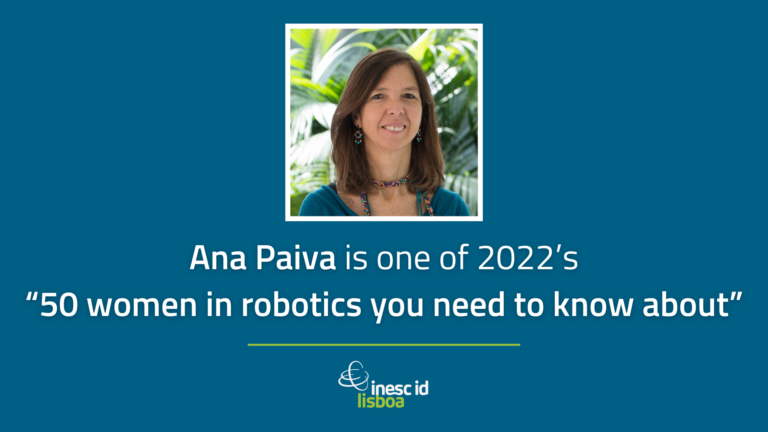
    Ana Paiva has been selected as one of 2022’s “50 women in robotics you need to know about”.

    Once a year, in celebration of Ada Lovelace Day (held on the second Tuesday of October), the Women in Robotics network a global community of women who work in robotics or aspire to do so puts together a shortlist of inspiring women across the entire robotics industry that everyone should know about. And this year, Professor Paiva has been one of the fifty selectees.

    A researcher within the INESC-ID Artificial Intelligence for People and Society Research Area and Full Professor at Instituto Superior Técnico (as well as the Katherine Hampson Bessell Fellow at Radcliffe Institute), Professor Paiva is once again singled out as a role model for women of all ages and career stages aspiring to work in STEM or already building their own path as researchers and innovators.

    As the list announcement reiterates, “The role models these 50 women represent are diverse, ranging from emeritus to early career stage. Role models are important. Countess Ada Lovelace, the world’s first computer programmer and an extraordinary mathematician, faced an uphill battle in the days when women were not encouraged to pursue a career in science. Fast forward 200 years and there are still not enough women in science, technology, engineering or math (STEM).” Professor Paiva is one of the visible female role models bringing robotics to life, edging the world of STEM one career closer to equality.

  • André Ribeiro and Alberto Rodrigues da Silva receive “Most Influential Paper” Award at QUATIC’22

    André Ribeiro and Alberto Rodrigues da Silva receive “Most Influential Paper” Award at QUATIC’22

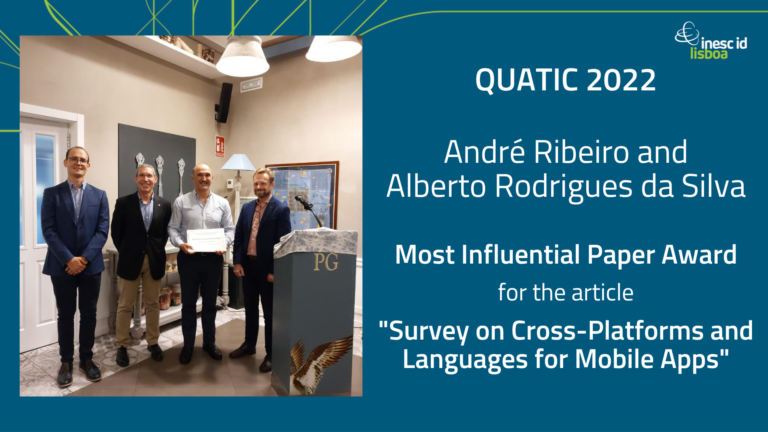
    André Ribeiro former masters student in computer science and engineering at Instituto Superior Técnico (IST) and Alberto Rodrigues da Silva Associate Professor at the Department of Computer Engineering at IST and researcher at INESC-ID have received the “Most Influential Paper” Award at the QUATIC 2022 conference.

    Ribeiro and Silva received the award given to the article with the greatest impact and influence in the Information Technology Quality community ten years after its publication for the article Survey on Cross-Platforms and Languages ​​for Mobile Apps. The winning paper focuses on multi or cross-platform applications and Domain Specific Languages (DSL), which facilitate the development of cross-platform mobile applications, while tackling the current state of affairs in this area.

    “A forum for disseminating advanced methods, techniques and tools for supporting quality approaches to ICT engineering and management”, the 15th International Conference on the Quality of Information and Communications Technology QUATIC 2022 — was organized by the University of Castilla-La Mancha in Talavera de la Reina, Spain, and took place from 12-14 September 2022.

  • Tell me what your proteome is and I’ll tell you what you are: the proteomic maps of 949 human cancer cell lines

    Tell me what your proteome is and I’ll tell you what you are: the proteomic maps of 949 human cancer cell lines

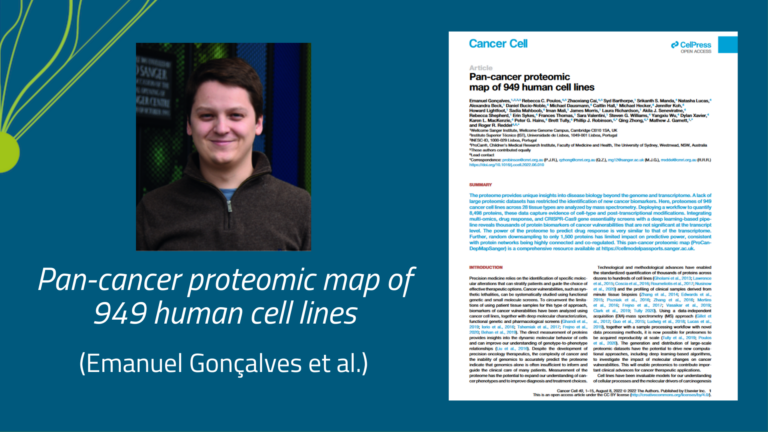
    Emanuel Gonçalves INESC-ID Automated Reasoning and Software Reliability (ARSR) computational biology researcher has published a groundbreaking study in the journal Cancer Cell (published online 14 July 2022).

    In the article Pan-cancer proteomic map of 949 human cell lines, the last study resulting from Gonçalves’ postdoctoral work at the Wellcome Sanger Institute, Gonçalves together with co-first authors Rebecca C. Poulos and Zhaoxiang Cai and an immense and interdisciplinary group of colleagues addressed one substantial gap in cancer research: until now a comprehensive characterization of the proteomes of cancer cells was lacking, an absence that substantially limited the identification of novel cancer biomarkers (the molecular signature that each tumour produces).

    To tackle this challenge, the team profiled the proteomes — the complete set of proteins expressed by a genome of 949 cancer cell lines from 28 different tissues using mass spectrometry (a technique used to identify individual molecules in a complex solution based on their unique mass-to-charge signature). Then, analysing some 8,498 proteins within an integrated strategy bringing together multi-omics with drug response and the CRISPR-Cas9 gene editing technology (to manipulate the expression of genes one by one and look at how essential each of the respectively expressed proteins was), Gonçalves and his colleagues revealed thousands of protein biomarkers of cancer vulnerabilities (those molecular changes that promote tumour development and progression, such as those in genes responsible for cell proliferation).

    “This study significantly expands our molecular knowledge of cancer cells — more than doubling the number of cancer cell lines with proteomes characterized so far — and of protein regulation in cancer,” Gonçalves shared with us. “Complementing genomics, this dataset provides unique information only captured at the protein level, which we would be missing otherwise, with several important applications, from more accurate therapeutic biomarkers to unique insights into protein associations.”

    A study of this dimension, technical complexity and impact inevitably results in game-changing and novel ways of looking at cancer diagnosis, study and potential treatments. As Gonçalves reminded us, “As part of the Cancer DepMap effort, this enables a proteomic lookup map to study cancer, from identifying potential therapeutic biomarkers to studying fundamental processes of protein regulation. This will hopefully become an important resource for the broad community.” Importantly, this pan-cancer proteomic map (ProCan-DepMapSanger), an invaluable resource, is already available online.

    And how is Gonçalves’ future research progressing from this major paper? “Looking forward, I’m interested in continuing the work of harnessing these large scale datasets and their integration. There are biological mechanisms that can only be studied and understood when taking a holistic approach integrating multiple molecular datasets, like the one we present here.”

    Interdisciplinarity is key in tackling the biggest challenges in contemporary biomedical science. The joining together of computational and molecular biology approaches represents one such unique hope that of fully tackling the emperor of all maladies.

  • HATE COVID-19.PT: Detecting hate speech in social media

    HATE COVID-19.PT: Detecting hate speech in social media

    A few weeks ago, the team that brought the FCT-funded HATE COVID-19.PT project to life met at INESC-ID. Since May 2021, HATE COVID-19.PT has developed methods for semi-automatically creating a large-scale Portuguese annotated corpus covering online hate speech, while exploring how the information in that annotated corpus can support hate speech detection, allowing users to visualize the metrics extracted from data.

    Coordinated by Paula Cristina Quaresma da Fonseca Carvalho, researcher within the INESC-ID Information and Decision Support Systems (IDSS) Research Area, and with the participation of three other IDSS researchers (Mário Jorge Costa Gaspar da Silva, Paula Cristina Quaresma da Fonseca Carvalho and Danielle Caled Vieira), two researchers from the Human Language Technologies (HLT) Research Area (Ricardo Daniel Santos Faro Marques Ribeiro and Fernando Manuel Marques Batista) and Cláudia Silva (researcher at ITI-LARSyS), HATE COVID-19.PT saw its results presented and discussed in a one-day workshop that took place on 17 May.

    We spoke with Paula Carvalho about this exciting project and the May workshop:

    How did the project come about and what were its initial objectives?

    This research project was one of the applications approved for funding by the Fundação para a Ciência e a Tecnologia (FCT), within the scope of the call for special support for projects on hate speech. The idea of ​​submitting an application for this call made perfect sense at the time, since some of the researchers that make up the HATE COVID-19.PT team were involved in projects, more directly or indirectly, related to hate speech (namely the analysis and detection of misinformation in the media and in social networks). In addition to the linguistic and computational challenges that the recognition of hate speech presents, this phenomenon, increasingly present in social networks, constitutes a clear violation of human rights, as well as one of the greatest threats to social cohesion and democratic societies. From the point of view of natural language processing, it is crucial to create resources that allow, on the one hand to understand the linguistic and discursive materialization of this phenomenon and, on the other, to support the creation of learning models that allow its automatic recognition. However, with regard specifically to the Portuguese language, the existing resources are scarce and the geographic and temporal dimensions, crucial for the characterization of the evolution of online hate speech in the Portuguese context (also one of the objectives of this project), are not normally taken into account.

    In a simplified way, the initial objectives of this project consisted in the creation of solid resources that allowed for the investigation of the main linguistic and discursive strategies underlying the materialization of direct and indirect hate speech, taking into account the different target groups studied, in the Portuguese context, as well as how to assess the impact of the pandemic on the evolution of online hate speech in Portugal. In addition, we proposed to explore semi-supervised learning approaches to address the limitations associated with manual annotation approaches. The manually and automatically annotated data would then be used to develop learning models that allow for the recognition of online hate speech in Portuguese.

    What was the purpose of the May 17th workshop, and what is your perception of how the workshop went?

    The workshop we organized had two main objectives: to share the main research results achieved during the project with the community and to involve civil society in their discussion. In our view, the dialogue between researchers and society, sometimes underestimated by the scientific community, is fundamental.

    In the initial phase of this project we created three focus groups, made up of members of communities that are frequently the target of hate speech, offline and online, in Portugal, namely the Afro-descendant community, the Roma community and the LGBTQ+ community. This work, of a qualitative nature, was crucial to better understand this phenomenon and its impact on these communities. Therefore, for the project team, it made perfect sense to once again involve these communities in the workshop, not just as guests, but as participants with an active voice. Additionally, Paula Cardoso (founder of Afrolink), Hélder Bértolo (chairman of the board of Opus Diversidades) and Vanessa Lopes (currently an intern journalist at the Público and activist for the rights of the Roma Community) participated in the round table dedicated to the discussion of the results of this project.

    We were also able to include the intervention of Portuguese specialists in the project who have been approaching the topic of hate speech in the scope of their research, namely Marisa Torres Silva, Professor at Nova FCSH and researcher at ICNOVA, and Rita Guerra, Professor at ISCTE and researcher at CIS-ISCTE.

    Personally, I believe that it was a very important event, allowing for the sharing of knowledge, in a multidisciplinary perspective, while also highlighting stimulating and enriching interventions by the audience.

    Now that the project has come to an end, what seems to be the biggest conclusions of the project and what impact did they have?

    As I mentioned earlier, one of the main objectives that we defined within the scope of this project was the creation of linguistic resources, in particular annotated corpora (that is, data collections), which are scarce for Portuguese, in order to understand and characterize this phenomenon and ultimately contribute to its automatic recognition. This objective was accomplished and, at this moment, we are able to say that we have created perhaps the largest collection of data (on hate speech) annotated for Portuguese, considering several dimensions of the problem that are typically little explored or explored in an unsystematic way in the literature. In particular, around 200,000 comments were manually recorded, focusing on three target groups (Afro-descendant community, Roma and LGBTQ+) and two social networks (Twitter and YouTube). The annotation system includes, for example, the distinction between hate speech, offensive speech and counter-narratives, as well as the main rhetorical and discursive strategies used in the analyzed comments.

    It should also be noted that the annotation process involved both individuals from the target communities and individuals who do not belong to any vulnerable or historically marginalized group. Although we cannot and should not make generalizations (taking into account the size and characteristics of the sample) there are some interesting conclusions that we can be drawn from the studies carried out. For example, we observed that indirect hate speech (implicit or covert) is as frequent or more frequent on social networks than direct hate speech. Indirect hate speech is often anchored in superficial and fallacious argumentation strategies, including the appeal to fear, the call to action (e.g., the appeal to vote in far-right parties); moreover, this type of discourse is also materialized through rhetorical figures such as irony or sarcasm. With particular reference to a study of a qualitative nature carried out in the initial phase of this project, which involved the creation of focus groups with members of the targeted communities, we were able to conclude that indirect hate speech is considered more harmful than direct hate speech by target groups, even when this type of discourse is expressed through praise or humor. These are, therefore, strategies that seek to normalize and perpetuate stereotypes associated with target groups, often present in comments identified as containing hate speech. We also observed that, according to the data we analyzed, namely on Twitter, it is not possible to establish a direct relationship between the pandemic and the increase in hate speech on social networks in Portugal. In fact, the highest peaks of online hate speech recorded during that period seem to be closely related to events, in the international and national paradigm, that involve the targeted communities (e.g., the murder of G. Floyd and the Marega case).

    The results achieved in this project are therefore fundamental to support the development of models for automatic detection of hate speech in Portuguese. At the moment, the linguistic resources created, pioneers for the analysis of hate speech in Portuguese, are being explored within the scope of the master’s work of two research fellows, hired within the scope of this project, who will present their master’s dissertations, coming soon to Instituto Superior Técnico.

  • Two robots walk into a bar: the AGENTS project is featured in Público

    Two robots walk into a bar: the AGENTS project is featured in Público

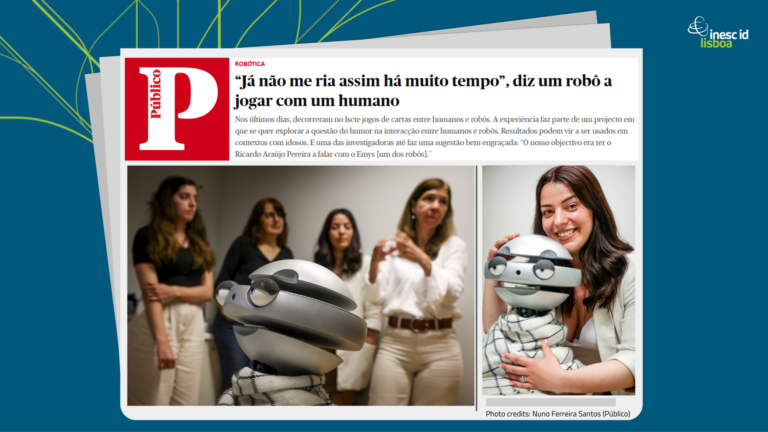
    Automatic generation of humor for social robots (AGENTS) — an FCT- and Carnegie Mellon University (CMU) Portugal-funded project — has been featured in the Portuguese newspaper Público.

    Based at INESC-ID and ISCTE and coordinated by Ana Paiva, researcher within the INESC-ID Artificial Intelligence for People and Society Research Area and Professor at Instituto Superior Técnico, AGENTS explores how humour can be used to create more naturalistic and lifelike interactions between robots and other agents. In this piece, Raquel Oliveira and Inês Batina (both early career researchers at INESC-ID), as well as Patrícia Arriaga (researcher at ISCTE) and Ana Paiva, provide a glimpse at the recent set of human-robot interaction experiments that were conducted at ISCTE with close to 60 subjects.

    The full piece can be accessed here and more details on the project can be viewed here.