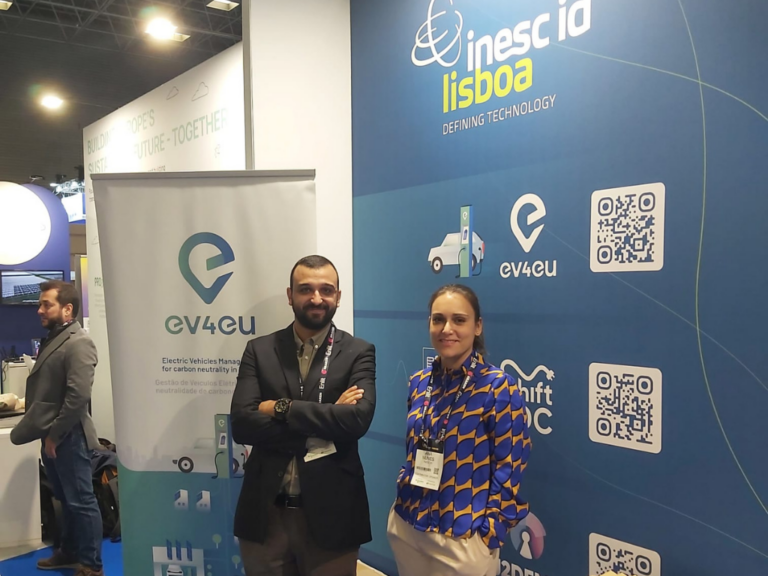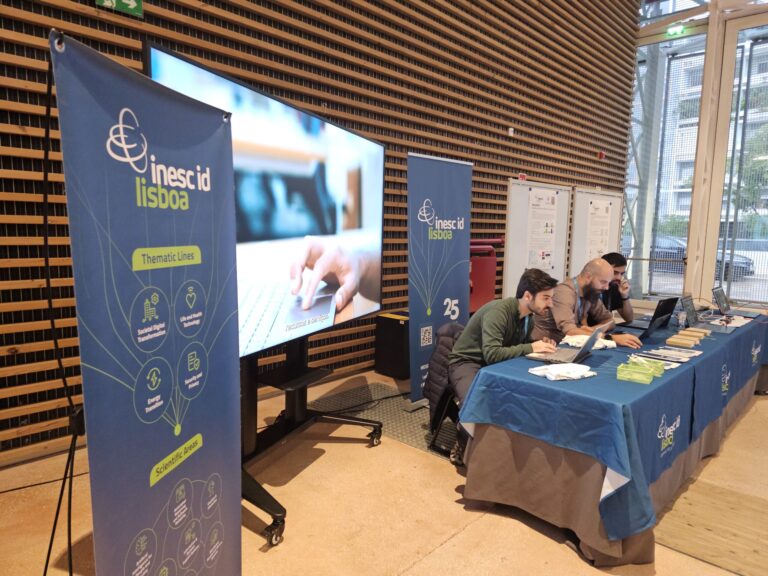
After last year’s success, EV4EU, Shift2DC and U2DEMO made a comeback to the Enlit Europe, which took place in Bilbao, Spain, from November 18 to 20. One of Europe’s most influential events in the energy sector, Enlit gathered more than 15000 energy professionals to discuss challenges in the sector and allowed visitors to explore projects and companies, while seeing how energy is generated, distributed and consumed.
EV4EU – development of user-centric V2X management strategies for houses, buildings, parking lots, and EV fleets, that will allow the massive growth of electric vehicles.
Shift2DC – a new approach on the way direct current (DC) solutions are used in power systems by creating smarter, more efficient, and eco-friendly energy systems, including ongoing research on Madeira Island and the creation of a DC Digital Port on the island.
U2Demo – development of innovative energy management strategies and technological solutions to promote equitable and democratic access to sustainable energy resources, empowering consumers to manage their energy use more effectively, save money, and take control of their energy data.
Joining our INESC-ID members were fellow partners from key institutions: Asier Aristondo (Tecnalia), Amel Addala Jullien (EDF) and Benedict Mortimer, Dimitrios Baros and Sergio Orlando (Eaton). EV4EU and Shift2DC were also part of the session “Smart Cities: From Buildings to Neighbourhoods and Transportation” along with projects Chronicle, WeForming, BilbOPS, ALRIGH2T, GIANTS and BuildOn.
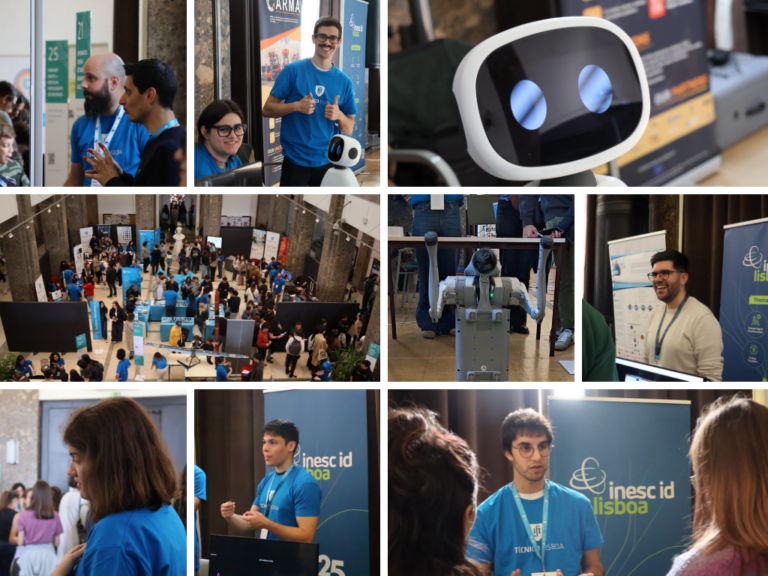
At a time when the discussion on Defence is gaining prominence in political agendas in Portugal and across Europe, Téc4Defence brought together for the first time research institutes connected to Instituto Superior Técnico, companies active on the sector, and the Armed Forces to debate the future of Defence and dual-use technologies (for both civilian and military purposes).
The event, organised by several student groups of Técnico with the objective of strengthening the role of science and engineering in National Defence and integration at European level, featured a full programme of roundtables, company pitches, debates, and technological solutions in development, including demonstrations of real prototypes with practical applications.
In the exhibition area, the INESC-ID stand had a strong presence with a team of volunteers from the High-Performance Computing Architectures and Systems (HPCAS) scientific area. Researchers Ricardo Chaves, Nuno Neves, José Antunes, Pedro Martins, and Manuel Goulão, demonstrated an encryption system for military networks and shared information on two European projects: SEQURED (see article), which develops innovative solutions to protect data from public and private organisations against future quantum-enabled cyberattacks.; and ORQESTRA, which focuses on integrating post-quantum cryptography technologies into real defence systems.
Throughout the day, our stand welcomed students, representatives of the Armed Forces, and industry professionals interested in the work carried out at our institute. The exhibition area also featured demonstrations from other research institutes, including INESC-MN, the Institute for Plasmas and Nuclear Fusion (IPFN), and the Institute for Systems and Robotics (ISR), alongside tech companies and the Navy, Air Force, and Army. Together, we showcased work in areas such as security, UAVs, advanced materials, telecommunications, surveillance, and microelectronics.
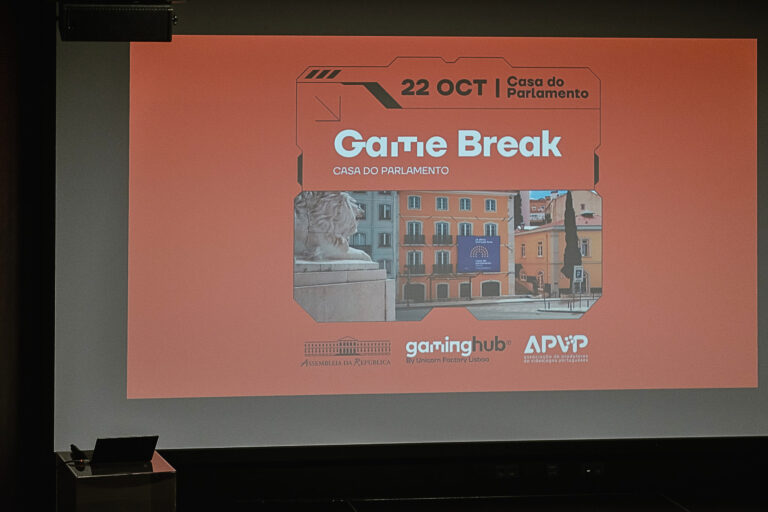
In the house of democracy, all sorts of games are played. But on October 22, a few members of parliament and advisors only had to cross the street from Assembleia da República to Casa do Parlamento, an interactive and multimedia centre dedicated to the history and functioning of the Portuguese Parliament, to step into a different kind of game: discovering how video games are being used for social good, including contributions from INESC-ID in the field of serious games and Portugal’s video game industry.
This special edition of Game Break, organised by the Gaming Hub at Unicorn Factory Lisboa, with the support of the Portuguese Video Game Producers Association (APVP), brought together policymakers, researchers, industry professionals, universities and civil society to explore together how video games are shaping the future of the sector in Portugal.
Inês Lobo and Miguel Belbute, PhD students in the Artificial Intelligence for People and Society scientific area (at GAIPS), represented INESC-ID with interactive demonstrations of two serious games: All Sustainable and Geometry Friends. Both projects reflect the institute’s thematic line on Societal Digital Transformation, which explores how digital technologies can empower informed decision-making and promote inclusivity and positive social change.
Co-designing sustainability and inclusion
All Sustainable, a digital game designed to teach sustainability concepts, is the result of a collaboration between INESC-ID researchers at GAIPS and users from CERCIOEIRAS. Across five co-design sessions, participants contributed to the game’s content and structure, from defining challenges related to sustainability and independent living, to deciding gameplay elements like narrative, rules, and characters. This gave participants a chance to help develop something they found both relevant and fun, reinforcing the inclusive philosophy behind the project.
Initially created for people with intellectual disabilities, the game has proven to be a valuable tool for helping children develop sustainability-related skills. It is now also being adopted in schools. “It’s incredibly rewarding to develop these games for minority groups and to see more people interested in getting them to those who need them,” says Miguel Belbute. “But what excites me most is seeing the results. For instance seeing neurodivergent children play and knowing it’s making a difference.”
For Miguel, who enjoys showing the “human” side of games, the fact that All Sustainable was co-designed with people with intellectual disabilities allows to better understand their relationship with digital games and what really connects them to the experience. That was one of the key messages he and Inês Lobo shared with the many visitors, from parliamentary advisors and game industry professionals to university professors and students from across the country.
Trust isn’t a simple game
In turn, Geometry Friends, demonstrated by Inês, is a 2D puzzle platformer game where two characters, a circle and a rectangle, each with unique movement abilities, must collaborate to collect diamonds and complete levels. Designed as a cooperative game, the characters, representing a human and an autonomous agent, need to work together to reach a common goal.
“In our study, we use this game to explore how people perceive different types of agents — those that lead the game and those that follow the player’s plan,” she explains.
The reactions, Inês notes, are far from predictable. “They depend not only on personal preferences, such as favouring cooperative or competitive games, but also on the framing of the game itself: whether it’s presented as a collaborative mission or not.”
Also developed by GAIPS , Geometry Friends serves as a platform for AI research, including reinforcement learning and studies in human-agent collaboration. Its design requires players, whether human or AI, to combine efforts and unique capabilities, making it an ideal “laboratory” for developing artificial intelligence. The game provides inexpensive virtual simulations where algorithms can be tested and refined across thousands of interactions; research that has direct implications for the design of systems we interact with every day, from virtual assistants to social robots.
Serious games, a serious business
Serious games are not designed to simply entertain, but to educate, train and inform. Used in contexts such as education, healthcare or professional training, these games are gaining ground as tools for social transformation.
Miguel and Inês noted that several members of parliament showed genuine curiosity. “The majority had no idea about the dimension of the gaming industry or what was happening in the field,” Miguel shared.
In fact, far from being just child’s play, according to a study by Bain & Company, video games are already the world’s largest entertainment industry, expected to generate €190 billion in revenue in 2025. Serious games are also growing fast, with a market estimated at €14 billion and annual growth rates of up to 25% through 2030. In Portugal, with over 160 active video game studios, projected 2024 revenues above €100 million and a 60% annual growth, the national video game industry is thriving.
As digital technologies increasingly influence how we learn, decide, and engage with each other, INESC-ID has an important role to play. The growing momentum of the video game industry — and the research driving it — holds real potential for impact. And if we want a more participatory and inclusive democracy, maybe it’s time we start taking games more seriously.
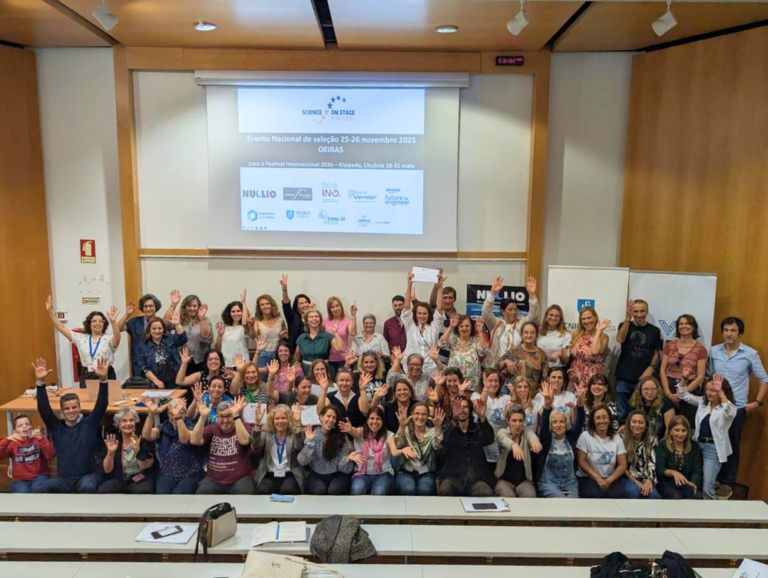
A hundred teachers from all around the country gathered on the ground floor of Técnico Oeiras last weekend, October 25-26, as the Science on Stage National Festival 2025 took place!
The event was organised by NUCLIO – Núcleo Interativo de Astronomia e Inovação em Educação, with the support of Engenharia para Todos project, a collaboration between INESC-ID and Instituto Superior Técnico (IST), and the Oeiras Municipality.
The teachers, from pre-school to high school education and various STEM subjects, shared innovative practices in teaching and science, promoted new ideas, and also networked with other participants, with the prospect of future collaborations. Of the total 26 projects presented, 7 were selected to represent Portugal at the European Science on Stage Festival 2026, which will take place in Lithuania, in May 2026.
Besides presentations, there were also plenty of hands-on workshops for all families and participants attending the festival. Engenharia para Todos, had a display of its own, through a promotional video showing activities and projects developed in schools and within the community. Its work highlights, once more, how a creative, experimental and inclusive approach can bring engineering and technology closer to all audiences.
Among the participants, were the Oeiras City Councillor Pedro Patacho; the Director of the Department of Education, Maria Paula Rodrigues; and Maria José Amandio from the Science and Innovation Office of Oeiras Municipality.
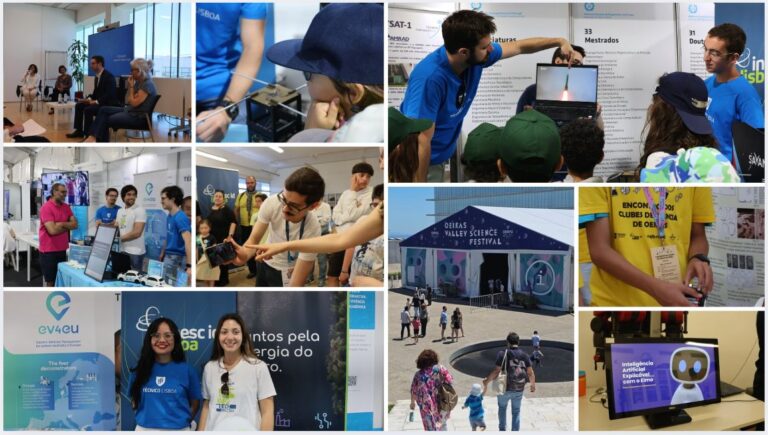
Not even the threat of tropical cyclone Gabrielle discouraged the hundreds of families and curious visitors who filled the Marina of Oeiras for another edition of the European Researchers’ Night (NEI). And last Friday, September 26, brought its reward: the announced storm turned into a perfect autumn afternoon and evening. Once again, the marina became a stage for live science, with more than 35 institutions, interactive experiments, games, conversations, and performances for all ages.
For the second year in a row, INESC-ID took part in the event with a sea-view booth – part of a series of science outreach efforts coordinated by the Communications and Outreach Office. We were in great company, alongside colleagues from CERENA (also part of the Instituto Superior Técnico associated institutes community)and several other institutions.
Exploring Electric Mobility
Starting the first shift of the day, our booth featured the EV4EU and Aliança para a Transição Energética (ATE) projects, the latter being a key pillar of Portugal’s Recovery and Resilience Plan (PRR). Students Guilherme Pereira and Marcelo Braço Forte, from the Sustainable Power Systems scientific area, led the activity with an interactive quiz, challenging visitors and offering the chance to win a mini electric vehicle kit.
Serious Games for Psoriatic Arthritis Rehabilitation
As the sun went down, the baton was passed to returning volunteers Bárbara Ramalho from Graphics and Interaction (HUMAN Lab) and Samuel Gomes from GAIPS, joined by newcomers Rodolfo Costa and Filipa Magalhães. Together, they showcased the latest version of the game iPROLEPSIS, inviting the public to play and respond to questionnaires while explaining how the tasks were designed to train movements often affected by psoriatic arthritis.
Engineering for Everyone
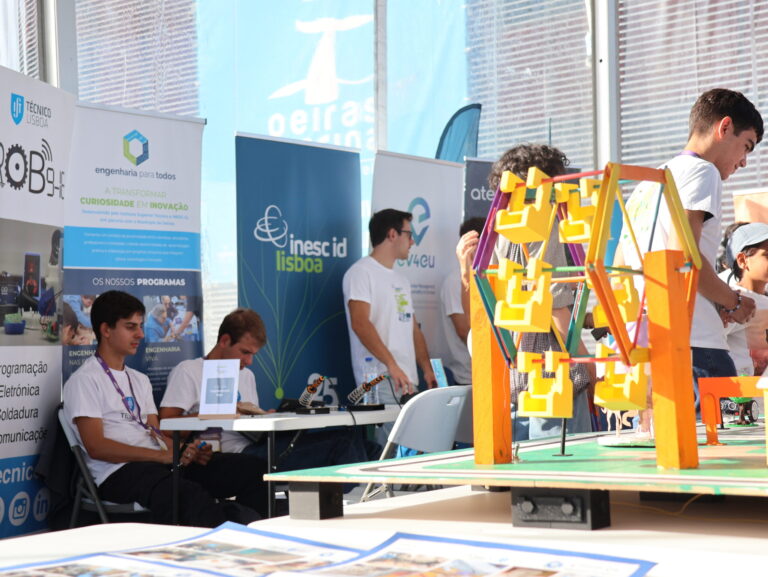
Our booth’s second table was dedicated to the Engenharia para Todos project – a joint initiative by INESC-ID and Instituto Superior Técnico, with support from the Oeiras Municipality. This project embodies the spirit of this year’s edition by actively engaging children, public schools, and local communities in hands-on science and technology. Presented by coordinator Maria João Verdasca, and scholarship students Afonso Gonçalves and Martim Jesus, dozens of children had the chance to learn how to solder electronic components to build mini rockets.
Right in front, students from the C4 Science Club at Agrupamento de Escolas de Carnaxide — who developed their Smart City project throughout the year with support from Engenharia para Todos — proudly presented their city, built from 3D modelling and printing to Arduino programming.
At the end of the night, with all booths already packed away, only one small future scientist remained, determined and focused, finishing the last soldering points on her rocket. We waited patiently, watching her with quiet satisfaction. Only then, in a moment of silent complicity, did we unplug the soldering iron and close our participation.
Held every year on the last Friday of September, the European Researchers’ Night brings science to the streets with hundreds of free events across Europe. This year’s edition in Oeiras, part of the EU-EMBRACES project, was coordinated by ITQB NOVA in partnership with the Oeiras Municipality.
In a fractured, fast-changing world, Europe is facing urgent questions about security, sustainability and technological sovereignty. At Encontro Ciência 2025, Portugal’s largest annual science and technology gathering, we brought those questions into the room.
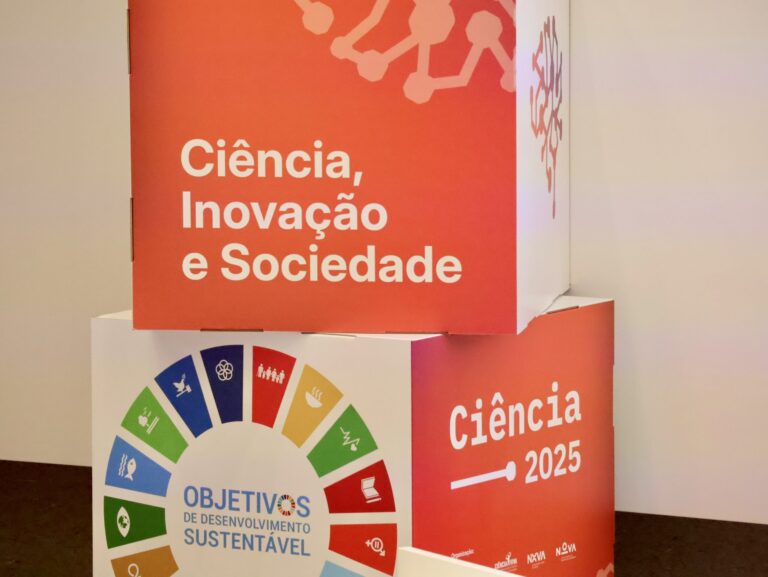
Held from July 9 to 11 at NOVA SBE in Carcavelos, this year’s edition explored the theme “Ciência, Inovação e Sociedade”, bringing together researchers, policymakers, and institutions to discuss the future of science in society. The European Commission was the official guest of honour, represented by high-level officials in the fields of science and innovation.
INESC-ID contributed with a flagship panel, joining voices from across the INESC network to ask a vital question: what role should research play in Europe’s resilience, autonomy, and defence?
Strategic Autonomy and Defence
At the heart of INESC-ID’s participation was the panel “The Role of Research in Resilience, Strategic Autonomy and Defence in the EU”, organised and moderated by Silvia Castro, Head of the Innovation Management Office. The session focused on Europe’s current challenges, highlighting how the INESC institutes are stepping up in response to shifting priorities, emerging risks, and a growing role for public research.
Defence was an unavoidable theme (a clear sign of the times) and many research areas were framed through that lens. But the conversation didn’t shy away from the deeper challenge: how can research serve both security and society without losing its compass? This focus was illustrated by presentations on dual-use technologies spanning cybersecurity, nanoelectronics, energy, health, and photonics.
The session featured contributions from Nuno Santos (INESC-ID), Nuno Cruz (INESC TEC), Carlos Henggeler Antunes (INESC Coimbra), Nazua Costa (INOV-INESC), and Susana Cardoso de Freitas (INESC MN), each presenting concrete examples of research underway and aligned with EU and national priorities.
It also drew on several insights, presented by João Claro (INESC TEC), from the recent INESC Brussels HUB Summer Meeting 2025, which gathered researchers, EU policymakers, and industry leaders to discuss strategic autonomy and the role of dual-use research in Europe’s future.
“The INESC Brussels HUB Summer Meeting showed how essential it is to have spaces for critical reflection, especially as we face growing geopolitical complexity and a rapidly changing research and innovation ecosystem,” remarked Silvia.
AI, Policy, and Education
Beyond the resilience agenda, INESC-ID contributed to a range of other thematic sessions: Rui Henriques joined a discussion on how artificial intelligence is reshaping the agri-food sector, boosting efficiency, sustainability, and competitiveness from farming to food distribution.
Helena Moniz participated in a panel on science-informed policymaking, where the Science4Policy initiative organised by PLANAPP was presented. The session highlighted how Portugal is positioning itself at the forefront of connecting research and public policy, with Helena noting that “initiatives like FCT’s Science4Policy calls are globally innovative” and that “we often fail to see what we’re good at in Portugal.”
Finally, the “Engenharia para Todos” (Engineering for All) initiative – a partnership between INESC-ID, Instituto Superior Técnico and Câmara Municipal de Oeiras – helped connect science with wider audiences. Science Manager Maria João Verdasca presented an e-poster on the programme’s outreach model, while students from the C4 Science Club of Carnaxide showcased their Smart City project: a tangible example of how engineering education and hands-on science can promote civic engagement, creativity, and early contact with advanced technologies.
From strategic autonomy to smart cities, INESC-ID’s participation at Encontro Ciência 2025 showed how our work is addressing pressing societal needs by connecting research across fields and institutions.
“Just like last year’s session, which brought together diverse perspectives from across the INESC institutes on a common theme”, added Silvia, “this initiative was also an excellent opportunity for networking and strengthening inter-institutional ties” – a reminder that in complex times, collaboration is as vital as innovation.
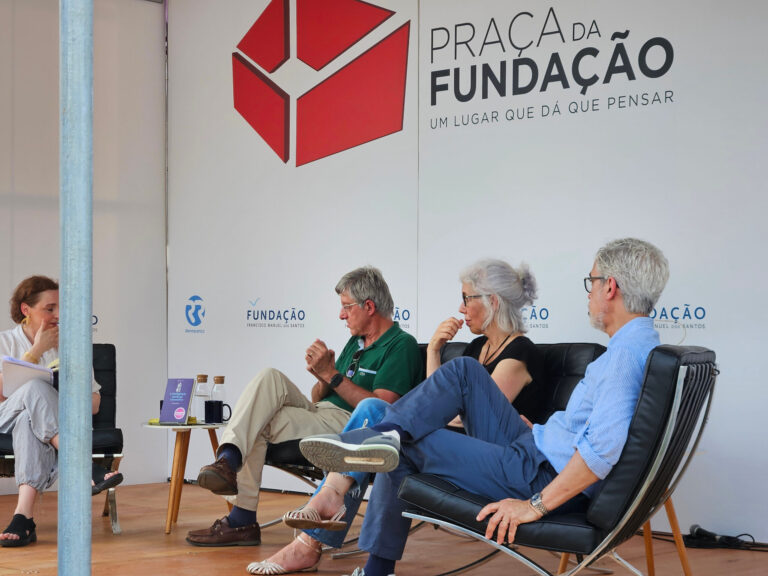
Last Sunday, June 8, INESC-ID brought AI into the spotlight at the Feira do Livro Lisboa 2025 (Lisbon Book Fair 2025) as researcher Arlindo Oliveira presented his book, “Generative Artificial Intelligence”, at the Fundação Francisco Manuel dos Santos stage. The presentation, in a roundtable format, featured insights from fellow INESC-ID researcher Luísa Coheur and Instituto de Telecomunicações researcher Mário Figueiredo.
Throughout the one-hour talk, the three researchers delved into the definition of Generative Artificial Intelligence, its potential risks regarding privacy, security, and the spread of misinformation, and the many questions it raises. They reflected on whether AI could one day experience emotions, delve into creativity and reasoning, develop a conscience, and what ethical and philosophical challenges might arise if it does. As it is stated in the book’s synopsis: “Will machines one day have rights and obligations like the rest of us? It’s worth thinking about.”
Generative Artificial Intelligence is a technology built on several decades of research in the area of automatic learning and has captured attention since the launch of ChatGPT. The interest, however, now extends beyond the research community. The book, which followed an essay on the topic and an invitation from Fundação Francisco Manuel dos Santos, aims to address this matter, presenting and contextualising artificial intelligence, the methodologies within, and its applications and potential risks, in a way that’s accessible to a general audience.
“If I light a match, will it fly too?” Eliane is “seven and a half” years old and has a curious mind that shines through in her sharp questions and wide-eyed wonder. Her inquiry came after Diogo Diniz, a third-year undergraduate student in Computer Science and a volunteer at Técnico’s booth (where INESC-ID was also present), explained how rockets ascend thanks to the downward force of fire—demonstrating this with a video of a rocket launch.
But this wasn’t just any rocket. It was the one that lifted off from the Guiana Space Centre, carrying onboard ISTSat, the first Portuguese university-built satellite, developed under NanoSat Lab (a consortium gathering IST, IT, INOV and other research institutes, with INESC-ID as the leader).
Eliane wasn’t entirely convinced. With a slightly skeptical look, she added: “I’m going to build a machine that goes down, with matches pointing up.”
Without knowing it, Eliane was perfectly embodying the motto of the Oeiras Science Festival: Discover, Question, Imagine. Organized by the Municipality of Oeiras and co-hosted by Taguspark, this science celebration ran from May 21 to 25 and brought together schools, researchers, and families to engage in hands-on science, interactive demos, and open-ended exploration.
As expected, INESC-ID was present with contributions in both formats: exhibition stands with demos and multiple talks across the event’s five-day agenda. In parallel, on May 24, the festival also hosted the Técnico Oeiras Campus Open Day.
While Diogo Diniz was making his outreach debut, Pedro Amado—currently a master’s student supervised by INESC-ID researcher, Gonçalo Tavares—was already a seasoned participant in public engagement. “I really enjoy talking with kids,” he shared. “There’s a lack of natural vocation in students, and coming to Técnico without a sense of purpose requires extra effort,” he reflected.
Rockets, robots, and electric cars
João Paulo Monteiro, from the ISTSat project team, is also no stranger to this kind of event, especially after the satellite’s successful launch in July 2024. Between answering questions, he received a real-time alert on the project’s satellite tracking platform: something had passed within 400 meters of ISTSat. “Probably Starlink,” he guessed. “It happens all the time.” And he was right.
Explaining to a group of 7th graders from Agrupamento de Escolas Aquilino Ribeiro, in Porto Salvo, Oeiras, Pedro Amado described the new space landscape: “Today’s satellites are much smaller and can be launched by private companies.”
At the same stand, the project EV4EU – Exploring Electric Mobility raised awareness about the ongoing energy transition. Visitors could test their knowledge through a quiz designed by INESC-ID researcher Marcelo Braço Forte, with the chance to win a miniature electric car. In total, 114 participants tried their luck.
The Mushroom Game, developed by GAIPS, focused more on knowledge than chance. Alongside its AI companion, ELMO the Robot, the game tested how much visitors trusted artificial intelligence systems while teaching them how to identify safe and poisonous mushrooms. Students from 6th and 7th grade proved to be keen technophiles, answering nearly all of Miguel Belbote’s questions correctly. Belbote, a researcher at GAIPS, already an experienced outreach participant, enjoyed the enthusiastic responses.
“Guess how much this robot dog weighs,” he asked, pointing to the GO2 Robot Dog. “Twelve kilos?” ventured one of the seven boys in the group. “Fifteen,” he replied. Not a bad guess.
But in the end, this isn’t about getting all the answers right. What matters most is wanting to know.
And in that respect, every single student—Eliane included—passed with flying colors.
Oeiras Valley Science Festival was also an opportunity to celebrate the cooperation between students, teachers, and researchers, who came together for two afternoons, on the 2nd Meeting of the Oeiras Science Clubs. Co-organised by Técnico Oeiras and ITQB NOVA with the support of the Engenharia para Todos project (INESC-ID and Oeiras Municipality), it was a moment of exchange that featured presentations, a science fair, a roundtable discussion, and a poster exhibition showcasing the “Mentorias” project, in which scientists work closely with students.
What about us? Culture, language and sovereignty in the Age of AI
The final day of the festival saw four INESC-ID researchers actively participating in three roundtable sessions focused on the promises and challenges of Artificial Intelligence.
Early in the morning, Helena Moniz joined the session “Artificial Intelligence and Us”, where she and fellow speakers Paulo Novais (University of Minho), Pedro Bizarro (Feedzai), and Mário Figueiredo (IST) reflected on the growing role of AI in our lives and in shaping the decisions that will define our future. Helena emphasised the importance of being aware of the cultural and ideological biases often embedded in these models, highlighting the need to represent cultural diversity and the many ways of living and thinking found across societies.
Shortly after, Isabel Trancoso and Luísa Coheur took part in the session “Artificial Intelligence in Written and Spoken Language: Applications in Health, Education and Industry”. Isabel explored the human voice as an identity marker in the digital age, while Luísa brought attention to the challenges AI presents in the educational context. The session was moderated by André Peralta (NOVA) and also featured Liliana Ferreira (Fraunhofer Portugal), who added a complementary perspective to the panel’s reflections.
In the afternoon, Arlindo Oliveira took the stage for one of the festival’s final sessions — “Generative AI and European Sovereignty in AI”. Alongside André Martins (IST) and Paulo Dimas (Center for Responsible AI), Arlindo explored the rapid rise of large language models (LLMs), their technological impact, and the far-reaching challenges they pose — not only at the economic, political, and social levels, but also in terms of strategic autonomy. It was a conversation that brought the pressing theme of innovation and sovereignty to the table with critical insight and a sense of urgency – giving voice to the central message of the festival.
Organized by the Católica Research Centre for the Future of Law, in collaboration with FGV Direito Rio (Brazil), the event brought together national and international experts to discuss pressing challenges in digital regulation. Topics ranged from emerging technologies to the legal and ethical frameworks shaping our digital future.
Ahead of a panel discussion on the topic, Isabel Trancoso and also Mário Figueiredo, professor at Instituto Superior Técnico, delivered keynote talks on Artificial Intelligence and the societal challenges it presents
Participation in this high-level forum underscores INESC-ID’s active role in shaping public dialogue around the intersection of technology, ethics, and policy. Entry to the event was free, subject to prior registration.
An AI-powered robot dog, a European-made high-performance chip, a sustainability-focused game co-designed with People with Intellectual Disabilities (PID), a small AI robot that helps identify dangerous mushrooms, and even a tool that video-tracks camouflaged sea creatures — these are the projects INESC-ID presented at this year’s Técnico Open Day, held on April 5, drawing in curious minds of all ages.
Just past 9 a.m, the nervous buzz among the team of INESC-ID researchers and volunteer students was palpable. With support from the Communication and Outreach Office, connections were tested, key topics mentally rehearsed and final touches applied at what was INESC-ID’s largest-ever presence at a science fair, featuring three booths and a demonstration arena. Everything was ready to welcome the record-breaking 2700 attendees entering Instituto Superior Técnico’s central pavilion, from aspiring engineers to knowledge-seeking families and science fans of all ages.
Robots and games that teach and inspire
At the first booth, Inês Lobo, a PhD student from the AIPS scientific area (at GAIPS group), introduced visitors to Todos Sustentáveis (All Sustainable), a co-designed game that empowers People with Intellectual Disabilities (PID) to be sustainable citizens. Originally created for this community, the game is now also being adopted in schools – and judging by the line of children waiting their turn, it will be a big hit.
“A father even thanked me for being able to rest for half an hour while his son played the game”, shared an amused Inês.
Next to her, fellow PhD student Sandra Andrade, demonstrated the adorable AI robot ELMO and the Mushroom Game – an engaging way to explore how trust influences AI assisted decision-making – perfect for sparking discussions about AI and even teaching a little mycology along the way. “I was surprised by the age range of the participants, from babies to grandparents, all very interested in artificial intelligence and robots”, Sandra noted.
Meanwhile, in the adjacent demonstration arena, Miguel Belbute, also from GAIPS, and the GO2 Robot Dog from the CARMA project delighted crowds. Designed to support emergency responders in disaster zones, the athletic robot impressed visitors with its agility, so much so that it had to pause several times to recharge.
“When the children gathered around me and the robot, asking endless questions after the last demo”, Miguel recalled, “I felt like we were looking at the next generation of engineers!”
European Innovation in Chips and Computing
At the next booth, INESC-ID researchers Pedro Tomás, Tiago Rocha and Nuno Neves, from HPCAS, showcased a major achievement: a high-performance, energy-efficient chip developed under the European Processor Initiative (EPI). This powerful computer chip is helping Europe stay competitive and ahead in high-tech fields like artificial intelligence and scientific simulations.
Using a real-time remote connection to the Barcelona Supercomputing Center, the researchers demonstrated the chip’s capabilities, while answering questions from young students fascinated by the technology, as well as from visitors interested in the impact of these efforts on Europe’s future. “It surprised me both the number and diversity of people who stopped by,” noted Pedro Tomás, taking part in the event for the first time.
AI Meets Marine Biology
Finally, at our maritime-themed booth, IDSS researcher Sofia Pinto’s Master’s students Tomás Gomes and Guilherme Gonçalves (also first timers in outreach events) showcased their thesis research using AI-assisted video tracking to help biologists at the Lisbon Oceanarium. Their systems can detect camouflaged or hidden animals in aquarium video feeds, helping marine scientists better understand behaviour, stress and health of aquatic life in captivity.
“It was a great feeling to be able to go out into the field and apply computer science to help animal welfare” said Tomás, who took valuable time away from thesis writing to volunteer. “This is definitely something I want to do again.”
A full day of demos. Dozens of questions. Hundreds of sparked minds. A smiling (if tired) INESC-ID team packed up, already looking forward to the next one.
Featured Projects by INESC-ID:
A chip that puts Europe ahead in computing(Pedro Tomás, Nuno Neves, Tiago Rocha – HPCAS)
Autonomous robots for emergency assistance(Miguel Belbute – AIPS)
Mushroom Game: AI for decision assistance (Sandra Andrade – AIPS)
“Todos Sustentáveis” (All Sustainable): a game for sustainable citizens (Inês Lobo – AIPS)
Can computer science help study Oceanarium animals? (Sofia Pinto, Tomás Gomes, Guilherme Gonçalves – IDSS)
About Técnico Open Day
Técnico Open Day is an annual event, organised by Instituto Superior Técnico, that brings together students, professors, researchers, staff, student groups, departments, and associated institutes for a day of over a hundred activities for all ages. With free admission, it includes a science fair with associated research centres and institutes, student groups, laboratory visits, conversations with scientists, course presentations, experimental games, lectures, and much more.