
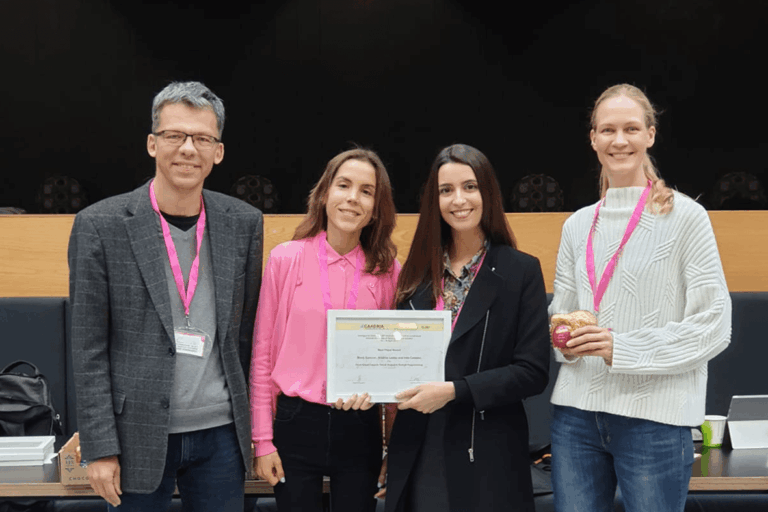
CAADRIA 2019 AWARDS

The research team led by INESC-ID Researcher António Menezes de Leitão received last week two awards during the CAADRIA conference, Best Paper Award and Best Presentation Award. The paper From Visual Input to Visual Output in Textual Programming co-authored by Maria João Sammer, António Leitão and Inês Caetano won the best paper award. The work approaches Algorithmic Design that uses algorithms to generate designs. These algorithms are built using either a Visual Programming Language (VPL) or a Textual Programming Language (TPL). In architecture, there is a clear propensity to the use of VPLs, e.g., Grasshopper or Dynamo, over the use of TPLs, e.g., Python or AutoLisp. In addition to all the user-friendly and interactive features that make VPLs more appealing to architects, most of them already integrate components for textual programming. In contrast, TPLs have not been as successful in incorporating visual features. Given the user-friendliness of VPLs and the relevance of TPLs for large-scale and complex designs, we discuss Visual Input Mechanisms (VIMs) in the context of TPLs. In this paper, we extend previous research in this area by exploring and implementing the most valuable VIMs in a TPL adapted for architectural design. Researcher Renata Castelo Branco was awarded best presentation paper for the publication Game of Renders: The Use of Game Engines for Architectural Visualization. The paper shows that Good visualization mechanisms offer architects, and their clients, a better grasp of how their designs are going to turn out when built, and the experience one might have inside the constructions. This also helps the architect orient the design in a more informed manner. However, typically used modeling tools do not offer satisfactory visualization solutions. The operations available to view and navigate through the 3D space are flawed in terms of speed, interactivity, and real-time rendering quality. To solve […]

Talks and Lectures: Artificial Intelligence Applications, Implications and Speculations

Artificial intelligence is increasingly imposing itself on the reality of contemporary societies, although new technological developments come into being every day, this phenomenon is not correspondingly reflected in the public sphere. Considering that it is important to know and discuss this reality, this cycle of debates takes a look at the current applications of artificial intelligence reflecting upon its social implications in a whole range of different areas (ranging from health to privacy, employability and other areas) and the way in which the future can be imagined within this new paradigm. Between April and June, the cycle is divided into three separate moments, each of them a double programme: a debate with several speakers from the academic and business worlds and a conference. 17 APRIL 16:00 Applications with Luísa Coheur, Pedro Bizarro, Milind Tambe 18:30 Applications (The Good and the Bad) with Mário Figueiredo 15 MAY 16:00 Implications with Luís Moniz Pereira, Manuel Dias, Virginia Dignum 18:30 Robot ascension with Martin Ford 05 JUNE 16:00 Speculations with Ana Paiva, André Martins, Arlindo Oliveira 18:30 Artificial intelligence Compatible Human with Stuart Russell Free entry (subject to availability), tickets available on the day from 15:00 at the ticket-office. In portuguese and english with simultaneous translation Live streaming here More information about the event here

INESC ID leads European project “iv4XR”

INESC ID leads European project on the use of AI for testing advanced interactive software systems as part of the H2020 The project, called iv4XR (Intelligent Verification/Validation for Extended Reality Based Systems), is led by INESC ID and will be developed by a European consortium, as part of the H2020 programme. Project iv4XR  will develop groundbreaking verification and validation technology for  Extended Reality (XR) systems based on techniques from AI to provide learning and reasoning over a virtual world. With this technology XR developers can deploy powerful test agents to automatically explore and test the correctness of a virtual world as they iteratively develop and refine it. This includes testing user experience using socio-emotional AI. The project results will enable developers to conduct automated assessment of the quality of user experience, parameterized by different target groups of users, and different user experience goals. Nowadays, Extended Reality (XR) systems (e.g. advanced interactive systems, such as, Virtual Reality (VR) and Augmented Reality (AR)) have emerged in various domains, ranging from entertainment, cultural heritage, to combat training and mission critical applications. The development and authoring of such systems is an iterative process that also includes quality assurance to make sure that the resulting systems are correct and delivering a high quality user experience. As the complexity of these systems keeps increasing, the XR industry now finds itself confronting a soaring engineering challenge: paradoxically, XR’s fine grained and high level of interactivity and realism make such systems very hard and expensive to test. The current XR authoring and development toolset poses no XR testing technology beyond rudimentary record and replay tools that only work for simple test scenarios. The iv4XR project will address this difficult challenge. This project will be carried out by a team consisting of four companies (large and SMEs) representing the XR industry, […]

Distinguished Lecture Series

AI for Social Good: Learning and Planning in the End-to-End, Data-to-Deployment Pipeline Prof. Milind Tambe University of Southern California  17/04/2019 Room 0.19/0.20, IST – Pavilhão de Informática II, Alameda | 13:30H Abstract With the maturing of AI and multiagent systems research, we have a tremendous opportunity to direct these advances towards addressing complex societal problems. I will focus on the problems of public safety and security, wildlife conservation and public health in low-resource communities, and present research advances in multiagent systems to address one key cross-cutting challenge: how to strategically deploy our limited intervention resources in these problem domains. I will discuss the importance of conducting this research via building the full data to field deployment end-to-end pipeline rather than just building machine learning or planning components in isolation. Results from our deployments from around the world show concrete improvements over the state of the art. In pushing this research agenda, we believe AI can indeed play an important role in fighting social injustice and improving society. Bio Milind Tambe is Helen N. and Emmett H. Jones Professor in Engineering at the University of Southern California(USC) and the Founding Co-Director of CAIS, the USC Center for Artificial Intelligence in Society, where his research focuses on advancing AI and multiagent systems research for Social Good. He is recipient of the IJCAI (International Joint Conference on AI) John McCarthy Award, ACM/SIGAI Autonomous Agents Research Award from AAMAS (Autonomous Agents and Multiagent Systems Conference), AAAI (Association for Advancement of Artificial Intelligence) Robert S Engelmore Memorial Lecture award, INFORMS Wagner prize, the Rist Prize of the Military Operations Research Society, the Christopher Columbus Fellowship Foundation Homeland security award, International Foundation for Agents and Multiagent Systems influential paper award; he is a fellow of AAAI and ACM. He has also received meritorious Commendation from […]

Distinguished Lecture Series

Generating Software Tests Andreas Zeller CISPA Helmholtz Institute for IT Security 15/04/2019 Anfiteatro VA4 no piso-1 do Edificio de Civil – IST/Alameda | 11:00H Abstract Software has bugs. What can we do to find as many of these as possible? In this talk, I show how to systematically test software by generating such tests automatically, starting with simple random “fuzzing” generators and then proceeding to more effective grammar-based and coverage-guided approaches. Being fully automatic and easy to deploy, such fuzzers run at little cost, yet are very effective in finding bugs: Our own Langfuzz grammar-based test generator for JavaScript runs around the clock for the Firefox, Chrome, and Edge web browsers and so far has found more than 2,600 confirmed bugs. Our latest test generator prototypes are even able to automatically learn the input language of a given program, which allows to generate highly effective tests for arbitrary programs without any particular setup. In the past months, we have collected our tools and techniques in an interactive textbook (www.fuzzingbook.org) with 10,000 well-documented lines of Python code for highly productive fuzzing. Bio Andreas Zeller is Faculty at the CISPA Helmholtz Center for Information Security, and professor for Software Engineering at Saarland University, both in Saarbrücken, Germany. In 2010, Zeller was inducted as Fellow of the ACM for his contributions to automated debugging and mining software archives, for which he also obtained the ACM SIGSOFT Outstanding Research Award in 2018. His current work focuses on specification mining and test case generation, funded by grants from DFG and the European Research Council (ERC). Host António Manuel Ferreira Rito da Silva

“Artificial Intelligence, Cooperation and Social Robotics” at the Lisbon Academy of Sciences.

Lisbon Academy of Sciences promoted another  “Tardes na Academia“, on March 26th, at 5pm. On this IV Session,  INESC-ID Researcher Francisco C. Santos  invites  Ana Paiva, also researcher at INESC-ID,  for an afternoon on: “Artificial Intelligence, Cooperation and Social Robotics”. This initiative aims to engage distinct generations of scientists and researchers, in the various fields of science and knowledge represented in the SJC (Seminário de Jovens Cientistas). The SJC is integrated in the Institute of Advanced Studies of the Lisbon Academy of Sciences and seeks to maintain the link between the Academy and the younger members of the scientific community, as is happening in other European countries. The trans-disciplinary nature of the JCC allows to address the most relevant issues for society, producing tools that can be used by science policy makers and promoting the sharing of knowledge and knowledge with society in general.

Arquivo.pt 2019 Award

Arquivo.pt is a research infrastructure managed by the Foundation for Science and Technology, I.P. (FCT, IP) through its FCCN unit, which allows searching and accessing web pages since 1996. The main objective is the preservation of information published on the web for memory, study and research purposes. Arquivo.pt 2019  contest aims to reward original and innovative works that demonstrate the usefulness of the Arquivo.pt service, the importance of preserving and using the information published on the web. Entries may deal with any subject, provided that Arquivo.pt is used as the main source of information, practical applications or complete research studies based on information preserved from the web by Arquivo.pt. The applications must clearly demonstrate the usefulness and unique nature of Arquivo.pt for the proposed work and the impact of the work on the society or community for which it is intended. The competition is open until May 3rd at 1PM, to all interested parties, individually or in groups, although its main recipients are members of the educational and scientific community. Information about this competition can be obtained from: contacto@arquivo.pt or  +351 218 440 100

Investigador edita novo livro sobre controlo baseado no modelo de estado

João Miranda Lemos, coordenador do grupo de investigação “Control of Dynamical Systems” (CSD) no INESC-ID, editou um novo livro do IST PRESS, intitulado, “Controlo no Espaço de Estados”. Este livro foi escrito para suportar um segundo curso de Controlo baseado no modelo de estado, mas com um pouquinho de criatividade podemos incluir ( da maneira mais séria) muitos exemplos algo inesperados. O livro está organizado em quatro partes, que correspondem a grandes temas da engenharia dos sistemas de controlo: • Modelo de estado de sistemas lineares;• Controlo por realimentação linear de variáveis de estado• Controlo de sistemas não lineares• Controlo ótimo. http://istpress.tecnico.ulisboa.pt/node/498