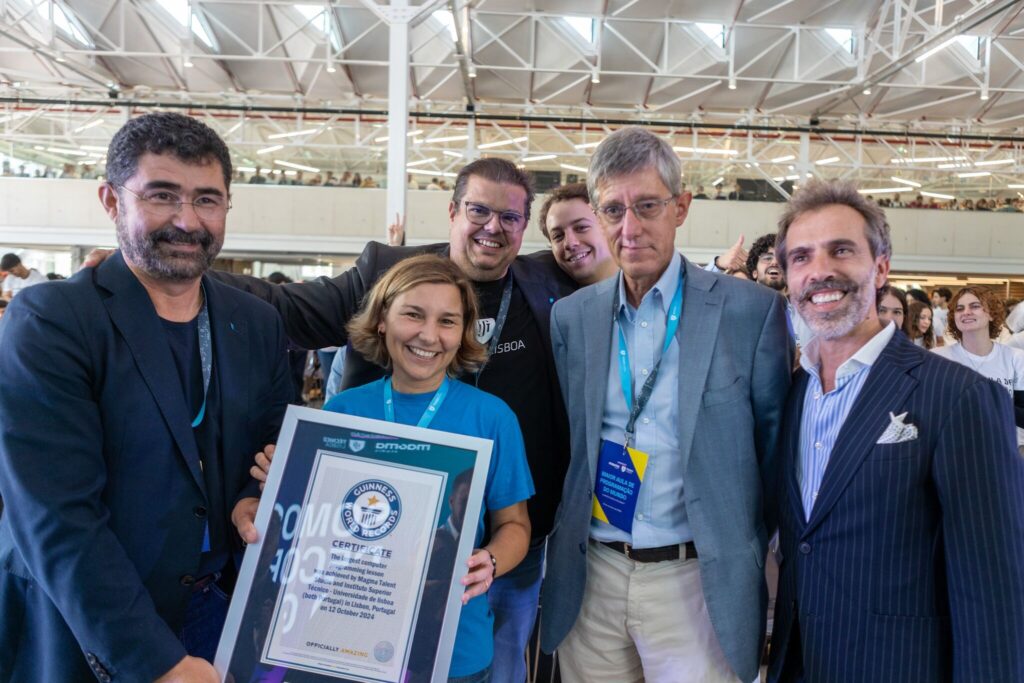
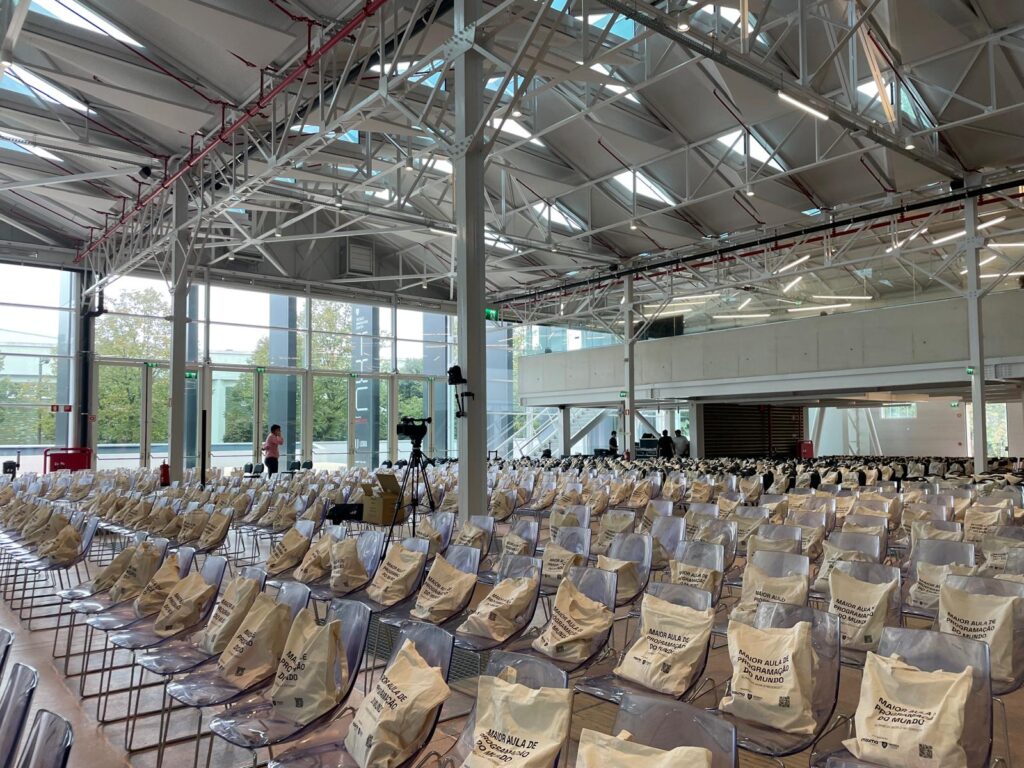
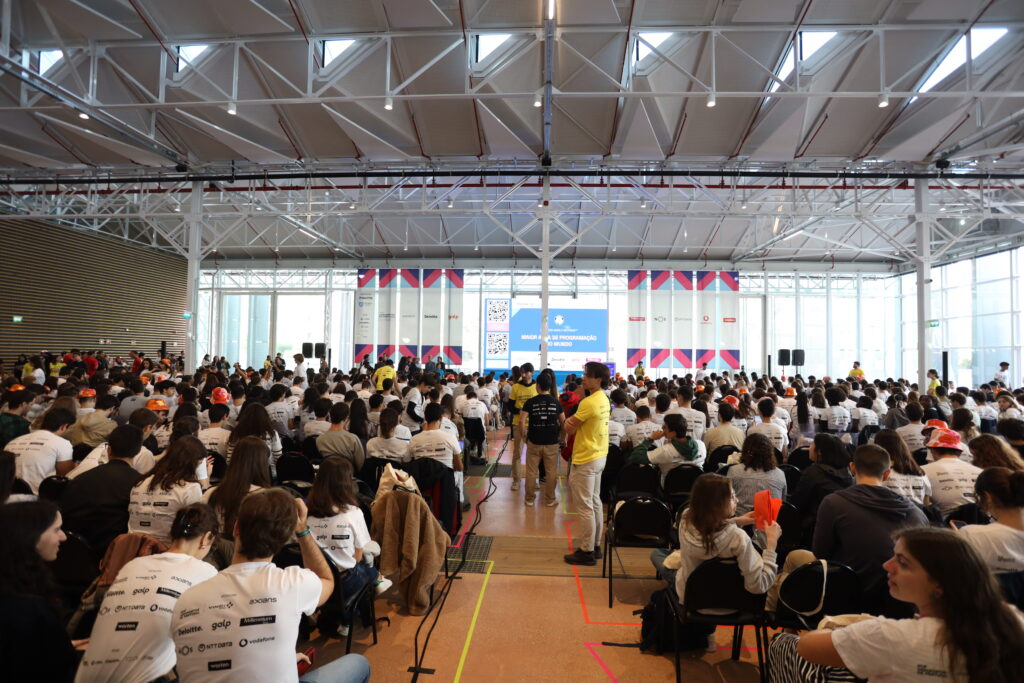
A line spiralling around the building of the Técnico Innovation Center (TIC), at eight in the morning of an otherwise lazy Saturday, was a good hint that we were about to experience something we had never seen before. Something worthy of the Guinness World Records.
Being a PhD student in Computer Science it was definitely not the opportunity to learn about Phython that led Pedro Orvalho, 27, and his colleagues to get up earlier last October 13 and attend the meeting. “I was curious about how the class would be managed and, of course, also about the Guinness Record”, admits the researcher at INESC-ID, in Automated Reasoning and Software Reliability. When Pedro finally entered the venue, there were no more chairs nor gift bags. Certainly, the organizers didn’t expect more than the registered participants to show up. But they did!
Three teachers were responsible for the 90-minute class: INESC-ID President, Inês Lynce, and INESC President, Arlindo Oliveira, both professors at Técnico, and Rodrigo Girão Serrão, a former student at IST.
For Inês, the challenge was to plan a lesson for such a large and diverse audience. “It couldn’t be a class like the ones I teach at Técnico”, she admits. So that is why she came up with the idea of explaining the notion of an algorithm using something we have all done at least once in our lives: making a paper plane. In the gift bags, the participants could find sheets of paper in different colours and by following the instructions provided by Inês the planes came out of their hands (but they were not allowed to test their aerodynamical properties!). Rodrigo used the example of the Sudoku game, to explain the notion of programming and Arlindo brought the Game of Life and the classical book Os Maias, by Eça de Queiroz, to demonstrate a language model previously trained on the masterpiece of Portuguese literature.
The operations did not run smoothly all the time. “The access points were insufficient, and the mobile internet couldn’t handle it, resulting in a slow connection to OpenAI’s language model, which was used in the second example”, tells Arlindo Oliveira. A similar problem affected the remote control to operate the slides. “This caused the presentation to freeze more than once, putting me in a difficult position”, he regrets, admitting that “these two factors (and the sound delay in such a large room) were due to the scale of the event, and it was hard to anticipate, as classes are typically not held in such a large space.” After all, it was a first!
Despite the setbacks, the event was a huge success. The Guinness World Record Adjudicator, Paulina Sapinska was checking during the lesson to ensure that all the attendees were following the class and not checking social networks, for example. After the count, the record was set: There were 1,668 participants at the TIC (the previous record had set 724 participants in Dallas, EUA, in 2016).
Besides this, Inês Lynce highlights the festive atmosphere, the number of girls present and the general enthusiasm regarding programming. As stated by the President of Técnico, Rogério Colaço, a true “celebration of young talent.”
Have you ever thought about the environmental impact of asking ChatGPT a question, casually scrolling through social media, or binge-watching a series on Netflix?
These everyday activities of our technological society are made possible by the vast amounts of data being exchanged in an increasingly instant-paced, AI-driven world. Tens of thousands of data centres spread across the globe are at the heart of this highly complex flow of information. However, as the number of data centres increases, so does their consumption of natural resources and energy, leading to a larger carbon footprint and significant environmental impacts.
This was the focus of a recently aired episode titled “Data Centres: what’s the path to sustainability?” on RTP’s TV programme “Biosfera,” where INESC-ID researcher Rodrigo Rodrigues, from the scientific area Distributed Parallel and Secure Systems, helped explain why and how data centres are becoming major consumers of energy and natural resources worldwide. According to Rodrigo, “In some countries, that consumption is overwhelming. For instance, in Ireland, the electricity consumed just to power data centres already represents 20% of the total electricity consumed.”
In the episode, he also discussed innovative solutions being developed by companies to minimise this impact, giving him “reasons to be optimistic and vigilant.” While “AI can revolutionise digital transition and the generation of knowledge for preserving our planet”, it will “not be easy to track the environmental impacts associated with the manufacture and use of these data systems”.
Featured in the cover theme of this October’s edition of National Geographic, Ana Teresa Freitas, a senior INESC-ID researcher and coordinator of INESC-ID’s Life and Health Technology Thematic Line, shared valuable insights and predictions about the revolution of medicine currently underway.
Unlike TV shows like House or Grey’s Anatomy, where doctors are the sole protagonists, Ana Teresa, an international expert on AI applied to medical research, highlighted that the future of medicine and the profile of medical doctors will likely see significant changes. Algorithms will play a larger role in triage and diagnosis, and hospitals will be transformed by technology. In the future, wearables will replace basic exams, providing continuous data to computing hubs, computing specialists, teleconsultations, and robotic arms in operating rooms will be the norm, and medicine will include a much broader range of skills beyond traditional expertise.
Read the online editorial (in PT) here or the full article in the printed version.
Jorge Fernandes, INESC-ID researcher in the area of Nano-Electronic Circuits and Systems, and CMU Portugal Faculty member at Instituto Superior Técnico, has recently participated in an episode of the Antena 1 podcast, “90 Segundos de Ciência” (“90 Seconds of Science”).
The focus, during the one minute and half allowed, was the CMU Portugal’s Exploratory Research project “mm-Size Stimulator Implants”, which aims to create integrated circuits with low energy consumption for electrical stimulation therapies and to develop a revolutionary new generation of microelectronic implants.
These implants are intended to be completely battery-free, eliminating the need for a titanium capsule, and so small that can comfortably be applied under the patient’s skin.
With a new range of autonomous and biocompatible implants such as these, Jorge Fernandes believes that it “can revolutionise medical practice and change the use of therapies that are typically administered through medication, replacing them with others that interact with the nervous system through electrical stimulation”.
Stanford has released the World’s Top 2% Most Influential Scientists lists, which feature 18 INESC-ID researchers, among the 200 thousand most cited scientists in the world.
The recognition consists of two lists naming top scientists, doctors, engineers, and mathematicians. One list refers to the 2023 most influential scientists, while the other focuses on career-long impact. The lists are compiled by Stanford University (USA) and published by Elsevier. Eligible individuals are classified in 22 scientific fields and 174 subfields, based on data from Scopus.
INESC ID’s most influential scientists in 2023 (11):
“Curiosity, discovery and critical thinking are what’s behind science, and what sets us apart”.
That is the take of Inês Lynce, President and researcher at INESC-ID, who recently participated in an episode of “Diálogos Convergentes” (“Convergent Dialogues”), a podcast by Gerador. In this episode, Inês Lynce discussed with journalist, Tiago Sigorelho, what makes human thought different from a machine.
Throughout the conversation, the researcher shared key insights on the evolution of AI, its regulation, and the role of expectations in the increasing popularity of this tool. What was highlighted the most, however, was the importance of critical thinking, which, according to Inês Lynce is what mainly differentiates people and AI.
The topic goes on to note that nothing should ever be done without careful consideration beforehand: “never use a text without reviewing it, never use an image without appreciating it critically, never spread alarming news without checking the sources”.
Finally, as an avid advocate for gender equality, the president of INESC-ID voiced her concerns regarding the fact that some academic fields still present a considerable gender imbalance, which not only represents a loss for women who would be interested in pursuing those areas, but also a loss for the field itself, that would benefit from their contributions.
The podcast “Diálogos Divergentes” is an initiative by Gerador and Ciência Viva, where science and journalism come together through a talk between invited scientists and journalists, to ponder and discuss the frontiers of human knowledge and to better understand the world we live in.
The biggest event in our community is approaching: the 2nd INESC Lisboa Annual Meeting, which will take place on October 25. We have asked three questions to INESC Lisboa director, Leonel Sousa, about the event and the INESC Lisboa community.
– Why are these INESC Lisboa annual meetings relevant?
Until 2022, each of the INESCs in Lisbon held its annual Meeting. Starting in 2023, these meetings were merged into a single event, with over 250 participants and external guests. The 2023 event featured interventions from a Minister (Ministro da Economia e do Mar) , as well as the President of the Comissão de Coordenação e Desenvolvimento Regional de Lisboa e Vale do Tejo. During the Meeting, topics ranging from research to technology transfer were discussed, covering the fields of Electrical Engineering, Computer Science and Engineering, as well as the technological areas of microelectronics and nanotechnology. The Meeting, in its current format, is unique, providing an opportunity to learn about the activities of the INESCs in Lisbon, share experiences, and establish collaborations.
– Comparing to last year, what do you expect of this year’s meeting?
The second edition of the INESC Lisbon Meeting will be even more challenging than the 2023 edition. The joint sessions will fully occupy the morning of the Meeting, rather than just part of the morning. In addition to the institutional components, morning sessions will feature the in-person participation of Dr. Dejan Milojicic, Chair of the IEEE Future Directions Industry Advisory Board, a group within IEEE with strong industrial involvement. This board is responsible for identifying key technologies and technological megatrends and suggesting the best ways to advance these technologies. It will serve as a reflection on the evolution of R&DI activities at INESC Lisbon in the coming years.
– How has the INESC Lisboa community evolved throughout the years?
The INESC in Lisbon involves three research institutes, two of which have research units classified as Excellent by the FCT, two recognised by the government as Associated Laboratories (LA), and two Technology and Innovation Centers (CTI). The organisation of INESC-ID, INOV, and INESC MN has evolved individually since 1999/2000 with great success, and in the past four years, thanks to the synergies between these institutes within the INESC Lisbon platform, they have achieved a consolidated budget of €15 million, with more than 350 researchers and technicians from over 20 different countries, 134 projects and contracts, 43 of which are coordinated by these institutions. Only an invaluable and diverse community, like that of INESC in Lisbon, is capable of achieving such success!
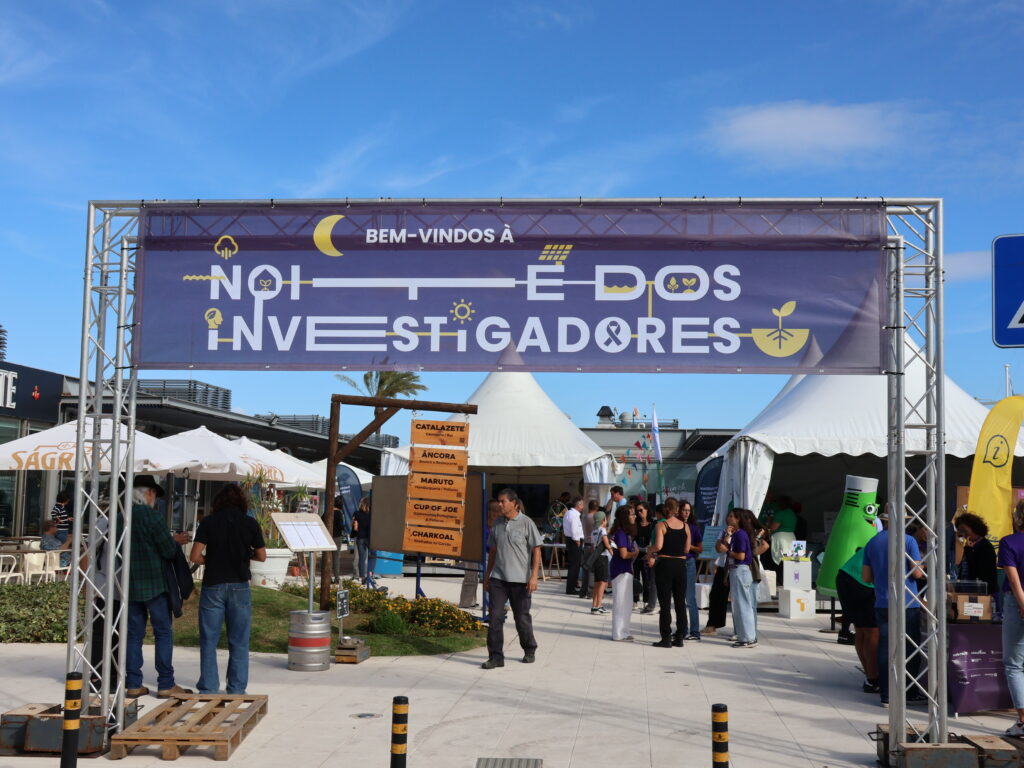
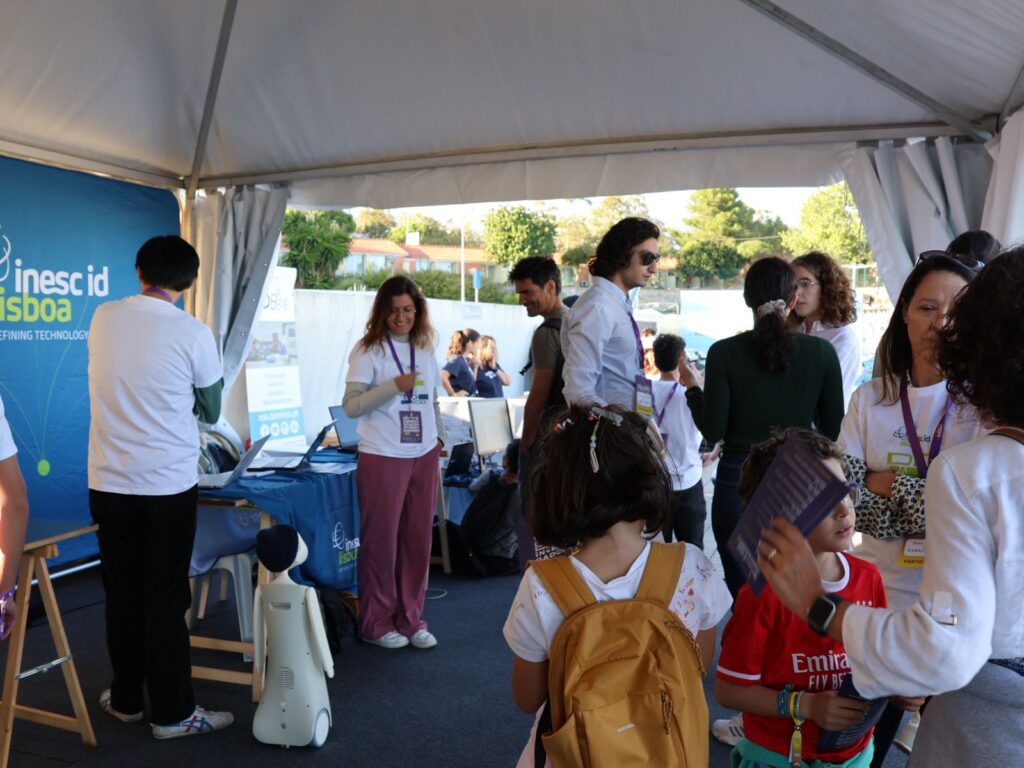
To celebrate science across Europe is the goal of the European Commission’s initiative, European Researchers’ Night (NEI). And that’s exactly how it felt last Friday, the 27th, at Marina de Oeiras – a celebration!
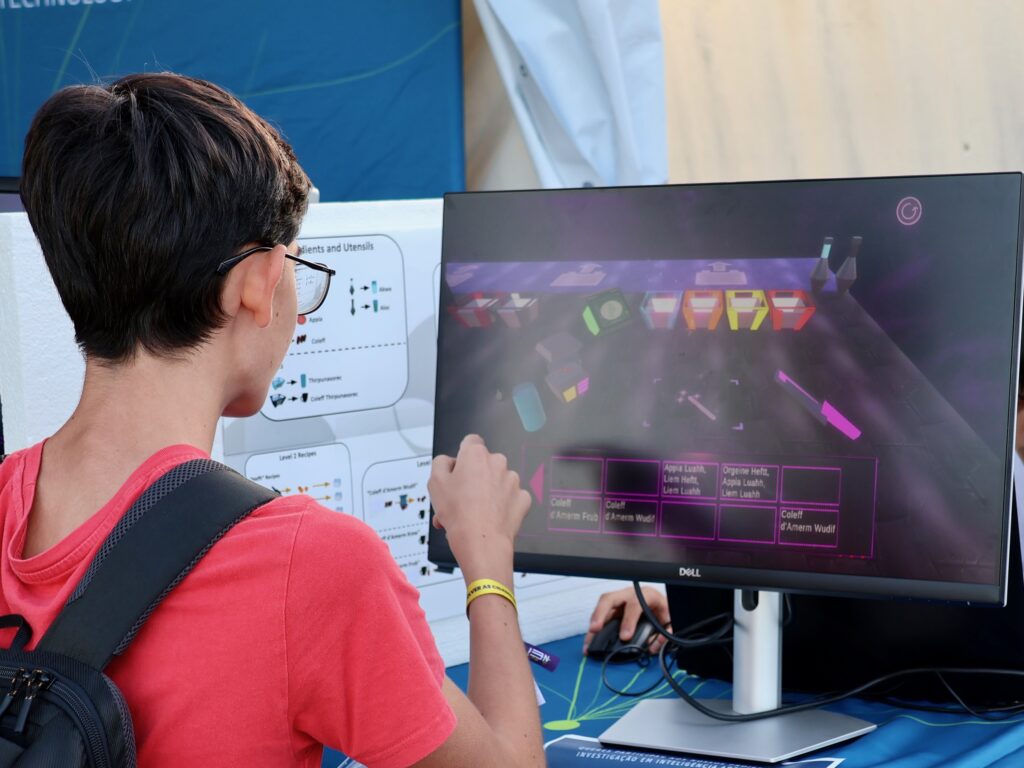
At 12 years old, Renata is very sure of what she wants to be when she grows up. The eighth-grader likes Biology the most and wants to be a scientist or an astronaut. Accustomed to attending science outreach events, Renata visited INESC-ID’s booth at NEI, where she tested the Alien Bar game developed at Group of Artificial Intelligence for People and Society (GAIPS Lab), to explore cooperation between people. Throughout the afternoon, the researchers Samuel Gomes and Luís Costa, both regulars at such events, explained to visitors the concept behind these so-called serious games.
Spread across three tables, INESC-ID’s participation at NEI, which has been celebrated throughout Europe since 2005, included a demonstration of platforms to study the psychology behind cooperation and teamwork, games to help cope with psoriatic arthritis and a demo of a social robot, interacting with the attendees. We also had the project Engenharia para Todos, aimed at promoting skills in the fields of Science and Technology.
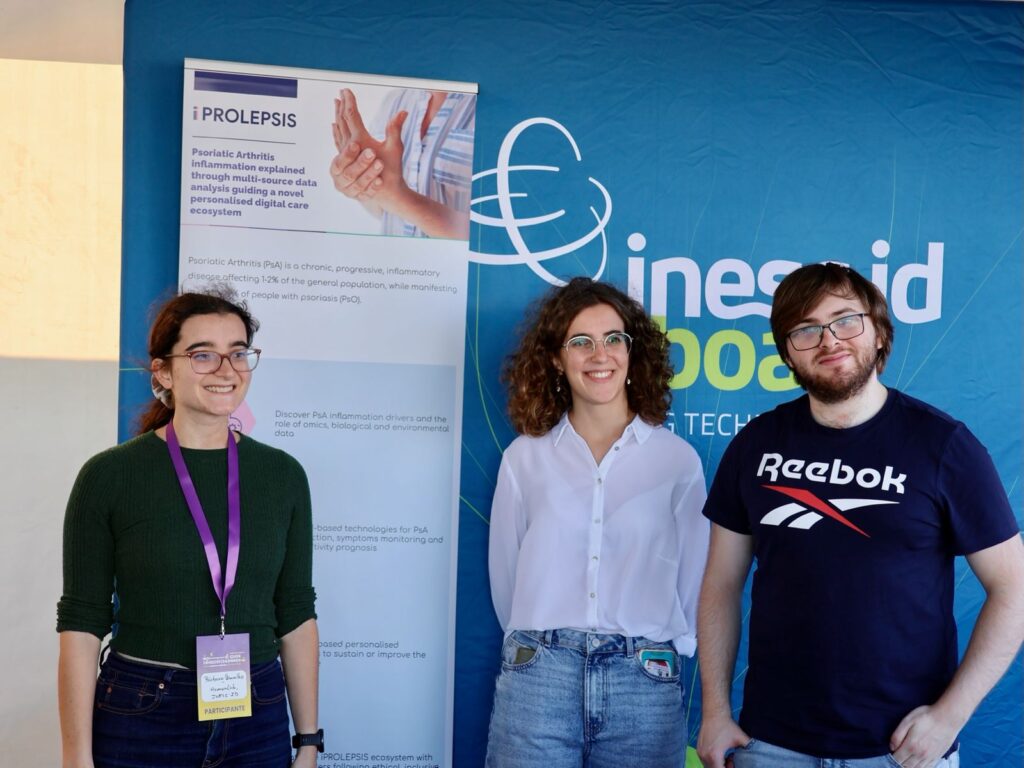
Although it was her first time participating in such events, PhD student and researcher Bárbara Ramalho from HUMAN Lab in Graphics and Interaction appeared completely at ease. Together with the master’s students Marta Vicente and Hugo Escobar, they showcased the game iPROLEPSIS, inviting volunteers to play while explaining how its tasks are designed to train wrist rotation or breathing—movements that are often affected in people with psoriatic arthritis.
Also in the games section, we had Inês Lobo, from GAIPS, displaying the collaborative game Geometry Friends, highlighting a study that explores human interaction with agents, exhibiting different levels of initiative – leader, follower, shift initiative.
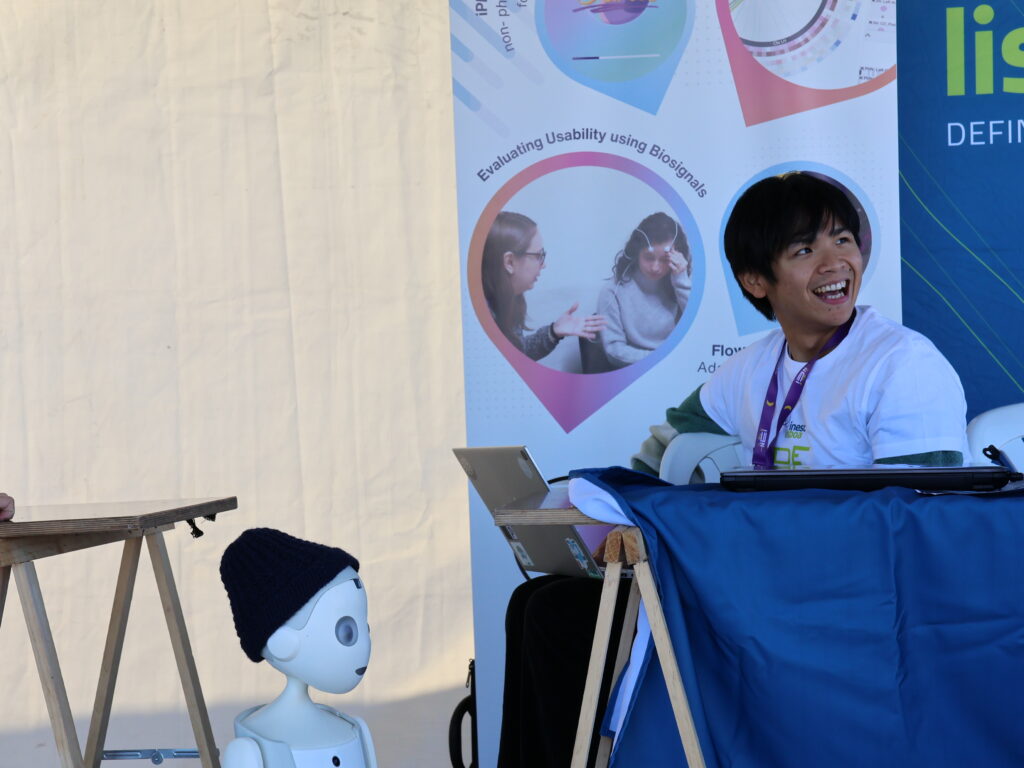
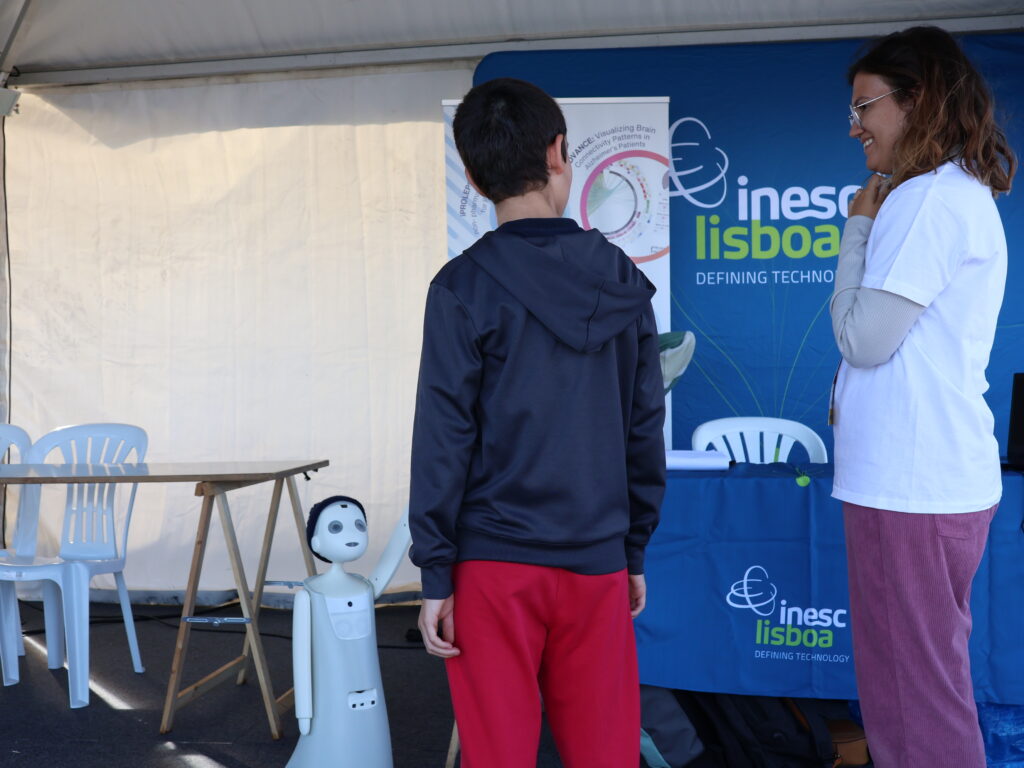
Undoubtedly, the star of the show was Navel, our social robot, easily recognisable with its blue beanie and blinking eyes. Developed at GAIPS, Navel simulates a curious little boy and is designed to engage in social interactions in hospitals, elderly care institutions, or any setting where human contact is needed. Research assistant Haohua Dong proudly and enthusiastically took care of Navel throughout the event.
INESC-ID’s participation in NEI Marina, an event promoted by António Xavier Institute of Chemical and Biological Technology of the NOVA University of Lisbon (ITQB NOVA), in partnership with the Município de Oeiras, offered a dynamic and interactive experience, showcasing the intersection of technology, human interaction, and social good. And was definitely a rewarding experience to all of the people involved.
Who hasn’t had a frustrating experience with a chatbot? If you haven’t, either you’ve never used one, or you’ve interacted in American English or any other of the preferred languages of the big tech companies.
It may not be obvious, but developing a conversational agent could be a powerful way to promote inclusion. This is precisely one of the goals of the consortium Accelerat.ai, created to advance the digital transformation of the public and private sectors in Portugal, with active participation from INESC-ID. “We intend to develop technology in Portugal to support sectors that are particularly important, such as a conversational system for SNS24 (Portuguese National Health Service’s helpline) and customer support solutions for businesses”, describes Alberto Abad from Scientific Area Human Language Technologies and the leader of INESC-ID’s participation in the consortium, which is supported under the Recovery and Resilience Plan (RRP).
As seen in other areas of technology, the need to improve the quality and reliability of conversational agents was stressed during the Covid-19 pandemic, due to the transformation of services that previously provided in-person assistance and had to close. Consequently, there was a shortage of personnel to handle requests coming through contact centres, which were often not designed for that purpose. “Such circumstances created a need for, whenever possible, automated assistance,” notes Abad, a professor at Técnico, which is also a member of the consortium.
In this world of ours, there are about 7 000 spoken languages. According to Defined.ai, an AI marketplace for tools, data and models, and the leader of Accelerat.ai consortium, “29% of business has lost clients due to a lack of multilingual support and 70% of end-users express greater loyalty to companies offering support in their native language.” And so, the mission of this ambitious project, with a budget of 35 million euros, 2.18 million of which is allocated to INESC-ID, is to develop a conversational assistant for languages outside the top 15 language roadmaps of the big 5 tech companies, starting with European Portuguese.
The solutions in development are based on Conversational Artificial Intelligence Agents and CCaaS (Contact Centre as a Service). At INESC-ID, we will investigate and explore the capacity to mutually convert from speech to text and text to speech – an area known as Automatic Speech Recognition and Speech Synthesis. “It is a technology that has existed for many years, with several components – speech-to-text, and the reverse, text-to-speech”, Abad notes. “Additionally, there is the ‘brain’ of the system, which involves dialogue management and task handling, and this has evolved significantly in recent times with the advent of large language models (LLMs) that have transformed the landscape.”
To public and private organizations
Some of this technology is already on the market, typically dominated by major tech companies such as Microsoft, Google, and Apple. These corporations have a business vision and often overlook niche languages, such as European Portuguese, spoken by ten million people. Consequently, the level of maturity and the amount of data available to develop these systems for minority languages is lower. “Therefore, the goal of the project is to provide Portuguese companies with technology specifically tailored to the Portuguese context, including its variants”, like dialects or regional forms of the language.
Together on this mission, Defined.ai states that the project represents a strategic effort to cater the needs of the public and private sectors in Portugal and related markets, enhancing communication and accessibility in digital platforms. “If a developer intends to use voice systems in the Portuguese market, they must rely on generic models with a considerable margin of error, or in English and Brazilian Portuguese, languages that are not the preferred options for Portuguese speakers”, defended Daniela Braga, from Defined.ai, in a press release.
Over the past ten years, errors on this kind of systems have been drastically reduced. “The systems are improving so much that we may be approaching a situation where, in certain tasks, it will be difficult to distinguish a human from a machine. The components are the same, but they work much better”, explains Alberto Abad. And so synthetic speech may end up being indistinguishable from recordings in terms of naturalness and fluidity. “Today, it is possible to have dialogue systems that solve many problems”, he adds. But still there is margin for improvement, by pushing the boundaries of the state of the art.
Picking up on emotional cues
One of the research goals is to extract emotional cues from speech to create more empathetic, human-like responses, moving further away from a robotic response. Another purpose is to improve speech recognition in non-ideal conditions, such as low-resource languages (with relatively less data available for training), or atypical speech. “Systems are tested for normative speech – such as children, where the lexicon is different, pitch is different and there are more fluctuations”, says the researcher. Elderly and people with any type of disability that affects speech are also in the scope of Accelerat.ai. The system may be trained to speak slower when interacting with elderly, use youthful speech with youngsters or adapting the accent, to create more closeness to the user.
“Speech can be considered private information. If used maliciously, it is easy to create synthesis systems with our voice”, he alerts. “There can be a set of automatically extracted information that we might want to protect” – Alberto Abad.
It is becoming increasingly evident that voice data can contain valuable information that may be used to detect health conditions, such as Parkinson’s disease. “Depending on the type of client and the circumstances, this information can be useful for characterizing the patient, as in a hospital setting”, exemplifies Abad.
However, the more valuable the data, the greater the concern about privacy. “Speech can be considered private information. If used maliciously, it is easy to create synthesis systems with our voice”, he alerts. “There can be a set of automatically extracted information that we might want to protect.” To guarantee this, INESC-ID’s team is also working in ways to extract information while ensuring user privacy. And for this there are several approaches. “One idea is to use encryption. Another is to allow users to control which information they want to be leaked—such as being okay with their gender being known but not wanting anything else to be disclosed, or only allowing their speech to be used to understand what they are saying.”
Presence at Interspeech
Privacy is also a significant part of the project, with PhD students working in this area. “Currently, when we use such a system, the speech is stored, and we don’t know what might be done with it. We are working on improving speech recognition, on extracting features and health biomarkers, and in the future, on making interactions more private, addressing security and ethical concerns.”
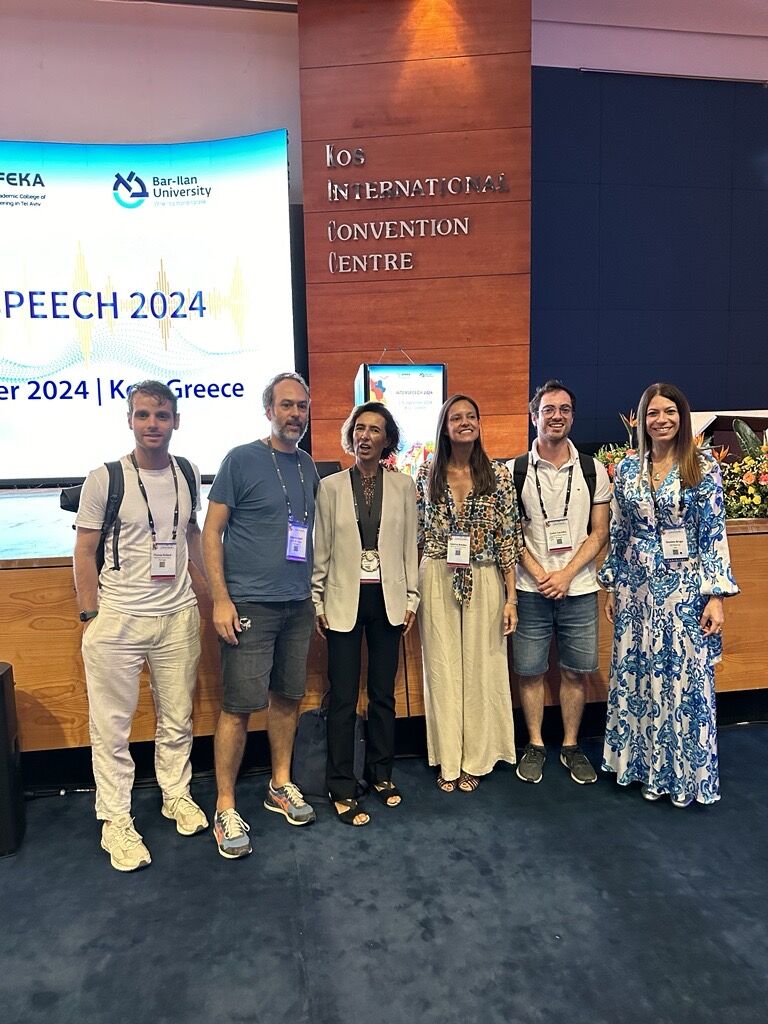
Six senior researchers, five post-doc, three PhD students, a master student are part of the project, a team that had a notable presence in the last Interspeech conference (the largest one on speech and language technologies in the world), with the participation of several members, the presentation of three scientific works related to the improvement of automatic speech recognition in low-resource settings and the use of LLMs as speech annotators to characterize speakers, the participation of a junior PhD as an expert pannellist in the special session “Connecting Speech-science and Speech-technology for Children’s Speech”. and above all, with the recognition of Professor Isabel Trancoso who received the ISCA Medal for Scientific Achievement, an annual distinction that honors each year an individual who has made extraordinary contributions to the field of speech communication science and technology.
Projects like Accelerat.ai bring progress to conversational AI, prioritizing inclusiveness and accessibility. With applications ranging from healthcare to customer support, innovations in speech recognition and synthesis will increasingly become part of our everyday lives, bringing human-centered solutions at the base of AI development in Portugal and beyond.
Helena Moniz was born and raised in the Azores islands, and this is not a mere detail when telling the story of how the Bridge AI project, led by INESC-ID, came to life. In response to a call on Science4Policy, opened by Science and Technology Foundation (FCT), it aims to bring together ethics, law, and literacy regarding the European legislation on Artificial Intelligence, known as the AI Act.
“By choosing this thematic area, we are primed to advance Portugal’s readiness for impending AI regulations and fortify our nation’s position as a frontrunner in responsible and innovative AI implementation”, stresses the INESC-ID researcher, from the Human Language Technologies scientific area and a professor at Universidade de Lisboa. “We want to make a difference. How will a Portuguese citizen relate to the law, and how are we going to implement it?”, Helena adds. “How will my aunt in the Azores understand it?”
The project, now running at full speed, has a brand-new website and the agenda for its public presentation event on October 19 is set. Confirmed speakers include Pedro Conceição, Director of the Human Development Report Office at the United Nations.
Bridge AI was born out of the mission-driven spirit of young researchers like Joana Lamego (Champalimaud Foundation), Nuno André, and António Novais (both from Unbabel). It aims to foster a strong connection between academia, business, and the public sector. The project promotes AI literacy in society and serves as a valuable tool for Portuguese decision-makers, helping them make informed, evidence-based decisions.
To achieve its goals, five working groups have been established, each focusing on different aspects of AI regulation, approved last May at the European Counsel. These groups will provide recommendations and conclusions at the major event on October 19, which will be held at Champalimaud Foundation, one of the project’s partners.
Bridge AI also includes case studies, in partnership with companies like Unbabel, Priberan and Sword Health, that work in the fields of AI and Health technology. The Centre for Responsible AI is another key member, along with two law firms, Carnegie Mellon Portugal and the British and the American embassies.
“It’s important to strike a balance between legislation and innovation. The law should not be a barrier”, notes Helena Moniz.
With a funding of 40.000 euros, FCT emphasizes in its evaluation document that “the study is perfectly aligned with the thematic line and adjusted to the national context.”