Blog

  • Call for 3 PhD research scholarships

    Call for 3 PhD research scholarships


    Call for PhD Research Studentships

    INESC ID launched a call for 3 (three) PhD Research Grants under the FCT Research Grant Regulations (RBI) and the Research Grant Holder Statute (EBI).

    For more information visit the complete announcement:

    Portuguese version   |     English version


    [MEC id=”1745″]
  • INESC-ID researchers among the World’s Top 2% Scientists list

    INESC-ID researchers among the World’s Top 2% Scientists list

    The Stanford University recently released an update of the World’s Top 2% Scientists list, which includes more than 100,000 researchers. 124 Técnico researchers were included in the ranking of the world most influential researchers in their fields, which represents a substantial increase compared to 2020.

    The ranking covers 22 major fields and 176 subfields. The updated list published on 19th October used Scopus database until August 2021.

    Gil Marques, Arlindo Oliveira, Leonel Sousa, José Fernando Silva, Francisco C. Santos, Ana Paiva, Joaquim Jorge,  João Paulo Carvalho, Luís M. Correia are some of INESC-ID researchers in this world’s top 2% scientists list. The presence of INESC-ID researchers in the list of the most influential researchers in the world reflects the high quality of scientific production and the excellence of our researchers in multiple areas.

    Among INESC-ID researchers, an extense list of Técnico researchers can be seen here: https://tecnico.ulisboa.pt/files/2021/11/lista-de-nomes_top-cientistas_2021.pdf

    Source: Técnico

  • Distinguished Lecture – Keshab K. Parhi

    Distinguished Lecture – Keshab K. Parhi

    Técnico – Alameda campus

    “Accelerator Architectures for Deep Neural Networks: Inference and Training”. – 2 pm – EA3

    We are pleased to announce a new IST Distinguished Lecture, on 19th November, with the support of the “Distinguished Lecturer Program (DLP)” at the Institute of Electrical and Electronics Engineers (IEEE), namely the IEEE CAS Society DLP.

    • 19th November 2021, 2 p.m., in EA3 amphitheatre (North Tower).
    • Speaker: Keshab K. Parhi (University of Minnesota, Minneapolis, USA)*
    • Title: “Accelerator Architectures for Deep Neural Networks: Inference and Training”.
    • Abstract: Machine learning and data analytics continue to expand the fourth industrial revolution and affect many aspects of our lives. The talk will explore hardware accelerator architectures for deep neural networks (DNNs). I will present a brief review of history of neural networks. I will talk about our recent work on Perm-DNN based on permuted-diagonal interconnections in deep convolutional neural networks and how structured sparsity can reduce energy consumption associated with memory access in these systems (MICRO-2018). I will then talk about reducing latency and memory access in accelerator architectures for training DNNs by gradient interleaving using systolic arrays (ISCAS-2020). Then I will present our recent work on LayerPipe, an approach for training deep neural networks that leads to simultaneous intra-layer and inter-layer pipelining (ICCAD-2021). This approach can increase processor utilization efficiency and increase speed of training without increasing communication costs.
    • *Bio: Keshab K. Parhi received the B.Tech. degree from the Indian Institute of Technology (IIT), Kharagpur, in 1982, the M.S.E.E. degree from the University of Pennsylvania, Philadelphia, in 1984, and the Ph.D. degree from the University of California, Berkeley, in 1988. He has been with the University of Minnesota, Minneapolis, since 1988, where he is currently Distinguished McKnight University Professor and Edgar F. Johnson Professor of Electronic Communication in the Department of Electrical and Computer Engineering. He has published over 650 papers, is the inventor of 32 patents, and has authored the textbook VLSI Digital Signal Processing Systems (Wiley, 1999) and coedited the reference book Digital Signal Processing for Multimedia Systems (Marcel Dekker, 1999). His current research addresses VLSI architecture design of machine learning systems, hardware security, data-driven neuroscience and molecular/DNA computing. Dr. Parhi is the recipient of numerous awards including the 2017 Mac Van Valkenburg award and the 2012 Charles A. Desoer Technical Achievement award from the IEEE Circuits and Systems Society, the 2004 F. E. Terman award from the American Society of Engineering Education, and the 2003 IEEE Kiyo Tomiyasu Technical Field Award. He served as the Editor-in-Chief of the IEEE Trans. Circuits and Systems, Part-I during 2004 and 2005. He is a Fellow of IEEE, ACM, AAAS and the National Academy of Inventors.

    Moderator: Leonel Sousa (Full professor, IST/DEEC; INESC-ID/SiPS).

  • Iolanda Leite: the scientist who seeks to build socially competent robots

    Iolanda Leite: the scientist who seeks to build socially competent robots

    The INESC-ID and Técnico alumna is an Assistant Professor and Researcher at the KTH Royal Institute of Technology and she is passionate about robotics.

    Iolanda Leite has always been interested in Tamagotchis and Furby robots, and how they worked. Nowadays, she is still fascinated by them and that is reflected in a successful career abroad, at the KTH Royal Institute of Technology, where she is an Assistant Professor and Researcher.

    Iolanda Leite entered Técnico – Taguspark campus in 2002. “There was a very familiar environment among students, teachers and non-teaching staff. Those times were quite intense”, she says when looking back on those days. “I have very good memories, especially every time we were about to finish a project. I made friends for life in those times”, she recalls.

    The passion for robotics arises when she was still a Técnico student attending Artificial Intelligence or Intelligent Agents course units. “The projects were very interesting and the professors inspired me a lot”, she shares. During her MSc degree, she chose to major in Intelligent Systems, “it was probably at that point that I have seriously considered a research career in this area”, she shares.

    For further reading: https://tecnico.ulisboa.pt/en/news/campus-community/iolanda-leite-the-scientist-who-seeks-to-build-socially-competent-robots/

    *Técnico news credits

  • Leonel Sousa appointed to the ACM Distinguished Speakers Program Committee

    Leonel Sousa appointed to the ACM Distinguished Speakers Program Committee

    Leonel Sousa, researcher at INESC-ID and professor at the Instituto Superior Técnico, was appointed to the ACM Distinguished Speakers Program Committee, and  is among the 8 nominees who will be part of the committee responsible for the oversight of the program.

    “After an excellent experience, for three years, as ‘Distinguished Speaker’ at ACM, I was surprised to be invited to join the ACM Distinguished Speaker Program Committee”, says the INESC-ID researcher and Técnico professor, who also explains “this program is responsible for selecting ‘Distinguished Speakers’, distinguished colleagues from academia and companies in the area of computer systems.”

    The ACM speakers represent a wide range of businesses, colleges and universities, including: IBM, Microsoft, BBN Technologies, Raytheon, Sony Pictures Imageworks, Lawrence Livermore National Laboratory, Siemens Information Systems, Stanford University, Carnegie Mellon, University of British Columbia, Georgia Tech, UCLA, McGill University, Tsinghua University and many others.

    Founded in 1947, ACM is an important and prestigious organisation that brings together computing educators, researchers, and professionals, and promotes computer research and innovation through its journals, magazines, high quality scientific events and conferences.

    **Técnico news credits

  • First INESC-ID Alumni Talk

    First INESC-ID Alumni Talk

    The first INESC-ID Alumni Talk took place today, September 24, 2021.

    An event that joined together INESC-ID researchers, students and trainees to share experiences, knowledge and create good memories again.


    The session also served as the launch of the INESC-ID alumni group on Linkedin.


    The INESC-ID Alumni Talk had a very special panel. 3 INESC-ID alumni accepted our invitation and our challenge and shared their journey and challenges with us. André Luís Martins, Senior Software Engineer at Hitachi Vantara,  Jaime Jorge, CEO and Co-founder of Codacy and Joana Gonçalves, Assistant Professor, PatternRecognition & Bioinformatics, at TU Delft.

    The moderator for this inaugural session was Professor Arlindo Oliveira, Researcher at INESC-ID, President of the INESC Holding and a Distinguished Professor at Instituto Superior Técnico.


    INESC-ID ALUMNI GROUP

    If your life passes or has passed through INESC-ID join us on Linkedin.

    Being part of the INESC-ID Alumni Group is an opportunity to:
    • Maintain connection to INESC-ID and reconnect with former colleagues;
    • Share experiences and strengthen networking;
    • Create new work networks and develop new projects;
    • Get to know firsthand the latest research projects and results of INESC-ID;
    • Be updated on trends in the area and the latest articles published in the area;
    • Participate in exclusive events for INESC-ID Alumni;
    • Take advantage of the resources and results of INESC-ID to continue professional and personal development;
    • Celebrate the achievements of each and every one;
    • Contribute to the integration of current early stage researchers in the market;
    • Help and motivate current and future students;
    • Leverage the common past for mutual support and development.

    And we leave you with a challenge: Do you accept to be one of the speakers in one of the INESC-ID Alumni Talks and share your journey and experience? Send us an email to info@inesc-id.pt.

    Follow INESC-ID on Social Networks:


  • Luis M. Correia

    Short Personal Interview


    Luis M. Correia was born in 1958, in Portimão, Portugal. He is an INESC-ID Researcher since 2016, integrating the Scientific Area Communication Networks (CN).


    How did you get to INESC-ID?

    It was an R&D centre that fulfilled my expectations.


    INESC-ID is…

    an institution that excels in research, development and innovation activities, and that takes the lead in a number of technological areas, enabling its members to develop their work and creativity.


    Research project(s) under development

    Wireless Communications in Body Area Networks


    How would you explain in the most accessible and least technical language possible, what is the application / expected results of this (these) project (s)?

    It is the natural extension to a more personal use of the communications that are currently being done with the mobile phone and already other existing wearables.


    Tell us about your favorite project so far (or one of them)?

    4WARD (an EC project that launched the basis for many of the 5G features, in 2008).


    What are the biggest challenges of working in research in this area?

    The diversity of aspects to take into consideration is so large, that it’s a real challenge to have a detailed view of the global system.

    What book are you currently reading?

    Loonshots: How to Nurture the Crazy Ideas That Win Wars, Cure Diseases, and Transform Industries

    How would you explain to your child (or your parents or grandparents) what your job is? How do you explain what means to be a researcher in this area?

    To look for new technologies for people to communicate and make their live easier and more comfortable.


    How do you see the mission of INESC-ID “ to produce added value to people and society, supporting the response of public policies to scientific, health, environmental, cultural, social, economic and political challenges, in the fields of Computer Science and Electrical and Computer Engineering”?

    It’s an excellent one for an R&D centre working in the technology area.


    Email

    luis.m.correia@tecnico.ulisboa.pt


    Linkedin Profile Link

    https://pt.linkedin.com/in/luis-m-correia-5205201


    Academic Degree

    Ph.D.


    Training / Research Area

    Wireless Communications


    INESC-ID Scientific Area

    Communication Networks (CN)


  • Tomás Alves

    Short Personal Interview


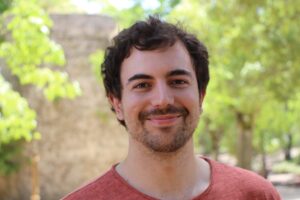
    Tomás Alves was born in 1994, in Lisbon Portugal. He is an  INESC-ID Researcher and PhD Student since 2017, integrating the Scientific Area Graphics and Interaction (GI).
     

    How did you get to INESC-ID?

    I applied and was selected to be part of the GameCourse project (PTDC/CCI-CIF/30754/2017).


    INESC-ID is…

    one of the strongest research institutions in Portugal.


    Research project(s) under development

    My PhD topic focuses on developing personality-aware information visualization systems to improve user interaction and decision making.

    How would you explain in the most accessible and least technical language possible, what is the application / expected results of this (these) project (s)?

    The technology will help you make the best decisions based on your personality.


    Tell us about your favorite project so far (or one of them)?

    The PhD. I have had a lot of opportunities to collaborate with fellow colleagues in interesting topics both in and outside my research area.


    What are the biggest challenges of working in research in this area?

    Our research studies are utterly dependent of participants to provide data for our analysis. This COVID phase just exacerbated this need and put a lot of studies on hold.

    What book are you currently reading?

    Authority, by Jeff VanderMeer

    How would you explain to your child (or your parents or grandparents) what your job is? How do you explain what means to be a researcher in this area?

    I am working towards building technology more helpful and reliable by making it adapt itself to your own personality. Being a researcher in Human-Computer Interaction means that the user and their individual characteristics must always come first while developing technology.


    How do you see the mission of INESC-ID “to produce added value to people and society, supporting the response of public policies to scientific, health, environmental, cultural, social, economic and political challenges, in the fields of Computer Science and Electrical and Computer Engineering”?

    A cornerstone in the digital structure of Portugal.

    Email

    tomas.alves@tecnico.ulisboa.pt


    Linkedin Profile Link

    https://www.linkedin.com/in/tomas-martins-alves/


    Academic Degree *

    Bologna Master Degree in Information Systems and Computer Engineering – Alameda


    Training / Research Area(s) *

    Human-Computer Interaction, Personality Psychology, Decision Making


    INESC-ID Scientific Area

    Graphics and Interaction (GI)

  • Helena Moniz, INESC-ID Researcher was nominated President of the EAMT and Vice-President of the IAMT

    Helena Moniz, INESC-ID Researcher was nominated President of the EAMT and Vice-President of the IAMT

    Helena Moniz, INESC-ID Researcher was nominated President of the European Association for Machine Translation (EAMT) and Vice-President of the International Association for Machine Translation (IAMT).

    “I am humbly grateful for such an amazing committee consider me as one of them. It is a true honour and a responsibility. I surely hope I may assist the EAMT diverse community of translators, end users of Machine Translation, NLP scientists, and industry partners. The present offers great challenges and opportunities to our community. My motto has been the balance between AI technologies and the human factor and I believe this is very much needed in such exciting times for (M)T!”, mentioned Helena Moniz.

    Helena Moniz is an Assistant Professor at the School of Arts and Humanities at the University of Lisbon, where she teaches Computational Linguistics, Computer Assisted Translation, and Machine Translation Systems and Post-editing.

    She received a PhD in Linguistics at FLUL in cooperation with the Technical University of Lisbon (IST), in 2013. She has been working at INESC-ID/CLUL since 2000, in several national and international projects involving multidisciplinary teams of linguists, speech, and NLP scientists. Within this fruitful collaborations, she participated in 16 national and international projects.

    Since 2015-, She is also the PI of a Protocol between INESC-ID and Unbabel, a translation company combining AI + post-editing, working in AI Research Projects.

    She is currently the vice-coordinator of the Human Language Technologies Lab at INESC-ID and responsible for the WG3 of the COST Action Multi3Generation (CA18231).

  • 2021 European Researchers’ Night

    2021 European Researchers’ Night

    How can Science contribute to the knowledge about the causes and effects of climate change and to climate neutrality by 2050?

    The European Researchers’ Night is an initiative funded by the European Commission, through Marie Curie Actions, aiming to celebrate Science and reduce the gap between researchers and citizens. The European Researchers’ Night translates into a series of activities happening throughout the year culminating in a night of celebration of Science, taking place in several European cities.


    The European Researchers’ Night 2021 (ERN2021) will take place on 24th September across Europe. The consortium’s activities, such as lectures, workshops, among others, under the theme “Climate Science“, will take place from 4 p.m. to 11 p.m., in a hybrid format, i.e., with reduced face-to-face activities and a parallel programme fully online.

    INESC-ID will participate in the following activities:

    • “Understanding the risks is key to preparedness.” | Game, Apps and Challenges

    In this game we will help you understand warnings and how to be prepared and respond in case of earthquake and tsunami.

    Knowing the risks is essential to being prepared. In this game you will learn to know the alerts and what to do to be prepared and respond in case of earthquake and tsunami. It is intended to make the population aware of natural risks, namely seismic and tsunami risks, in order to increase the resilience of communities. Educating and informing about risk prevention and mitigation is essential for promoting a risk culture.

    Organised by: Instituto Superior Técnico /CERIS and INESC-ID

    Researcher: Mónica Amaral Ferreira

    Thematic area: Architecture, Art and Design, Natural and Environmental Sciences, Technology

    • “Do you know how satellites help to know how the weather’s like?”  | Quizzes

    The activity presents some of the methods used to assess the Earth’s climate based on satellite technology, and challenges the visitor to answer a quiz to test their knowledge.

    Organised by: INESC-ID

    Researcher: Rui Policarpo Duarte

    Thematic area: Technology.

     NEI2021 online programme  

    More information.