Blog

  • New H2020 project

    New H2020 project

    Algos and SD research groups will partner with Barcelona Supercomputing Center and several other institutions in this new European project, with 3.9 M funding, to develop and deploy a production-ready parallel programming environment. This will turn future exascale supercomputers, which will be overwhelmingly heterogeneous, into manageable platforms for application developers in different domains.

    The consortium of the EPEEC project (European joint Effort toward a Highly Productive Programming Environment for Heterogeneous Exascale Computing) that started on 1 October 2018,  will significantly advance and integrate existing state-of-the-art components based on European technology (programming models, runtime systems, and tools) with key features enabling 3 overarching objectives: high coding productivity, high performance, and energy awareness.

    Five applications representing different scientific domains will be used as part of a strong interdisciplinary co-design approach and as technology demonstrators: AVBP (fluid dynamics and combustion), DIOGENeS (nanophotonics / nanoplasmonics), OSIRIS (plasma physics), Quantum ESPRESSO (materials sciences) and SMURFF (life sciences). EPEEC will exploit results from past Future and Emerging Technologies (FET) projects that have led to the cutting-edge software components it builds upon, and aims to influence the most important parallel programming standardisation bodies.

    The project will ensure the composability and interoperability of its programming models and runtimes, which will incorporate specific features to handle data-intensive and extreme-data applications. Enhanced leading-edge performance tools will offer integral profiling, performance prediction, and visualisation of traces.

    An automatic generator of compiler directives will provide outstanding coding productivity from the very beginning of the application developing/porting process. Developers will be able to leverage either shared memory or distributed-shared memory programming flavours, and code in their preferred language (C, Fortran, or C++) and accelerator programming model (OpenMP, OpenACC, CUDA, or OpenCL).
  • First VMCAI Winter School – CALL FOR PARTICIPATION

    First VMCAI Winter School – CALL FOR PARTICIPATION

    VMCAI Winter School is a winter school on formal methods associated with VMCAI 2019 (VMCAI 2019 – 20th International Conference on Verification, Model Checking, and Abstract Interpretation) that took place in Lisbon, Portugal on January 9-12, 2019. In the vein of VMCAI, the school is meant to facilitate interaction, cross-fertilization, and advancement of hybrid methods that combine Verification, Model Checking, Abstract Interpretation, etc.

    The VMCAI Winter School program featured two tutorial lectures per day, presented by distinguished speakers and experts in these fields.

    List of tutorial lectures:

    * An Introduction to Learning from Programs, by Marc Brockschmidt (Microsoft Research, Cambridge, UK)

    * Models and Techniques for Analyzing Security Protocols, by Veronique Cortier (Loria, Nancy, France)

    * Neural Network Verification, by M. Pawan Kumar (University of Oxford, UK)

    * Computing with SAT Oracles: From CDCL SAT Solving to Ubiquitous Industry Adoption, by João Marques-Silva (University of Lisbon, Portugal)

    * Abstract Interpretation, by Patrick Cousot  (New York University, USA). This tutorial will be complemented by an invited talk by Sylvie Putot (Ecole Polytechnique, France) on “Zonotopic abstract domains for numerical program analysis”.

    * Developing distributed protocols formally with Ivy, by Ken McMillan (Microsoft Research, Redmond, USA)

    A more detailed program is available at the school website http://vmcaischool19.tecnico.ulisboa.pt/

    Organizers: Constantin Enea (IRIF, University Paris Diderot); Vasco Manquinho (INESC-ID, IST – Universidade de Lisboa); Ruzica Piskac   (Yale University)


  • INSIDE Project featured in DN Insider Magazine

    INSIDE Project featured in DN Insider Magazine

    The latest edition of DN Insider, a Diário de Notícias newspaper supplement, highlighted the world of robots “made in Portugal” and how they will change our lives.

    Special highlight to INESC-ID project, INSIDE, developed under the CMU Portugal Program and robot “ASTRO”, that explores the benefits that the interaction with a heterogeneous network of intelligent devices can bring to the therapy of children with Autism Spectrum Disorder (ASD).

    Full article and interview of the PI of the INSIDE Project and researcher at INESC-ID, Francisco Melo, available here:
    https://www.cmuportugal.org/wp-content/uploads/2018/11/Notícia-Robôs_DN-Insider_25.11_site.pdf

  • INSIDE Project featured in DN Insider Magazine

    INSIDE Project featured in DN Insider Magazine

    The latest edition of DN Insider, a Diário de Notícias newspaper supplement , highlighted the world of robots “made in Portugal” and how they will change our lives.

    Special highlight to INESC-ID project, INSIDE, developed under the CMU Portugal Program and robot “ASTRO”, that explores the benefits that the interaction with a heterogeneous network of intelligent devices can bring to the therapy of children with Autism Spectrum Disorder (ASD).

    Full article and interview of the PI of the INSIDE Project and researcher at INESC-ID, Francisco Melo, available here:
    https://www.cmuportugal.org/wp-content/uploads/2018/11/Notícia-Robôs_DN-Insider_25.11_site.pdf

  • OPEN DAYS 2018 – SCIENCE AND TECHNOLOGY WEEK

    OPEN DAYS 2018 – SCIENCE AND TECHNOLOGY WEEK

    What science is done in Portugal? Who are our scientists? How do they work? What do they research? What results do they get?

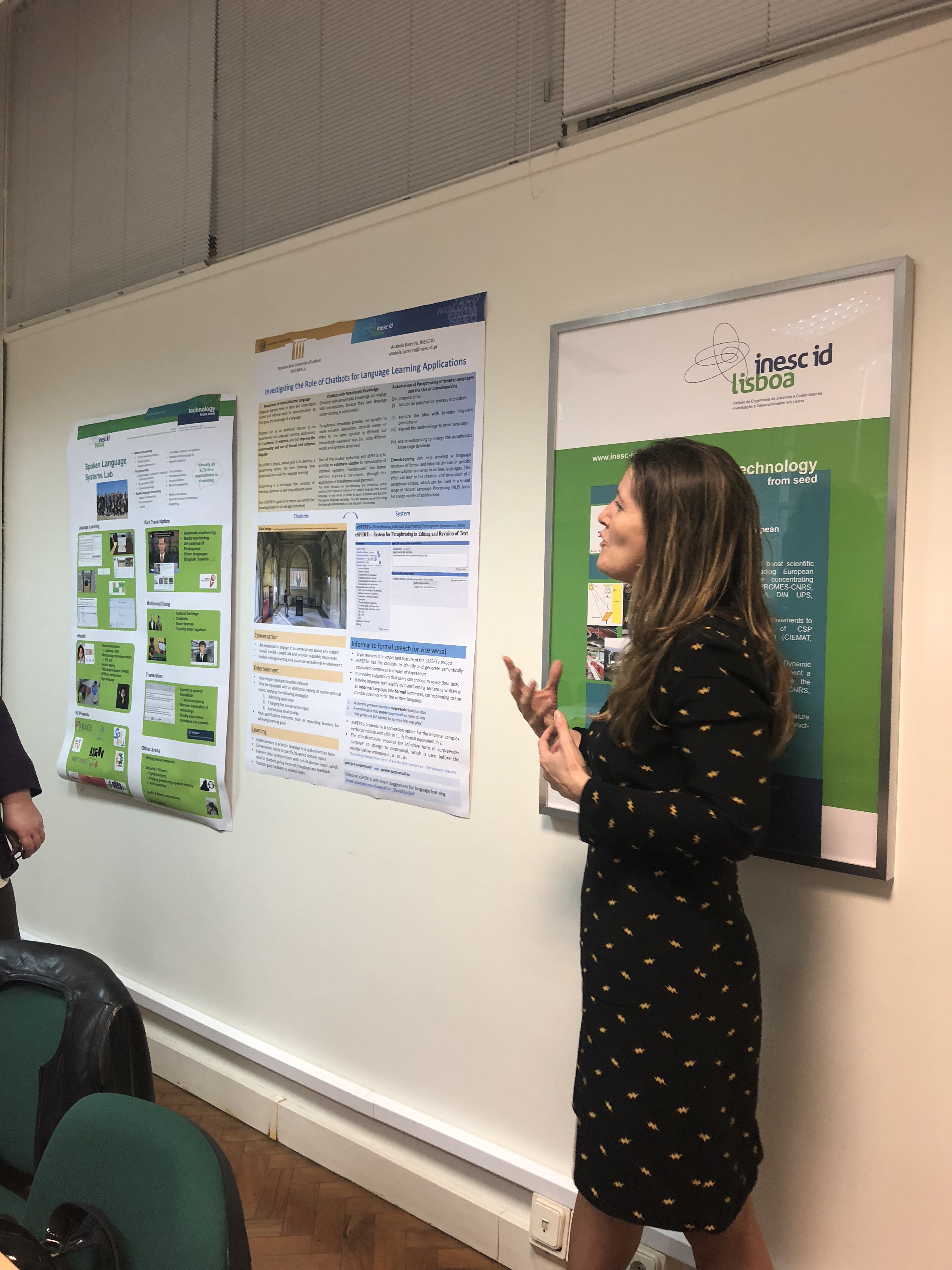
    In the scope of the SCIENCE AND TECHNOLOGY WEEK, INESC-ID ALAMEDA opened its doors on November 23rd to  provide the opportunity for scientific observation and personal contact with specialists from different fields of knowledge.

    The goal of being part of this FCT initiative is to contribute as much as we can for the dissemination of science, crossing path with the community, and fulfill the objectives of the project.

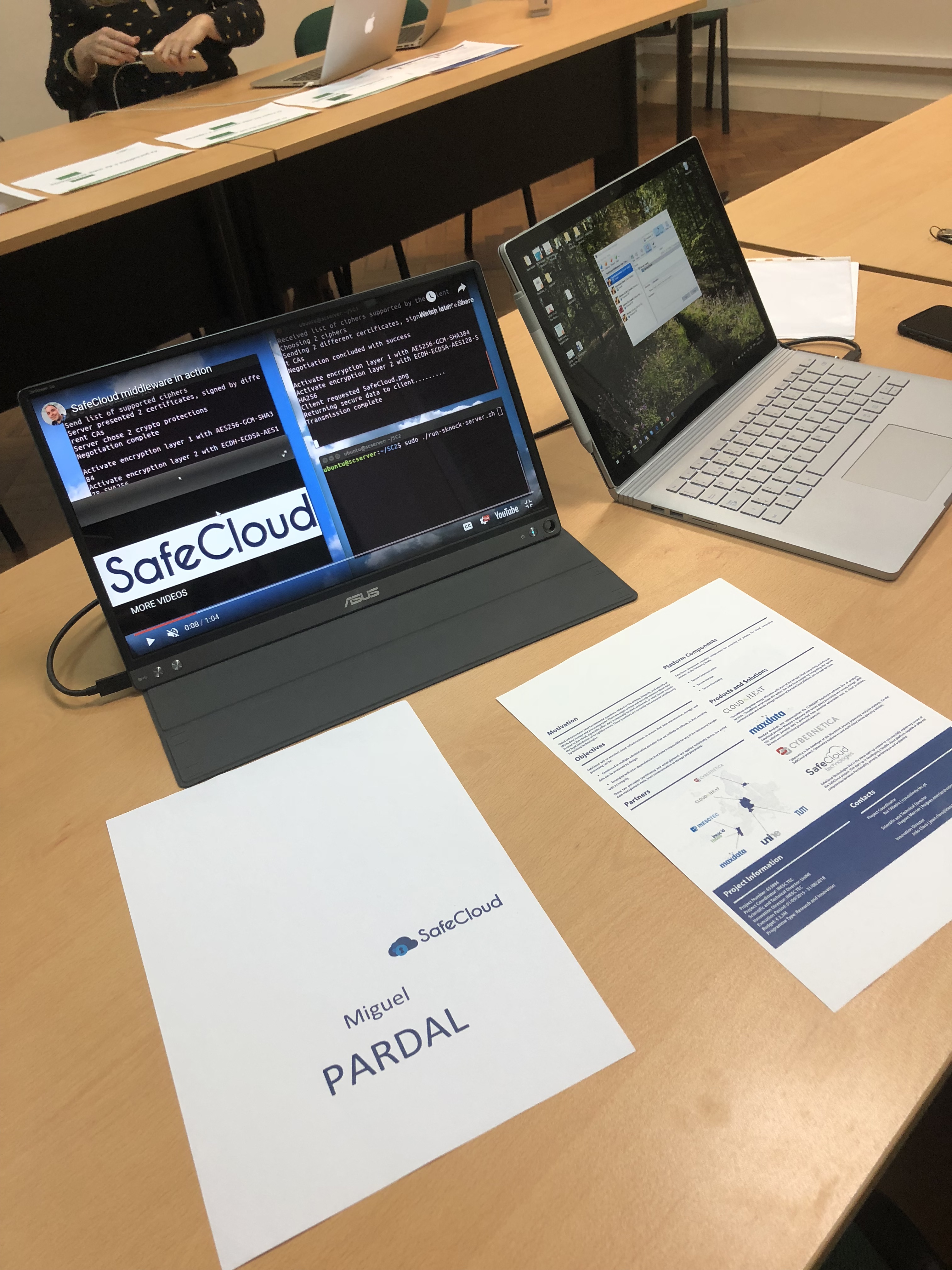
    This year Researchers  Anabela Barreiro and Miguel Pardal showcased 2 projects:

    ➡️ eSPERTO – Sistema de Parafraseamento para Edição e Revisão de Texto

    ➡️ SafeCloud added security communication

  • Encarnação Award

    Encarnação Award

    During the ICGI’2018 Conference, that took place between 15 and 16 November 2018 at the Faculty of Sciences of the University of Lisbon, in Portugal, INESC – ID Researcher Daniel Mendes was awarded the 2018 edition of the annual “Professor José Luís Encarnação” prize, in recognition of his outstanding research activities in the area of ​​Computer Graphics and Applications.

    This award established by The Portuguese Computer Graphics Group includes in its purposes the promotion of quality research in the area of ​​Computer Graphics and its Applications, in particular to develop in Portuguese students the taste and motivation to develop research activities in this scientific area with the aim of encouraging higher education students to carry out research activities of excellence in the area of ​​Computer Graphics and Applications, which can be evaluated through the publication of results at conferences or Magazines of high prestige and international impact.This award is therefore addressed to students of Portuguese nationality of any cycle of Higher Education who demonstrate that they have published (and presented, in the case of a conference) a full paper in a forum of excellence.


  • RAGE at the “Tech with a societal aspect” exhibition in the European Parliament.

    RAGE at the “Tech with a societal aspect” exhibition in the European Parliament.

    INESC-ID has been asked to present the RAGE project on 20 and 21 November 2018 at a meeting of the European Parliament in Brussels. Together with 9 other projects, the RAGE project has been selected from hundreds of current research and innovation projects in the Horizon2020 Program of the European Commission.
    The theme of this meeting is ‘Technology, Science and Arts for the good’. In organizing this event, the European Parliament intends to draw attention to how multidisciplinary research can contribute to solve social problems.

    Serious games are playing an important role in many areas, this includes education and training, health care and aging, inclusiveness, citizenship, innovation and the digital transformation.

    Research carried out in RAGE focuses on smart, reusable technologies for making serious games. This ensures that games are not only more advanced, but it also makes their development more efficient and cheaper. With these new technologies, RAGE has also developed a number of serious games (on entrepreneurship and social skills) and has run successful tests with 1,500 participants. Game developers can download the technologies developed by RAGE and integrate them in their own games.

    The RAGE project has already proved itself to be very successful. In 2017 RAGE was nominated and took part in the finals of the European Innovation Radar prize for promising ‘Early stage innovations’. This year the European Commission has already recognized the RAGE project as one of the ‘flagships’ of Horizon2020.


  • 3rd Alumni Meeting of the Laboratório de Jogos of Instituto Superior Técnico

    3rd Alumni Meeting of the Laboratório de Jogos of Instituto Superior Técnico

    The 3rd Alumni Meeting of the Laboratório de Jogos of Instituto Superior Técnico (III Encontro de Alumni do Laboratório de Jogos do IST), was held on October 26th at 5:15 pm, at the IST Taguspark Campus.
    In this event the participants discovered the current projects of former students of the Games subject area, explored the work we have developed in the Laboratório de Jogos, and learn about the professional experience of alumni who are currently working in the gaming industry.
    The event featured three individual Alumni talks and a panel with more Alumnis and a visit to the Laboratório de Jogos lab to try out masters theses and games developed by our current students.

    If you want to know more about the event, follow the pages dedicated to the III Meeting of Alumni:

    • Facebook Event: https://www.facebook.com/events/2252757561626048
    • Facebook Page: https://www.facebook.com/LabJogosIST
    • Website: http://labjogos.tecnico.ulisboa.pt/…/encontroAl…/alumni2018/


  • “Virtual Agent” APP won the EDP UNIVERSITY CHALLENGE 2018

    “Virtual Agent” APP won the EDP UNIVERSITY CHALLENGE 2018

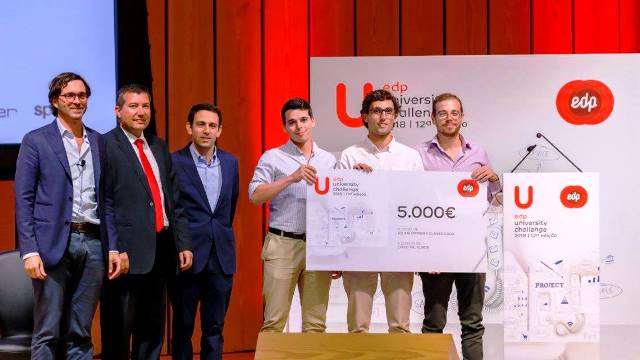
    Luís Henriques, Ricardo Rei and Luís Nunes, Master Students at INESC-ID, won the 12th edition of the EDP University Challenge 2018 contest that took place October 9th at EDP’s headquarters in Lisbon.
    Inspired by the theme of this edition – Customer Service – the students developed the project “Costumers Support Chatbot” that proposes the creation of a virtual agent integrated in Facebook that provides support services to the client through techniques of natural language and machine learning.


    http://visao.sapo.pt/-edp-university-challenge/2018-10-10-App-com-agente-virtual-de-apoio-ao-cliente-e-a-vencedora-do-EDP-University-Challenge-2018

  • RAGE @ Gamescom2018

    RAGE @ Gamescom2018

    On 21, 22 & 23 August a strong RAGE team was present at Gamescom 2018 at the Kölnmesse in Cologne, Germany. This key dissemination activity was a big success as a project: we had the opportunity to meet with a large number of game developers and industry key perso nalities, leveraging on the opportunity provided by the Dutch Games Association to have a RAGE booth in the Dutch Pavilion. The FAtiMA toolkit developed at INESC-ID was one of the featured technological results of the project.

    Again in 2018 Gamescom showed why it is by far the largest game industry fair in Europe, and one of the key global events of this sector. This year, around 370,000 visitors from 114 countries, including 31,200 trade visitors, visited Gamescom 2018. In this 10th anniversary of the fair, more than 1,000 exhibitors from 56 countries were present. Within the hive of the fair´s activity, RAGE had the opportunity to explain the game studios and market players how the ecosystem and its portal work for both game developers and components creators: what it offers them, and the benefits it brings to improve the development of serious games.