INESC -ID 20 Years – Museu do Oriente

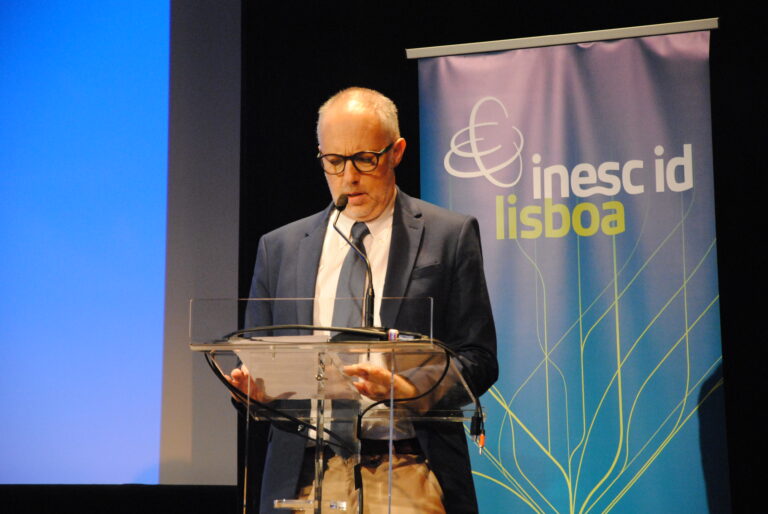
INESC-ID celebrated the 20th anniversary with a special event that took place at Museu do Oriente. The ceremony started with the intervention of the Minister of Science, Technology and Higher Education, Manuel Heitor. We had two special panels discussing both…

Socio-Cognitive Systems Journal

The INESC-ID researcher Rui Prada is one of the members of the Socio-Cognitive Systems Journal board editorial. This new journal will be officially launched early in 2020 but they are already accepting submissions in their website. Also, an editorial talking about the topic will be released in Online First very soon.

‘IoT Board for Agriculture Applications’ at Keep in Touch 2019

INESC-ID has been present in Keep in Touch 2019 with the ‘IoT Board for Agriculture Applications’ demo, presented by the researcher João Tagaio. The Internet of Things (IoT) allows the connection of different devices to the internet. Therefore, is possible to obtain a series of data and from them, extract useful information to the final user.  However, some challenges emerge in the communication area, in terms of protocols used and in the electronics area, where is necessary to develop chips that present a very low current consumption. In this presentation, it was presented a Real Time Clock (RTC), developed by SiliconGate startup, with consumption in the order of nano ampere. Because of this, the chip is ideal for IoT systems where is necessary to wake up the microcontroller from a sleep state. The Clock when generating an alarm wakes up the microcontroller which in turn reads the sensors data and communicate them through the radio frequency module. The thesis presented also consists of the development of an IoT system to precision agriculture where an RTC is used to wake up the system. The intention is to achieve very low current consumption levels in a way that the system could work with just one battery charge for years.

Talks and Lectures: Artificial Intelligence Applications, Implications and Speculations

Artificial intelligence is increasingly imposing itself on the reality of contemporary societies, although new technological developments come into being every day, this phenomenon is not correspondingly reflected in the public sphere. Considering that it is important to know and discuss this reality, this cycle of debates takes a look at the current applications of artificial intelligence reflecting upon its social implications in a whole range of different areas (ranging from health to privacy, employability and other areas) and the way in which the future can be imagined within this new paradigm. Between April and June, the cycle is divided into three separate moments, each of them a double programme: a debate with several speakers from the academic and business worlds and a conference. 17 APRIL 16:00 Applications with Luísa Coheur, Pedro Bizarro, Milind Tambe 18:30 Applications (The Good and the Bad) with Mário Figueiredo 15 MAY 16:00 Implications with Luís Moniz Pereira, Manuel Dias, Virginia Dignum 18:30 Robot ascension with Martin Ford 05 JUNE 16:00 Speculations with Ana Paiva, André Martins, Arlindo Oliveira 18:30 Artificial intelligence Compatible Human with Stuart Russell Free entry (subject to availability), tickets available on the day from 15:00 at the ticket-office. In portuguese and english with simultaneous translation Live streaming here More information about the event here

Distinguished Lecture Series

AI for Social Good: Learning and Planning in the End-to-End, Data-to-Deployment Pipeline Prof. Milind Tambe University of Southern California  17/04/2019 Room 0.19/0.20, IST – Pavilhão de Informática II, Alameda | 13:30H Abstract With the maturing of AI and multiagent systems research, we have a tremendous opportunity to direct these advances towards addressing complex societal problems. I will focus on the problems of public safety and security, wildlife conservation and public health in low-resource communities, and present research advances in multiagent systems to address one key cross-cutting challenge: how to strategically deploy our limited intervention resources in these problem domains. I will discuss the importance of conducting this research via building the full data to field deployment end-to-end pipeline rather than just building machine learning or planning components in isolation. Results from our deployments from around the world show concrete improvements over the state of the art. In pushing this research agenda, we believe AI can indeed play an important role in fighting social injustice and improving society. Bio Milind Tambe is Helen N. and Emmett H. Jones Professor in Engineering at the University of Southern California(USC) and the Founding Co-Director of CAIS, the USC Center for Artificial Intelligence in Society, where his research focuses on advancing AI and multiagent systems research for Social Good. He is recipient of the IJCAI (International Joint Conference on AI) John McCarthy Award, ACM/SIGAI Autonomous Agents Research Award from AAMAS (Autonomous Agents and Multiagent Systems Conference), AAAI (Association for Advancement of Artificial Intelligence) Robert S Engelmore Memorial Lecture award, INFORMS Wagner prize, the Rist Prize of the Military Operations Research Society, the Christopher Columbus Fellowship Foundation Homeland security award, International Foundation for Agents and Multiagent Systems influential paper award; he is a fellow of AAAI and ACM. He has also received meritorious Commendation from […]

Distinguished Lecture Series

Generating Software Tests Andreas Zeller CISPA Helmholtz Institute for IT Security 15/04/2019 Anfiteatro VA4 no piso-1 do Edificio de Civil – IST/Alameda | 11:00H Abstract Software has bugs. What can we do to find as many of these as possible? In this talk, I show how to systematically test software by generating such tests automatically, starting with simple random “fuzzing” generators and then proceeding to more effective grammar-based and coverage-guided approaches. Being fully automatic and easy to deploy, such fuzzers run at little cost, yet are very effective in finding bugs: Our own Langfuzz grammar-based test generator for JavaScript runs around the clock for the Firefox, Chrome, and Edge web browsers and so far has found more than 2,600 confirmed bugs. Our latest test generator prototypes are even able to automatically learn the input language of a given program, which allows to generate highly effective tests for arbitrary programs without any particular setup. In the past months, we have collected our tools and techniques in an interactive textbook (www.fuzzingbook.org) with 10,000 well-documented lines of Python code for highly productive fuzzing. Bio Andreas Zeller is Faculty at the CISPA Helmholtz Center for Information Security, and professor for Software Engineering at Saarland University, both in Saarbrücken, Germany. In 2010, Zeller was inducted as Fellow of the ACM for his contributions to automated debugging and mining software archives, for which he also obtained the ACM SIGSOFT Outstanding Research Award in 2018. His current work focuses on specification mining and test case generation, funded by grants from DFG and the European Research Council (ERC). Host António Manuel Ferreira Rito da Silva

“Artificial Intelligence, Cooperation and Social Robotics” at the Lisbon Academy of Sciences.

Lisbon Academy of Sciences promoted another  “Tardes na Academia“, on March 26th, at 5pm. On this IV Session,  INESC-ID Researcher Francisco C. Santos  invites  Ana Paiva, also researcher at INESC-ID,  for an afternoon on: “Artificial Intelligence, Cooperation and Social Robotics”. This initiative aims to engage distinct generations of scientists and researchers, in the various fields of science and knowledge represented in the SJC (Seminário de Jovens Cientistas). The SJC is integrated in the Institute of Advanced Studies of the Lisbon Academy of Sciences and seeks to maintain the link between the Academy and the younger members of the scientific community, as is happening in other European countries. The trans-disciplinary nature of the JCC allows to address the most relevant issues for society, producing tools that can be used by science policy makers and promoting the sharing of knowledge and knowledge with society in general.

Evaluation INESC-ID

As Associate Laboratory since 2004,  INESC-ID is periodically evaluated by the Foundation for Science and Technology (FCT). This status is reserved for research institutions of great merit that have been recognized in external assessments as having the “capacity to cooperate…