-
INESC-ID researchers recognized in Stanford’s list of top 2% most-cited
Several INESC-ID researchers have been included in the comprehensive data sets comprising Stanford's list of the World's top 2% most-cited researchers in 2021 via Elsevier.
read more › -
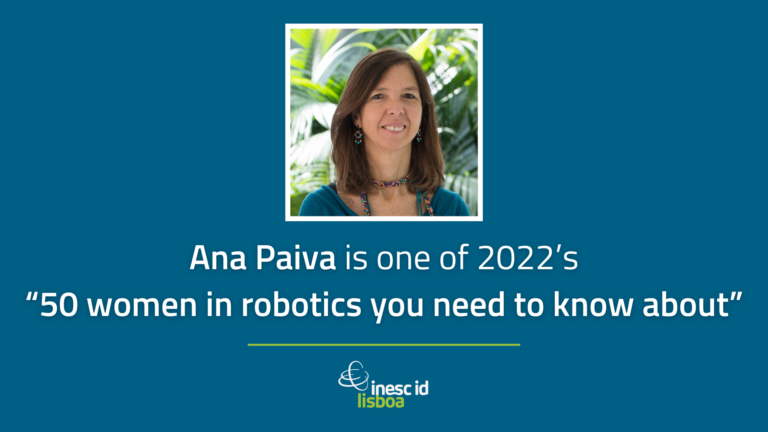
Ana Paiva is one of 2022’s “50 women in robotics you need to know about”
Ana Paiva has been selected as one of 2022’s “50 women in robotics you need to know about”.
read more › -
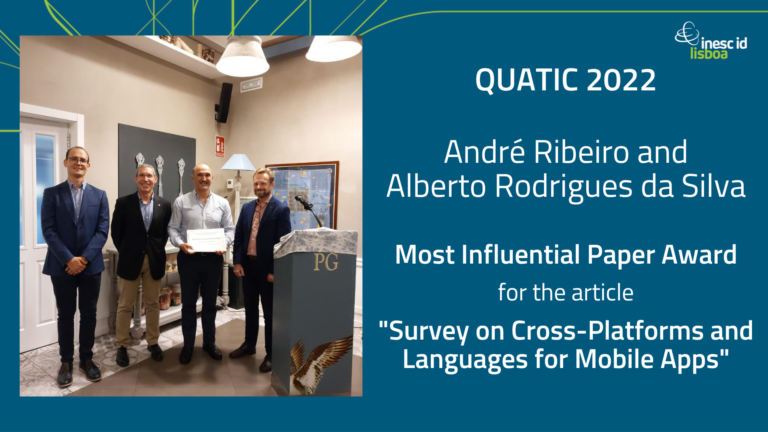
André Ribeiro and Alberto Rodrigues da Silva receive “Most Influential Paper” Award at QUATIC’22
André Ribeiro — former masters student in computer science and engineering at Instituto Superior Técnico (IST) — and Alberto Rodrigues da Silva — Associate Professor at the Department of Computer Engineering at IST and researcher at INESC-ID — have received the "Most Influential Paper" Award at the QUATIC 2022 conference.
read more › -
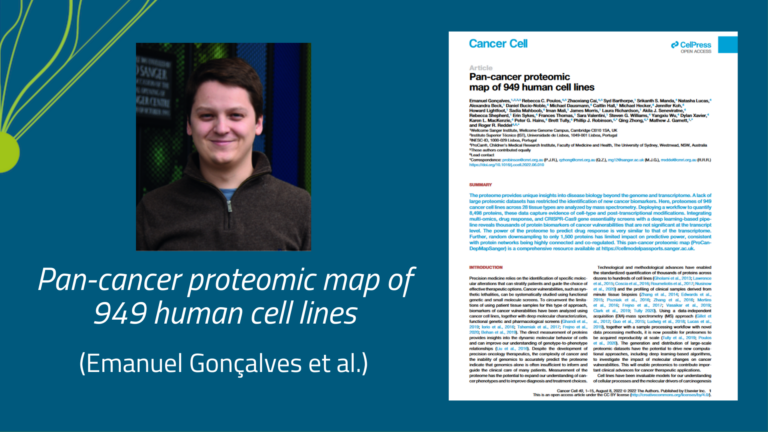
Tell me what your proteome is and I’ll tell you what you are: the proteomic maps of 949 human cancer cell lines
Emanuel Gonçalves — INESC-ID Automated Reasoning and Software Reliability (ARSR) computational biology researcher — has published a groundbreaking study in the journal Cancer Cell (published online 14 July 2022).
read more › -
HATE COVID-19.PT: Detecting hate speech in social media
A few weeks ago, the team that brought the FCT-funded HATE COVID-19.PT project to life met at INESC-ID. Since May 2021, HATE COVID-19.PT has developed methods for semi-automatically creating a large-scale Portuguese annotated corpus covering online hate speech, while exploring how the information in that annotated corpus can support hate speech detection, allowing users to visualize the metrics extracted from data.
read more › -
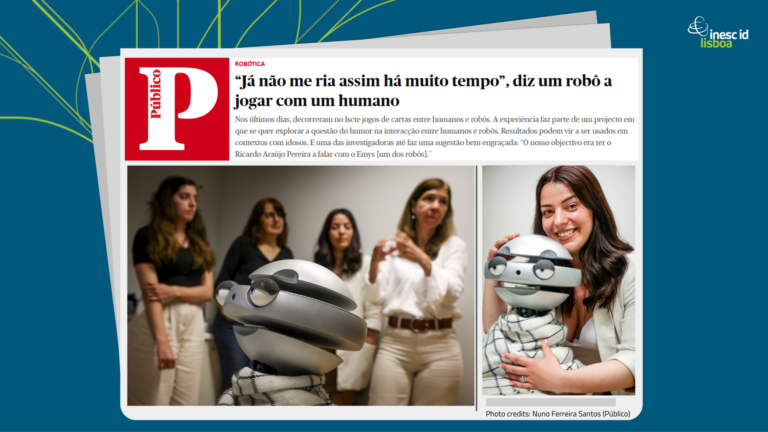
Two robots walk into a bar: the AGENTS project is featured in Público
Automatic generation of humor for social robots (AGENTS) — an FCT- and Carnegie Mellon University (CMU) Portugal-funded project — has been featured in the Portuguese newspaper Público.
read more › -
RiverCure: a new paradigm in flood modelling and simulation
The second RiverCure workshop took place on 02 June 2022 at Instituto Superior Técnico, signaling the close of this four-year FCT-funded project that brought together INESC-ID, Instituto Superior Técnico and Agência Portuguesa do Ambiente (APA).
read more › -
EV4EU launches today!
EV4EU launches today, 01 June 2022! With a duration of four years, EV4EU is funded by the European Union in 9-million euros through Horizon Europe, the new research and innovation programme for the period 2021-2027.
read more › -
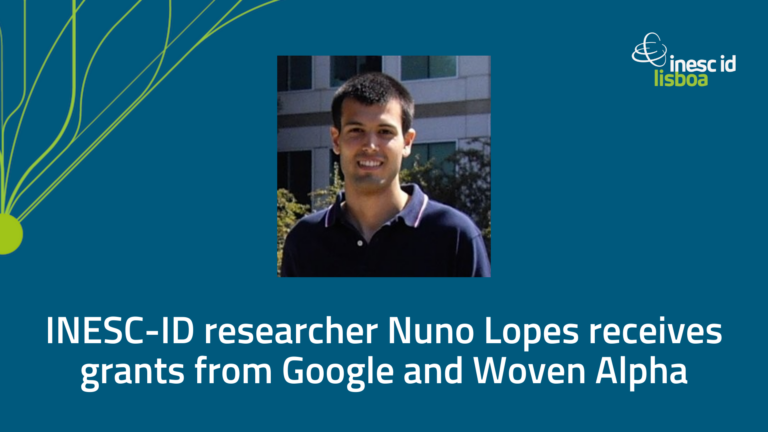
Nuno Lopes receives research grants from Google and Woven Alpha
Nuno Lopes — researcher within the High Performance Computing Architectures and Systems Research Area at INESC-ID and Associate Professor at the Department of Computer Science and Engineering at Instituto Superior Técnico — has been awarded research grants from Google and Woven Alpha (a subsidiary of Toyota) worth €35,000 and $30,000, respectively.
read more ›